Topics (384k) Articles (398k) Users (410) Discussions (242) Comments (383) Files (13k) New article

A variational model balances agreement with observed data against a regularity or geometric penalty. Examples include total variation denoising, the relaxed graph-area functional, and the Mumford–Shah functional. Convex penalties support unique reconstruction, while segmentation energies can have multiple competing partitions.
Diffusion filtering evolves an observed image signal using a diffusion equation. The heat equation gives Gaussian image smoothing, while gradient-dependent or tensor-dependent diffusion can reduce transport across image edges. A image smoothing scale, stopping rule and appropriate boundary conditions are part of the filter.
An image edge is a rapid grey-value transition, modeled as a large gradient or a jump discontinuity. It differs from an edge of a graph. Variational models can penalize image edge length, while diffusion image processing estimates image edge directions to limit image smoothing across them.
For a smoothed image signal , average the gradient outer product as . The dominant eigenvector estimates the normal to a coherent image edge, and eigenvalue contrast measures local directional structure. Two distinct scales separate differentiation from orientation averaging.
A grey-value image signal is a scalar function on an image signal domain or an array of pixel values. Continuous image processing models use spaces such as , Sobolev spaces or the BV space, while discrete models use finite-dimensional arrays. The chosen representation distinguishes smooth transitions, noise and image edges.
Phylogenetics infers evolutionary relationships from evidence such as anatomy and DNA sequences. A phylogenetic tree summarizes a proposed pattern of ancestry; phylogenetic characters supply the observations, and an inference procedure states how alternative trees are compared.
For sequence data, a nucleotide substitution model assigns probabilities to changes along branches. The phylogenetic pruning algorithm efficiently sums over unknown ancestral states to compute a likelihood function. This connects a historical hypothesis to an explicit calculation rather than treating the most visually similar species as automatically closest relatives.[ref]
Evolutionary trees from DNA sequences: a maximum likelihood approach by Joseph Felsenstein. Ancestral-state summation and likelihood recursion
An electrolyte is a conducting medium in which mobile ions carry electric current, according to IUPAC Gold Book: electrolyte. In introductory chemistry, a substance that yields ions when dissolved in water is also called an electrolyte. Both usages point to the same mechanism: an electric field gives mobile cations and anions directed drift velocities.
Mobility matters as much as the presence of electric charge. In a simple ideal model of solid sodium chloride, ions are confined to their sites and do not carry a sustained transport electric current. Molten sodium chloride has mobile ions; dissolved sodium chloride gives mobile and ions in water. Real solids can have some ionic transport through imperfections; the immobile-solid picture is an introductory limit, rather than a claim that all solids are perfect insulators.
A strong electrolyte yields essentially all ions from the dissolved substance, whereas a weak electrolyte yields only a fraction under the specified conditions. Dissolved sodium chloride is a strong electrolyte. Sucrose is a nonelectrolyte: it dissolves as neutral molecules, so dissolving something does not automatically create mobile ions. Water's own small population of hydronium and hydroxide remains possible. See 11.2 Electrolytes (§11.2: strong, weak, and nonelectrolytes) and Flowers et al., Chemistry 2e, §11.4, Table 11.3: sucrose and sodium chloride.
Acetic acid is a weak electrolyte and a weak acid. In water, some neutral acetic acid molecules transfer a proton to water, producing hydronium and the negatively charged partner:Both sides have net electric charge zero. At chemical equilibrium, neutral acetic acid coexists with these ions; the fraction converted depends on the conditions. Electrolyte strength describes this extent of ion production, while concentration describes how much substance is present per specified quantity of chemical solution. A dilute strong electrolyte can contain fewer ions per volume than a concentrated weak electrolyte. Neither the words strong and weak nor a conductivity comparison alone specifies concentration.
Now specify an electrolytic cell with a positive anode on the left, a negative cathode on the right, and an approximately uniform electric field pointing right in the bulk electrolyte. With a steady external source and neglecting diffusion and convection, positive cations drift right toward the negative cathode; negative anions drift left toward the positive anode. Yet both populations contribute a rightward conventional current! For number densities and drift velocities , the transport current density isThe product of electric charge and velocity determines conventional current: for the anion, both the charge and its rightward velocity component are negative, making its rightward contribution positive. This is the same sign rule used for electron conventional current. It follows directly from the existing charge carrier formula.
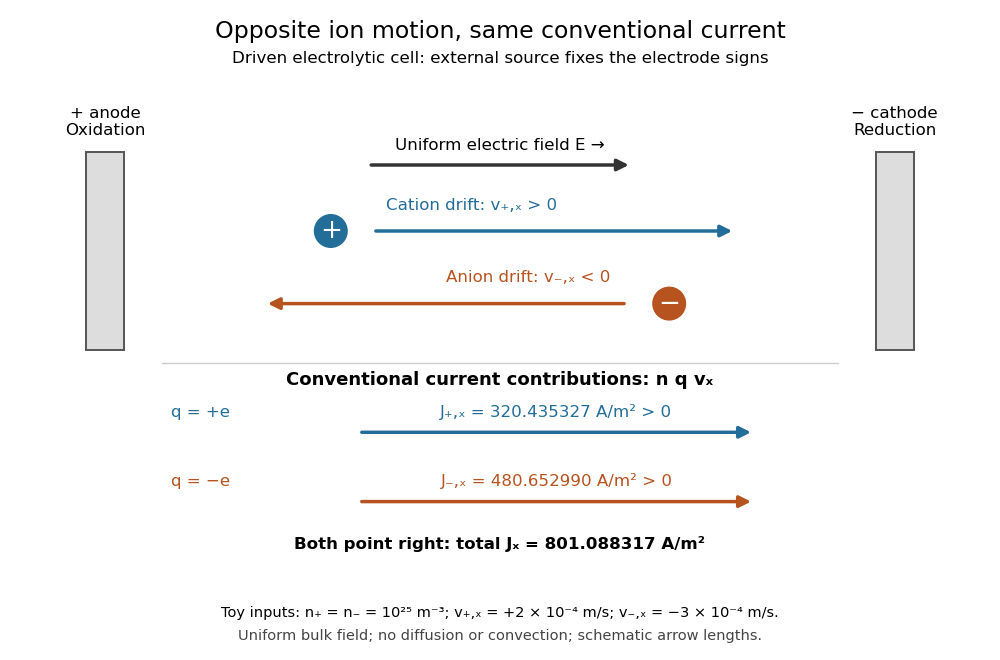
Opposite ion drift velocities contribute to the same conventional current in a specified electrolytic cell
. The positive anode is left and the negative cathode right. The upper arrows show ion motion; the lower arrows show the signs of for current density. A uniform bulk electric field is assumed; diffusion, convection, and electrode boundary layers are omitted. Arrow lengths are schematic. Details.For an independent numerical example, stipulate , , and . With the exact elementary charge , the contributions areEqual number densities of singly charged cations and anions give zero bulk charge density, while their motion gives nonzero current density. This is why a neutral electrolyte can conduct. These numbers are chosen toy inputs, not measurements of sodium chloride; maintaining sustained cell electric current also requires suitable electrode reactions. Blocking electrodes can instead lead to charge accumulation and decay of the electric current.
An electrolyte connects the microscopic motion of ions to observable electrical conductivity. A counterion-only model keeps just the mobile counterions needed to oppose a fixed electric charge; Poisson-Boltzmann equations use ideal Boltzmann distributions to model their equilibrium distributions, rather than the drift example above.
These permutations have no cycle of length two, while fixed points and longer cycles are allowed. Inclusion-exclusion over specified two-cycles gives the count shown: only disjoint specified pairs can coexist. Their fraction among all permutations tends to . This condition differs from being a derangement and from refusing to express a permutation as a product of transpositions.
For a positive integer , every rational number has a unique representation with and . With , the coefficients satisfy . Their existence and uniqueness use modular multiplicative inverses and the Chinese remainder theorem.
Thermal dissociation is temperature-driven breaking of a molecule into simpler fragments. The chemical equilibrium abundance depends on pressure as well as temperature: reactions increasing particle number are generally favored at low pressure. In an exoplanet atmosphere, reduced water on a very hot dayside does not by itself establish a low planetary oxygen abundance.
Over a field, a cyclic vector gives a companion matrix, whose characteristic relation annihilates its generator and hence every iterate. If there is no cyclic vector spanning the whole space, a nonzero proper cyclic subspace is invariant. Induction annihilates the restriction and the quotient; the quotient polynomial first sends the whole space into the invariant subspace, and the restriction polynomial then kills it. The block-triangular characteristic polynomial is the product of these two polynomials.
A collision can transfer kinetic energy to an atom or ion and excite a bound electron. Subsequent radiative de-excitation removes that energy from an optically thin gas. The thermal excitation rate is strongly reduced when the transition energy exceeds , giving the threshold behavior of atomic line cooling.
Recover a compactly supported acoustic source from measurements of its outgoing field, such as its far-field pattern. The Helmholtz equation forward problem is specified with the Sommerfeld radiation condition. At a single frequency, the source-to-far-field operator at fixed frequency has invisible fixed-frequency nonradiating sources, and its compactness makes recovery of the visible component unstable.
Small-height Dirichlet scattering expands the acoustic boundary condition about a mean plane for a fixed regular surface profile. The zeroth-order field includes the flat reflection; higher orders solve outgoing Helmholtz equation problems with induced boundary data. Small controls the incident-field Taylor expansion, but rapidly varying roughness can require additional control of normal derivatives and spectral moments.
An acoustic analogy rearranges fluid conservation equations into a chosen linear acoustic propagation operator plus effective forcing. The rearrangement can be exact before source approximations are made. A term classified as forcing can also contain propagation effects omitted from the reference operator; this produces propagation-source ambiguity in an acoustic analogy. The Lighthill acoustic analogy is a familiar homogeneous reference-medium example.
An acoustic waveguide confines sound transversely while allowing longitudinal propagation. Rigid walls impose a homogeneous normal-velocity condition, producing Neumann transverse modes. Each transverse eigenvalue gives a longitudinal wave number: modes below their cutoff decay evanescently, while cut-on modes carry outgoing sound. An open semi-infinite guide can be studied with the Wiener-Hopf method.
Nuclear physics studies atomic nuclei, their internal structure and the processes that change them. A nucleus contains protons and neutrons, whose short-range nuclear forces bind them while the Coulomb force repels the protons. The resulting nuclear energy levels and nuclear binding energies connect this subject to the low-energy consequences of quantum chromodynamics. Weak interactions additionally permit changes of nuclear composition through beta decay.
The mass defect makes the connection between structure and released energy quantitative. For a nucleus with protons, neutrons and nuclear mass , its nuclear binding energy isA bound nucleus has less rest energy than its separated nucleons. In a nuclear reaction, the difference between the sums of initial and final rest energies supplies the Q value. The sign of that difference and the Coulomb barrier answer different questions: a reaction can release energy overall while still requiring a way to cross an entrance barrier.
Scattering experiments supplied an early structural clue. Rare large deflections of alpha particles by thin matter could be explained by close encounters with a highly concentrated central charge. Ernest Rutherford's 1911 analysis connected such angular measurements to a compact atomic centre, establishing a route from measured scattering cross-sections to internal structure.[ref]
The Scattering of Alpha and Beta Particles by Matter and the Structure of the Atom by Ernest Rutherford. Sections 1–2 and 7, large single deflections and the concentrated central charge
An atom contains an atomic nucleus and bound electrons; a neutral atom has equal numbers of protons and electrons. The atomic number specifies the number of protons, while different isotopes of the same element have different numbers of neutrons. Losing or gaining electrons produces an ion, rather than a different atomic number.
The hydrogen atom gives the simplest electronic model: one electron bound through a Coulomb interaction to one proton. Its spectral lines reveal differences between discrete energy levels. Multi-electron chemical atoms add the Pauli exclusion principle and electron correlation, so their structure is not obtained by placing every electron in the same one-electron ground state.
Image processing transforms recorded image signal data to remove noise, recover detail or extract structure. Variational image processing describes desired reconstructions through energies, while diffusion image processing describes filtering through evolution equations.
Pinned article: Introduction to the OurBigBook Project
Welcome to the OurBigBook Project! Our goal is to create the perfect publishing platform for STEM subjects, and get university-level students to write the best free STEM tutorials ever.
Everyone is welcome to create an account and play with the site: ourbigbook.com/go/register. We belive that students themselves can write amazing tutorials, but teachers are welcome too. You can write about anything you want, it doesn't have to be STEM or even educational. Silly test content is very welcome and you won't be penalized in any way. Just keep it legal!
Intro to OurBigBook
. Source. We have two killer features:
- topics: topics group articles by different users with the same title, e.g. here is the topic for the "Fundamental Theorem of Calculus" ourbigbook.com/go/topic/fundamental-theorem-of-calculusArticles of different users are sorted by upvote within each article page. This feature is a bit like:
- a Wikipedia where each user can have their own version of each article
- a Q&A website like Stack Overflow, where multiple people can give their views on a given topic, and the best ones are sorted by upvote. Except you don't need to wait for someone to ask first, and any topic goes, no matter how narrow or broad
This feature makes it possible for readers to find better explanations of any topic created by other writers. And it allows writers to create an explanation in a place that readers might actually find it.
Figure 1. Screenshot of the "Derivative" topic page. View it live at: ourbigbook.com/go/topic/derivativeVideo 2. OurBigBook Web topics demo. Source. - local editing: you can store all your personal knowledge base content locally in a plaintext markup format that can be edited locally and published either:This way you can be sure that even if OurBigBook.com were to go down one day (which we have no plans to do as it is quite cheap to host!), your content will still be perfectly readable as a static site.
- to OurBigBook.com to get awesome multi-user features like topics and likes
- as HTML files to a static website, which you can host yourself for free on many external providers like GitHub Pages, and remain in full control

Figure 2. You can publish local OurBigBook lightweight markup files to either OurBigBook.com or as a static website.
Figure 3. Visual Studio Code extension installation.
Figure 5. . You can also edit articles on the Web editor without installing anything locally. Video 3. Edit locally and publish demo. Source. This shows editing OurBigBook Markup and publishing it using the Visual Studio Code extension. 
- Infinitely deep tables of contents:



All our software is open source and hosted at: github.com/ourbigbook/ourbigbook
Further documentation can be found at: docs.ourbigbook.com
Feel free to reach our to us for any help or suggestions: docs.ourbigbook.com/#contact