Topics (384k) Articles (398k) Users (410) Discussions (242) Comments (383) Files (13k) New article
Electrochemistry studies how chemical reactions, transport, and chemical equilibrium couple to electric charge and electric potential. In a cell, electrons travel through the external circuit, while mobile ions carry electric current through the electrolyte. At the electrodes, redox reactions connect these two forms of electric charge transport. This connection makes it possible both to obtain electrical work from a chemical reaction and to use electrical work to drive a chemical reaction.
An anode is an electrode where oxidation occurs; a cathode is an electrode where reduction occurs. These definitions refer to the chemical reactions, rather than universal positive or negative terminal signs. In a galvanic cell delivering electrical work, the anode is negative and the cathode positive. In an electrolytic cell driven by an external source, the anode is positive and the cathode negative. See Pingarrón et al., Terminology of electrochemical methods of analysis (IUPAC Recommendations 2019), §§3.1 and 3.4 and Flowers et al., Chemistry 2e, §17.2: galvanic cells.
For a worked example, consider an electrolytic cell containing molten sodium chloride, with the anode connected to the positive terminal and the cathode to the negative terminal of an external source. At the cathode, sodium cations gain electrons; at the anode, chlorine anions lose electrons:The first line has net electric charge zero on each side; the second has on each side. Adding the lines cancels the transferred electrons and preserves both chemical atom counts and net electric charge. The sodium product is neutral, and the chlorine product is a diatomic molecule. These equations specify molten sodium chloride; aqueous chemical solutions introduce competing water reactions. See 17.7 Electrolysis (§17.7: electrolysis of molten sodium chloride).
Electrochemistry underlies battery charging and the manufacture of chemicals by electrolysis. Its particularly useful idea is that an electron inventory in a balanced chemical equation also accounts for transported electric charge. Transport alone is a different question from an electrode chemical reaction: an ion may carry electric current through the electrolyte without itself being consumed at an electrode.
Historically, Michael Faraday introduced the terms electrode, electrolyte, anion, cation, and ion in the terminology section of his 1834 paper, Experimental Researches in Electricity, Seventh Series by Michael Faraday (§§662–667). His §667 explicitly treats the direction assigned to electric current as a convention. His ion language predates the modern electron and atomic nucleus picture used in the charge-counting example above.
For an electrolyte near chemical equilibrium, a Poisson-Boltzmann equation can approximate the distribution of ions in an electric potential. Such an equilibrium model does not by itself describe a cell carrying sustained electric current.
An ion is a chemical atom or a group of chemical atoms with a nonzero net electric charge. A positive ion is a cation; a negative ion is an anion. The whole entity carries the electric charge: a hydronium ion is a group of four chemical atoms with net charge . This definition agrees with [ref].
For an ordinary ion containing only atomic nuclei and electrons, let count all its protons and all its electrons. Each proton contributes the elementary charge , each electron contributes , and neutrons contribute zero. ThereforeThe signed integer is the net electric charge number. Removing an electron increases by one; adding an electron decreases by one. Changing the electron count leaves the atomic number, and therefore the identity of the chemical element, unchanged.
For example, a neutral sodium chemical atom has protons and electrons. Its cation still has protons, but only electrons, so . A neutral chlorine chemical atom has protons and electrons; its anion has protons and electrons, so . These are particle inventories, not pictures of atomic orbitals. See 2.6 Ionic and Molecular Compounds (§2.6: ions and ionic compounds).
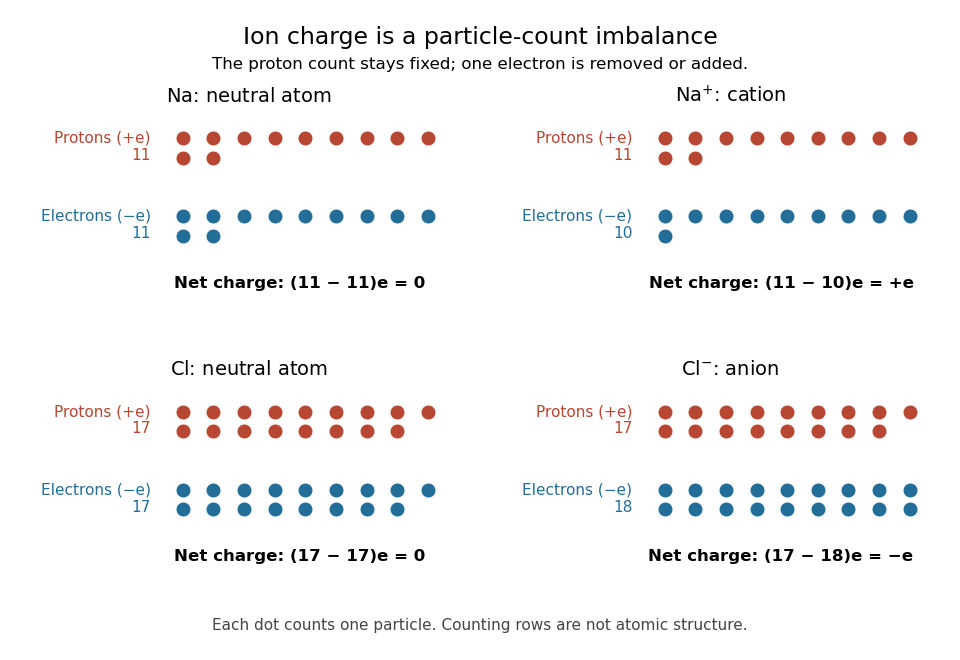
Ion electric charge bookkeeping: neutral sodium and chlorine chemical atoms compared with their cation and anion
. Every colored dot counts one proton or one electron. Rows are counting arrays, not spatial models of atomic nuclei or electron shells. The net electric charges are . Details.One sodium chloride formula unit accounts for one cation and one anion, whose net electric charges sum to zero. Ordinary solid sodium chloride is an extended arrangement of ions, rather than discrete molecules. This is a useful distinction: a neutral material can contain charged constituents, and its chemical formula tells us their ratio without claiming that each pair is a separate molecule.
Ion bookkeeping connects chemistry to electric current: moving ions can transport electric charge, while stationary ions cannot supply a transport current density. In electrochemistry, both signs of ions can contribute to the same conventional current. An ion opposing a fixed electric charge is called a counterion.
Evolution is descent with inherited modification. Within a population, changes in allele frequencies provide a precise genetic description; over longer histories, branching descent connects populations through common descent. An individual growing larger is biological development, whereas an inherited variant becoming more frequent across generations is evolution. See UC Museum of Paleontology: the definition of evolution.
Mutation supplies new alleles, genetic recombination reshuffles inherited material, natural selection favors variants with greater reproductive contribution in a specified environment, and genetic drift changes frequencies through chance. Gene flow moves variants between populations. Consequently, an increasing allele frequency alone does not identify natural selection. See Clark, Douglas and Choi, Biology 2e: population genetics.
Evidence includes ordered fossils, shared inherited structures and similarities in DNA; phylogenetics uses such observations to infer relationships. A phylogenetic tree is an inferred historical account, with uncertainty about particular branches. See Clark, Douglas and Choi, Biology 2e: evidence of evolution. Evidence also comes from experiments: Blount, Borland and Lenski reported an Escherichia coli lineage able to use citrate with oxygen present by 31,500 generations, and tested historical dependence by replaying evolution from stored ancestors. See Blount, Borland and Lenski, 2008: original experimental report. Such observations constrain explanations; no single frequency equation captures every evolutionary process.
The network of chemical reactions that maintains a living system, supplies energy and builds or processes its material. Gas emissions can arise as primary metabolic byproducts or secondary metabolic byproducts, with different implications for an atmospheric biosignature gas.
Enzymes make this network operate on biologically useful timescales. Following material through successive substrates and reaction products explains why a single fast enzyme need not make the entire network fast: another step may constrain the flow. Changing enzyme amounts or activity therefore changes which routes can carry material, connecting molecular chemical kinetics to the maintenance and growth of a biological cell. See Alberts et al., Molecular Biology of the Cell: multienzyme complexes and cell metabolism.
The longest element of a finite Weyl group is the element sending all positive roots of a root system to negative roots. It is the longest element of a finite Coxeter group. For the G2 root system it is : its twelve roots form two hexagons, and the dihedral reflection group of a root system contains the rotation through . It determines the highest weight of a dual representation.
For a point blowup of a smooth algebraic surface , where is a smooth projective surface over an algebraically closed field, multiplication by the exceptional section to power identifies with . Every effective pluricanonical representative must contain , since after subtracting copies its intersection with is . The projection formula for sheaves and identify the remaining sections with those on . No effectivity of itself is assumed.
Subtract the weak equation for from its Kato inequality for scalar conservation laws and divide by two. The result is an inequality for with a flux bounded in magnitude by . The same shrinking-interval argument proves almost everywhere. Choosing the constant solution proves preservation of nonnegativity even when . Two-sided absolute-value contraction alone should not be mistaken for this one-sided comparison proof.
For a faithful representation of by integration against a regular projection-valued measure , every nonempty open subset satisfies . Choose a nonzero continuous function supported inside , using compact Hausdorff normality. If , its spectral integral vanishes, contradicting faithfulness. Regularity is understood through the scalar spectral measures.
The S-unramified power class group of a number field is finite. For , the fractional ideal of away from is an th power . Sending to gives an exact sequenceThe S-unit group is finitely generated, and the localized ideal class group is a quotient of the finite ordinary ideal class group. Both end groups are finite. This is the arithmetic finiteness needed in the Kummer-theoretic proof of the weak Mordell-Weil theorem.
If on the solutions' state range, the Kato inequality for scalar conservation laws implies the displayed estimate for almost every . Approximate the shrinking interval by smooth cutoffs satisfying and multiply by a temporal cutoff ending at . Since , the lateral flux cannot increase the integral. The estimate gives uniqueness and a finite propagation speed without global assumptions on the data.
Surjectivity of good reduction over a local field by  Codex 0 Created 2026-10-05 Updated 2026-10-14
If an elliptic curve has good reduction over a local field , its integral projective model is smooth. Every point over the residue field lifts by the Hensel lemma, applied in a chart with a unit partial derivative. Thus reduction gives an exact sequence . The kernel of reduction of an elliptic curve is the maximal ideal of the valuation ring, with the formal group of an elliptic curve as its group operation.
For a smooth projective variety, its th plurigenus is , for . These dimensions describe pluricanonical linear systems. Blowup invariance of plurigenera proves their invariance under a point blowup on a smooth surface.
For and , write , and . The polar equations areWhere the polar phases are defined, direct differentiation gives the first integrals and . In particular and are constant. If and , then , a Riccati equation whose positive solution develops a finite-time pole. This is finite-time blowup of the reduced amplitude system; it does not establish blowup of the full wave equation beyond the domain of the weakly nonlinear expansion.
Square-class index formula for two-isogeny descent by Codex 0 Created 2026-10-05 Updated 2026-10-06
Codex 0 Created 2026-10-05 Updated 2026-10-06For and over , define the square-class homomorphisms by , , , and similarly with . Their kernels are the images of the dual degree-two isogenies of elliptic curves. If is the rank of an abelian group of , then . To check the factor four, put . The index of in is . If is a square, and ; otherwise and . In either case .
For integral with , every square class in the image of the two-isogeny descent map on has a signed square-free representative supported on primes dividing . At a prime not dividing , a positive valuation of must be even from the curve equation; a negative valuation is even because the cubic leading term determines . Thus its image has at most elements. Apply this also to the two-isogenous curve and use the square-class index formula for two-isogeny descent to obtain , where counts distinct prime divisors of the nonzero absolute value.
For odd , let be a nonsingular cubic Weierstrass equation of an elliptic curve over . Its Trace of Frobenius is , where is the Legendre symbol extended by . By the Euler criterion, reduce this sum to . The sum of a positive power over is zero unless divides , when it is . Since the polynomial has degree , only its coefficient contributes.
For a bounded normal operator with spectral measure of a normal operator , any projection commutes with and by the Borel functional calculus for a normal operator. Its range is a closed reducing subspace. If the spectrum has two points, choose disjoint nonempty relative open sets around them. Full support of a faithful spectral measure makes both projections nonzero and their product zero, so either range is nonzero and proper, in particular an invariant subspace.
For nonproportional roots of a reduced crystallographic root system, is consecutive, and . Realize the crystallographic root system as the roots of a complex semisimple Lie algebra. The sum of the one-dimensional root spaces in this string is a module for the sl2 subalgebra associated with a root. Its weights are ; they have one fixed parity. Complete reducibility gives a sum of irreducible representations of the sl2 Lie algebra. Two summands of this parity would overlap at weight zero when the parity is even, or at weights when it is odd, contradicting the one-dimensional root spaces. Thus there is one irreducible string, whose opposite endpoint weights sum to zero. This proves the relation. For distinct simple roots, and the cardinality is . The nonproportional hypothesis excludes , where zero is not a root and the consecutive-string statement fails.
For a length- projective complete intersection , the groups vanish for every integer and . Starting with cohomology of twisting sheaves on projective space, induct through . Both adjacent groups in the long exact sequence in sheaf cohomology vanish precisely in the indicated range.
Global regular functions on a positive-dimensional projective complete intersection by Codex 0 Created 2026-10-05 Updated 2026-10-06
Codex 0 Created 2026-10-05 Updated 2026-10-06For a length- homogeneous regular sequence of positive degrees in , with , the global regular functions on its projective complete intersection are exactly . In the successive restriction sequences, intermediate cohomology vanishing for a projective complete intersection makes the first-cohomology group on the preceding stage zero. Inductively all negative twists have zero global sections, so at twist zero the restriction of constants is an isomorphism. The positive-dimension assumption is essential: a zero-dimensional complete intersection can have more global functions, including nilpotents.
Pinned article: Introduction to the OurBigBook Project
Welcome to the OurBigBook Project! Our goal is to create the perfect publishing platform for STEM subjects, and get university-level students to write the best free STEM tutorials ever.
Everyone is welcome to create an account and play with the site: ourbigbook.com/go/register. We belive that students themselves can write amazing tutorials, but teachers are welcome too. You can write about anything you want, it doesn't have to be STEM or even educational. Silly test content is very welcome and you won't be penalized in any way. Just keep it legal!
Intro to OurBigBook
. Source. We have two killer features:
- topics: topics group articles by different users with the same title, e.g. here is the topic for the "Fundamental Theorem of Calculus" ourbigbook.com/go/topic/fundamental-theorem-of-calculusArticles of different users are sorted by upvote within each article page. This feature is a bit like:
- a Wikipedia where each user can have their own version of each article
- a Q&A website like Stack Overflow, where multiple people can give their views on a given topic, and the best ones are sorted by upvote. Except you don't need to wait for someone to ask first, and any topic goes, no matter how narrow or broad
This feature makes it possible for readers to find better explanations of any topic created by other writers. And it allows writers to create an explanation in a place that readers might actually find it.
Figure 1. Screenshot of the "Derivative" topic page. View it live at: ourbigbook.com/go/topic/derivativeVideo 2. OurBigBook Web topics demo. Source. - local editing: you can store all your personal knowledge base content locally in a plaintext markup format that can be edited locally and published either:This way you can be sure that even if OurBigBook.com were to go down one day (which we have no plans to do as it is quite cheap to host!), your content will still be perfectly readable as a static site.
- to OurBigBook.com to get awesome multi-user features like topics and likes
- as HTML files to a static website, which you can host yourself for free on many external providers like GitHub Pages, and remain in full control

Figure 2. You can publish local OurBigBook lightweight markup files to either OurBigBook.com or as a static website.
Figure 3. Visual Studio Code extension installation.
Figure 5. . You can also edit articles on the Web editor without installing anything locally. Video 3. Edit locally and publish demo. Source. This shows editing OurBigBook Markup and publishing it using the Visual Studio Code extension. 
- Infinitely deep tables of contents:



All our software is open source and hosted at: github.com/ourbigbook/ourbigbook
Further documentation can be found at: docs.ourbigbook.com
Feel free to reach our to us for any help or suggestions: docs.ourbigbook.com/#contact