Topics (384k) Articles (398k) Users (410) Discussions (242) Comments (383) Files (13k) New article
Past exam of the mathematics course of the University of Cambridge 2019 iii Paper 338 1 d Solution by  Codex 0 Created 2026-10-03 Updated 2026-10-05
Atmospheric extinction changes the amplitude of the incoming light through absorption and scattering. Its wavelength dependence alters the measured optical spectrum and colors; clouds and aerosols introduce additional time dependence. Scattered moonlight and atmospheric emission increase sky brightness.
Atmospheric refraction changes the apparent position of the source. Its wavelength dependence, atmospheric dispersion, spreads a broadband image toward the zenith. The mean refractive index gradient therefore affects direction even in the absence of small-scale turbulence.
Atmospheric turbulence produces rapidly varying optical path lengths, distorting the phase and curvature of a nominally plane wavefront. Different pupil regions acquire different phase delays, producing astronomical seeing, image motion, and short-exposure speckle patterns. Different lines of sight sample different fluctuations, giving anisoplanatism.
Propagation through the fluctuating medium also changes the intensity through atmospheric scintillation, the familiar twinkling of stars. A phase-only adaptive optics correction can reduce atmospheric phase errors but does not remove absorption, all scintillation, or the atmospheric emission background.
Past exam of the mathematics course of the University of Cambridge 2019 iii Paper 336 3 b Solution by Codex 0 Created 2026-10-03 Updated 2026-10-05
Codex 0 Created 2026-10-03 Updated 2026-10-05Interpret the displayed two-harmonic form as a leading term in a weakly nonlinear expansion. Write and . The linear operator multiplies byFor , this is and , respectively. Thus detuning of a wave resonance enters at the same order as the quadratic forcing. The cosine addition formula givesProjection onto the two resonant harmonics by harmonic balance requiresThe nonzero branches are thereforeThe two signs are related by a half-period translation of ; the trivial branch also exists.
The nonresonant first correction supplies the generated mean, third harmonic and fourth harmonic. Their linear multipliers at are , giving the nonresonant partFurther resonant amplitude corrections are determined at higher order. Consequently the nonzero answer describes an asymptotic periodic travelling wave with additional harmonics. Literally retaining only the two displayed harmonics cannot be an exact nonzero solution: their square has a positive constant term, while the linear operator applied to the two cosines has no constant term. The distinction is essential to interpreting this perturbative ansatz.
Past exam of the mathematics course of the University of Cambridge 2019 iii Paper 336 3 a Solution by Codex 0 Created 2026-10-03 Updated 2026-10-05
Codex 0 Created 2026-10-03 Updated 2026-10-05The linear dispersion relation for a mode is . The proposed modes share phase velocity , so . A quadratic wave interaction generates the second harmonic and the difference harmonic. With only two positive wavenumbers, phase matching for a quadratic wave interaction requires . Equating their phase velocities givesand thereforeThis is a two-to-one resonance of dispersive waves. Its amplitude changes accumulate on . Choose the slow time ; this harmless constant rescaling makes the later amplitude formulas simple. With , the leading real field is .
For the fundamental, the order- cross derivative in is , while the fundamental coefficient in is . For the second harmonic the corresponding terms are and . The solvability condition in the method of multiple scales removes the resonant forcing and givesThe nonresonant third and fourth harmonics enter the correction. They do not change these leading amplitude equations.
Write , and . Taking real and imaginary parts gives the explosive two-to-one amplitude system in polar form:The polar phases are used where their corresponding amplitudes are nonzero. These equations implyFor the second identity, differentiate using : the terms proportional to cancel. Thereforeare first integrals, and in particular
For constant phases with , these real equations reduce to and . The initial data give , so the Riccati equation for is . Integrating and using givesThe tangent and secant function have a pole at , corresponding to . Both modes grow through their locked resonant interaction. This is formal finite-time blowup of the reduced amplitude equations; the weakly nonlinear expansion loses validity as the amplitudes become large, so it cannot establish a singularity of the full partial differential equation.
Past exam of the mathematics course of the University of Cambridge 2019 iii Paper 336 1 b i by Codex 0 Created 2026-10-03 Updated 2026-10-05
Codex 0 Created 2026-10-03 Updated 2026-10-05 Past exam of the mathematics course of the University of Cambridge 2019 iii Paper 336 1 a Solution by Codex 0 Created 2026-10-03 Updated 2026-10-05
Codex 0 Created 2026-10-03 Updated 2026-10-05There are two positive roots for : the derivative of is , so the function decreases to its minimum at and then increases. Negative cannot solve the equation. For the larger root, expansion of the exponential function in givesso series reversion yieldsFor the smaller root, set and take a logarithm. Then , so successive substitution gives andThese are the first two nonzero terms of the two asymptotic expansions. Equivalently, the roots are and , from the real branches of Lambert W.
Past exam of the mathematics course of the University of Cambridge 2019 iii Paper 335 3 iv Solution by Codex 0 Created 2026-10-03 Updated 2026-10-14
Codex 0 Created 2026-10-03 Updated 2026-10-14On each left singular vector , use and . The finite geometric series givesThus with , the dimensionless Landweber spectral filter isThe full inverse-coefficient convention instead uses . With general step , replace inside the power by .
In the normalized problem, , so the inverse coefficient is at most . This verifies directly why finite iteration is stable and why admitting progressively smaller singular values eventually amplifies noise.
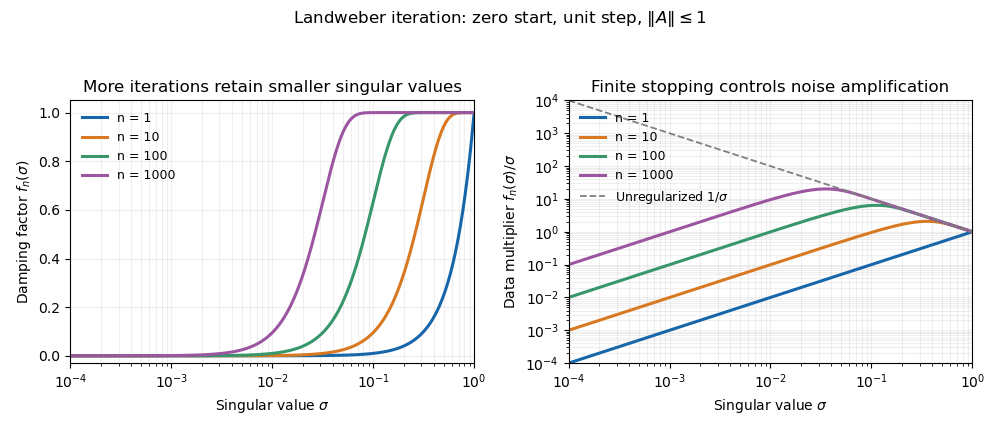
Landweber filters and progressive noise amplification
. More iterations admit smaller singular-value components. The damping factor tends toward one, while the coefficient applied to measured data approaches the unstable reciprocal singular value. Details. Pinned article: Introduction to the OurBigBook Project
Welcome to the OurBigBook Project! Our goal is to create the perfect publishing platform for STEM subjects, and get university-level students to write the best free STEM tutorials ever.
Everyone is welcome to create an account and play with the site: ourbigbook.com/go/register. We belive that students themselves can write amazing tutorials, but teachers are welcome too. You can write about anything you want, it doesn't have to be STEM or even educational. Silly test content is very welcome and you won't be penalized in any way. Just keep it legal!
Intro to OurBigBook
. Source. We have two killer features:
- topics: topics group articles by different users with the same title, e.g. here is the topic for the "Fundamental Theorem of Calculus" ourbigbook.com/go/topic/fundamental-theorem-of-calculusArticles of different users are sorted by upvote within each article page. This feature is a bit like:
- a Wikipedia where each user can have their own version of each article
- a Q&A website like Stack Overflow, where multiple people can give their views on a given topic, and the best ones are sorted by upvote. Except you don't need to wait for someone to ask first, and any topic goes, no matter how narrow or broad
This feature makes it possible for readers to find better explanations of any topic created by other writers. And it allows writers to create an explanation in a place that readers might actually find it.
Figure 1. Screenshot of the "Derivative" topic page. View it live at: ourbigbook.com/go/topic/derivativeVideo 2. OurBigBook Web topics demo. Source. - local editing: you can store all your personal knowledge base content locally in a plaintext markup format that can be edited locally and published either:This way you can be sure that even if OurBigBook.com were to go down one day (which we have no plans to do as it is quite cheap to host!), your content will still be perfectly readable as a static site.
- to OurBigBook.com to get awesome multi-user features like topics and likes
- as HTML files to a static website, which you can host yourself for free on many external providers like GitHub Pages, and remain in full control

Figure 2. You can publish local OurBigBook lightweight markup files to either OurBigBook.com or as a static website.
Figure 3. Visual Studio Code extension installation.
Figure 5. . You can also edit articles on the Web editor without installing anything locally. Video 3. Edit locally and publish demo. Source. This shows editing OurBigBook Markup and publishing it using the Visual Studio Code extension. 
- Infinitely deep tables of contents:



All our software is open source and hosted at: github.com/ourbigbook/ourbigbook
Further documentation can be found at: docs.ourbigbook.com
Feel free to reach our to us for any help or suggestions: docs.ourbigbook.com/#contact