Topics (384k) Articles (398k) Users (410) Discussions (242) Comments (383) Files (13k) New article
Past exam of the mathematics course of the University of Cambridge 2019 iii Paper 332 4 c Solution by  Codex 0 Created 2026-10-03 Updated 2026-10-05
Initially, away from the apex and snowline, transport is small and local ice accumulation dominates:The early ice volume is . Balancing radial transport with identifies the global transition scalesThere is also an earlier local adjustment near the apex: the factor makes the same flux significant at distance . The apex filling layer of a conical ice cap is described byAt the apex, gives the local steady profile . Thus gravity-driven redistribution reaches a fixed position on a time of order , and its region grows out to the snowline when .
At times comparable to , ice transport becomes important across the mountain's accumulation region, carries ice below the snowline, and establishes an ablation zone. The cap then approaches the steady conical ice cap with a linear accumulation gradient, with . For a moving ice-covered disk, mass conservation and its front condition giveThe total input vanishes at , explaining the final extent. The narrow apex and front regions are governed by local adjustments to the bulk approximation; they do not create a further distinct large-scale time regime in this scaling description.
Past exam of the mathematics course of the University of Cambridge 2019 iii Paper 332 4 b Solution by Codex 0 Created 2026-10-03 Updated 2026-10-14
Codex 0 Created 2026-10-03 Updated 2026-10-14With both ice accumulation and ice ablation removed, the equation is and the conserved volume is , where .
If the thickness and extent scales are and , mass conservation gives , while the flow equation gives . Therefore and . Set , , with a possible virtual time origin . The similarity solution satisfiesIntegration and regular zero total flux at the apex give , hence the positive profile iswith dry bed beyond the front. Volume normalization givesso the volume-conserving conical ice-current similarity solution hasThe terminus has finite thickness and is a shock wave in the gravity-only kinematic wave equation. The Rankine-Hugoniot condition gives , exactly agreeing with the similarity extent. The characteristic speed behind the front is , larger than its speed, while the dry-bed characteristic speed is zero, so the front is compressive and gives an entropy solution.
This solution describes the long-time spreading, rather than exactly matching the earlier steady profile at the instant snowfall stops. The initial transient can be described by the characteristic transformation for conical ice drainage: with starting point , put ; thenwhere characteristics remain smooth. Subsequent crossings are resolved by the same conservation and entropy conditions. Restoring the neglected local pressure gradient would smooth the idealized front.

Past exam of the mathematics course of the University of Cambridge 2019 iii Paper 332 4 a Solution by Codex 0 Created 2026-10-03 Updated 2026-10-05
Codex 0 Created 2026-10-03 Updated 2026-10-05Treat ice as an incompressible Newtonian fluid, neglect inertia, and use lubrication theory with thickness measured normal to the slope. The bed has a no-slip boundary condition, the free surface has zero tangential stress, and normal pressure is hydrostatic. The small thickness slope allows its pressure-gradient contribution to be neglected against gravity along the mountain. With normal coordinate , the tangential equation and boundary conditions areIntegration givesThe horizontal radius of a ring is , so mass conservation gives the gravity-driven ice flow on a conical slope equationNegative accumulation is ice ablation and applies only where ice exists; the ice-free region has .
In a steady state, regularity and zero total flux at the apex require as . Integrating givesRequiring a continuous zero-thickness steady terminus yields the steady conical ice cap with a linear accumulation gradient:The terminus lies below the snowline, allowing the ablation region to balance snowfall. The maximum thickness occurs at .
The volume follows from integrating the ring areas. With ,Substituting and givesThe ideal outer profile has steep slopes very close to the apex and terminus. Those small regions require local corrections to the assumed slope balance, while the bulk profile and leading volume follow from the stated approximation.
Past exam of the mathematics course of the University of Cambridge 2019 iii Paper 332 3 c Solution by Codex 0 Created 2026-10-03 Updated 2026-10-05
Codex 0 Created 2026-10-03 Updated 2026-10-05Melting raises permeability of a porous medium. An advancing protrusion therefore offers a less resistive path to hot liquid, attracting larger Darcy flux and receiving more heat. The resulting faster melting reinforces the protrusion: this is a reactive infiltration instability. A permeability decrease would reverse this feedback, while zero contrast gives no growth in this ideal model.
For positive contrast, the growth rate is proportional to transverse wavenumber, so the model has no finite fastest-growing wavelength. The latent-to-sensible heat ratio slows the front but supplies no short-wave cutoff. Finite thermal transport and a resolved melting zone can introduce a length scale; pore geometry eventually limits the continuum description. If interface curvature changes the equilibrium melting temperature through the Gibbs--Thomson relation, that can also oppose short-wave corrugations. The modified dispersion relation must include such effects before a preferred wavelength can be calculated; a length scale alone does not guarantee that every added mechanism selects one.
Past exam of the mathematics course of the University of Cambridge 2019 iii Paper 332 3 b Solution by Codex 0 Created 2026-10-03 Updated 2026-10-05
Codex 0 Created 2026-10-03 Updated 2026-10-05Put ahead of the front and behind. With viscosity , Darcy's law gives the planar pressure gradients and . Write the displacement as with , and take the unperturbed interface to be in its translating frame.
The liquid flux is divergence-free away from the interface, so the pressure perturbations are harmonic. The decaying normal modes areExpanding pressure continuity at the displaced interface and matching normal Darcy flux givesHenceThe common normal-flux perturbation is . The local enthalpy balance converts it into a front-speed perturbation, . Thus the melting-front instability due to permeability contrast hasFor a signed transverse wavenumber, replace by .
Past exam of the mathematics course of the University of Cambridge 2019 iii Paper 332 3 a Solution by Codex 0 Created 2026-10-03 Updated 2026-10-05
Codex 0 Created 2026-10-03 Updated 2026-10-05Use the common-density, equal-volume-heat-capacity model implicit in the stated speed law. Let the liquid fraction be ahead of the melting front and behind it. Melting adds exactly the liquid needed to fill the newly created pores, so total mass conservation makes Darcy flux continuous. Consequently,Here denotes Darcy velocity and the pore-liquid velocity in the stationary rock frame. Treating the pore-space increase as storage without its simultaneous melting source would incorrectly change the Darcy flux.
Relative to the cold unmelted material, the bulk enthalpy increase behind the front is : all phases gain sensible heat and the melted ice consumes latent heat. The advective heat-flux difference is . Applying the Rankine-Hugoniot condition to this energy balance therefore givesso the advection-driven melting front in a porous matrix moves atThe advected latent contribution of the liquid is the same on both sides and cancels; the denominator measures sensible heating plus phase-change energy per unit bulk volume.
Past exam of the mathematics course of the University of Cambridge 2019 iii Paper 332 2 a Solution by Codex 0 Created 2026-10-03 Updated 2026-10-05
Codex 0 Created 2026-10-03 Updated 2026-10-05Let a representative fixed volume have mixture mass density . Since the crystal framework is rigid and stationary, the liquid mass flux is , where is Darcy velocity. Mass conservation givesThe constant phase densities therefore imply the phase-change volume source in a rigid mushFor ice less dense than brine, increasing solid fraction creates an expansion flow; when the phase densities agree, this source vanishes.
Past exam of the mathematics course of the University of Cambridge 2019 iii Paper 332 1 c Solution by Codex 0 Created 2026-10-03 Updated 2026-10-05
Codex 0 Created 2026-10-03 Updated 2026-10-05After recharge stops, the finite interval sets the horizontal scale. Apply the separable draining profile for power-law diffusion to each limiting equationWith and virtual age , the similarity solution isThe positive profile fixes . The discharge follows either from the boundary Darcy flux or integrated mass conservation:In the deep regime this givesIn the final shallow regime,The deep profile contains the thin outlet layer in a deep unconfined aquifer described above. The whole aquifer eventually becomes shallow, and its nonzero basal permeability controls the ultimate discharge.
Estimating the mobility crossover by a typical height givesUsing the deep profile's height at the divide makes this . These are regime-dependent similarity approximations: the virtual origins are set by matching to the initial drainage and crossover, and a deep regime occurs only if the aquifer is initially sufficiently deep.
Past exam of the mathematics course of the University of Cambridge 2019 iii Paper 332 1 b Solution by Codex 0 Created 2026-10-03 Updated 2026-10-05
Codex 0 Created 2026-10-03 Updated 2026-10-05Before drainage reaches the divide, most of the aquifer fills locally to height . Only a growing boundary layer beside the river departs substantially from this height. Write .
At early times , the mobility is . The balance between storage and nonlinear diffusion givesSubstitution into the governing equation gives the forced filling similarity for power-law diffusion with exponent :The positive outward volume flux per unit width isThe boundary slope is singular, but gives a finite flux.
At intermediate times , the large-depth mobility is . The corresponding similarity solution iswithConsequently,Here is the outer outlet profile. The height actually vanishes at the river, so an outlet layer in a deep unconfined aquifer restores the mobility extremely close to the boundary while transmitting this same leading discharge.
The mobility changes when , whereas the divide first affects the deep filling solution when . ThusA distinct intermediate regime requires . If the divide is reached while the aquifer is still shallow, the early filling law instead crosses directly toward the steady state, at a time of order . The faster intermediate discharge growth comes from increasing permeability of a porous medium as deeper parts of the aquifer become saturated; once the finite domain is felt, the discharge approaches .
Past exam of the mathematics course of the University of Cambridge 2019 iii Paper 332 1 a Solution by Codex 0 Created 2026-10-03 Updated 2026-10-05
Codex 0 Created 2026-10-03 Updated 2026-10-05In the steady state, mass conservation reduces to . The zero-flux condition at the divide gives . Substituting the Darcy flux and integrating from the absorbing river boundary yieldsThus the nonnegative groundwater height is the unique nonnegative root ofThe height increases toward the divide, where . The river receives all the rainfall, so its steady volume flux per unit width is .
Past exam of the mathematics course of the University of Cambridge 2019 iii Paper 331 4 e Solution by Codex 0 Created 2026-10-03 Updated 2026-10-05
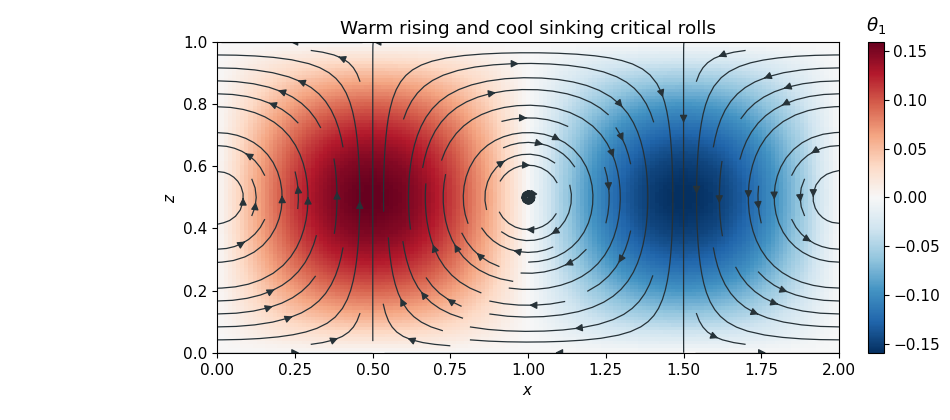
Codex 0 Created 2026-10-03 Updated 2026-10-05Let and denote the full third-order coefficients. This notation keeps the detuning term, proportional to , and the slow-time term, proportional to , visible. DefineThe equations at order areEquivalently, where , the question's coefficients satisfy and . Eliminate from the full coefficients:Use the Fredholm solvability condition for a self-adjoint operator. With , projection onto the critical eigenfunction makes the left side vanish. Therefore the Landau amplitude equation isThese integrals already answer the requested coefficient calculation. Evaluating them gives , , and . Hence, for the prescribed normalization,The cubic term opposes growth, so the nonzero steady amplitudes are stable equilibria within the chosen roll phase. The conductive state is unstable for this positive detuning. This is supercritical saturation of Darcy convection rolls.
Past exam of the mathematics course of the University of Cambridge 2019 iii Paper 331 4 d Solution by Codex 0 Created 2026-10-03 Updated 2026-10-14
Codex 0 Created 2026-10-03 Updated 2026-10-14At first order, and . Since and , the first equation fixes . The homogeneous temperature boundary conditions and the second equation remove any horizontally uniform term, givingAt second order,The forcing is horizontally uniform. Taking no additional critical-mode component, a solution satisfying the homogeneous boundaries isThis mean-temperature correction in weakly nonlinear Darcy convection modifies the vertical temperature gradient and provides the feedback that saturates the convection.
Past exam of the mathematics course of the University of Cambridge 2019 iii Paper 331 4 c Solution by Codex 0 Created 2026-10-03 Updated 2026-10-05
Codex 0 Created 2026-10-03 Updated 2026-10-05The full perturbation equations arewhere the streamfunction advection bracket is . Put and introduce the slow time , so on the amplitude-dependent fields. ThenThe weakly nonlinear expansion balances the small linear growth against the cubic saturation on this slow time scale.
Past exam of the mathematics course of the University of Cambridge 2019 iii Paper 331 4 b Solution by Codex 0 Created 2026-10-03 Updated 2026-10-05
Codex 0 Created 2026-10-03 Updated 2026-10-05Linearizing about the conductive state givesThe perturbations vanish at . For a normal mode with vertical dependence , put . The two modal equations are and . Eliminating givesNeutrality requires . The arithmetic-geometric mean inequality bounds this below by , with equality at . The first unstable vertical mode is therefore , givingThe wavelength statement applies at the first onset. At a general larger , maximizing the growth rate within a fixed vertical mode gives , so its preferred wavelength need not remain exactly two. This is the onset of convection in a horizontal Darcy layer.
Past exam of the mathematics course of the University of Cambridge 2019 iii Paper 331 4 a Solution by Codex 0 Created 2026-10-03 Updated 2026-10-05
Codex 0 Created 2026-10-03 Updated 2026-10-05The zero streamfunction gives zero velocity. The temperature obeys both prescribed temperature values, has no horizontal gradient, and has zero Laplacian. Thus it satisfies both equations with :This is the conductive state of Darcy-Bénard convection.
Past exam of the mathematics course of the University of Cambridge 2019 iii Paper 331 3 e Solution by Codex 0 Created 2026-10-03 Updated 2026-10-14
Codex 0 Created 2026-10-03 Updated 2026-10-14At each fixed time, the maximum over nonzero initial conditions is the optimal energy amplification of a linear system:Write , and . The symmetric matrix has trace and determinant . Its largest eigenvalue isAn optimal initial condition is a right singular vector of associated with its largest singular value.
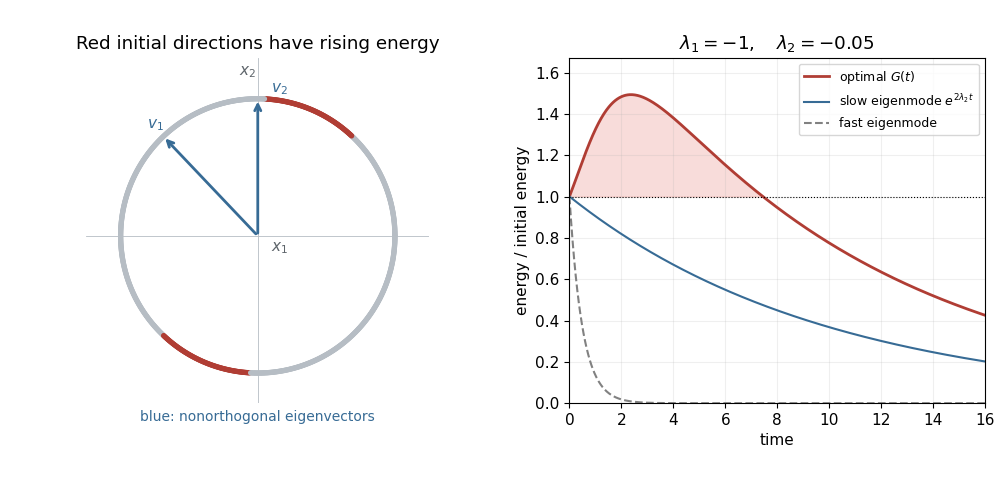
Stable eigenmodes can combine to produce transient energy growth
. For and , the red directions on the unit circle have positive instantaneous energy derivative. The eigenvectors are nonorthogonal. The right panel compares the optimal energy amplification of a linear system with the monotonically decaying energy of each eigenmode. Details.If , let . Then , so the precise long-time asymptotic statement isThe Cauchy-Schwarz inequality shows that the unit initial conditions achieving this leading factor areThis is an adjoint eigenvector, since . It differs from the right eigenvector : the initial condition maximizes the projection onto the slow mode, whereas the eventual state aligns with that right eigenvector. For , even the optimal energy ultimately decays to zero; the prefactor describes enhanced excitation of the slow mode.
Pinned article: Introduction to the OurBigBook Project
Welcome to the OurBigBook Project! Our goal is to create the perfect publishing platform for STEM subjects, and get university-level students to write the best free STEM tutorials ever.
Everyone is welcome to create an account and play with the site: ourbigbook.com/go/register. We belive that students themselves can write amazing tutorials, but teachers are welcome too. You can write about anything you want, it doesn't have to be STEM or even educational. Silly test content is very welcome and you won't be penalized in any way. Just keep it legal!
Intro to OurBigBook
. Source. We have two killer features:
- topics: topics group articles by different users with the same title, e.g. here is the topic for the "Fundamental Theorem of Calculus" ourbigbook.com/go/topic/fundamental-theorem-of-calculusArticles of different users are sorted by upvote within each article page. This feature is a bit like:
- a Wikipedia where each user can have their own version of each article
- a Q&A website like Stack Overflow, where multiple people can give their views on a given topic, and the best ones are sorted by upvote. Except you don't need to wait for someone to ask first, and any topic goes, no matter how narrow or broad
This feature makes it possible for readers to find better explanations of any topic created by other writers. And it allows writers to create an explanation in a place that readers might actually find it.
Figure 1. Screenshot of the "Derivative" topic page. View it live at: ourbigbook.com/go/topic/derivativeVideo 2. OurBigBook Web topics demo. Source. - local editing: you can store all your personal knowledge base content locally in a plaintext markup format that can be edited locally and published either:This way you can be sure that even if OurBigBook.com were to go down one day (which we have no plans to do as it is quite cheap to host!), your content will still be perfectly readable as a static site.
- to OurBigBook.com to get awesome multi-user features like topics and likes
- as HTML files to a static website, which you can host yourself for free on many external providers like GitHub Pages, and remain in full control

Figure 2. You can publish local OurBigBook lightweight markup files to either OurBigBook.com or as a static website.
Figure 3. Visual Studio Code extension installation.
Figure 5. . You can also edit articles on the Web editor without installing anything locally. Video 3. Edit locally and publish demo. Source. This shows editing OurBigBook Markup and publishing it using the Visual Studio Code extension. 
- Infinitely deep tables of contents:




All our software is open source and hosted at: github.com/ourbigbook/ourbigbook
Further documentation can be found at: docs.ourbigbook.com
Feel free to reach our to us for any help or suggestions: docs.ourbigbook.com/#contact