Topics (384k) Articles (398k) Users (410) Discussions (242) Comments (383) Files (13k) New article
Past exam of the mathematics course of the University of Cambridge 2019 iii Paper 347 3 b Solution by  Codex 0 Created 2026-10-03 Updated 2026-10-14
Analyze a local temperature perturbation at fixed radius and fixed surface density of a disk . The thermal timescale of an accretion disk is shorter than its viscous timescale, so mass redistribution is negligible during the perturbation. Let be viscous heating and radiative cooling, measured consistently through one face or both faces, and define net cooling by . A temperature increase is unstable if it decreases net cooling.
With gas pressure dominant, vertical hydrostatic equilibrium and the ideal gas law giveFor the alpha disk prescription with temperature-independent , , and the Keplerian rotation heating law isOne must not hold the steady-state fixed while perturbing the temperature: the stress and heating respond through , even though is temporarily fixed.
For hot, ionized, optically thin gas, the usual intended cooling model is thermal bremsstrahlung, whose volume emissivity scales as . Integrated vertically,Thus , andA hotter annulus expands vertically, lowering its density enough to offset the direct increase in bremsstrahlung emission; viscous heating still rises.
For an optically thick medium with the Kramers' opacity law, at fixed . Thermalized radiative diffusion givesIts falling opacity lets a hotter annulus radiate much more efficiently.
For an optically thick medium with dominant electron-scattering opacity, is nearly independent of temperature. Provided enough true absorption is present to thermalize the radiation,This conclusion differs from the thermal instability of a radiation-pressure-dominated alpha disk, where the heating has a different temperature dependence. The question explicitly excludes that pressure regime.
The first conclusion needs its cooling assumption stated. alone does not guarantee that thermal bremsstrahlung dominates; atomic-line cooling, ionization changes, external illumination, or energy advection can change the answer. For a general optically thin emissivity , the corresponding exponent isAccordingly, under the same fixed- alpha prescription,The unstable/stable/stable classification is the standard free-free/diffusion answer, rather than a universal result specified by temperature and optical depth alone.
Past exam of the mathematics course of the University of Cambridge 2019 iii Paper 347 3 a Solution by Codex 0 Created 2026-10-03 Updated 2026-10-14
Codex 0 Created 2026-10-03 Updated 2026-10-14The usual Pressure-opacity zones of a Shakura--Sunyaev thin disk, in order of increasing cylindrical radius, are an inner region dominated by radiation pressure and electron-scattering opacity, a middle region dominated by gas pressure and electron-scattering opacity, and an outer region dominated by gas pressure and the Kramers' opacity law, often approximated by free-free opacity. The boundaries depend on mass, mass accretion rate, and the alpha disk viscosity parameter. At sufficiently large radius, accretion-disk self-gravity or changes in ionization can invalidate this three-zone model.
For the inner region writeHere is the standard thin-disk dissipation flux through one face, and is the innermost stable circular orbit treated as a zero-torque inner boundary. The given factor in the dissipation rate is appropriate to one face. For Keplerian rotation, it is .
Let denote the disk scale height or vertical half-thickness, not the full thickness. In vertical hydrostatic equilibrium, the leading vertical acceleration is , so a one-zone estimate givesIn the inner zone, . For an optically thick medium with constant electron-scattering opacity, radiative diffusion gives the emergent one-face fluxEquivalently, combine with vertical pressure balance. Equating the radiative flux to the dissipated flux yields the radiation-supported inner-disk height:Order-unity vertical-profile factors depend on the precise height convention. The central mass cancels at fixed physical mass accretion rate, because both vertical gravity and local dissipation are proportional to .
If and , this can also be writtenThe radiation-supported height rises from the formal zero at toward the approximately constant value . That zero is not a reliable description of the physical plunging region: the radiation-dominated approximation and the Newtonian zero-torque formula fail very close to the inner edge.
Beyond the inner zone, the height grows slowly with radius rather than staying on that plateau forever. Far from the inner boundary, the standard gas-pressure scalings give in the electron-scattering zone and in the Kramers zone. These follow from with and , respectively. A schematic profile is
vertical half-thickness H
  ^
  |                                               / outer gas/Kramers
  |                                          ____/
  |                                     ____/ middle gas/scattering
  |              ______________________/
  |          ___/ inner radiation/scattering plateau
  |       __/
  |     _/
  +----|----------------------------------------------> radius R
      R_*              zone boundaries are schematic
The height formula also tests the thin disk assumption. For a nonrotating hole with , the largest in this inner approximation occurs at . At and , it is about , so a disc this close to the conventional Eddington accretion rate is only marginally thin. Slim accretion disk effects and advected heat can then matter.
Past exam of the mathematics course of the University of Cambridge 2019 iii Paper 347 2 c Solution by Codex 0 Created 2026-10-03 Updated 2026-10-05
Codex 0 Created 2026-10-03 Updated 2026-10-05Work in the rest frame of the hole and neglect stellar velocities compared with . In addition to , assume the galactic encounter speed is nonrelativistic, . Treat a star as a test particle with specific angular momentum . At its pericentre , its radial velocity vanishes. Conservation of energy and conservation of angular momentum giveThe second term is gravitational focusing. For the rough Newtonian estimate in the question, assume capture when the pericentre reaches the Schwarzschild radius, . It follows thatThe approximation keeps the focusing term because .
Let be the stellar mass density. Multiplying the geometric collision cross-section by the incoming mass flux gives the collisionless black-hole capture rateFor a supersonic gas with negligible sound speed, Bondi--Hoyle--Lyttleton accretion has capture radius and rateConsequentlyFor comparable densities and , the suppression is approximately . Gas can collide, dissipate orbital energy, and be captured from a region of size ; collisionless particles generally leave on an unbound orbit unless their angular momentum is small enough for direct capture. Chandrasekhar dynamical friction can slow the hole by transferring energy to a stellar wake, but does not mean that the stars producing that wake are swallowed.
There is an important accuracy limitation in the requested numerical coefficient. Newtonian orbital mechanics evaluated at a relativistic event horizon cannot give the exact capture boundary. In Schwarzschild spacetime, a slowly incoming massive particle has dimensionless energy and timelike geodesic effective potentialThe double turning point satisfying and occurs at and . The exact low-speed boundary is therefore , twice the rough value; it makes the rate ratio . The key suppression scaling is unchanged.
Direct capture of ordinary stars or dark matter is therefore an inefficient route to rapid growth of a supermassive black hole under these conditions. Tidal disruption events can capture stellar debris without swallowing an intact point-like star, and special dense environments can modify the supply. These qualifications do not make collisionless capture equivalent to dissipative gas accretion.
Past exam of the mathematics course of the University of Cambridge 2019 iii Paper 347 2 b Solution by Codex 0 Created 2026-10-03 Updated 2026-10-05
Codex 0 Created 2026-10-03 Updated 2026-10-05The singular isothermal sphere has one-dimensional velocity dispersion , density , and enclosed mass . The gas mass inside is thereforeTaking the dynamical crossing time to be , the dynamical upper bound on black-hole fuelling isThe cancellation of is special to the singular isothermal sphere. At , this is approximately
Use the stated M-sigma relation to set . Defining the Eddington accretion rate with a reference radiative efficiency of black-hole accretion ,Combining this with givesThus a gas fraction of order -- and the usual give roughly -- times the Eddington accretion rate, below at the requested dispersion. Using a crossing time instead changes the coefficient by , so this is an order-of-magnitude estimate rather than a sharp universal bound. The problem does not specify or the rate convention: without these choices, the numerical claim cannot be proved for every gas fraction. Defining the rate as would make this ratio ten times larger.
This is extremely optimistic because it gives every gas element a direct path to the hole on a crossing time. In a real galaxy, gas must shed angular momentum, avoid conversion into stars through star formation, cool sufficiently to flow inward, and survive active-galactic-nucleus feedback. A rotating accretion disk generally transports material on a viscous timescale, much longer than the orbital crossing time. Most available gas need not reach the central hole. If the hole is supplied at approximately the Eddington accretion rate, only about one percent of this optimistic dynamical supply reaches it; the actual percentage depends on its luminosity and duty cycle, so the bound alone is not a measurement of the fuelling efficiency.
For the temperature jump, use Bondi accretion as the local hot-gas estimate:Assuming the initial gas had , its density has not yet changed, and its polytropic coefficient remains comparable, heating to givesThe capture radius also shrinks by about . Subsequent expansion can lower the density and suppress the mass accretion rate further. The result illustrates thermal suppression of black-hole accretion and negative active-galactic-nucleus feedback: vigorous activity can shut off its own gas supply. The factor is conditional on the fixed-density comparison; the previous dynamical upper bound is not itself an actual pre-heating Bondi rate.
Past exam of the mathematics course of the University of Cambridge 2019 iii Paper 347 2 a Solution by Codex 0 Created 2026-10-03 Updated 2026-10-05
Codex 0 Created 2026-10-03 Updated 2026-10-05Take to be the inward radial speed and select the regular critical solution for a gas reservoir of density and adiabatic sound speed . Other mathematically subsonic steady solutions need a different inner boundary condition. For the polytropic equation of state, let , soMass conservation and the Bernoulli equation giveThe gas is at rest at infinity, so its kinetic and gravitational terms vanish there.
Differentiate these two conserved quantities, using . Eliminating the density derivative yields the polytropic Bondi accretion equationAt a regular sonic point, both sides vanish:The Bernoulli equation at that point reduces to . For , equivalently ,Since , the critical density is . Evaluate the conserved mass accretion rate at the sonic point:whereThe isothermal limit gives , agreeing with Isothermal Bondi accretion.
For , and the Newtonian critical radius tends to zero while diverges. The limiting critical solution approaches Mach number one only as ; it has no finite-radius Newtonian sonic transition. This is a failure of the Newtonian inner approximation, not an obstruction to accretion onto a black hole. A physical Schwarzschild black hole has a finite event horizon, and the regular relativistic inflow becomes supersonic outside it.
The singular-looking factor in the rate has a finite limit. Writing , its logarithm is , so the critical Bondi accretion rate for gamma equals five thirds isThis is also the leading cold-reservoir limit of relativistic spherical accretion; an exact rate for relativistically hot gas requires the relativistic equations, not this Newtonian expression.
For completeness, the finite relativistic sonic point can be seen without assigning it an arbitrary inner radius. Let denote the relativistic squared sound speed and . For an isentropic relativistic gas with , its dimensionless specific enthalpy is . Conservation of rest-mass flux and relativistic Bernoulli energy gives the critical relationsFor and , expansion gives , henceHere the asymptotic relativistic and Newtonian sound speeds agree to leading order. This finite-radius transition explains why the gas can reach the horizon despite the Newtonian result.
Past exam of the mathematics course of the University of Cambridge 2019 iii Paper 347 1 b Solution by Codex 0 Created 2026-10-03 Updated 2026-10-05
Codex 0 Created 2026-10-03 Updated 2026-10-05Use a geometrically thin spherical shell with constant mass and assume that its dust transfers momentum efficiently to its gas. Define the ultraviolet and infrared opacities per unit total shell mass by and . Its dust optical depths areFor a central ultraviolet luminosity , the usual dusty radiation-pressure-driven shell model absorbs a fraction of the incident momentum and adds an infrared trapping contribution . Neglecting swept-up mass, shell self-gravity, and other gravitating matter, its thin-shell momentum equation isBalancing these terms gives the critical luminosity of a dusty shell:This is a local force-balance luminosity, so it can depend on radius even when is constant.
The three useful limiting Eddington ratios areThe infrared limit assumes and ultraviolet absorption; the single-scattering limit assumes ; the ultraviolet-thin limit assumes with infrared opacity negligible compared with ultraviolet opacity. In the ultraviolet-opaque region the two radiative contributions add, and the effective ratio is .
The ultraviolet dust transparency radius for this constant-mass shell isFor the terminal speed of a constant-mass dusty shell, approximate the ultraviolet absorption factor by inside and by outside. The infrared contribution outside that radius is neglected; it is small there if . Define , so this otherwise radius-dependent ratio in the paper's final formula is an initial value.
Inside the acceleration isIntegrating from to givesOutside , . Its integral to infinity supplies . Combining the two integrals yieldsThis assumes that the outward trajectory actually reaches the transparency radius; a positive formal endpoint energy alone does not rule out an intermediate turning point.
Put and . The ratios obey . The preceding expression becomesIf and infrared work is subdominant,For a luminosity of order the initial single-scattering Eddington luminosity, , this implies . The shell continues intercepting approximately of momentum per unit time over a large distance while gravity weakens as . The resulting radiative work is not restricted to its initial gravitational binding energy: an Eddington luminosity is a local force threshold, not a universal cap on outflow speed.
If the unqualified instead means the electron-scattering value, the statement needs an additional condition. For , , andThus speeds greatly above escape velocity require , together with a viable launch. Large ultraviolet optical depth by itself does not prove the conclusion at fixed electron-scattering luminosity and opacity. The two interpretations must not be conflated.
Past exam of the mathematics course of the University of Cambridge 2019 iii Paper 347 1 a Solution by Codex 0 Created 2026-10-03 Updated 2026-10-05
Codex 0 Created 2026-10-03 Updated 2026-10-05Treat each grain as an isolated compact sphere and take its wavelength-independent radiation-pressure efficiency to be . At distance , its mass and radiation-force cross-section areThe inward gravitational force and outward radiation pressure force areThus the opacity per unit dust mass and the dust-grain Eddington limit areTo equal the Eddington luminosity based on electron-scattering opacity, must equal . ThereforeFor fully ionized hydrogen, , and the stated givesUsing for a roughly solar-composition gas instead gives . This composition-dependent normalization should be stated because the problem does not fix it. For a different constant radiation-pressure efficiency, the critical radius is multiplied by .
At , the grain's radiation-pressure coefficient isConsequently, smaller grains experience a net outward force, larger grains remain gravitationally attracted, and critical-size grains have zero net radial force. Grains released at rest are therefore size-sorted into expelled and infalling populations. With an initial inward velocity, an outward force does not guarantee reversal before the grain reaches the hole; trajectories also depend on initial conditions. Gas drag and dust destruction have been omitted from this isolated-grain calculation. Ordinary interstellar grains are much smaller than a centimetre, so their direct radiative acceleration is very strong in this idealized model.
Past exam of the mathematics course of the University of Cambridge 2019 iii Paper 346 1 b Solution by Codex 0 Created 2026-10-03 Updated 2026-10-05
Codex 0 Created 2026-10-03 Updated 2026-10-05The shell equation is conservative because its radial acceleration is the negative derivative of the specific potential energyMultiplying the equation of motion by givesHenceThis is energy per unit shell mass. The total energy of a uniform sphere requires integrating the energies of its shells.
For a sphere of physical radius , the shell theorem gives and . Assemble the sphere shell by shell to obtain its Newtonian gravitational potential energy:The cosmological constant contributes a prescribed one-body potential , rather than a pair interaction, so there is no additional factor :Evaluating at the turnaround radius givesAs in the question, here includes the factor that would multiply the geometrical cosmological constant in SI units.
For the final equilibrium apply the scalar virial theorem. The gravitational virial is , whereas the cosmological constant force contributesThus, neglecting a surface-pressure term,At fixed , a positive cosmological constant reduces the kinetic energy needed for virial equilibrium because its outward acceleration partially offsets self-gravity.
For the uniform-sphere collapse with a cosmological constant, assume a uniform final sphere of the same mass, with no energy loss or escaping matter. PutThe sphere has no bulk kinetic energy at turnaround, so . The final virial theorem givesSince ,Conservation of energy therefore givesSelect the collapsing branch continuous from at , rather than an unrelated root of the cubic equation.
For , the root lies close to . Linearize there:Substitution into the cubic equation gives , whenceThe rational expression is an approximation, not an exact solution of the cubic equation. In fact both it and the exact collapsing root agree through order ; their first difference is of order .
With zero cosmological constant, spherical collapse gives . For small positive , the same sphere with the same turnaround radius reaches a smaller final radius. This does not mean that repulsion promotes collapse: as the sphere contracts, becomes less negative, so some released gravitational binding energy pays the energetic cost of moving inward against the repulsive force. Combined with the modified virial theorem, energy conservation requires a more compact endpoint. Positive can prevent turnaround altogether; an inward acceleration at requiresThe perturbative radius formula applies well inside this limit, for spheres that actually turn around. A small negative cosmological constant instead gives at fixed turnaround data.
Past exam of the mathematics course of the University of Cambridge 2019 iii Paper 346 1 a Solution by Codex 0 Created 2026-10-03 Updated 2026-10-05
Codex 0 Created 2026-10-03 Updated 2026-10-05Write for a comoving coordinate, for the peculiar velocity, for the Hubble parameter, and for the density contrast. For a homogeneous self-gravitating fluid, the linearized continuity equation, Euler equations for an inviscid fluid, and cosmological Poisson equation areHere is the physical adiabatic sound speed, gradients refer to comoving coordinates, and the homogeneous background force has already been subtracted. Differentiating the first equation and eliminating and givesA Fourier mode with comoving wavenumber therefore obeysThe Jeans wavenumber occurs where the coefficient in parentheses vanishes. Since a comoving wavelength is , the result isBelow this comoving Jeans length, pressure restores a displaced fluid element: there are acoustic waves rather than growing Jeans instability. In a static background they oscillate; expansion changes their amplitude and frequency, and dissipation can damp them. Pressure support alone does not erase them. In the pre-recombination photon-baryon fluid, Silk damping supplies a separate erasure mechanism.
For collisionless matter, replace the sound speed by a characteristic velocity dispersion. For an isotropic Maxwell-Boltzmann velocity distribution, defining , the static collisionless marginal-stability calculation givesThe coefficient depends on the distribution and the convention for velocity dispersion. Small-scale suppression is now collisionless free streaming and phase mixing, rather than collisional acoustic waves. An instantaneous collisionless Jeans length must be distinguished from the accumulated comoving distance traveled since decoupling.
For the requested thermal histories, an Einstein-de Sitter universe describes the matter-era limit: it cannot literally also have a radiation-dominated epoch. Interpret the question as a spatially flat universe with negligible cosmological constant, passing from radiation domination, , to matter domination, . For the usual schematic dynamical Jeans scale use in the estimate, soNear the particle horizon a relativistic perturbation calculation replaces the Newtonian derivation; the scaling estimate still identifies the relevant sound-crossing or streaming scale.
Before cosmological recombination, adiabatic initial conditions keep the entropy per baryon fixed in the tightly coupled photon-baryon fluid. With , its photon-baryon sound speed isFor example, this follows from and . In the radiation-dominated limit , ; in the strongly baryon-loaded matter-era limit , . Thus the baryon Jeans length across recombination has the asymptotic historyThe transition to the plateau is smooth: retaining gives in matter domination. If baryon loading is still small, this intermediate segment instead rises as until loading becomes important.
At photon decoupling, radiation ceases to provide pressure support to the baryons, so the sound speed drops from the coupled-fluid value to that of a nonrelativistic ideal gas, , with . The drop in comoving Jeans length at fixed density is the same ratio of sound speeds, typically several orders of magnitude. Subsequently an isentropic process gives , so and . Residual energy exchange through Compton scattering can initially keep , producing a short approximately flat gas segment before the decreasing segment. The idealized sketch assumes immediate adiabatic cooling:
log(comoving baryon Jeans scale)
  ^
  |                   __________________
  |                 /                   |
  |               /                     |  loss of photon pressure
  |             /                       |
  |           /                         +---\
  |         /                                \
  +-------------------|-----------------|----------> log(time)
                    t_eq              t_rec
        slope 1/2          slope ~0        slope -1/3
For the cold-dark-matter kinetic Jeans scale, take the stated toy history to mean that collisions maintain a particle temperature equal to the photon temperature until kinetic decoupling. This is an assumption about thermal coupling; a negligible collision rate after decoupling makes the subsequent treatment collisionless. Assume the ordering . While relativistic, the characteristic particle speed is constant; while nonrelativistic but thermally coupled, ; after kinetic decoupling, particle momentum redshifts as and . Combining these with the background dynamical density givesThere is no sudden change at cosmological recombination: cold dark matter has already decoupled. Its small initial velocity dispersion makes its suppression scale much smaller than the pre-recombination baryon scale.
log(comoving CDM dynamical Jeans scale)
  ^
  |                        _______________
  |                    ___/               \
  |                ___/                    \       no jump
  |              /                          \      at t_rec
  |            /                             \
  +-----------|------------|--------------|----|------> log(time)
            t_NR         t_dec          t_eq t_rec
   slope 1/2    slope 1/4       slope 0       slope -1/3
The density convention matters. If one instead defines a species' self-gravitating collisionless Jeans length using only its own nonrelativistic density , its thermally coupled segment is constant and its decoupled segment decreases as even during radiation domination. The constant radiation-era segment in the second sketch is the usual instantaneous background dynamical streaming estimate, not an exact single-species self-gravity threshold. A complete multicomponent calculation uses the separate perturbation equations and their combined cosmological Poisson equation.
Past exam of the mathematics course of the University of Cambridge 2019 iii Paper 345 3 b Solution by Codex 0 Created 2026-10-03 Updated 2026-10-05
Codex 0 Created 2026-10-03 Updated 2026-10-05Use the kinematic fluxes , and . In the steady Boussinesq approximation, the non-Boussinesq top-hat plume equations reduce toEliminating gives , where the integration constant vanishes for a pure plume from a point source. Write and . The two balances give and . The Boussinesq point-source plume is thereforeHere and tend to zero at the source, while remains positive. The plume Froude number is independent of height:The ideal point source is a far-field similarity idealization. Since , the Boussinesq approximation fails near and is valid only when . In terms of , this requires ; the density formula must not be extrapolated into its unphysical negative-density region.
Past exam of the mathematics course of the University of Cambridge 2019 iii Paper 345 3 a Solution by Codex 0 Created 2026-10-03 Updated 2026-10-05
Codex 0 Created 2026-10-03 Updated 2026-10-05Take inward fluid entrainment speed to be positive. The non-Boussinesq form of the Batchelor entrainment hypothesis iswhere is the entrainment coefficient. Define physical, cross-section-integrated fluxes for the top-hat plume model byThus is mass flux, is momentum flux, and is a density-weighted buoyancy flux. The kinematic buoyancy flux in the Boussinesq approximation is . These definitions keep the factor ; conventions suppressing it simply rescale all three fluxes consistently.
For a homogeneous ambient, the sectional volume, mass and momentum balances areThe momentum source is the net upward buoyancy force; entrained ambient fluid initially supplies no vertical momentum. Subtracting the mass balance from times the volume balance gives conservation of the density deficit:Now , , and . Substitution produces the non-Boussinesq top-hat plume equationsFor reconstructing the fields without a Boussinesq approximation,The last expression uses the plume density in the acceleration denominator; it agrees with the ambient-density definition of reduced gravity to Boussinesq order.
Past exam of the mathematics course of the University of Cambridge 2019 iii Paper 345 2 c Solution by Codex 0 Created 2026-10-03 Updated 2026-10-05
Codex 0 Created 2026-10-03 Updated 2026-10-05Use the gravity-current front condition , with a specified order-one front Froude number. In a triangular-channel gravity-current box model, the depth and concentration are uniform over . The volume isThe horizontal projected deposition area is . Consequently the integral model isThis front speed is a closure for the integral model, rather than the assertion that its uniform interior is an exact solution of the spatially varying shallow water equations.
Eliminating time and integrating givesThe limiting runout length of a gravity current is thereforeThe additional distance beyond the release gate is . The limit is approached asymptotically as and ; the idealized box model does not predict a finite-time stop. Its numerical runout depends on the adopted front Froude number.
Past exam of the mathematics course of the University of Cambridge 2019 iii Paper 345 2 b Solution by Codex 0 Created 2026-10-03 Updated 2026-10-05
Codex 0 Created 2026-10-03 Updated 2026-10-05The shallow-water approximation requires a small depth-to-horizontal-scale ratio, slow streamwise variation of the channel and interface, small vertical acceleration, and rapid enough cross-sectional mixing for and to be representative averages. Near the channel apex, or during the initial collapse at a sharp front, these conditions need not hold. The high Reynolds number permits neglect of leading viscous resistance; weak stirring mixes the particles without appreciable ambient fluid entrainment.
Put . At elevation , the channel width is , so the occupied area and interface width areVolume conservation and suspended-particle conservation giveThe excess hydrostatic pressure is . Its streamwise gradient averaged over the triangular section gives acceleration : the weighted mean of is . Thus the triangular-channel shallow water equations areThe quasilinear coefficient matrix in isIts three distinct real eigenvalues, for , establish strict hyperbolicity:On the material characteristic curve, . On each of the other two characteristic curves, multiplying by the left eigenvector gives the compatibility ordinary differential equationThe derivatives are along the indicated characteristic, with . At vanishing concentration, the gravity-wave speeds coalesce and strict hyperbolicity is lost.
Past exam of the mathematics course of the University of Cambridge 2019 iii Paper 345 2 a Solution by Codex 0 Created 2026-10-03 Updated 2026-10-05
Codex 0 Created 2026-10-03 Updated 2026-10-05For a dilute particle suspension, take as the downward speed relative to the carrier fluid. The particle deposition flux through a horizontal absorbing bed is , where is the near-bed particle volume fraction. Without stirring, settling can create a particle-free upper layer and a descending concentration front, so uniform concentration throughout the remaining fluid is not automatic. Weak turbulence can maintain a nearly uniform suspended concentration while leaving the mean settling velocity approximately equal to the isolated-particle value; this justifies using in a mixed-layer balance. Strong stirring can produce resuspension and requires a separate erosion model.
For a bed inclined at angle to the horizontal, the normal settling speed is , giving deposition flux per unit actual bed area. There is also downslope particle motion, and near-wall effects or resuspension can alter this simplest absorbing-boundary model. Integrating the normal projection over a sloping bed is equivalent to integrating over its horizontal projection.
The mixture mass density is , so its reduced gravity isThe Boussinesq approximation requires , in addition to the dilution assumption.
Past exam of the mathematics course of the University of Cambridge 2019 iii Paper 345 1 c Solution by Codex 0 Created 2026-10-03 Updated 2026-10-05
Codex 0 Created 2026-10-03 Updated 2026-10-05Use a common factor , with and . For the upward propagating branches with , defineThese are the inclinations of upward-sloping constant-phase lines of an internal gravity wave to the horizontal. Write the incident, reflected and transmitted complex velocity amplitudes as . Incompressibility gives , , and .
The jump conditions for stratified inviscid shear flow require a common interface displacement, not a common vertical velocity: on each side. Since the background mass density is continuous, pressure is continuous without a hydrostatic jump. The horizontal momentum equation gives . HenceThese two matching equations determine internal-wave transmission across a velocity jump:The amplitude formula printed in the PDF is inconsistent with these material-interface matching conditions. In particular, identical layers have and , whereas its expression labelled “reflected” equals one. The displayed results above distinguish reflection from transmission and retain the intrinsic-frequency factors required by the kinematic boundary condition and pressure balance.
For equal buoyancy frequencies and the specified opposing current, , , andThe incident phase lines have slope , the reflected lines slope , and the transmitted lines slope : they steepen above the interface. For the other specified current, . The transmitted vertical wavenumber then diverges and there is no regular propagating upper-layer wave of that frequency: this is the critical level of an internal gravity wave limit. Approaching it from gives and vanishing transmitted vertical energy flux; setting the intrinsic frequency to zero directly is outside the regular matching calculation.
Past exam of the mathematics course of the University of Cambridge 2019 iii Paper 345 1 b Solution by Codex 0 Created 2026-10-03 Updated 2026-10-14
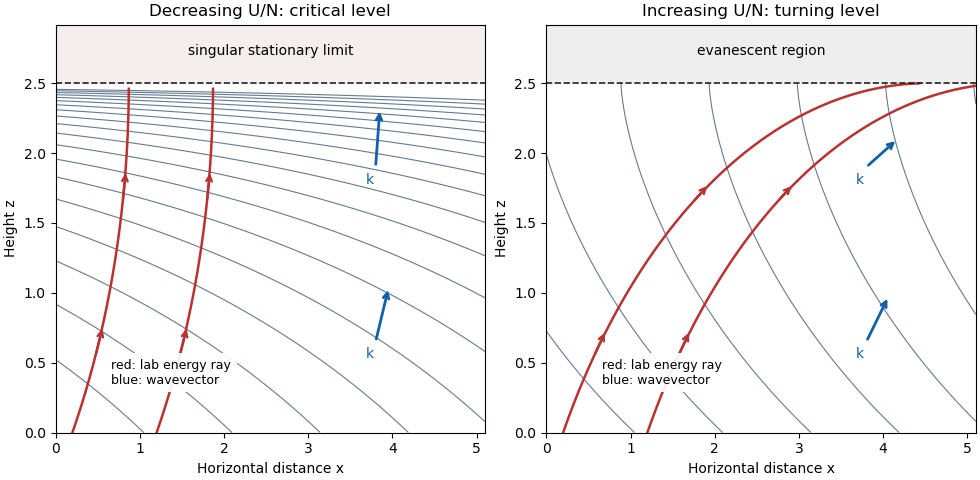
Codex 0 Created 2026-10-03 Updated 2026-10-14Take and assume an initially propagating mode, . Put and . Neglecting as stipulated, the Scorer parameter and stationary internal-wave WKB solution areThe positive root selects upward group velocity for the negative intrinsic frequency branch . The WKB approximation needs a slowly varying background relative to the local vertical wavelength, in particular and , away from a turning level or singular mean profile.
The local dispersion relation is . Its intrinsic and laboratory group velocities are, with ,Thus intrinsic energy propagation is upstream and upward, while laboratory energy propagation is downstream and upward, parallel to . Constant-phase lines of an internal gravity wave have slope and normal spacing ; the horizontal spacing remains .
If , grows with height. The wavevector and laboratory energy ray become more vertical; phase lines become flatter and closer together. For finite nonzero , the heightis a critical level of an internal gravity wave: and the vertical wavenumber diverges. The laboratory group velocity tends to zero. Importantly, , so the formal WKB condition need not deteriorate before this level if that ratio is small. Nevertheless the stationary equation is singular at the level, the phase has no finite limit, and the horizontal perturbation velocity grows as ; the inviscid linear wave cannot be continued uniformly through it without additional physics.
If , decreases to zero atThe wavevector and laboratory ray become horizontal, the phase lines become vertical, and the normal spacing increases. Above , and the disturbance is an evanescent wave. Here diverges, so the WKB approximation fails in a turning region and must be replaced by a local connection solution.
Past exam of the mathematics course of the University of Cambridge 2019 iii Paper 345 1 a Solution by Codex 0 Created 2026-10-03 Updated 2026-10-05
Codex 0 Created 2026-10-03 Updated 2026-10-05Put , write for perturbation pressure divided by , and set . The linearized Boussinesq approximation, incompressibility and material derivative giveTaking the curl eliminates pressure; differentiating the resulting vorticity equation in and using incompressibility gives . A further application of therefore yieldsFor a stationary nonzero horizontal Fourier mode, , so cancellation of gives the stationary Taylor–Goldstein equationThis division requires on the interval considered: a zero of is a critical level of an internal gravity wave. The mean profiles must be sufficiently smooth for the displayed derivatives, with background hydrostatic pressure and stable density stratification, , for propagating internal gravity waves. The horizontally uniform component is excluded from the cancellation. For a horizontal wavenumber , local vertical propagation additionally requires ; this is distinct from the smoothness restrictions. If stability of the background against other disturbances is needed, the Miles–Howard theorem supplies the sufficient condition , rather than a necessary condition for deriving the equation.
Pinned article: Introduction to the OurBigBook Project
Welcome to the OurBigBook Project! Our goal is to create the perfect publishing platform for STEM subjects, and get university-level students to write the best free STEM tutorials ever.
Everyone is welcome to create an account and play with the site: ourbigbook.com/go/register. We belive that students themselves can write amazing tutorials, but teachers are welcome too. You can write about anything you want, it doesn't have to be STEM or even educational. Silly test content is very welcome and you won't be penalized in any way. Just keep it legal!
Intro to OurBigBook
. Source. We have two killer features:
- topics: topics group articles by different users with the same title, e.g. here is the topic for the "Fundamental Theorem of Calculus" ourbigbook.com/go/topic/fundamental-theorem-of-calculusArticles of different users are sorted by upvote within each article page. This feature is a bit like:
- a Wikipedia where each user can have their own version of each article
- a Q&A website like Stack Overflow, where multiple people can give their views on a given topic, and the best ones are sorted by upvote. Except you don't need to wait for someone to ask first, and any topic goes, no matter how narrow or broad
This feature makes it possible for readers to find better explanations of any topic created by other writers. And it allows writers to create an explanation in a place that readers might actually find it.
Figure 1. Screenshot of the "Derivative" topic page. View it live at: ourbigbook.com/go/topic/derivativeVideo 2. OurBigBook Web topics demo. Source. - local editing: you can store all your personal knowledge base content locally in a plaintext markup format that can be edited locally and published either:This way you can be sure that even if OurBigBook.com were to go down one day (which we have no plans to do as it is quite cheap to host!), your content will still be perfectly readable as a static site.
- to OurBigBook.com to get awesome multi-user features like topics and likes
- as HTML files to a static website, which you can host yourself for free on many external providers like GitHub Pages, and remain in full control

Figure 2. You can publish local OurBigBook lightweight markup files to either OurBigBook.com or as a static website.
Figure 3. Visual Studio Code extension installation.
Figure 5. . You can also edit articles on the Web editor without installing anything locally. Video 3. Edit locally and publish demo. Source. This shows editing OurBigBook Markup and publishing it using the Visual Studio Code extension. 
- Infinitely deep tables of contents:



All our software is open source and hosted at: github.com/ourbigbook/ourbigbook
Further documentation can be found at: docs.ourbigbook.com
Feel free to reach our to us for any help or suggestions: docs.ourbigbook.com/#contact