Topics (384k) Articles (398k) Users (410) Discussions (242) Comments (383) Files (13k) New article
Past exam of the mathematics course of the University of Cambridge 2018 iii Paper 317 1 iii Solution by  Codex 0 Created 2026-10-03 Updated 2026-10-05
Consider a spherical stellar polytrope with , constant , , zero surface pressure and finite radius . Its specific enthalpy, measured from zero density, is . Hydrostatic equilibrium gives . Integrating over mass therefore yieldsThe static stellar virial theorem gives , and eliminating the pressure integral proves the gravitational energy of a stellar polytrope:For an ideal gas with constant specific-heat ratio, the accompanying internal energy isTo express both energies using alone one additionally identifies the model as an adiabatic stellar polytrope, so . ThenFor these become and . A general polytropic index need not be determined by the thermodynamic specific-heat ratio; without the adiabatic identification both and remain.
Past exam of the mathematics course of the University of Cambridge 2018 iii Paper 317 1 ii Solution by Codex 0 Created 2026-10-03 Updated 2026-10-05
Codex 0 Created 2026-10-03 Updated 2026-10-05For an ideal gas with constant specific-heat ratio , the specific internal energy is and . HenceThe stellar virial theorem consequently reads . For a static nonrotating star with negligible surface pressure, , so .
Fully ionized nonrelativistic ions and electrons form a monatomic ideal gas, with , provided electron degeneracy pressure and radiation pressure are negligible. ThusBeing steady alone does not eliminate rotation or other macroscopic kinetic energy; those are additional assumptions needed for this relation.
Past exam of the mathematics course of the University of Cambridge 2018 iii Paper 317 1 i Solution by Codex 0 Created 2026-10-03 Updated 2026-10-05
Codex 0 Created 2026-10-03 Updated 2026-10-05Work in an inertial frame centred on the centre of mass, and follow a fixed material mass, with no stellar wind or accretion through its boundary. Assume nonrelativistic motion, Newtonian self-gravity, no external gravitational field, and sufficiently regular integrable fields. DefineHere is the scalar second mass moment, rather than a moment of inertia about one axis. The kinetic energy measures resolved internal motions relative to the centre of mass; random microscopic motion contributes to pressure and internal energy, and must not be counted again in .
The paper's symmetric compressive tensor is minus the tensile stress tensor, so its force per unit volume is . Differentiating the material integral twice and substituting the equation of motion givesIntegration by parts and the divergence theorem turn the stress contribution intoFor the requested scalar stellar virial theorem, assume isotropic pressure, , with uniform surface pressure . Then and the surface integral is . No spherical shape is needed for this step.
Finally, symmetrizing the pair integral for the Newtonian gravitational potential givesThereforeAnisotropic magnetic or viscous stresses retain their full trace and boundary terms; a changing integration mass adds transport terms.
Past exam of the mathematics course of the University of Cambridge 2018 iii Paper 316 4 vi Solution by Codex 0 Created 2026-10-03 Updated 2026-10-05
Codex 0 Created 2026-10-03 Updated 2026-10-05Write and . The leading Keplerian shear isThe distinction between total mass and the individual planet's two-body central mass is order , below the retained order .
At one common reference epoch, the local Kepler orbit expansion takes the formwhere is the initial mean longitude relative to the rotating reference ray. Comparing its sine and cosine coefficients with the free solution of Hill equations givesThe required orbital elements from Hill coordinates are thereforeThese equalities have the first-order accuracy of the local approximation. If , the longitude of periapsis is undefined. The combination fixes the initial true longitude divided by . The special initial alignment imposed in part v would require , but the general two-planet solution need not impose it.
Substitution also verifies and : these are the unforced Hill equations. Close encounters add mutual-gravity forcing and can change the constants. Replacing by in the oscillation is consistent at leading order over local orbital times; accumulated phase differences must be retained when following much longer evolution.
Past exam of the mathematics course of the University of Cambridge 2018 iii Paper 316 4 v Solution by Codex 0 Created 2026-10-03 Updated 2026-10-05
Codex 0 Created 2026-10-03 Updated 2026-10-05To first order, the initial-phase correction in can be omitted inside a term already multiplied by . ThusFor and , expand the exact rotating reference frame coordinates. Products of the small radial and angular displacements are second order. This givesAt the two sine terms cancel, as required. Equal mean motion gives a closed local epicyclic motion with radial-to-tangential amplitude ratio ; unequal mean motion adds along-track drift. The local expansion also requires , so small frequency mismatch alone does not justify it for arbitrarily large times.
Past exam of the mathematics course of the University of Cambridge 2018 iii Paper 316 4 iv Solution by Codex 0 Created 2026-10-03 Updated 2026-10-14
Codex 0 Created 2026-10-03 Updated 2026-10-14Choose the common initial longitude of the particle and as zero. Let the fixed inertial longitude of periapsis be , positive ahead of that ray. At release , but the mean anomaly isThereafter , , and the particle's longitude is . The reference ray has longitude .
In the rotating reference frame, the radial axis points outward along the star- ray and the axis points forward. Define . The exact positional relations are
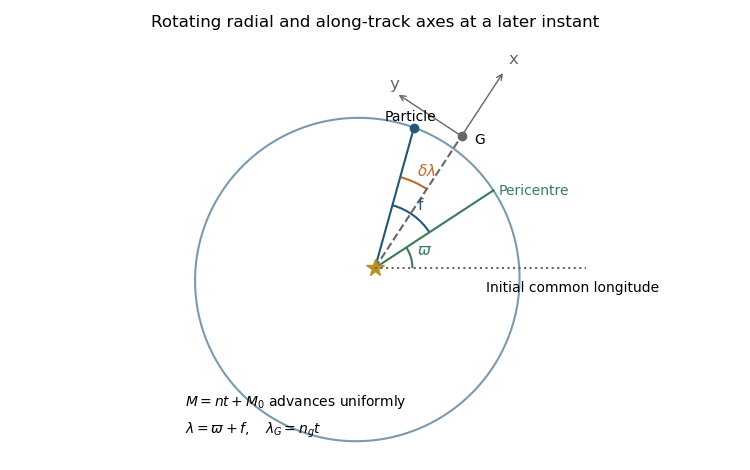
The diagram shows a later instant; initially , so . Retaining the correction in is what will preserve that initial condition in the approximate trajectory.
Past exam of the mathematics course of the University of Cambridge 2018 iii Paper 316 4 iii Solution by Codex 0 Created 2026-10-03 Updated 2026-10-05
Codex 0 Created 2026-10-03 Updated 2026-10-05Iterating Kepler's equation once gives . The exact radius expression then yieldsExpansion of the true anomaly conversion gives , soThe factor of two includes both the nonuniform relation between and and the change from center angle to focus angle .
Past exam of the mathematics course of the University of Cambridge 2018 iii Paper 316 4 ii Solution by Codex 0 Created 2026-10-03 Updated 2026-10-05
Codex 0 Created 2026-10-03 Updated 2026-10-05With the ellipse center as origin and its major axis horizontal, the auxiliary-circle construction gives particle coordinates , , while the stellar focus is at . ThereforeSquaring and adding gives . The Kepler orbit radius and the anomaly conversion are consequentlyEquivalently,The sine and cosine formulas, or a quadrant-aware angle function, fix the correct branch when using the half-angle relation.
Past exam of the mathematics course of the University of Cambridge 2018 iii Paper 316 4 i Solution by Codex 0 Created 2026-10-03 Updated 2026-10-14
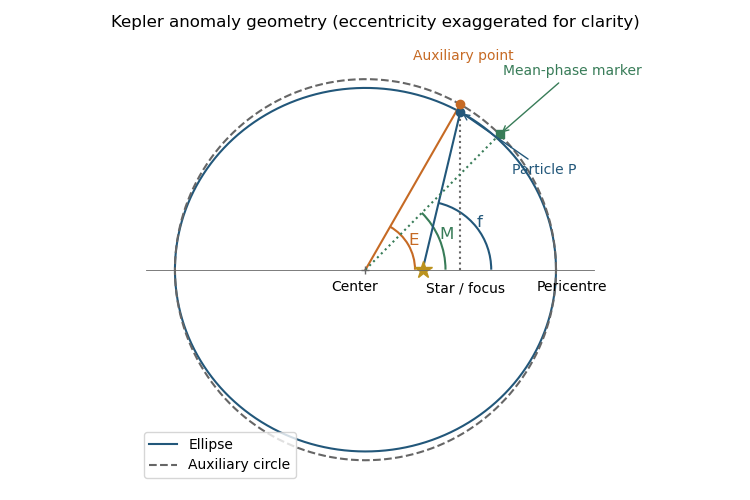
Codex 0 Created 2026-10-03 Updated 2026-10-14Measure angles from periapsis in the direction of motion. The true anomaly is the angle at the stellar focus between the pericentre ray and the star-particle radius vector. Draw the auxiliary circle of radius around the ellipse's center; the point on that circle with the same projected major-axis coordinate as the particle defines the eccentric anomaly at the center.
The mean anomaly is a uniformly advancing time phase, with at pericentre passage . It is the angle swept by a fictitious uniformly moving circular phase marker, not generally the actual position angle. The mean motion is the angular frequencyThe second formula is Kepler's equation, which converts the uniform time phase into geometric position.
Past exam of the mathematics course of the University of Cambridge 2018 iii Paper 316 3 viii Solution by Codex 0 Created 2026-10-03 Updated 2026-10-05
Codex 0 Created 2026-10-03 Updated 2026-10-05In the proper-eccentricity annulus, averaging over random proper phases cancels the proper vector in the first-order angular variation. The mean line density is proportional to , while the full ring width is independent of angle. Thus at corresponding radial locationsThere is a forced-apocentre enhancement in number surface density of a disk, together with the proper-excursion edge profile.
For a narrow aligned eccentric ring with locally constant , its width has the same first-order factor as its line density. Their ratio is constant: the constant-eccentricity aligned ring has no first-order surface-density contrast. It still contains more particles per unit longitude at apoapsis, spread across a wider area.
The more general surface density contrast in an eccentric ring depends on the eccentricity gradient. With a smooth number distribution per unit semi-major axis and aligned apsides,Hence decreasing can also make the aligned ring apocentre-dense; for it has the same first-order contrast as the proper-phase case. A positive gradient gives a pericentre enhancement. The problem leaves this profile unspecified, so there is no universal observational distinction based solely on the two apse densities.
Resolved ring width and a measured forced-eccentricity profile can distinguish the constant-width and similar-ellipse constructions. Interpreting observed brightness additionally requires the grain temperature, illumination, emissivity, and viewing geometry; brightness is not itself particle number density. Inferences from one contrast alone can therefore be degenerate.
Past exam of the mathematics course of the University of Cambridge 2018 iii Paper 316 3 vii Solution by Codex 0 Created 2026-10-03 Updated 2026-10-05
Codex 0 Created 2026-10-03 Updated 2026-10-05For a phase-mixed orbit, probability in a short arc is , so the line density on a Kepler orbit is inversely proportional to speed. At true anomaly ,Using the vis-viva equation, and hence . ThereforeFor one particle, the normalized line probability is . This is density per arc length; density per unit polar angle has a further factor and is proportional to .
Past exam of the mathematics course of the University of Cambridge 2018 iii Paper 316 3 vi Solution by Codex 0 Created 2026-10-03 Updated 2026-10-05
Codex 0 Created 2026-10-03 Updated 2026-10-05If the proper eccentricity is negligible and the semi-major axis ranges over , particles lie on nearly aligned forced Kepler orbits. For a locally constant forced vector, these are geometrically similar ellipses, represented to first order by circles of radius centered at .
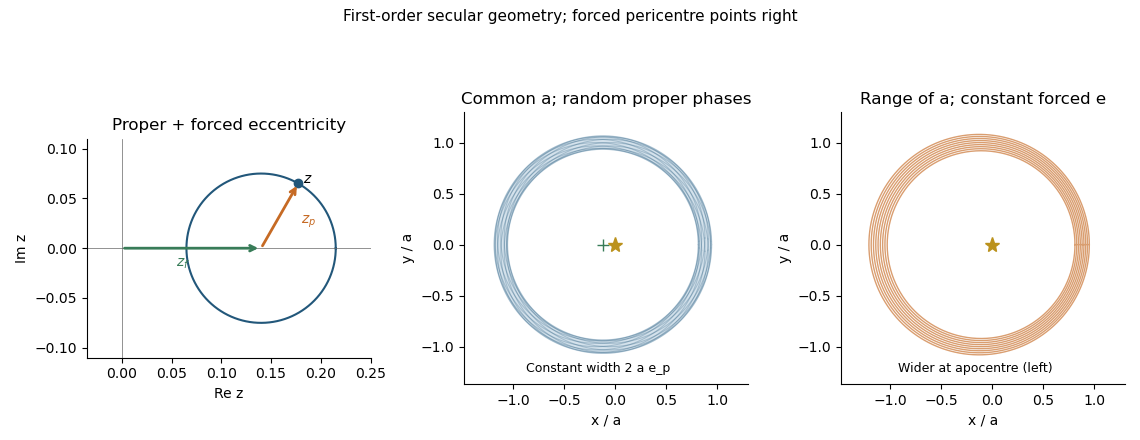
The boundaries of the aligned eccentric ring are thereforeIt is narrower at forced periapsis and wider at forced apoapsis, unlike the constant-width proper-eccentricity annulus. Its centers shift slightly between the two edges, as shown in the right panel of the figure. The condition makes the proper radial excursion negligible compared with the variation in forced center location.
Past exam of the mathematics course of the University of Cambridge 2018 iii Paper 316 3 v Solution by Codex 0 Created 2026-10-03 Updated 2026-10-05
Codex 0 Created 2026-10-03 Updated 2026-10-05To first order in orbital eccentricity, the semi-minor axis is , while the ellipse's center is displaced from the star by . Thus each orbit is a circle of radius about , in complex spatial coordinates.
Write at one secular epoch. The centers of the individual circles lie on a circle of radius about . Their union is the proper-eccentricity annulusIts full radial width is and its center is displaced by toward the forced apoapsis direction. Relative to the star, if the forced longitude of periapsis is zero,The middle panel of the preceding figure shows this construction. For fully sampled orbital phases and proper phases, the annulus is occupied throughout, but its density need not be uniform; turning points in the proper radial excursion give integrable edge enhancements. The construction requires and is an instantaneous secular geometry.
Past exam of the mathematics course of the University of Cambridge 2018 iii Paper 316 3 iv Solution by Codex 0 Created 2026-10-03 Updated 2026-10-05
Codex 0 Created 2026-10-03 Updated 2026-10-05For one isolated perturbing planet, its Kepler orbit has fixed longitude of periapsis, so is constant and its secular forcing frequency is zero. A constant forced eccentricity satisfies . Since ,This assumes . If an external process made the planet precess at frequency , the particular solution would instead be ; the stated formula relies on the isolated single-planet case.
Past exam of the mathematics course of the University of Cambridge 2018 iii Paper 316 3 iii Solution by Codex 0 Created 2026-10-03 Updated 2026-10-14
Codex 0 Created 2026-10-03 Updated 2026-10-14Put . For , the solution of the linear secular forcing of a test particle equation isThe initial condition gives and . The proper eccentricity is the constant amplitude of the homogeneous response; its proper longitude of periapsis is . The forced eccentricity is the driven vector , not necessarily a constant magnitude.
On an Argand diagram, describes a circle of radius . Its center can itself move under the planetary modes, so need not trace one fixed circle in the inertial complex plane. At a secular resonance , that mode instead produces , and the undamped linear response grows until the approximation fails.
Past exam of the mathematics course of the University of Cambridge 2018 iii Paper 316 3 ii Solution by Codex 0 Created 2026-10-03 Updated 2026-10-05
Codex 0 Created 2026-10-03 Updated 2026-10-05The planetary expansion is a decomposition into secular eigenmodes of conservative linear Laplace-Lagrange secular theory. It assumes small orbital eccentricities, coplanarity, approximately constant semi-major axis values, and averaging over fast orbital phases away from important mean-motion resonances and close encounters. Dissipation, migration, and nonlinear secular effects are absent from this constant-coefficient representation.
The are real eigenfrequencies of the Laplace-Lagrange secular matrix, describing apsidal precession. For mode , the signed real coefficients give its amplitude in planet ; their relative magnitudes are fixed by an eigenvector, and their signs distinguish aligned and anti-aligned apsides. The common phase specifies that mode's orientation at the chosen time origin. A planet's actual orbital eccentricity is , which generally varies through interference of modes; it is not a sum of the positive mode amplitudes.
Past exam of the mathematics course of the University of Cambridge 2018 iii Paper 316 3 i Solution by Codex 0 Created 2026-10-03 Updated 2026-10-05
Codex 0 Created 2026-10-03 Updated 2026-10-05Differentiating the disturbing function in Lagrange planetary equations givesFor the complex eccentricity ,Use . Each planetary term becomes , soUnlike the polar orbital element equations, this linear equation is nonsingular at .
Past exam of the mathematics course of the University of Cambridge 2018 iii Paper 316 2 vii Solution by Codex 0 Created 2026-10-03 Updated 2026-10-05
Codex 0 Created 2026-10-03 Updated 2026-10-05For the bound release orbits, use andThe inspiral time under Poynting–Robertson drag is thenThe limiting branches areThus the formal bound-grain curve, shown in the right panel of the preceding figure, diverges at both ends and has a minimum at an intermediate . At there is no Poynting–Robertson drag and the circular grain survives indefinitely in this collision-free model.
Initially unbound grains do not have a bound-orbit inspiral lifetime. For the release calculation gives outward trajectories; their residence time in a specified finite observation region is a dynamical escape time, not the averaged above. A numerical escape lifetime cannot be assigned without specifying the outer boundary. Extremely close to , energy lost on the first passage can alter even this bound/unbound classification: orbital averaging requires roughly . Accordingly the divergence is a formal limit of the supplied secular equations, not an exact prediction for marginal grains.
Past exam of the mathematics course of the University of Cambridge 2018 iii Paper 316 2 vi Solution by Codex 0 Created 2026-10-03 Updated 2026-10-14
Codex 0 Created 2026-10-03 Updated 2026-10-14Assume negligible fragment release speed relative to a circular parent planetesimal. Its initial speed is , but radiation pressure reduces the grain's gravitational parameter to . Its specific orbital energy and specific angular momentum areFor , the resulting dust orbit released from a circular parent ring hasRelease is at periapsis: the inherited tangential speed exceeds the new circular speed. Low- grains remain near the dust birth ring; higher bound gives increasingly eccentric orbits extending well outside it. Uniform release longitude produces an approximately axisymmetric dust halo, with long residence times near apoapsis. At the conservative release orbit is parabolic; above this radiation-pressure blowout threshold it is initially unbound. For , zero or repulsive effective gravity also prevents a bound ellipse.
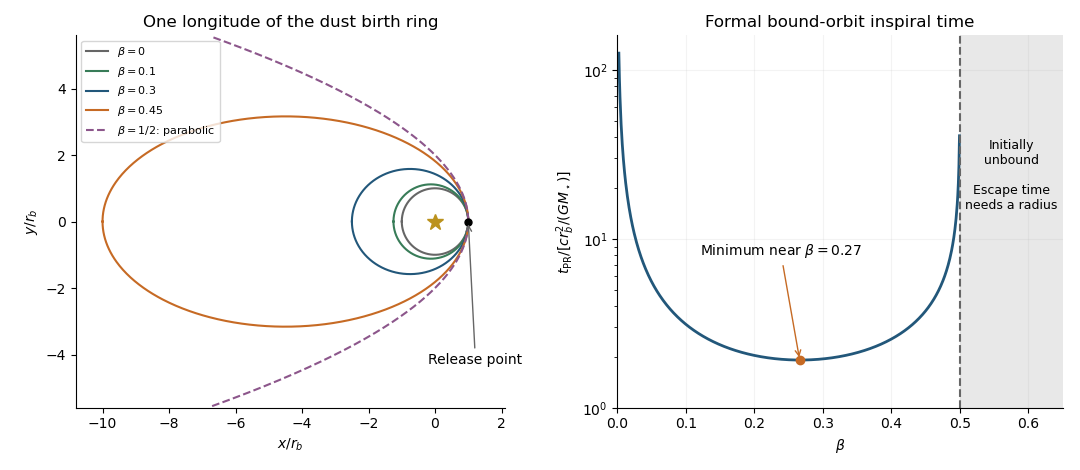
Dust release orbits and inspiral time under Poynting–Robertson drag
. Left: representative orbits released at one point on the birth ring, including the parabolic release limit. Right: the formal averaged lifetime of bound grains as a function of the radiation-pressure coefficient. Details.The left panel shows one release longitude; rotating it around the ring fills the halo. At longer times Poynting–Robertson drag also carries bound grains inward, so an initially outward-spanning release distribution does not imply an empty inner region in a continuously supplied, collision-free population.
Past exam of the mathematics course of the University of Cambridge 2018 iii Paper 316 2 v Solution by Codex 0 Created 2026-10-03 Updated 2026-10-05
Codex 0 Created 2026-10-03 Updated 2026-10-05Eliminate using the Poynting–Robertson drag invariant, . The eccentricity rate becomesSince the point-star limit corresponds to and , the inspiral time under Poynting–Robertson drag isFor , the integral is , recovering despite the apparent singularity of .
Pinned article: Introduction to the OurBigBook Project
Welcome to the OurBigBook Project! Our goal is to create the perfect publishing platform for STEM subjects, and get university-level students to write the best free STEM tutorials ever.
Everyone is welcome to create an account and play with the site: ourbigbook.com/go/register. We belive that students themselves can write amazing tutorials, but teachers are welcome too. You can write about anything you want, it doesn't have to be STEM or even educational. Silly test content is very welcome and you won't be penalized in any way. Just keep it legal!
Intro to OurBigBook
. Source. We have two killer features:
- topics: topics group articles by different users with the same title, e.g. here is the topic for the "Fundamental Theorem of Calculus" ourbigbook.com/go/topic/fundamental-theorem-of-calculusArticles of different users are sorted by upvote within each article page. This feature is a bit like:
- a Wikipedia where each user can have their own version of each article
- a Q&A website like Stack Overflow, where multiple people can give their views on a given topic, and the best ones are sorted by upvote. Except you don't need to wait for someone to ask first, and any topic goes, no matter how narrow or broad
This feature makes it possible for readers to find better explanations of any topic created by other writers. And it allows writers to create an explanation in a place that readers might actually find it.
Figure 1. Screenshot of the "Derivative" topic page. View it live at: ourbigbook.com/go/topic/derivativeVideo 2. OurBigBook Web topics demo. Source. - local editing: you can store all your personal knowledge base content locally in a plaintext markup format that can be edited locally and published either:This way you can be sure that even if OurBigBook.com were to go down one day (which we have no plans to do as it is quite cheap to host!), your content will still be perfectly readable as a static site.
- to OurBigBook.com to get awesome multi-user features like topics and likes
- as HTML files to a static website, which you can host yourself for free on many external providers like GitHub Pages, and remain in full control

Figure 2. You can publish local OurBigBook lightweight markup files to either OurBigBook.com or as a static website.
Figure 3. Visual Studio Code extension installation.
Figure 5. . You can also edit articles on the Web editor without installing anything locally. Video 3. Edit locally and publish demo. Source. This shows editing OurBigBook Markup and publishing it using the Visual Studio Code extension. 
- Infinitely deep tables of contents:




All our software is open source and hosted at: github.com/ourbigbook/ourbigbook
Further documentation can be found at: docs.ourbigbook.com
Feel free to reach our to us for any help or suggestions: docs.ourbigbook.com/#contact