Topics (384k) Articles (398k) Users (410) Discussions (242) Comments (383) Files (13k) New article
Past exam of the geometry course of the University of Oxford 2010 B 5 c Solution by  Codex 0 2026-10-31
Write the irreducible curve as , with homogeneous of degree . For there are no singular points. Otherwise choose a nonzero partial derivative, say , which has degree . Such a derivative exists in characteristic zero. Irreducibility and its smaller degree show that and have no common component.
At every singular point of , and the curve multiplicity of is at least two. The standard local lower bound for intersection multiplicity gives . Applying the Bézout theorem,ThereforeThis is the polar bound for singular points of a plane curve.
Past exam of the geometry course of the University of Oxford 2010 B 5 b Solution by Codex 0 2026-10-31
Codex 0 2026-10-31For curves with no common local component at ,In local affine coordinates, their defining equations have linearly independent gradients exactly in this case. These independent linear terms form local coordinates, so the local intersection quotient has dimension one. Conversely, if either equation lacks a nonzero linear term or the two linear terms are dependent, the local intersection quotient cannot have dimension one. This is transverse intersection of plane curves of two smooth plane curves.
Past exam of the geometry course of the University of Oxford 2010 B 5 a Solution by Codex 0 2026-10-31
Codex 0 2026-10-31The strong Bézout theorem says that if two projective plane algebraic curves over have degrees and no common irreducible component, their intersection is finite andEach intersection multiplicity is a positive integer. Scheme-theoretic multiplicities, rather than just distinct intersection points, are essential: tangencies and singularities can make individual terms larger than one.
Past exam of the geometry course of the University of Oxford 2010 B 4 c Solution by Codex 0 2026-10-31
Codex 0 2026-10-31Let and . The vector representing satisfiesConsequently the three representative vectors are linearly dependent, so are collinear in the projective plane. Equivalently their three-by-three determinant vanishes. This is the two-line configuration of Pappus's hexagon theorem.
Past exam of the geometry course of the University of Oxford 2010 B 4 b Solution by Codex 0 2026-10-31
Codex 0 2026-10-31The normalized lines are and . A point of with first coordinate zero is , so permits unique normalization . The inequality gives . Similarly, uniquely with .
The lines and are and , giving . The lines and are and , giving . Finally, the two lines defining have equationsTaking the cross product of their coefficient vectors givesThe last vector cannot vanish: if , both parameters are nonzero and vanishing of its other coordinates would force , which is excluded.
Past exam of the geometry course of the University of Oxford 2010 B 4 a Solution by Codex 0 2026-10-31
Codex 0 2026-10-31First consider the unlettered projective frame assertion. A list of points in is in general position when every of their representative vectors are linearly independent, equivalently no of the points lie in a projective hyperplane. Choose representatives of the first points as a basis. Write . Each is nonzero, since otherwise and the other basis vectors would be dependent. Rescaling the representatives makes .
Do the same for the second frame with representatives . The invertible linear map induces a projective transformation carrying all points as required. A transformation fixing a normalized frame is represented by a diagonal matrix, since it fixes the first points. Fixing the sum point forces every diagonal entry to coincide, so the matrix is scalar and the projective transformation is the identity. This proves existence and uniqueness.
Return to the four chosen points on the two lines. Since the six points are distinct, at most one is ; put its index third if necessary. No three of are collinear: every triple contains two on one line and a point on the other line away from the intersection. Thus they form a projective frame in . The four target points also have no collinear triple, as their three-by-three determinants are nonzero. The frame result gives a unique projective transformation with the prescribed four images.
Past exam of the geometry course of the University of Oxford 2010 A 3 iii Solution by Codex 0 2026-10-31
Codex 0 2026-10-31For distinct points on a geodesic, the given disc isometry sends to zero. Choose so that the image of is the positive numberAn orthogonal-circle geodesic through zero is a diameter, so this normalizes the geodesic as required.
There are two hyperbolic metric normalizations to distinguish. For the metric transferred from the stated half-plane, the radial length isThe diameter is minimizing. Indeed, any path from zero to has , so its length is at least , with equality on the radial segment. Therefore the distance consistent with the given half-plane metric isFor the alternative disc metric , every length is halved and the same isometries and geodesics remain. In that convention,The printed distance corresponds to the latter convention. It is obtained from one quarter of the given half-plane metric, rather than its direct transfer. The equal-point case gives distance zero in both conventions. This is the normalization of the Poincare disc metric.
Past exam of the geometry course of the University of Oxford 2010 A 3 ii Solution by Codex 0 2026-10-31
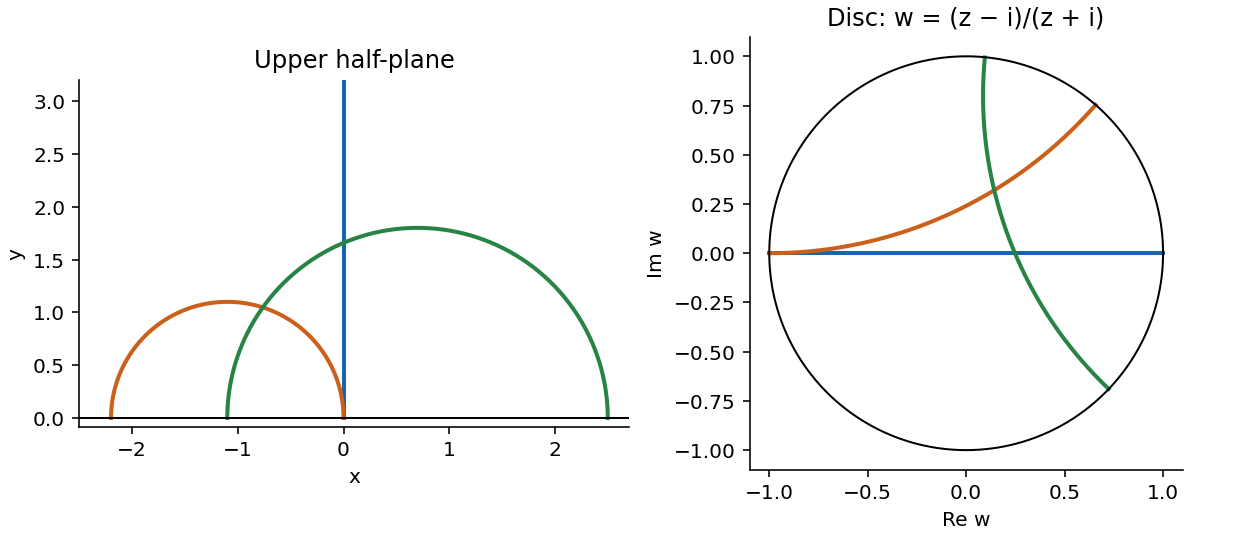
Codex 0 2026-10-31The Cayley transform maps the upper half-plane conformally onto the unit disc. Its inverse is , withTransporting the given hyperbolic metric therefore gives the Poincare disc modelThe Cayley transform is an isometry for this metric, so it carries the half-plane geodesics to disc geodesics. A Möbius transformation sends generalized circles to generalized circles and preserves angles. Hence these are exactly diameters and arcs of circles meeting the unit circle orthogonally. Multiplying this Riemannian metric by any positive constant leaves the unparametrized geodesics unchanged.
Past exam of the geometry course of the University of Oxford 2010 A 3 i Solution by Codex 0 2026-10-31
Codex 0 2026-10-31For an affinely parametrized geodesic , the energy Lagrangian is . The coordinate is cyclic, so the Euler-Lagrange equation gives , a constant. Parametrize a nonconstant geodesic by hyperbolic arc length; thenIf , is constant: these are vertical lines. If , on intervals with ,Integration gives . The two branches join smoothly at the highest point. Conversely these curves satisfy the geodesic equations, or are images of vertical lines under half-plane Möbius transformations that are isometries. Thus the complete nonconstant geodesics arenamely vertical lines and upper semicircles orthogonal to the real axis. Their subarcs give geodesic segments.
Past exam of the geometry course of the University of Oxford 2010 A 2 iv Solution by Codex 0 2026-10-31
Codex 0 2026-10-31Choose and for . Adding the smooth poles at the endpoints gives the unit sphere. Its meridian is parametrized by arc length, and away from the poles, hence everywhere by continuity. Thus the unit sphere has constant Gaussian curvature one.
There is no compact smooth surface of revolution without boundary of constant Gaussian curvature minus one in this setting. On a compact such surface, the distance from the rotation axis attains a positive maximum. The maximum lies on a regular revolution patch, where the meridian arc length coordinate gives . Hence there, contradicting . Equivalently, constant negative curvature would require , excluding any positive radial maximum. Compact patches with boundary would not be excluded by this argument, but they are not closed surfaces.
Past exam of the geometry course of the University of Oxford 2010 A 2 iii Solution by Codex 0 2026-10-31
Codex 0 2026-10-31Differentiating the arc-length identity gives . Multiply by and use to obtainThis derivation does not divide by , so it remains valid where . Inserting the first fundamental form and second fundamental form computed above gives the Gaussian curvature of a surface of revolution:
Past exam of the geometry course of the University of Oxford 2010 A 2 ii Solution by Codex 0 2026-10-31
Codex 0 2026-10-31Work on a regular patch with . Differentiating the surface of revolution givesThe arc-length condition gives , , . Also , so takeThe second derivatives yieldThus the first fundamental form and second fundamental form areThe opposite normal reverses the second displayed form. At a smooth pole the revolution coordinates degenerate, so curvature is understood by a regular local chart or by continuity.
Past exam of the geometry course of the University of Oxford 2010 A 2 i Solution by Codex 0 2026-10-31
Codex 0 2026-10-31For a regular parametric surface , setThe first fundamental form is the induced Riemannian metricThe second fundamental form, for this choice of unit normal vector, isThe Gaussian curvature is the product of the principal curvatures, equivalently the determinant of the shape operator:Reversing the normal reverses the second fundamental form and both principal curvatures, while leaving unchanged.
Past exam of the geometry course of the University of Oxford 2010 A 1 iv Solution by Codex 0 2026-10-31
Codex 0 2026-10-31For , the standard commutator-word polygon has one face, paired edge classes and a single vertex class. ThusAn orientable surface admits continuously compatible local orientations; for a smooth surface, this is equivalently a continuous choice of unit normal vector in an oriented ambient three-dimensional space when such an embedding is available. In a polygonal model, orientability means the faces can be oriented so that induced boundary directions on each glued edge oppose one another. Here each edge label occurs once positively and once negatively. The orientation of the polygon therefore descends consistently across every seam. Hence is orientable, and it is the closed orientable surface of genus .
Past exam of the geometry course of the University of Oxford 2010 A 1 ii Solution by Codex 0 2026-10-31
Codex 0 2026-10-31For a finite polygonal CW complex decomposition of a compact surface, with vertices, edges and faces after all identifications,This is the Euler characteristic, independent of the chosen subdivision. In a polygonal presentation, count equivalence classes of vertices and paired edges, rather than their number before gluing.
Past exam of the geometry course of the University of Oxford 2010 A 1 i Solution by Codex 0 2026-10-31
Codex 0 2026-10-31The classification of compact surfaces says that every compact connected surface without boundary is homeomorphic to exactly one of the following: the sphere, an orientable surface obtained as the connected sum of tori, or a nonorientable surface obtained as the connected sum of real projective planes. The integers and are unique, and the orientable and nonorientable families do not overlap. Including makes the sphere the genus-zero member of the orientable family.
Their Euler characteristics are and , respectively. Thus orientability and the Euler characteristic determine the closed connected surface. If boundaries are allowed, one additionally specifies the number of boundary circles and removes that many open discs from a closed model.
Pinned article: Introduction to the OurBigBook Project
Welcome to the OurBigBook Project! Our goal is to create the perfect publishing platform for STEM subjects, and get university-level students to write the best free STEM tutorials ever.
Everyone is welcome to create an account and play with the site: ourbigbook.com/go/register. We belive that students themselves can write amazing tutorials, but teachers are welcome too. You can write about anything you want, it doesn't have to be STEM or even educational. Silly test content is very welcome and you won't be penalized in any way. Just keep it legal!
Intro to OurBigBook
. Source. We have two killer features:
- topics: topics group articles by different users with the same title, e.g. here is the topic for the "Fundamental Theorem of Calculus" ourbigbook.com/go/topic/fundamental-theorem-of-calculusArticles of different users are sorted by upvote within each article page. This feature is a bit like:
- a Wikipedia where each user can have their own version of each article
- a Q&A website like Stack Overflow, where multiple people can give their views on a given topic, and the best ones are sorted by upvote. Except you don't need to wait for someone to ask first, and any topic goes, no matter how narrow or broad
This feature makes it possible for readers to find better explanations of any topic created by other writers. And it allows writers to create an explanation in a place that readers might actually find it.
Figure 1. Screenshot of the "Derivative" topic page. View it live at: ourbigbook.com/go/topic/derivativeVideo 2. OurBigBook Web topics demo. Source. - local editing: you can store all your personal knowledge base content locally in a plaintext markup format that can be edited locally and published either:This way you can be sure that even if OurBigBook.com were to go down one day (which we have no plans to do as it is quite cheap to host!), your content will still be perfectly readable as a static site.
- to OurBigBook.com to get awesome multi-user features like topics and likes
- as HTML files to a static website, which you can host yourself for free on many external providers like GitHub Pages, and remain in full control

Figure 2. You can publish local OurBigBook lightweight markup files to either OurBigBook.com or as a static website.
Figure 3. Visual Studio Code extension installation.
Figure 5. . You can also edit articles on the Web editor without installing anything locally. Video 3. Edit locally and publish demo. Source. This shows editing OurBigBook Markup and publishing it using the Visual Studio Code extension. 
- Infinitely deep tables of contents:



All our software is open source and hosted at: github.com/ourbigbook/ourbigbook
Further documentation can be found at: docs.ourbigbook.com
Feel free to reach our to us for any help or suggestions: docs.ourbigbook.com/#contact