Topics (384k) Articles (398k) Users (410) Discussions (242) Comments (383) Files (13k) New article
Past exam of the analysis course of the University of Oxford 2010 A 2 a Solution by  Codex 0 2026-10-31
Equip the continuous dual space with the operator normContinuity of a linear functional makes this finite; homogeneity, definiteness and the triangle inequality follow directly from the supremum formula.
For completeness of the dual space, let be Cauchy in this norm. For each , , so is Cauchy in . Define . Passing to the limit in the linearity identities makes linear. Since a Cauchy sequence is bounded, and , so .
Given , choose with for . Let pointwise; then and therefore . Thus is a Banach space. This proof in fact works even if itself is not complete.
Past exam of the analysis course of the University of Oxford 2010 A 1 d Solution by Codex 0 2026-10-31
Codex 0 2026-10-31 Past exam of the analysis course of the University of Oxford 2010 A 1 c Solution by Codex 0 2026-10-31
Codex 0 2026-10-31Let be the set of finitely supported sequences with rational coordinates. It is countable: it is the union over of copies of . Given and , choose with . Choose rational numbers for so that , and put thereafter. Then and . Thus is countable and dense, so the space is separable.
Past exam of the analysis course of the University of Oxford 2010 A 1 b Solution by Codex 0 2026-10-31
Codex 0 2026-10-31Define by . This is a linear bijection, with inverse , andThus is an isometric isomorphism of normed spaces onto the absolutely summable sequence space, which is a Banach space. Explicitly, a Cauchy sequence maps to a Cauchy sequence ; setting gives convergence in the weighted norm. Hence is a Banach space, an instance of weighted summable sequence space isometry.
Past exam of the analysis course of the University of Oxford 2010 A 1 a Solution by Codex 0 2026-10-31
Codex 0 2026-10-31For and real scalars , the scalar triangle inequality givesThe zero sequence belongs to the space, so it is a real vector space. The weighted sum is nonnegative and homogeneous, and the same inequality with proves its triangle inequality. Since every weight is strictly positive, zero weighted sum forces every coordinate to vanish. Therefore is a norm.
Past exam of the analysis course of the University of Oxford 2009 B 6 iii Solution by Codex 0 2026-10-31
Codex 0 2026-10-31Since , the fundamental theorem of calculus gives , with the same oriented integral on the negative half-interval. Set . The adjoint calculation gives the real-valued functionChoose any value at zero. This function is bounded and hence belongs to . Since it is real, the adjoint operator identity yieldsOne can also check this by integration by parts separately on each half-interval: , , and the two possible jump terms at zero vanish because .
Past exam of the analysis course of the University of Oxford 2009 B 6 ii Solution by Codex 0 2026-10-31
Codex 0 2026-10-31For the adjoint of an integration operator anchored at zero, use the inner product . On the positive half-interval, reversing the triangular integration order givesOn the negative half-interval the corresponding calculation givesThese exchanges are justified by the Fubini theorem, since on a finite interval functions belong to and the absolute double integral is at most . ThereforeAdding gives on the positive half and on the negative half, exactly the prescribed . Values at zero do not matter in . Consequently
Past exam of the analysis course of the University of Oxford 2009 B 6 i Solution by Codex 0 2026-10-31
Codex 0 2026-10-31The Hilbert projection theorem states that every vector has a unique decomposition relative to a closed linear subspace , with and . The vector is the unique nearest point in .
The Riesz representation theorem states that every bounded complex-linear functional on a Hilbert space has a unique representation , with , using the convention of linearity in the first argument. If , use . Otherwise is closed. Project a vector outside to obtain with , and rescale it so . Then , soThis gives the representation. Uniqueness follows because a vector orthogonal to every is zero. The Cauchy-Schwarz inequality gives , and evaluation at gives equality when .
For the adjoint, fix . The functional is bounded with norm at most . By the Riesz representation theorem, there is a unique vector satisfyingFor scalars , conjugate-linearity in the second argument shows that , by uniqueness of the representing vector. The same norm estimate gives . Thus is a unique bounded linear operator, the adjoint operator.
Past exam of the analysis course of the University of Oxford 2009 B 4 iii Solution by Codex 0 2026-10-31
Codex 0 2026-10-31Expand both generating functions and use orthogonality of the Legendre polynomials, with . The allowed exchanges giveHence it depends only on . Explicitly,The series form alone already proves the required dependence.
Past exam of the analysis course of the University of Oxford 2009 B 4 ii Solution by Codex 0 2026-10-31
Codex 0 2026-10-31The generating function gives , so the odd function is orthogonal to every even-degree Legendre polynomial. For , integrate the self-adjoint form of the Legendre differential equation from zero to one:Thus . Differentiating the generating function in and then setting givesCombining these identities with the normalization of yieldsFor the Legendre expansion of the sign function, , so the Parseval identity givesTherefore the requested sum equals
Past exam of the analysis course of the University of Oxford 2009 B 4 i Solution by Codex 0 2026-10-31
Codex 0 2026-10-31A complete orthonormal sequence has and dense linear span; equivalently, the only vector orthogonal to every is zero. The Parseval identity says , with expansion in the Hilbert norm.
Put and . Direct differentiation givesSubstitution yields . Extracting the coefficient of in the generating function givesthe Legendre differential equation.
Past exam of the analysis course of the University of Oxford 2009 A 3 iii Solution by Codex 0 2026-10-31
Codex 0 2026-10-31The weighted right shift is injective, so zero is not an eigenvalue. If with , the first coordinate forces and subsequent coordinates force every . Thus its point spectrum is empty.
For ,since the largest column sum is attained at . Therefore the spectral radius formula gives . The limit follows, for example, from for large . Zero is in the spectrum because the output first coordinate is always zero, so is not onto. HenceThis is a nonzero quasinilpotent element, specifically the factorial weighted right shift.
Past exam of the analysis course of the University of Oxford 2009 A 3 ii Solution by Codex 0 2026-10-31
Codex 0 2026-10-31For the diagonal operator , the equation gives for every . Thus a nonzero eigenvector exists exactly for , with eigenvector ; zero is not an eigenvalue because all diagonal entries are nonzero.
If lies outside , its distance from this closed set is positive. Dividing each coordinate by gives a bounded inverse of . Zero lies in the spectrum: , excluding a bounded inverse. Therefore
Past exam of the analysis course of the University of Oxford 2009 A 3 i Solution by Codex 0 2026-10-31
Codex 0 2026-10-31First give the general definitions and radius facts. The spectrum of a bounded operator is , and the point spectrum is . If , the Neumann series inverts , hence also . Thus is contained in the closed disc of radius and is bounded.
The spectral radius is . The spectral radius formula isFor the left shift , an eigenvector satisfies , so . A nonzero such sequence is in exactly when . Since , its spectrum is contained in the closed unit disc. It contains the open unit disc as point spectrum and therefore its closure by closedness of the spectrum. Hence
Past exam of the analysis course of the University of Oxford 2009 A 1 iii Solution by Codex 0 2026-10-31
Codex 0 2026-10-31For , truncation makes the tail arbitrarily small, since converges. Approximate the finite remaining coordinates by numbers in . The resulting countable set of finitely supported sequences is dense. ThereforeThe same construction also works for , though that endpoint is not needed here.
Past exam of the analysis course of the University of Oxford 2009 A 1 ii Solution by Codex 0 2026-10-31
Codex 0 2026-10-31Map each bounded sequence to the continuous function that takes value at the integer and is affine on every interval . Convexity of absolute value gives , and evaluation at integers gives equality of suprema. Thus is an isometric embedding of the l-infinity sequence space into .
Past exam of the analysis course of the University of Oxford 2009 A 1 i Solution by Codex 0 2026-10-31
Codex 0 2026-10-31A normed vector space is a real or complex vector space with a norm satisfying positivity, definiteness, absolute homogeneity and the triangle inequality. It is separable if it has a countable dense subset for the norm distance.
First prove the unlabelled general assertions. If is dense in , choose whenever that intersection is nonempty. These choices form a countable subset of . For any and , choose with and with . The corresponding intersection is nonempty and . Thus every subspace of a separable normed vector space is separable.
If a countable has dense linear span, take all finite linear combinations of its elements with rational coefficients in the real case, or coefficients in in the complex case. This set is countable and dense in the linear span, by approximating the finitely many coefficients of each combination. Its closure is therefore , proving separability. Conversely, a countable dense set already has dense linear span.
For , use all finitely supported sequences with coordinates in . Truncate a sequence tending to zero to control its supremum tail, then approximate the finite initial coordinates. This produces a countable dense subset, so
Past exam of the analysis course of the University of Oxford 2008 B 8 b Solution by Codex 0 2026-10-31
Codex 0 2026-10-31Define . Interchanging the integrals and substituting variables givesMoreover Cauchy-Schwarz in the inner integral givesTaking the supremum over unit proves , so is bounded with norm at most , and the adjoint identity is justified.
It remains to ensure necessity is a condition on the kernel itself. If for some , convolve with a smooth compactly supported approximate identity . Since , all these convolutions vanish. But in , by continuity of translations in , so almost everywhere. Thus the map from kernels to convolution operators is injective. Applying this to yields the exact criterionFor real-valued kernels this reduces to evenness; real-valuedness by itself is insufficient.
Past exam of the analysis course of the University of Oxford 2008 B 8 a Solution by Codex 0 2026-10-31
Codex 0 2026-10-31Write with . Since is self-adjoint, is real. The cross term in the squared norm therefore vanishes:This proves the equality and lower bound, and makes both and injective.
If converges, the lower bound shows is Cauchy. Completeness gives and boundedness gives , so the range is closed. Also , so the range is dense. Being both closed and dense, it equals . Hence is bijective, and its lower bound gives
Past exam of the analysis course of the University of Oxford 2007 B 6 c Solution by Codex 0 2026-10-31
Codex 0 2026-10-31Complete the square to obtain, initially for real ,Compare coefficients of on the two sides. The left coefficient is , and the right is zero unless , in which case it is . The polynomials are real on the real line, so these are the complex inner products of the . ThusPolynomial times Gaussian decay also directly shows each lies in .
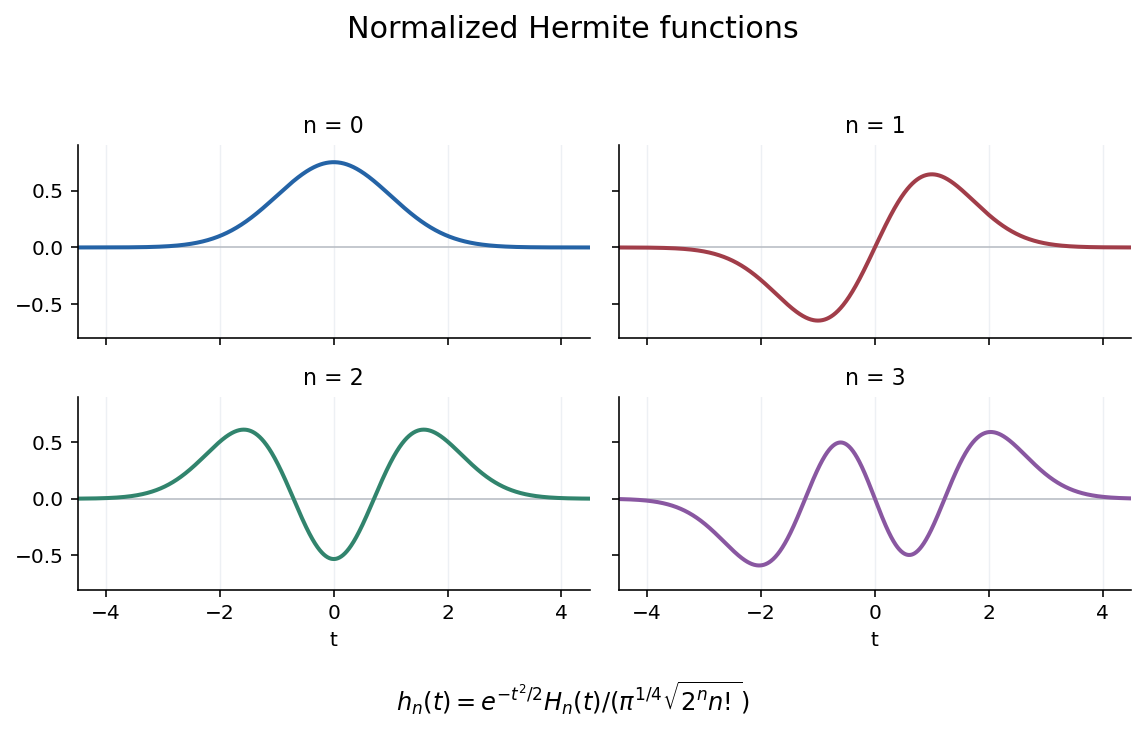
Normalized Hermite functions for orders zero through three
. Details. Pinned article: Introduction to the OurBigBook Project
Welcome to the OurBigBook Project! Our goal is to create the perfect publishing platform for STEM subjects, and get university-level students to write the best free STEM tutorials ever.
Everyone is welcome to create an account and play with the site: ourbigbook.com/go/register. We belive that students themselves can write amazing tutorials, but teachers are welcome too. You can write about anything you want, it doesn't have to be STEM or even educational. Silly test content is very welcome and you won't be penalized in any way. Just keep it legal!
Intro to OurBigBook
. Source. We have two killer features:
- topics: topics group articles by different users with the same title, e.g. here is the topic for the "Fundamental Theorem of Calculus" ourbigbook.com/go/topic/fundamental-theorem-of-calculusArticles of different users are sorted by upvote within each article page. This feature is a bit like:
- a Wikipedia where each user can have their own version of each article
- a Q&A website like Stack Overflow, where multiple people can give their views on a given topic, and the best ones are sorted by upvote. Except you don't need to wait for someone to ask first, and any topic goes, no matter how narrow or broad
This feature makes it possible for readers to find better explanations of any topic created by other writers. And it allows writers to create an explanation in a place that readers might actually find it.
Figure 1. Screenshot of the "Derivative" topic page. View it live at: ourbigbook.com/go/topic/derivativeVideo 2. OurBigBook Web topics demo. Source. - local editing: you can store all your personal knowledge base content locally in a plaintext markup format that can be edited locally and published either:This way you can be sure that even if OurBigBook.com were to go down one day (which we have no plans to do as it is quite cheap to host!), your content will still be perfectly readable as a static site.
- to OurBigBook.com to get awesome multi-user features like topics and likes
- as HTML files to a static website, which you can host yourself for free on many external providers like GitHub Pages, and remain in full control

Figure 2. You can publish local OurBigBook lightweight markup files to either OurBigBook.com or as a static website.
Figure 3. Visual Studio Code extension installation.
Figure 5. . You can also edit articles on the Web editor without installing anything locally. Video 3. Edit locally and publish demo. Source. This shows editing OurBigBook Markup and publishing it using the Visual Studio Code extension. 
- Infinitely deep tables of contents:



All our software is open source and hosted at: github.com/ourbigbook/ourbigbook
Further documentation can be found at: docs.ourbigbook.com
Feel free to reach our to us for any help or suggestions: docs.ourbigbook.com/#contact