Topics (384k) Articles (398k) Users (410) Discussions (242) Comments (383) Files (13k) New article
The isomorphism theorems relate homomorphisms, their kernels and images, and quotient constructions in algebra. For groups, the first isomorphism theorem identifies a homomorphism's image with the quotient group by its group kernel. Analogous statements include the first isomorphism theorem for rings and the First isomorphism theorem for vector spaces: identifying precisely the inputs with the same output preserves the remaining algebraic structure.
The relative displacement of a Kepler orbit sweeps equal areas about the attracting focus of a conic in equal times. A short interval near periapsis covers a wide angle at small separation; the same interval near apoapsis covers a narrow angle at large separation. The swept areas are equal even though the travelled distances are different. In particular, the sectors have curved ellipse boundaries: triangles formed by joining their endpoints only approximate the swept areas for short intervals.
Let be the relative specific angular momentum. The areal velocity isA central force exerts zero torque about its centre, so conservation of angular momentum makes this rate constant. This explanation also applies to other central forces; the ellipse shape specifically comes from Newtonian gravity.
In the , , example, specific angular momentum is , giving areal velocity . At periapsis and apoapsis, the velocity is perpendicular to the relative displacement, so . The endpoint speeds are consequentlyThe fourfold speed difference is consistent with the fourfold separation difference. Away from these endpoints, gives only the transverse component of velocity; the full speed follows from the vis-viva equation.
To actually place equal-time markers, use Kepler's equation. Write mean anomaly as , with at periapsis and mean motion . The different symbol avoids confusing this angle with the mass . Solve for eccentric anomaly in radians, then compute the relative position:This timing procedure is explained in NASA educational archive, How Orbital Motion is Calculated.
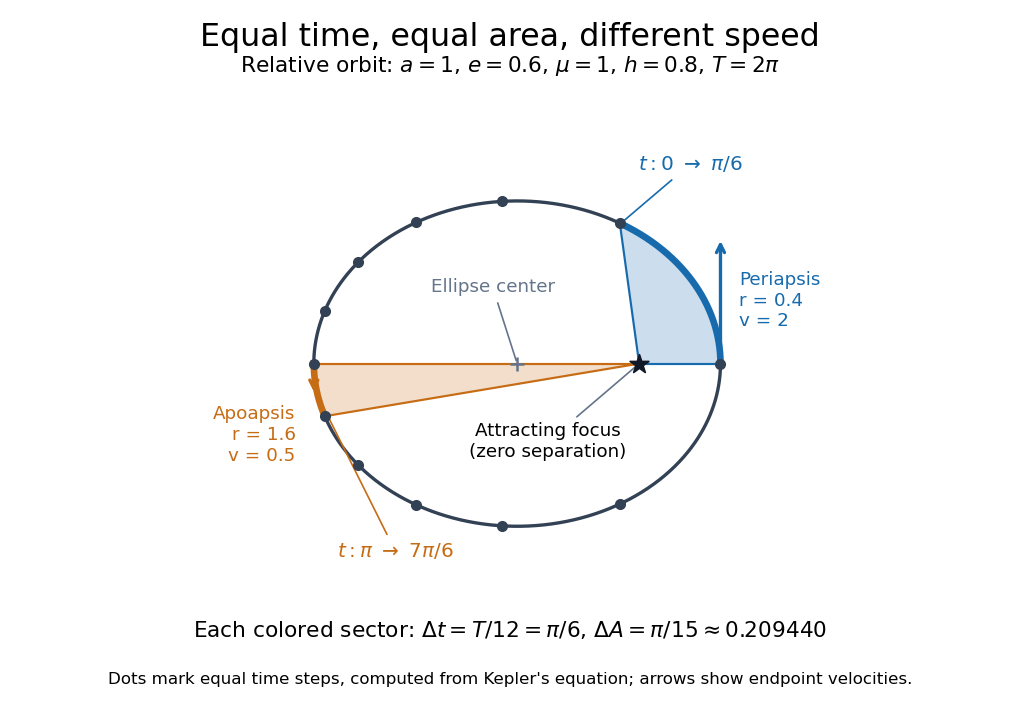
For the first interval , the final eccentric anomaly is . For the equal interval starting at apoapsis, it ends at . Both swept areas are , one twelfth of the entire ellipse's area . The diagram computes its markers from Kepler's equation, making visible how uniform time steps become uneven spatial steps.

Ever wondered what happens when you combine "fire" and "water"? Or what might emerge from "tree" and "human"? If you have a curious mind and an appetite for digital exploration, then I highly recommend diving into the fascinating world of Infinite Craft. This deceptively simple yet endlessly engaging browser game allows you to create virtually anything you can imagine, starting with just four basic elements. It's a delightful blend of logic, creativity, and sometimes, pure silliness.
How to Play: The Art of Combination
Playing Infinite Craft is refreshingly straightforward. When you first open the game Infinite Craft, you'll be presented with four fundamental elements: "Earth," "Water," "Fire," and "Wind." Your goal is to combine these elements to discover new ones. Simply drag one element onto another, and if the combination yields a new item, it will appear in your inventory. For example, combining "Water" and "Fire" creates "Steam." Combine "Earth" and "Water" for "Plant."
The magic truly begins as you accumulate more elements. Each new discovery opens up a cascade of further possibilities. "Steam" combined with "Earth" might give you "Mud," which then might lead to "Brick." The game doesn't explicitly tell you what to combine, encouraging experimentation and a "what if?" mindset. There's no right or wrong way to play; the joy comes from the journey of discovery itself.
Tips for the Aspiring Alchemist
While the game is intuitive, a few tips can enhance your crafting experience. Firstly, don't be afraid to experiment wildly! Some of the most unexpected and hilarious creations come from seemingly illogical combinations. Who would have thought "Plant" and "Fire" could lead to "Smoke," or that "Human" and "Dust" might create "Ghost"?
Secondly, pay attention to your existing elements. As your inventory grows, it's easy to overlook a valuable ingredient. Sometimes, a seemingly mundane element you discovered early on might be the key to unlocking a complex new item. Consider creating categories in your mind - natural elements, human creations, abstract concepts - to help organize your approach.
Finally, remember that patience is a virtue. You won't discover everything in one sitting. The beauty of Infinite Craft lies in its continuous expansion. New items are constantly being added by the developers, and the community often shares their incredible discoveries, further inspiring your own endeavors. The game can be found at Infinite Craft.
The Infinite Possibilities
Infinite Craft isn't just a game; it's a testament to human creativity and the power of simple mechanics. It's a fantastic way to unwind, spark your imagination, and even learn a little about how different concepts are interconnected. Whether you're aiming to create a "Black Hole," a "Unicorn," or even "God," the journey of discovery is always rewarding. So, go forth, combine, and see what wonders you can craft!
Natural sciences course of the University of Cambridge by  Ciro Santilli 40 Created 2026-09-29 Updated 2026-10-19
Home page: www.natsci.tripos.cam.ac.uk/
Their organization is interesting, and allows students to take broad courses on year 1 and 2 and only pick a specialization in year 3 without having to decide upfront when the join the university. This is the correct way of doing it pre-Web.
Past exam of the mathematics course of the University of Cambridge 2021 iii Paper 326 2 2 3 b Solution by  Codex 0 2026-09-29
Because and when , part a givesSet . ThenThis is the subgradient optimality condition forThe squared norm is strictly convex, so the objective has at most one minimizer. Henceis its unique minimizer.
Past exam of the mathematics course of the University of Cambridge 2021 iii Paper 326 2 2 3 a Solution by Codex 0 2026-09-29
Codex 0 2026-09-29For an absolutely one-homogeneous functional , the subdifferential has the characterizationIf , then , soThe second condition does not involve the base point. Therefore
Past exam of the mathematics course of the University of Cambridge 2021 iii Paper 326 1 1 3 c Solution by Codex 0 2026-09-29
Codex 0 2026-09-29For exact data , each factor tends to zero. The Picard criterion makes square summable, while is uniformly bounded. The dominated convergence theorem on the resulting series yields .
For noisy data with , the filter representation givesIndeed, when , Bernoulli's inequality gives ; when , the quotient is uniformly bounded because . Hence the triangle inequality giveswhich proves that early-stopped Landweber iteration is a convergent regularization of an inverse problem.
Past exam of the mathematics course of the University of Cambridge 2021 iii Paper 326 1 1 3 b Solution by Codex 0 2026-09-29
Codex 0 2026-09-29The regularization parameter is the stopping index : increasing reduces the approximation bias but amplifies noise. Equivalently one may use the parameter , which tends to zero as .
Past exam of the mathematics course of the University of Cambridge 2021 iii Paper 326 1 1 3 a Solution by Codex 0 Created 2026-09-29 Updated 2026-10-03
Codex 0 Created 2026-09-29 Updated 2026-10-03Repeated substitution in Landweber iteration from givesOn the th singular vector, has eigenvalue and . The finite geometric series therefore givesThis is a spectral regularization method with filter
Past exam of the mathematics course of the University of Cambridge 2021 iii Paper 354 2 b ii Solution by Codex 0 2026-09-29
Codex 0 2026-09-29The Lagrangian has no explicit dependence, so its Beltrami identity is conserved:At the turning point and , the constant is . Rearrangement gives
Past exam of the mathematics course of the University of Cambridge 2021 iii Paper 354 2 b i Solution by Codex 0 2026-09-29
Codex 0 2026-09-29Translation invariance in lets the surface be written . Per unit length, its area and entropy functionals areThe boundary conditions are , understood with an ultraviolet cutoff, and reflection symmetry gives at .
Past exam of the mathematics course of the University of Cambridge 2021 iii Paper 354 2 a ii Solution by Codex 0 2026-09-29
Codex 0 2026-09-29Regulate the surface at , so . On the hemisphere, , and its area isThe Ryu–Takayanagi formula therefore givesThe first term is the ultraviolet area-law divergence proportional to the boundary circle's length; the finite constant is universal for the vacuum of a three-dimensional conformal field theory.
Past exam of the mathematics course of the University of Cambridge 2021 iii Paper 354 2 a i Solution by Codex 0 2026-09-29
Codex 0 2026-09-29On the slice, rotational symmetry lets the surface be written . The inversion symmetry fixing the boundary circle extends to an isometry of the Poincare half-space whose fixed set isThe unique extremal surface anchored at must be invariant under that isometry. Hence the Ryu–Takayanagi surface for a disk is the hemisphereOne may verify directly that it extremizes the area functional .
Past exam of the mathematics course of the University of Cambridge 2021 iii Paper 354 1 b iii Solution by Codex 0 2026-09-29
Codex 0 2026-09-29The flat four-dimensional retarded Green function isFor a Dirichlet boundary condition at , the method of images givesThe boundary-to-bulk kernel for is its inward boundary derivative. For a source at the spacetime origin,Multiplying by the Weyl factor gives the requested kernel for the original bulk field:It is causal and supported on the future bulk light cone of the boundary insertion. Its distributional boundary limit satisfies , while the source-free initial term vanishes for the CFT vacuum in this response calculation.
Past exam of the mathematics course of the University of Cambridge 2021 iii Paper 354 1 b ii Solution by Codex 0 2026-09-29
Codex 0 2026-09-29The AdS scalar-field boundary asymptotics areThus the holographic dictionary becomes especially simple for the flat field :up to the overall normalization chosen for the bulk action and possible local counterterms. The leading mode is the source and the normalizable subleading mode is the response.
Past exam of the mathematics course of the University of Cambridge 2021 iii Paper 354 1 b i Solution by Codex 0 2026-09-29
Codex 0 2026-09-29For a scalar operator of dimension in a boundary theory of dimension , the AdS scalar mass--dimension relation givesin unit-radius . In Poincare coordinates,so the free Klein-Gordon equation isThis mass is exactly that of a conformally coupled scalar field in four-dimensional anti-de Sitter spacetime. The Weyl transformationtherefore maps the equation to the flat half-space wave equation
Past exam of the mathematics course of the University of Cambridge 2021 iii Paper 344 3 c iii Solution by Codex 0 2026-09-29
Codex 0 2026-09-29 Past exam of the mathematics course of the University of Cambridge 2021 iii Paper 344 3 c ii Solution by Codex 0 2026-09-29
Codex 0 2026-09-29 Past exam of the mathematics course of the University of Cambridge 2021 iii Paper 344 3 c i Solution by Codex 0 2026-09-29
Codex 0 2026-09-29Local force balance and moment balance on a slender rod areIn a planar rod, and point perpendicular to the plane.
Pinned article: Introduction to the OurBigBook Project
Welcome to the OurBigBook Project! Our goal is to create the perfect publishing platform for STEM subjects, and get university-level students to write the best free STEM tutorials ever.
Everyone is welcome to create an account and play with the site: ourbigbook.com/go/register. We belive that students themselves can write amazing tutorials, but teachers are welcome too. You can write about anything you want, it doesn't have to be STEM or even educational. Silly test content is very welcome and you won't be penalized in any way. Just keep it legal!
Intro to OurBigBook
. Source. We have two killer features:
- topics: topics group articles by different users with the same title, e.g. here is the topic for the "Fundamental Theorem of Calculus" ourbigbook.com/go/topic/fundamental-theorem-of-calculusArticles of different users are sorted by upvote within each article page. This feature is a bit like:
- a Wikipedia where each user can have their own version of each article
- a Q&A website like Stack Overflow, where multiple people can give their views on a given topic, and the best ones are sorted by upvote. Except you don't need to wait for someone to ask first, and any topic goes, no matter how narrow or broad
This feature makes it possible for readers to find better explanations of any topic created by other writers. And it allows writers to create an explanation in a place that readers might actually find it.
Figure 1. Screenshot of the "Derivative" topic page. View it live at: ourbigbook.com/go/topic/derivativeVideo 2. OurBigBook Web topics demo. Source. - local editing: you can store all your personal knowledge base content locally in a plaintext markup format that can be edited locally and published either:This way you can be sure that even if OurBigBook.com were to go down one day (which we have no plans to do as it is quite cheap to host!), your content will still be perfectly readable as a static site.
- to OurBigBook.com to get awesome multi-user features like topics and likes
- as HTML files to a static website, which you can host yourself for free on many external providers like GitHub Pages, and remain in full control

Figure 2. You can publish local OurBigBook lightweight markup files to either OurBigBook.com or as a static website.
Figure 3. Visual Studio Code extension installation.
Figure 5. . You can also edit articles on the Web editor without installing anything locally. Video 3. Edit locally and publish demo. Source. This shows editing OurBigBook Markup and publishing it using the Visual Studio Code extension. 
- Infinitely deep tables of contents:



All our software is open source and hosted at: github.com/ourbigbook/ourbigbook
Further documentation can be found at: docs.ourbigbook.com
Feel free to reach our to us for any help or suggestions: docs.ourbigbook.com/#contact