Topics (384k) Articles (398k) Users (410) Discussions (242) Comments (383) Files (13k) New article

A rank- vector bundle is trivial when it is isomorphic over its base to the product bundle . Equivalently, it admits a global frame of pointwise linearly independent sections.
A real line bundle is a rank-one real vector bundle. Over a paracompact Hausdorff space, or over a smooth manifold in the smooth category, it is orientable exactly when it is a trivial vector bundle.
To prove the nontrivial implication, choose a fiber metric. An orientation of a vector bundle selects one of the two unit vectors in each fiber. These choices agree continuously in oriented local frames, giving a global nowhere-zero section. The map is then a fiber-linear product isomorphism. Conversely, a trivial vector bundle has the positive standard basis as a continuous orientation of a vector bundle.
The Möbius line bundle over a circle is the basic counterexample to triviality: one circuit reverses the fiber orientation, so no global positive unit section of a vector bundle can be chosen.
A complex line bundle is a vector bundle whose fibers are one-dimensional complex vector spaces and whose transition maps are complex linear. Its underlying real bundle has rank two and a canonical orientation, and its Euler class equals its First Chern class.
For a set , its extended-real indicator functional is zero on and outside . It converts minimization subject to into unconstrained minimization after adding the indicator to the objective.
The conditional variance measures the remaining squared uncertainty after specified information has been used to form a conditional mean. For a real square-integrable random variable and a sub-sigma-algebra , let . ThenIt is a -measurable random variable, nonnegative almost surely, rather than necessarily a single number. With the information , its value is the variance in the group identified by . Its expected value is the mean squared error of predicting by its conditional mean.[ref]
In the exact mixture distribution in law of total expectation, group contains around mean two, and group contains around mean eight. Both groups have conditional variance four because their deviations from their own means are with equal probabilities. Therefore . Meanwhile, the two group means have variance . The law of total variance givesDirect calculation gives and , checking the decomposition.
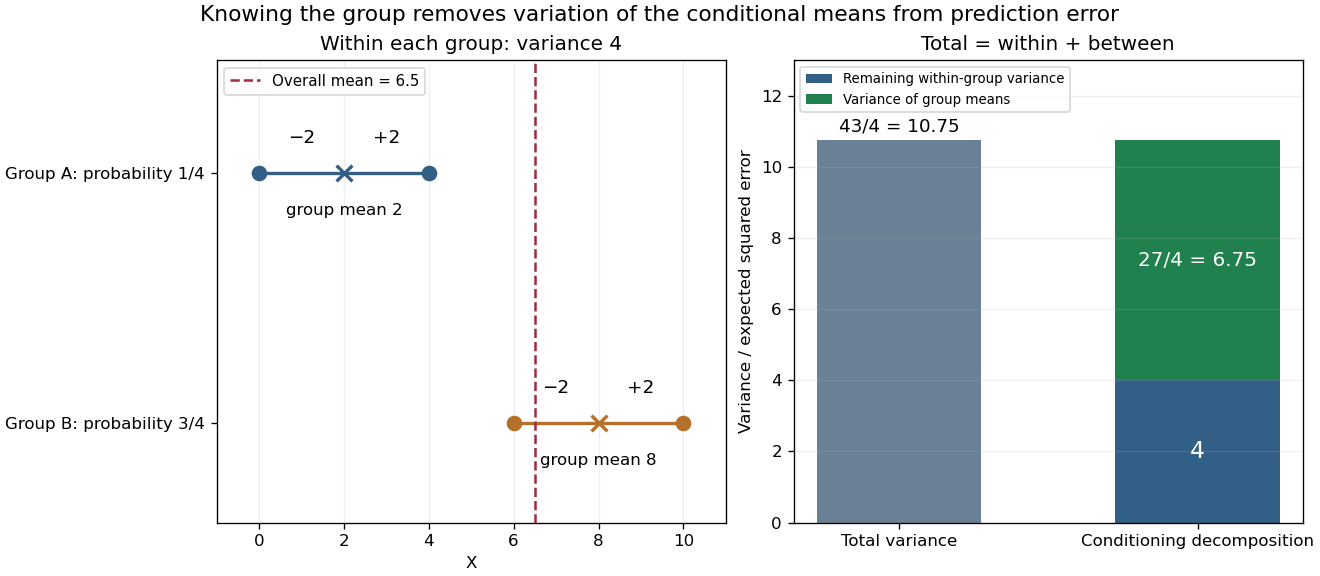
For any square-integrable -measurable predictor , the error identity isThe cross term vanishes because . Thus using the conditional mean minimizes mean squared error, while conditional variance quantifies what this information still cannot predict. This is the orthogonal projection interpretation in L2 space.[ref]
A Coulomb branch is a component on which scalar expectation values in vector or neutral multiplets leave an Abelian gauge sector unbroken. Charged fields can become massless at special points where additional branches meet it.
A Higgs branch is a component on which charged scalar expectation values break some or all of the gauge group. It is often obtained as a Kähler or hyperkähler quotient.
Suppose for . If and the real Selberg weights vanish unless and , thenOptimizing the main quadratic form gives , whereup to the harmless replacement of by under the alternative convention that denotes the level of the least common multiples.
The maximal unramified extension is the union of all finite unramified extensions of a non-Archimedean local field . Its Galois group is canonically , generated topologically by Frobenius.
Let be a non-Archimedean local field with residue field of cardinality . Arithmetic Frobenius automorphism acts on the algebraic closure of the residue field by . On itself this is the identity; on a degree- residue extension it has order .
For the degree- unramified extension , reduction identifies its Galois group with the residue-field Galois group, so there is a unique lifted automorphism with this residue action. It generates . Geometric Frobenius is its inverse. For example, in an unramified quadratic extension of , arithmetic Frobenius lifts on , rather than acting nontrivially on .
The Aldous-Broder algorithm samples a uniform spanning tree of a finite connected graph by running a simple random walk from any initial vertex. Whenever the random walk first visits a new vertex, retain the edge by which it arrived. Stop when every vertex has been visited.
Each retained edge joins a previously unseen vertex to the already visited connected subgraph. It cannot create a graph cycle; at termination the retained edges form a spanning tree. The stopping time is the cover time, finite almost surely. The nontrivial conclusion is that every spanning tree has exactly the same probability, independently of the starting vertex.[ref]
The Random Walk Construction of Uniform Spanning Trees and Uniform Labelled Trees by David Aldous. section1, equation1 and Proposition1
Repeated visits add no edges, which can make the method slow when only a few unvisited vertices remain. Wilson's algorithm instead attaches loop-erased random walks. On a recurrent infinite connected graph, the first-entrance construction continues indefinitely and gives the corresponding infinite-volume uniform spanning tree.
On a transitive graph, the free and wired uniform spanning-forest measures are invariant and ergodic under the transitive automorphism group. Consequently every translation-invariant event has probability zero or one.
In a finite connected graph with unit electrical resistance on each edge, choose distinct undirected edges and orient each once. Define the transfer current as the signed electric current through when one unit of electric current enters the tail of and leaves its head. For a uniform spanning tree ,Reversing one orientation negates its row and column, leaving the determinant unchanged. Distinctness is necessary: repeating an edge repeats a row and gives zero, although its inclusion can have positive probability.
Electrical reciprocity makes symmetric. The two-edge case therefore givesThus edge inclusions are negatively correlated.[ref]
Local Characteristics, Entropy and Limit Theorems for Spanning Trees and Domino Tilings via Transfer-Impedances by Robert Burton and Robin Pemantle. Theorem1.1 and section4, transfer-impedance determinants
The positive-weight version uses the corresponding conductance-normalized transfer current. Every extendable finite forest has positive inclusion probability, since at least one positively weighted spanning tree contains it.The free uniform spanning forest of an infinite locally finite graph is the weak limit of uniform spanning trees on finite induced connected exhaustions with free boundary. Every component is infinite almost surely.
Pinned article: Introduction to the OurBigBook Project
Welcome to the OurBigBook Project! Our goal is to create the perfect publishing platform for STEM subjects, and get university-level students to write the best free STEM tutorials ever.
Everyone is welcome to create an account and play with the site: ourbigbook.com/go/register. We belive that students themselves can write amazing tutorials, but teachers are welcome too. You can write about anything you want, it doesn't have to be STEM or even educational. Silly test content is very welcome and you won't be penalized in any way. Just keep it legal!
Intro to OurBigBook
. Source. We have two killer features:
- topics: topics group articles by different users with the same title, e.g. here is the topic for the "Fundamental Theorem of Calculus" ourbigbook.com/go/topic/fundamental-theorem-of-calculusArticles of different users are sorted by upvote within each article page. This feature is a bit like:
- a Wikipedia where each user can have their own version of each article
- a Q&A website like Stack Overflow, where multiple people can give their views on a given topic, and the best ones are sorted by upvote. Except you don't need to wait for someone to ask first, and any topic goes, no matter how narrow or broad
This feature makes it possible for readers to find better explanations of any topic created by other writers. And it allows writers to create an explanation in a place that readers might actually find it.
Figure 1. Screenshot of the "Derivative" topic page. View it live at: ourbigbook.com/go/topic/derivativeVideo 2. OurBigBook Web topics demo. Source. - local editing: you can store all your personal knowledge base content locally in a plaintext markup format that can be edited locally and published either:This way you can be sure that even if OurBigBook.com were to go down one day (which we have no plans to do as it is quite cheap to host!), your content will still be perfectly readable as a static site.
- to OurBigBook.com to get awesome multi-user features like topics and likes
- as HTML files to a static website, which you can host yourself for free on many external providers like GitHub Pages, and remain in full control

Figure 2. You can publish local OurBigBook lightweight markup files to either OurBigBook.com or as a static website.
Figure 3. Visual Studio Code extension installation.
Figure 5. . You can also edit articles on the Web editor without installing anything locally. Video 3. Edit locally and publish demo. Source. This shows editing OurBigBook Markup and publishing it using the Visual Studio Code extension. 
- Infinitely deep tables of contents:



All our software is open source and hosted at: github.com/ourbigbook/ourbigbook
Further documentation can be found at: docs.ourbigbook.com
Feel free to reach our to us for any help or suggestions: docs.ourbigbook.com/#contact