
Past exam of the mathematics course of the University of Cambridge 2013 ib Paper 2 13D i Solution Created 2026-09-24 Updated 2026-10-07
The denominator vanishes when . For , only lies inside the rectangle. This is a simple pole, since the denominator derivative there is . Its residue isThe positive orientation and the residue theorem consequently give
Past exam of the mathematics course of the University of Cambridge 2013 ib Paper 2 11G iii Solution Created 2026-09-24 Updated 2026-10-07
Factor . These factors generate pairwise comaximal ideals, so the Chinese remainder theorem givesThe three copies of have different module structures: acts by , respectively. Thus acts on as , making a module homomorphism.
The inverse, obtained by Lagrange interpolation, isEvaluating at recovers . Conversely, a polynomial whose three evaluations vanish is divisible by , so these maps are mutual inverses on the quotient module. Three copies with identical trivial -action would not give the required isomorphism.
Past exam of the mathematics course of the University of Cambridge 2013 ib Paper 2 11G ii Solution Created 2026-09-24 Updated 2026-10-07
The annihilating polynomial excludes any free -summand. In a cyclic primary decomposition summand , the same condition requires to divide . Thus , up to a scalar unit, and . The complex dimension of this summand is .
Write . The exponents must form a partition of an integer , giving exactlyThey are distinct module isomorphism types by uniqueness in the structure theorem for finitely generated modules over a principal ideal domain; equivalently they are the five possible Jordan block patterns for eigenvalue in dimension four.
Past exam of the mathematics course of the University of Cambridge 2013 ib Paper 2 11G i Solution Created 2026-09-24 Updated 2026-10-07
The structure theorem for finitely generated modules over a principal ideal domain applies because a Euclidean domain is a principal ideal domain. For a finitely generated -module,where the are nonzero nonunits. The free rank and the invariant factors of a finitely generated module are unique, with each determined up to multiplication by a unit. Equivalently, the torsion submodule decomposes into cyclic modules for irreducible , with uniquely determined prime-power elementary factors.
Past exam of the mathematics course of the University of Cambridge 2013 ib Paper 1 4A b Solution Created 2026-09-24 Updated 2026-10-07
For the Legendre transform, maximize over . Its derivative is , and strict concavity makes the stationary point the unique maximizer. Substitution gives the convex conjugate of x log xThe range of is all of , so all real dual arguments have this finite value. Every point of the original graph is supported by its tangent of slope ; the conjugate supremum therefore recovers from these supporting lines. Equivalently, the inverse derivative relation for this strictly convex differentiable Legendre transform gives on . If an extended-real function on all of is wanted, its closed convex extension has value zero at and infinity for ; biconjugation includes that endpoint closure.
Past exam of the mathematics course of the University of Cambridge 2013 ib Paper 1 4A a Solution Created 2026-09-24 Updated 2026-10-07
A convex function satisfies for all in its domain and . If the second derivative exists on an interval, this is equivalent to there. The equivalence follows from the nondecreasing first derivative, or from the supporting-line inequalities obtained by integration. HereThus it is a strictly convex function, and in particular convex.
Past exam of the mathematics course of the University of Cambridge 2013 ib Paper 1 2D iv Solution Created 2026-09-24 Updated 2026-10-07
At , numerator and denominator both have simple zeroes. Their derivatives give the removable valueAt each positive integer , the numerator is nonzero and the denominator has a simple zero, so these are simple poles. At zero the expansion on the principal sheet iswhich contains a fractional power. Thus zero is a branch point with pole-like leading growth, not an ordinary isolated pole. The negative real axis is the chosen branch cut. On local continuations across its nonzero points, negative integers also give simple poles because the continued square root is , never one. They lie outside the open principal branch domain; noninteger negative points are merely cut points, not intrinsic singularities.
Past exam of the mathematics course of the University of Cambridge 2013 ib Paper 1 2D iii Solution Created 2026-09-24 Updated 2026-10-07
On the stated branch of the principal complex logarithm, the only denominator zero is , and . ThereforeZero is a logarithmic branch point, not a removable isolated singularity, even though tends to zero as within the cut plane. Continuation around zero changes by . The nonpositive real axis is the chosen branch cut; its nonzero points are not intrinsically branch points and admit local analytic continuation. There are no other finite singularities inside the specified branch domain.
Past exam of the mathematics course of the University of Cambridge 2013 ib Paper 1 2D ii Solution Created 2026-09-24 Updated 2026-10-07
For , the denominator zeroes are . Its derivative is , nonzero at each such point. ThusThese poles accumulate at zero. Consequently zero is a non-isolated singularity, as described by reciprocal cosine with accumulating poles. It is not an isolated essential singularity: no punctured disc about zero is a domain of holomorphy for this reciprocal function. Although itself has an essential singularity at zero, taking its reciprocal introduces this accumulation of poles.
Past exam of the mathematics course of the University of Cambridge 2013 ib Paper 1 2D i Solution Created 2026-09-24 Updated 2026-10-07
The zeroes of occur at , . They are simple because there. Squaring the denominator therefore givesThere are no other finite singularities; this follows from the local zero-order criterion for a pole.
Past exam of the mathematics course of the University of Cambridge 2013 ib Paper 1 20H iii Solution Created 2026-09-24 Updated 2026-10-07
The chain is a reversible Markov chain, so detailed balance makes the stationary path probabilityA path contains an ordered occurrence of followed later by exactly when its reversal contains followed later by . These occurrences need not be adjacent. Therefore for every , and in particular the two finite expectations are equal. This is ordered-state visit times in a reversible chain.
To decompose the expectations, distinguish the entrance time , which allows time zero and has , from the positive return convention in part (i). The Strong Markov property at the first visit to or givesEquating them yields the difference formula with . Replacing by in the sum adds , again by Kac's lemma. HenceFor a numerical consistency check, the other entrance times are and , while . Both sides of the displayed identity equal .
Past exam of the mathematics course of the University of Cambridge 2013 ib Paper 1 20H ii Solution Created 2026-09-24 Updated 2026-10-07
Let be the expected time to complete the specified directed transition, starting at . This is a transition-completion time in a Markov chain, rather than merely a first visit to . First-step decomposition givesThe missing continuation in the middle equation represents successful completion, but its step is counted by the leading one. Substitution givesThus the requested expectation from is steps.
Past exam of the mathematics course of the University of Cambridge 2013 ib Paper 1 20H i Solution Created 2026-09-24 Updated 2026-10-07
First realize the chain as a random walk on a multigraph: put three parallel edges between , two between , and one between . There are six edges and vertex degrees . Choosing an incident edge uniformly gives exactly the stated transition probabilities. The stationary distribution of a graph random walk is the degree divided by twelve, , and detailed balance follows because each edge multiplicity contributes the same flux in both directions.
Past exam of the mathematics course of the University of Cambridge 2013 ib Paper 1 14B ii Solution Created 2026-09-24 Updated 2026-10-07
Use the drift-removing substitution for a Dirichlet Sturm-Liouville problem, . Direct differentiation gives . The homogeneous boundary conditions become , so the eigenvalues and eigenfunctions areThe self-adjoint weighted form isThus the weight and leading coefficient are both . The orthogonality of Sturm-Liouville eigenfunctions readsAfter multiplying the forcing equation by , it becomes . Expanding in the sine series of part (i) and dividing by givesEvery term satisfies the endpoint conditions. As a check, solving the transformed ODE directly gives , which has the same coefficients and forcing.
Past exam of the mathematics course of the University of Cambridge 2013 ib Paper 1 14B i Solution Created 2026-09-24 Updated 2026-10-14
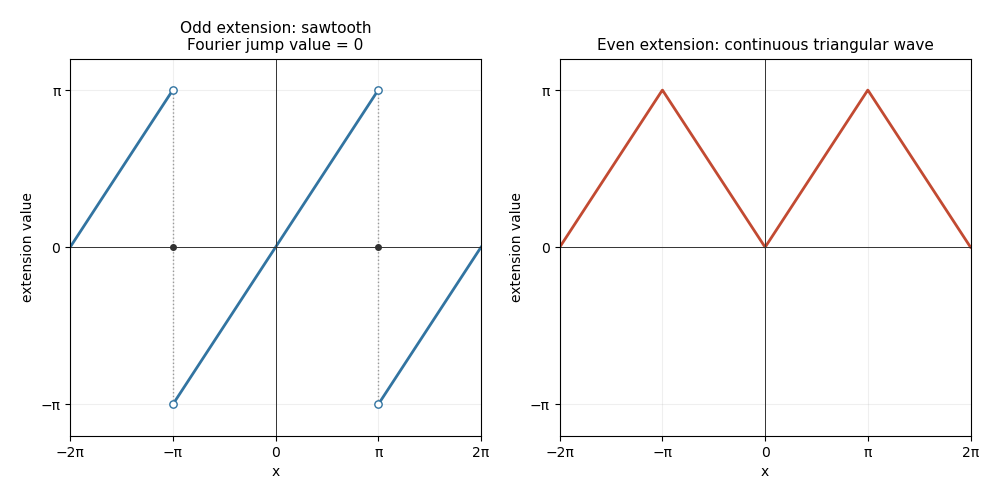
Integration by parts gives the Fourier sine series coefficientsHenceThe odd periodic extension is a sawtooth, equal to on and repeated every ; its jumps at odd multiples of have midpoint value zero in the Fourier series. In particular the sine series equals zero, rather than the specified endpoint value , at . The even periodic extension is the continuous triangular wave equal to on . Their sketches are below.

Past exam of the mathematics course of the University of Cambridge 2013 ib Paper 1 12G ii Solution Created 2026-09-24 Updated 2026-10-07
The quotient map is continuous and surjective by the quotient topology, so is compact as a continuous image of a compact space. To prove the Hausdorff property explicitly, let and set . Choose . The saturated open setsare disjoint by the triangle inequality. Each contains both antipodes of every one of its points, so and similarly for . Consequently are disjoint open quotient neighborhoods separating the classes. Thus the quotient is compact and Hausdorff. It is the real projective plane; equivalently the metric on the antipodal sphere quotient is and induces this topology.
Past exam of the mathematics course of the University of Cambridge 2013 ib Paper 1 12G i Solution Created 2026-09-24 Updated 2026-10-07
The sphere is the inverse image of under the continuous map , so it is closed in . It is bounded. The Heine-Borel theorem therefore makes it compact. Every metric space is Hausdorff: distinct points have disjoint open balls of radii smaller than half their distance. The Euclidean subspace metric supplies that property here. Hence is compact and Hausdorff.
Past exam of the mathematics course of the University of Cambridge 2013 ib Paper 1 10G ii Solution Created 2026-09-24 Updated 2026-10-07
For a prime , a diagonal matrix with two distinct nonzero eigenvalues exists. The same common-eigenspace argument makes the normalizer of a diagonal subgroup of GL2 precisely the monomial matrices. There are choices of nonzero entries for each of two permutation patterns, givingAt , however, the invertible diagonal subgroup is trivial. Every invertible matrix normalizes it, soThe first factor chooses a nonzero first column and the second chooses a column outside its one-dimensional span. The exceptional answer is necessary because the printed question permits every prime.
Past exam of the mathematics course of the University of Cambridge 2013 ib Paper 1 10G i Solution Created 2026-09-24 Updated 2026-10-07
The coordinate axes are exactly the simultaneous eigenspaces of all invertible diagonal matrices in . A matrix normalizing must permute these common eigenspaces: if , then is again a scalar multiple of . Thus a normalizer element has exactly one nonzero entry in each row and column, a monomial matrix. In dimension two it is either diagonal or diagonal times . Conversely swaps the diagonal entries and normalizes . ThereforeThis is the normalizer of a diagonal subgroup of GL2; the quotient records the permutation of the two axes.
Past exam of the mathematics course of the University of Cambridge 2013 ia Paper 4 9B b Solution Created 2026-09-24 Updated 2026-10-07
For inferring an inverse-square force from Kepler laws, first use the area swept by an infinitesimal radius sector:Kepler's second law makes the areal velocity constant, so is constant. Then , meaning that the acceleration has no transverse component. Newton's second law therefore gives a central force directed along the Sun–planet line.
For the radial dependence, set . Since ,The radial acceleration is the Binet equation expressionThe focus-based ellipse has , hence . ThusFor a planet of mass , the force is : it is attractive and obeys the inverse-square law. This deduction uses both the shape of the orbit and its constant areal velocity; the orbit shape alone would not determine its time-dependent acceleration.
There are unlisted articles, also show them or only show them.