
Past exam of the mathematics course of the University of Cambridge 2004 ia Paper 3 9C iv Solution Created 2026-09-24 Updated 2026-10-14
Past exam of the mathematics course of the University of Cambridge 2004 ia Paper 3 9C iii Solution Created 2026-09-24 Updated 2026-10-14
False. Directional derivatives do not imply differentiability; the resulting dependence on direction need not be a linear derivative.
Past exam of the mathematics course of the University of Cambridge 2004 ia Paper 3 9C ii Solution Created 2026-09-24 Updated 2026-10-14
False. Partial derivatives do not imply continuity; derivatives along coordinate axes need not control nearby non-axis approaches.
Past exam of the mathematics course of the University of Cambridge 2004 ia Paper 3 9C i Solution Created 2026-09-24 Updated 2026-10-14
Past exam of the mathematics course of the University of Cambridge 2004 ia Paper 3 3C ii Solution Created 2026-09-24 Updated 2026-10-14
The contraction of two Levi-Civita symbols gives . Similarly . Add the two directional-derivative terms to cancel the last terms, leavingThe product rule has therefore proved the gradient of a dot product identity
Past exam of the mathematics course of the University of Cambridge 2004 ia Paper 3 3C i Solution Created 2026-09-24 Updated 2026-10-14
Use the Levi-Civita symbol and sum over repeated indices. The contraction of two Levi-Civita symbols and the product rule giveReading the four terms as divergence and directional derivatives proves the curl of a cross product identity
Past exam of the mathematics course of the University of Cambridge 2004 ia Paper 2 7B ii Solution Created 2026-09-24 Updated 2026-10-14
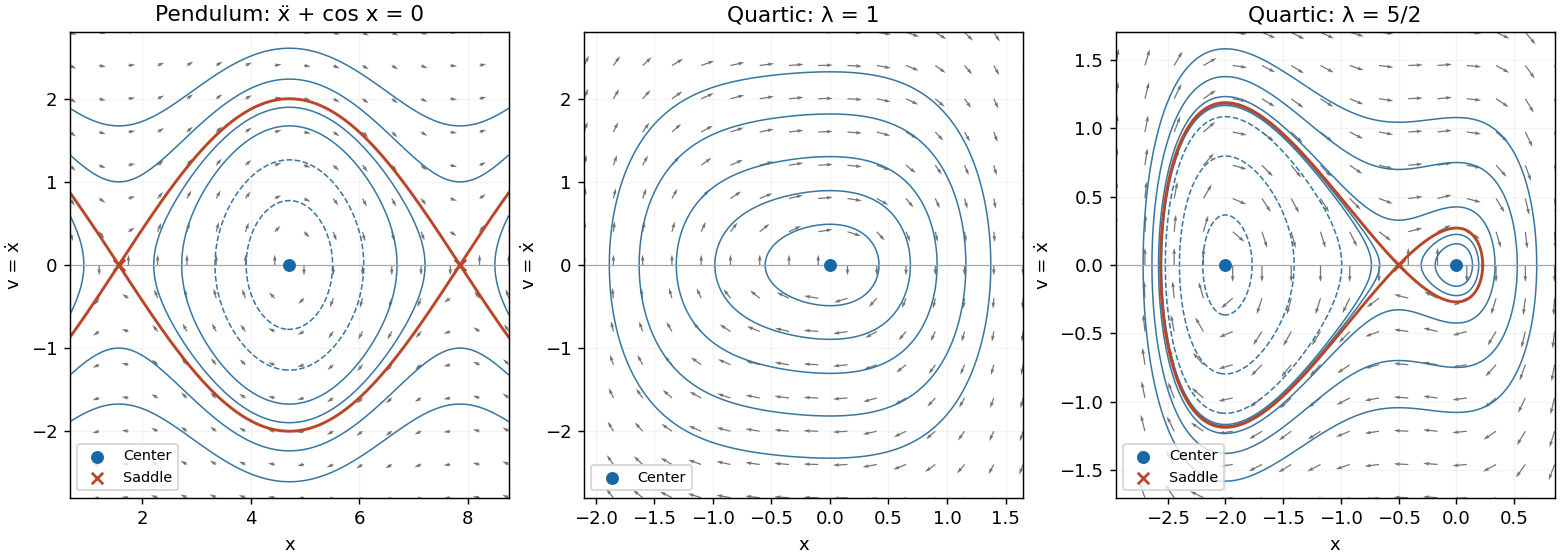
For both parameters the autonomous planar system is , . It has the conserved energyIndeed . At any equilibrium point the eigenvalues satisfy
For , the quadratic is strictly positive, so the only equilibrium point is , with eigenvalues . Since has the sign of , has a unique strict minimum at zero and tends to infinity in both directions. All positive energy levels are closed curves surrounding this stable center equilibrium. They are clockwise: rightward when and leftward when .
For , factor . The three equilibrium points and their classifications areThe two center equilibria are stable but not asymptotically stable; the saddle equilibrium is unstable. At the saddle equilibrium the local unstable and stable directions are and .
The potential values are , , and . Consequently there are closed loops around the left center for , closed loops in both wells for , and a figure-eight pair of homoclinic orbits at . At the right center is a stationary point while the left well still has a closed orbit. For , each closed curve encircles both centers and the saddle.
The two homoclinic orbits satisfy . Their outer turning points can be located exactly fromEvery nonstationary energy curve is oriented to the right in the upper half-plane and to the left in the lower half-plane. The sketches show the closed curves, the separating orbits, the stable and unstable saddle directions and the direction of flow.

Past exam of the mathematics course of the University of Cambridge 2004 ia Paper 2 7B i Solution Created 2026-09-24 Updated 2026-10-14
Here the autonomous planar system is , . Its equilibrium points areThe Jacobian matrix isFor even , the eigenvalues are , so these points are unstable saddle equilibria. Writing , their local unstable and stable directions are and respectively. For odd , the eigenvalues are .
To classify the latter points nonlinearly, differentiate the first integralAt this energy has a strict local minimum. Its nearby level sets are closed curves, proving that the odd- points are stable center equilibria, with no attraction to the center. The phase portrait consists of closed oscillatory orbits for , heteroclinic orbits at joining consecutive saddle equilibria, and open rotating orbits for . The separating curves haveAbove the horizontal axis , so flow is rightward; below it flow is leftward. The closed orbits are clockwise, and these same signs orient every separating and rotating orbit.
Past exam of the mathematics course of the University of Cambridge 2004 ia Paper 2 3F b Solution Created 2026-09-24 Updated 2026-10-14
The covariance is symmetric, because multiplication of real random variables is commutative. Expanding with the bilinearity just proved givesIdentical probability distributions imply equal second moments and equal means, hence equal variances. Therefore the assertion is true, withThe cancellation shows exactly why no assumption of independence is needed.
Past exam of the mathematics course of the University of Cambridge 2004 ia Paper 2 3F a Solution Created 2026-09-24 Updated 2026-10-14
Linearity of expectation gives . Expand the centered product and use linearity of expectation again:Thus the assertion is true whenever the covariances are defined. Neither independence nor identical distributions are required.
Past exam of the mathematics course of the University of Cambridge 2004 ia Paper 1 8C iii Solution Created 2026-09-24 Updated 2026-10-14
A direct construction, valid for every , isThe first coordinates give , andThe first two norms are one. For the third,Thus the required Gram matrix is . The column matrix is upper triangular and has determinantso these vectors are linearly independent. This is an explicit instance of unit vectors with a common inner product; at it reduces to the standard orthonormal basis.
Past exam of the mathematics course of the University of Cambridge 2004 ia Paper 1 8C ii Solution Created 2026-09-24 Updated 2026-10-14
No. For every , takein . These form a minimally dependent vector family: the full family is dependent because .
If the omitted vector is , the remaining coordinate vectors are independent. If the omitted vector is , a relation among the retained vectors has an coordinate coming only from , so its coefficient must be zero; the coefficients of all retained coordinate vectors must then be zero. Thus every -element subfamily is linearly independent, as required for a counterexample. When , the empty subfamily is independent while the one-vector family consisting of the zero vector is not, so the answer remains negative.
Past exam of the mathematics course of the University of Cambridge 2004 ia Paper 1 8C i Solution Created 2026-09-24 Updated 2026-10-14
Yes. Suppose . Taking its dot product with eliminates the last two terms and givesThe nonzero scalar triple product forces . Cyclically using and forces as well. This is the definition of linear independence. Equivalently the three-column matrix has nonzero determinant.
Past exam of the mathematics course of the University of Cambridge 2004 ia Paper 1 12F iii Solution Created 2026-09-24 Updated 2026-10-14
At the terms are . Their decay to zero alone is insufficient for convergence. In factbecause the difference has numerator . Since , induction gives . The comparison harmonic series diverges, so
At the terms are . Part (ii) gives positive decreasing magnitudes tending to zero, so the alternating series test applies. To see the convergence directly, let . Thenwhile , obtained by grouping . Thus the even partial sums have a finite limit. The odd partial sums differ from them by , so the whole sequence of partial sums has the same limit. Absolute convergence would require convergence of , already disproved. Hence
Past exam of the mathematics course of the University of Cambridge 2004 ia Paper 1 12F ii Solution Created 2026-09-24 Updated 2026-10-14
Extend the sequence by . Cancelling factorials in consecutive normalized central binomial coefficients givesThe given logarithmic inequality therefore impliesOn , , so summing its integrals gives . Exponentiating yields the explicit boundAlso every consecutive ratio is less than one, so is strictly decreasing, a fact needed for the alternating endpoint.
Past exam of the mathematics course of the University of Cambridge 2004 ia Paper 1 12F i Solution Created 2026-09-24 Updated 2026-10-14
Rearranging the assumed positive-term ratio inequality givesInduction therefore yields for every . In particularThe positive partial sums of the first series are nondecreasing and bounded above, so the bounded monotone sequence theorem proves that they converge. This is the ratio comparison test, and establishes convergence of .
Past exam of the mathematics course of the University of Cambridge 2003 ib Paper 4 8B a Solution Created 2026-09-24 Updated 2026-10-14
Partial fractions give . In the interior disk, expand both terms as geometric series:Thus the Laurent series is a Taylor series in this region:The nearer pole at determines the radius of convergence.
Past exam of the mathematics course of the University of Cambridge 2003 ib Paper 4 4E b Solution Created 2026-09-24 Updated 2026-10-14
The uniform limit theorem first gives continuity of on . For any triangle whose closed interior is in , the Cauchy integral theorem gives . Moreover,Hence , and Morera's theorem proves that is analytic on . In fact, the proof only needs locally uniform convergence on compact subsets, since each triangle is compact; the stated uniform convergence on the entire domain is stronger.
Past exam of the mathematics course of the University of Cambridge 2003 ib Paper 4 4E a Solution Created 2026-09-24 Updated 2026-10-14
Morera's theorem states that a continuous complex-valued function on an open set is holomorphic if its integral around every triangle whose closed interior lies in the set is zero. It is enough to impose this condition locally on disks.
Fix a disk contained in the open set and a base point . Define as the integral of along the straight segment from to . The zero triangle integral gives, for sufficiently small ,Continuity makes the quotient by tend to , so is holomorphic and . To justify that its derivative is holomorphic, apply the Cauchy integral formula for on a smaller circle:The right side may be differentiated again inside the circle because its denominator stays uniformly away from zero on the contour. Thus is holomorphic on . Such disks cover the open set, proving the theorem.
Past exam of the mathematics course of the University of Cambridge 2003 ib Paper 4 2D b Solution Created 2026-09-24 Updated 2026-10-14
For the single-frequency response, use separation of variables with . Set and ; then , so . A finite origin value forces , since is singular. Since , the prescribed origin amplitude gives . The regular time-harmonic spherical wave is thereforewith the quotient defined by its limit at zero.
This answers the literal finite-origin condition in the class of regular single-frequency responses. It is a standing combination of inward and outward waves: the numerator is proportional to . A purely outgoing wave from an ideal point source would instead be proportional to , which has no finite prescribed value . Such a source must be specified by a singularity strength, for example . The source's wording supplies neither an initial field nor an outgoing singular-source normalization; without restriction to the stated harmonic response, a general initial-value problem is not uniquely determined by the one origin condition.
There are unlisted articles, also show them or only show them.