
Past exam of the elasticity and plasticity course of the University of Oxford 2010 1 b Solution 2026-10-31
A Cartesian Cartesian second-rank tensor has components transforming under a constant orthogonal change of axes asHere and . By the chain rule and orthogonality,Thus the displacement gradient is a Cartesian second-rank tensor. Its symmetric part transforms in the same way:Hence the infinitesimal strain tensor is also second-rank. This is a passive coordinate rotation, under which both reference and spatial coordinates rotate; it does not assert finite-deformation frame indifference of the linearized strain formula.
Past exam of the elasticity and plasticity course of the University of Oxford 2010 1 a Solution 2026-10-31
The displacement follows a material point from its reference position to its current position:The deformation gradient is the Jacobian matrix , and the volume Jacobian isFor an orientation-preserving physical deformation, measures the local volume expansion factor. Incompressibility requires ; conservation of mass gives . For small displacement gradients, . If a spatial representation is desired, the same displacement is .
Past exam of the elasticity and plasticity course of the University of Oxford 2009 3 c Solution 2026-10-31
Insert the two constitutive stresses into the radial component of the Cauchy momentum equation. After collecting terms, , so . Its stresses areThe far pressure gives . At the tunnel wall, compressive bracing imposes , so . HenceWith no shear and , divide the yield identity by the nonzero to obtain . Solving its quadratic givesTo locate first yield, the stress-circle center is the constant , while its radius is . The radius is maximal at , so that is where it first meets the friction envelope as the bracing departs from the hydrostatic value. At the wall and ; hence andFor lowering bracing from , the hoop stress becomes more compressive, so and . Increasing bracing instead selects and reaches the other threshold . Stating the loading direction removes any ambiguity between the two reciprocal stress ratios. These conclusions describe first yield of the elastic field, not the later plastic-zone solution.
Past exam of the elasticity and plasticity course of the University of Oxford 2009 3 b Solution 2026-10-31
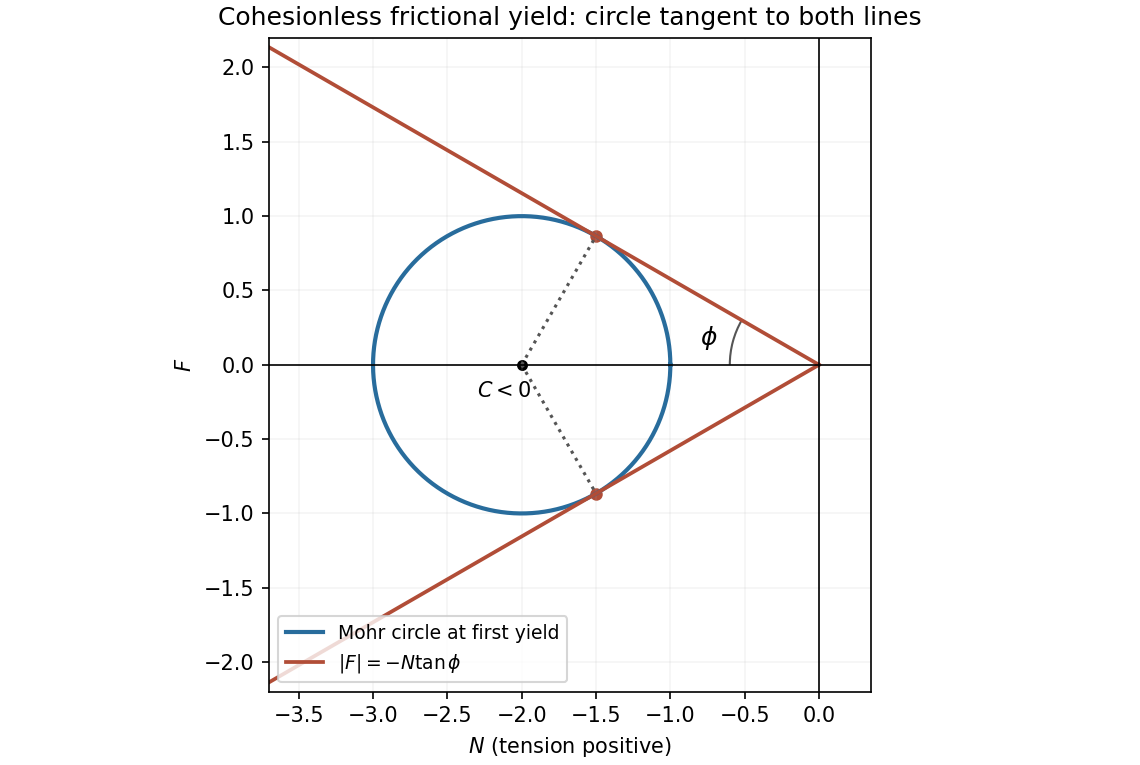
The Mohr circle has center on the normal-stress axis and radius . In the compressive regime , yield occurs when the circle first touches either friction line . The perpendicular distance of its center from either line is . Tangency therefore gives , or . But . ThusThe compressive sign restriction remains part of this equivalence: squaring alone would also produce algebraic branches that do not represent cohesionless compressive friction.
Past exam of the elasticity and plasticity course of the University of Oxford 2009 3 a Solution 2026-10-31
For dry friction, the tangential contact force opposes sliding and has limiting magnitude , where is the compressive normal force and . Sticking requires ; impending sliding reaches equality.
The cohesionless Mohr-Coulomb failure criterion applies the same local condition on internal planes: yield begins when some plane has . In the tension-positive Cauchy convention used here, for a compressive plane, soA cohesive material would add a positive intercept, but the later formulas in this paper are explicitly the zero-cohesion case. The model does not supply a tensile strength law.
Past exam of the elasticity and plasticity course of the University of Oxford 2009 2 a Solution 2026-10-31
Plane strain sets all strains involving to zero, including , while , and . ThusIn particular, generally does not vanish: the suppressed out-of-plane strain requires a reaction stress. Setting that entry to zero would instead be a plane-stress assumption.
Past exam of the elasticity and plasticity course of the University of Oxford 2009 1 c Solution 2026-10-31
The perturbation preserves the prescribed displacement because on the boundary. Strain varies as . Taylor expansion of the strain energy density givesSymmetry of the stress makes its contraction with the two symmetric terms equal, henceA minimizer must have zero first variation for both signs of . Integrating by parts and using the zero boundary variation yields . The fundamental lemma of the calculus of variations, applied to arbitrary compactly supported variations, givesThis is the static momentum equation. Fixed-displacement data remove the surface variation; prescribed tractions would instead appear through boundary work in the potential energy.
Past exam of the elasticity and plasticity course of the University of Oxford 2009 1 a Solution 2026-10-31
The infinitesimal strain tensor is the symmetric part of the displacement gradient tensor:Its diagonal entries are infinitesimal normal extensions; twice an off-diagonal entry is the corresponding engineering shear strain. An infinitesimal rigid rotation has an antisymmetric displacement gradient tensor and therefore contributes no linearized strain.
Past exam of the elasticity and plasticity course of the University of Oxford 2008 4 d Solution 2026-10-31
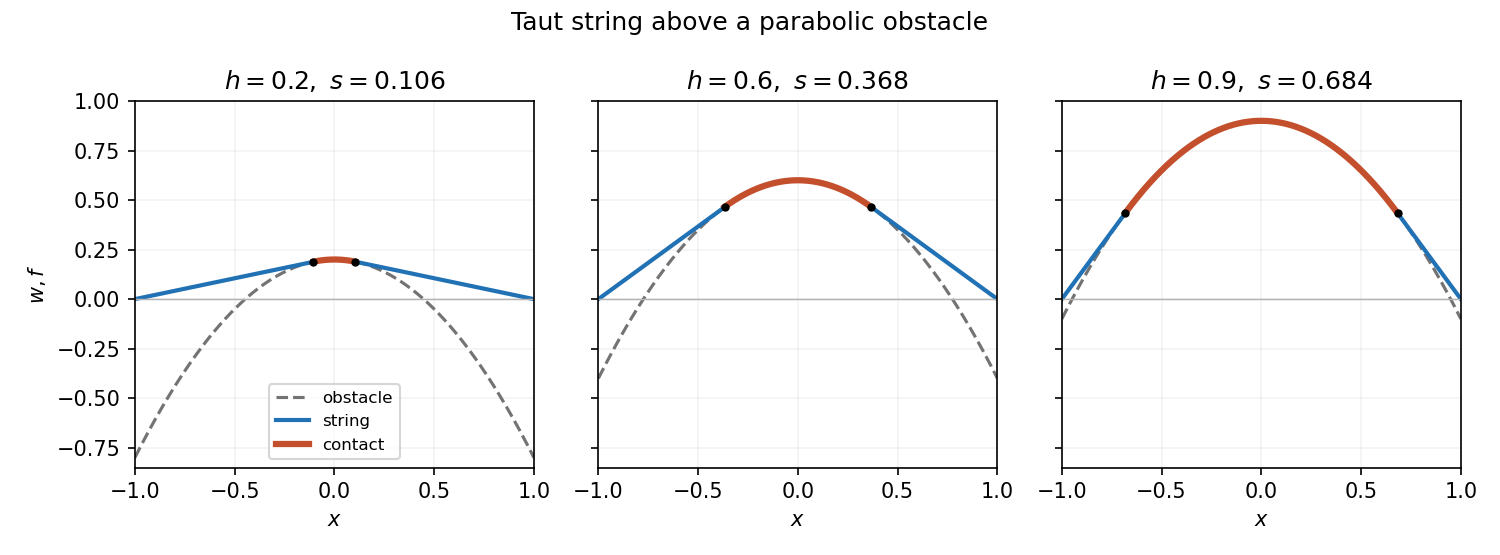
With no applied load the free string segments are straight, while in contact . By symmetry use contact and a right-hand line through tangent at . The tangency conditions are and , giving on and . ThereforeThe other algebraic root is outside the admissible contact interval except at the coincident endpoint .
Verification makes the construction complete: the values and slopes match at , the endpoints are zero, and outside contact . Inside contact ; outside it , so complementarity holds. The minimization argument proves this verified solution is the unique equilibrium. At the contact set is the single point and ; at contact fills the whole interval. This is the parabolic obstacle under a taut string.
Past exam of the elasticity and plasticity course of the University of Oxford 2008 4 c Solution 2026-10-31
The small-slope excess length is , so the first term is the work needed against uniform tension. The second is the potential energy of the downward distributed load. Their sum is total potential energy subject to the obstacle constraint.
Expand the difference exactly:The first two integrals together are nonnegative by part (b), and the square is nonnegative. ThusFor this also proves uniqueness: equality for two minimizers forces identical derivatives, and the fixed endpoints remove their additive constant. The convex admissible set and strictly convex energy make the variational inequality a global minimization condition.
Past exam of the elasticity and plasticity course of the University of Oxford 2008 4 b Solution 2026-10-31
For any admissible , put . At endpoints . On the contact set, and imply , while away from contact the reaction is zero. Hence everywhere. Integration by parts givesRearranging proves the requested variational inequality. Piecewise integration is legitimate because the slope is continuous at the contact boundary, so there are no omitted point-force terms.
Past exam of the elasticity and plasticity course of the University of Oxford 2008 4 a Solution 2026-10-31
Take positive upwards, so the source's sign convention makes a downward applied load. The small-slope tension contribution on a short interval is . Let be the upward contact reaction. Force balance gives . Nonpenetration is , and reaction is absent where . ThereforeThe contact boundary must have continuous to avoid a broken string, and continuous slope in this smooth-contact model with no concentrated point force. Integrating force balance over a vanishing interval around a contact endpoint gives when the load and reaction are locally bounded. This is the one-dimensional obstacle problem, with its reaction acting as a nonnegative constraint force.
Past exam of the elasticity and plasticity course of the University of Oxford 2008 3 d Solution 2026-10-31
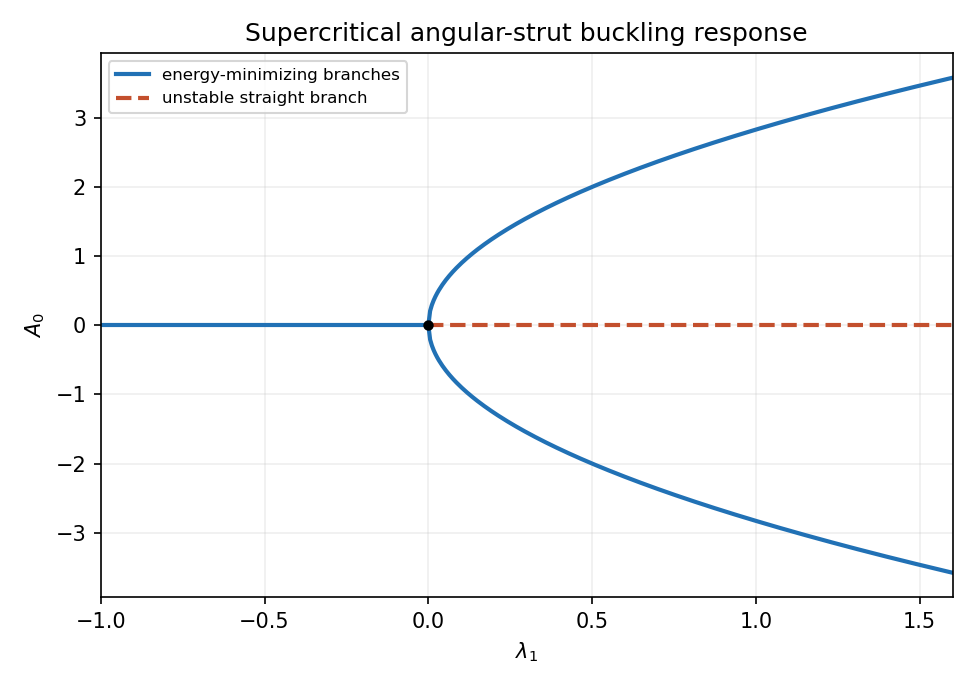
Near the first eigenvalue, load detuning supplies a term , while the first nonlinearity in is cubic. Balancing them gives , so .
Put . At order ,The operator has kernel , so Fredholm solvability requires its forcing to be orthogonal to that function. Since and ,When this holds the nonresonant forcing is ; for instance is a solution after absorbing its arbitrary first-mode component into the amplitude convention.
The branches are . This is a supercritical pitchfork bifurcation. The leading reduced energy is proportional to : the nonzero branches are minima for , while zero loses minimality on that side. At the origin the quartic term still stabilizes the critical state.


Past exam of the elasticity and plasticity course of the University of Oxford 2008 3 c Solution 2026-10-31
Linearization gives . The two homogeneous Dirichlet conditions select . For any small trial amplitude in this mode, , soFor every nonzero quadratic variation is positive by the sharp Poincaré inequality. For , the first mode gives negative energy at sufficiently small amplitude, so zero cannot be a local minimum.
The printed strict “only if” conclusion omits the critical case. At the quadratic test is degenerate, not negative. In fact zero is still the unique minimum of the full displayed functional: use and to get , with strict inequality for a nonzero continuous function because when . In particular on the critical first mode,Thus strict positivity of the second variation holds for , while local minimality of the full energy holds also at . This is the distinction captured by critical-load minimality of the angular Euler strut.
Past exam of the elasticity and plasticity course of the University of Oxford 2008 3 b Solution 2026-10-31
Set . The endpoint interval becomes , and multiplication of the dimensional equation by givesThe energy in these variables is . Thus measures load relative to the first linearized eigenvalue for the angular endpoint conditions actually imposed.
There are unlisted articles, also show them or only show them.