
Past exam of the mathematics course of the University of Cambridge 2013 ia Paper 4 6E ii Created 2026-09-24 Updated 2026-09-24
Past exam of the mathematics course of the University of Cambridge 2013 ia Paper 4 6E i Created 2026-09-24 Updated 2026-09-24
Past exam of the mathematics course of the University of Cambridge 2013 ia Paper 4 5E iii Created 2026-09-24 Updated 2026-09-24
Past exam of the mathematics course of the University of Cambridge 2013 ia Paper 4 5E ii Created 2026-09-24 Updated 2026-09-24
Past exam of the mathematics course of the University of Cambridge 2013 ia Paper 4 5E i Created 2026-09-24 Updated 2026-09-24
Past exam of the mathematics course of the University of Cambridge 2013 ia Paper 4 4B Solution Created 2026-09-24 Updated 2026-10-07
Use the inverse Lorentz transformationAlong the particle's worldline , so the relativistic velocity-addition formula isFor subluminal collinear velocities, put , and . The hyperbolic tangent addition formula, obtained by dividing the supplied sine/cosine addition formulas, givesBecause hyperbolic tangent is injective on the real line,Thus rapidity is additive even though velocity is not.
Each positive increment in the instantaneous rest frame adds the same rapidity . Starting from zero rapidity, iterated collinear boosts with equal rapidity giveEvery finite number of increments leaves ; the speed of light is approached as .
Past exam of the mathematics course of the University of Cambridge 2013 ia Paper 4 3B Solution Created 2026-09-24 Updated 2026-10-07
Use zero-relative-velocity mass shedding: the released sand initially shares the balloon's vertical velocity, rather than being actively ejected. Let and let a positive mass be shed in a short interval . The momentum of the balloon and that newly released sand changes byThe leading external impulse is . Newton's second law applied to this combined material system therefore givesWriting for the remaining balloon alone would omit the outgoing momentum flux. A nonzero relative ejection velocity would instead produce a rocket equation thrust term.
Initial mechanical equilibrium gives . Write , so up to depletion. ThenIntegrating from rest,Since and , the final upward speed isThe acceleration is nonnegative throughout release, consistent with the upward motion.
Past exam of the mathematics course of the University of Cambridge 2013 ia Paper 4 2E Solution Created 2026-09-24 Updated 2026-10-07
A real sequence converges to a finite limit ifA series converges when its partial sums form a convergent sequence with a finite limit. These are different conditions: a series concerns accumulated terms, whereas sequence convergence concerns the terms themselves.
If , then as well and . Explicitly, choose large enough that both partial sums lie within of ; the triangle inequality gives . Hence convergence of a series forces its terms to tend to zero.
For the converse, take . This is a null sequence, but its harmonic series diverges. In each block , there are terms each at least , so the block contributes at least . ThusA zero limit for the terms is necessary, but not sufficient, for convergent series.
Past exam of the mathematics course of the University of Cambridge 2013 ia Paper 4 1E Solution Created 2026-09-24 Updated 2026-10-07
The greatest common divisor is the largest positive integer dividing both and . To prove Bézout's identity without assuming a factorization theorem, consider the nonempty set of positive integer linear combinationsIt contains , so the well-ordering principle gives a least element . By Euclidean division, write with . Thenis another integer linear combination. If , it contradicts minimality, so and . Applying the same argument to gives . Conversely, every common divisor divides every integer linear combination and therefore divides . In particular every positive common divisor is at most . Thus andThis also proves the requested divisibility implication for any integer : if and , then .
For the scaling identity for greatest common divisors, put with . Since divides and , . On the other hand, multiplying Bézout's identity by expresses as , so . Positivity gives . Therefore without using prime factorization,
Past exam of the mathematics course of the University of Cambridge 2013 ia Paper 4 12B b Created 2026-09-24 Updated 2026-09-24
Past exam of the mathematics course of the University of Cambridge 2013 ia Paper 4 12B a Created 2026-09-24 Updated 2026-09-24
Past exam of the mathematics course of the University of Cambridge 2013 ia Paper 4 11B ii Created 2026-09-24 Updated 2026-09-24
Past exam of the mathematics course of the University of Cambridge 2013 ia Paper 4 11B i Created 2026-09-24 Updated 2026-09-24
Past exam of the mathematics course of the University of Cambridge 2013 ia Paper 4 10B b Created 2026-09-24 Updated 2026-09-24
Past exam of the mathematics course of the University of Cambridge 2013 ia Paper 4 10B a Created 2026-09-24 Updated 2026-09-24
Past exam of the mathematics course of the University of Cambridge 2013 ia Paper 3 9C Solution Created 2026-09-24 Updated 2026-10-14
For a smooth one-to-one coordinate transformation with nonsingular derivative, the Jacobian determinant isLocally a small coordinate box maps, to first order, to a parallelepiped whose volume is the absolute determinant of the derivative times the original volume. Summing these local volume approximations gives the change of variables formula, with accounting for either orientation. The usual regularity and nonsingularity hypotheses are part of this substitution theorem.
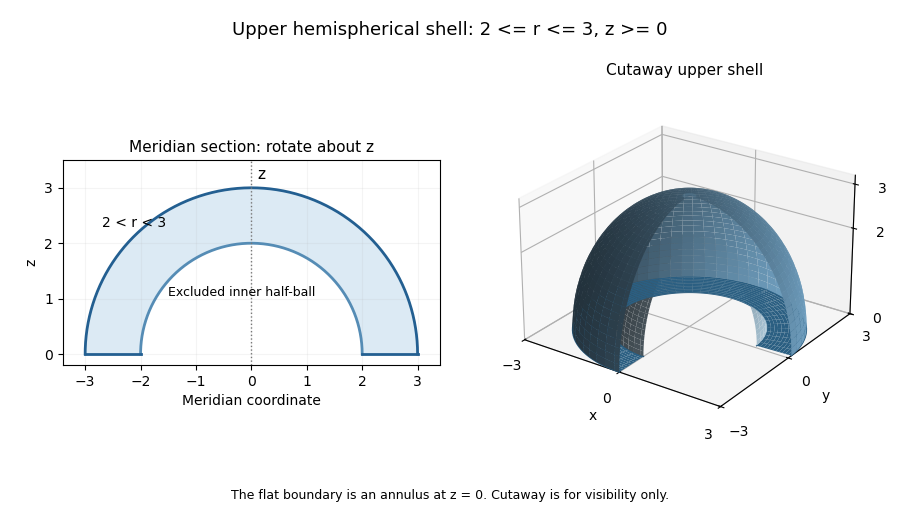
The region is the upper half of the spherical shell between radii two and three, including its annular flat boundary in the equatorial plane. Use spherical coordinates , , with , , . Their Jacobian determinant is ; the polar axis and azimuth seam have measure zero, so do not obstruct this integration.

Past exam of the mathematics course of the University of Cambridge 2013 ia Paper 3 8D Solution Created 2026-09-24 Updated 2026-10-07
For a nontrivial finite p-group of order with , partition into conjugacy classes. A noncentral class has size , a positive power of larger than one by Lagrange's theorem. The class equation therefore saysThe center of a group contains the identity, so , proving its nontriviality. The positive-exponent qualification matters: the one-element group has no nonidentity central element.
If , its center of a group has order or . In the first case, the quotient group has prime order and is cyclic. Whenever a central quotient group is cyclic, writing all elements as with central shows that they commute: . Thus that case would already make Abelian and its center of a group all of , a contradiction. Hence every group of order is Abelian.
If there is an element of order , it is a generator of a group for , giving . Otherwise every nonidentity element has order . Pick and . Their cyclic subgroups have trivial intersection, and they commute; the distinct products exhaust . Hence the classification of groups of order p squared isBoth groups exist and are nonisomorphic, since only the first has an element of order .
Past exam of the mathematics course of the University of Cambridge 2013 ia Paper 3 7D b Created 2026-09-24 Updated 2026-09-24
Past exam of the mathematics course of the University of Cambridge 2013 ia Paper 3 7D a Created 2026-09-24 Updated 2026-09-24
Past exam of the mathematics course of the University of Cambridge 2013 ia Paper 3 6D b Created 2026-09-24 Updated 2026-09-24
There are unlisted articles, also show them or only show them.