
Past exam of the mathematics course of the University of Cambridge 2013 ia Paper 3 6D a Created 2026-09-24 Updated 2026-09-24
Past exam of the mathematics course of the University of Cambridge 2013 ia Paper 3 5D b Created 2026-09-24 Updated 2026-09-24
Past exam of the mathematics course of the University of Cambridge 2013 ia Paper 3 5D a Created 2026-09-24 Updated 2026-09-24
Past exam of the mathematics course of the University of Cambridge 2013 ia Paper 3 4C Solution Created 2026-09-24 Updated 2026-10-07
For a continuously differentiable vector field on all of , the necessary and sufficient condition for a conservative vector field is . Necessity follows from equality of mixed partial derivatives of a potential; sufficiency uses the being a simply connected space. On a general domain the topology cannot be omitted.
Here the relevant mixed partial derivatives areThus the curl vanishes. Integrating the first component in gives . Matching the second component gives , hence . Matching the last component forces . A potential of a conservative vector field with the convention is consequentlyIf a physical potential is defined instead through , it is .
Past exam of the mathematics course of the University of Cambridge 2013 ia Paper 3 3C ii Created 2026-09-24 Updated 2026-09-24
Past exam of the mathematics course of the University of Cambridge 2013 ia Paper 3 3C i Created 2026-09-24 Updated 2026-09-24
Past exam of the mathematics course of the University of Cambridge 2013 ia Paper 3 2D Solution Created 2026-09-24 Updated 2026-10-07
A cyclic group has one generator of a group: . An abelian group has for every pair of elements. Powers of one element commute because , so every cyclic group is Abelian. The Klein four-group is Abelian but is not a cyclic group: every nonidentity element has order two, whereas a generator of a group for a four-element cyclic group would have order four.
Fix a generator of a group of . A group homomorphism is determined by because , and the relation forces . Conversely, such a defines : exponents differing by a multiple of give the same value, and addition of exponents verifies the group homomorphism law. Thus the homomorphism from a finite cyclic group correspondence isFor , the order of a permutation is the least common multiple of its disjoint cycle lengths. The condition allows identity, transpositions, two disjoint transpositions, and four-cycles. The sixteen homomorphisms are , with the full list of possible generator imagesThe remaining eight elements of the symmetric group are three-cycles and do not qualify.
Past exam of the mathematics course of the University of Cambridge 2013 ia Paper 3 1D iii Created 2026-09-24 Updated 2026-10-07
Both factors being normal subgroups places cross-commutators in their intersection, forcing cross-commutation.
Past exam of the mathematics course of the University of Cambridge 2013 ia Paper 3 1D ii Created 2026-09-24 Updated 2026-10-07
Past exam of the mathematics course of the University of Cambridge 2013 ia Paper 3 1D i Created 2026-09-24 Updated 2026-10-07
Past exam of the mathematics course of the University of Cambridge 2013 ia Paper 3 12C b Created 2026-09-24 Updated 2026-09-24
Past exam of the mathematics course of the University of Cambridge 2013 ia Paper 3 12C a Created 2026-09-24 Updated 2026-09-24
Past exam of the mathematics course of the University of Cambridge 2013 ia Paper 3 11C Solution Created 2026-09-24 Updated 2026-10-07
For a Cartesian change of basis represented by an orthogonal matrix , vectors transform as and . Their squared norms are invariant and . Substitution into the given expression therefore givesthe transformation law of a Cartesian second-rank tensor. The magnetic field's extra axial sign under an improper physical reflection, if included, appears twice and cancels in its quadratic contribution.
Write the Maxwell stress tensor as . Its divergence isThe identity follows by contracting two Levi-Civita symbols, or directly by differentiating components. Using Maxwell's equations consequently yieldsHence the local conservation of electromagnetic momentum isThe two subtracted terms are the Lorentz force density, while is the electromagnetic momentum density in the units used here.
Past exam of the mathematics course of the University of Cambridge 2013 ia Paper 3 10C Solution Created 2026-09-24 Updated 2026-10-14
Take the normal vector outward from the cylinder-and-cone solid. The surface consists of the cylindrical side and conical roof, with no bottom disk; this convention fixes the otherwise unspecified orientation of a surface. The boundary is the radius-two circle at . Reversing every normal vector reverses the final sign.
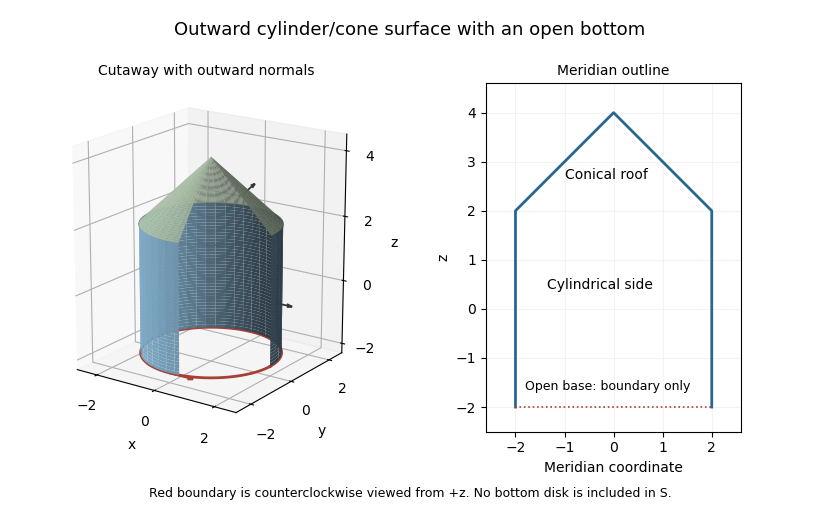
Outward-oriented cylindrical side and conical roof, with the open bottom circle as the sole boundary
. Details. 
For , its curl is . For the cylindrical parametrized surface, use , with , and use as the outward area vector. Its flux isFor the cone, let , and . Its outward area vector is . ThusThe total surface integral is therefore with the outward convention, or for the opposite convention.
For Stokes theorem, the induced bottom-circle orientation is counterclockwise as viewed from above, opposite to the orientation of an outward bottom cap. Use with increasing . Thenagreeing with the two parametrized fluxes. The seam at is internal and cancels between the two pieces; the cone tip does not supply another boundary curve.
Past exam of the mathematics course of the University of Cambridge 2013 ia Paper 2 9F Solution Created 2026-09-24 Updated 2026-10-07
The exponential distribution has survival probability for . Conditional probability therefore giveswhich proves the memoryless property. Let and . With ,The geometric distribution here starts at zero. Summing its first moment givesFor , sum the density over all integer translates:with zero density outside that interval. The integer and fractional parts of an exponential variable are independent, because for every integer and measurable ,This factorization proves independence of the discrete and continuous components, beyond just checking their separate marginals.
Past exam of the mathematics course of the University of Cambridge 2013 ia Paper 2 8A Solution Created 2026-09-24 Updated 2026-10-07
Let , with . Newton law of cooling gives the warming and cooling profilesIn the stipulated linear model, . The bacterial count obeys , so its logarithmic reduction is the cumulative thermal destruction under exponential warming and cooling:Writing , the warming integral divided by is and the cooling contribution is . Hence the required implicit equation isThe bracket is zero at zero and has derivative for , tending to infinity with . There is therefore one positive solution.
For the hardier species, is unchanged in this model if and the achieved remain the same. Raising the oven temperature changes , but its factor cancels against the changed slope of the linear destruction law. The entire normalized temperature history and hence the destruction integral remain the same; the comparison uses both the warming and equal-duration cooling stages.
Past exam of the mathematics course of the University of Cambridge 2013 ia Paper 2 7A Solution Created 2026-09-24 Updated 2026-10-07
Retain the derivative marks and coefficients from the printed system. In matrix form it is , withSince , multiplication by its inverse givesThe linear transformation , diagonalizes this system:Both start at zero. An integrating factor gives , soDirect substitution into the two original equations confirms the different forcing coefficients; the exact cancellation in depends on those coefficients.
Past exam of the mathematics course of the University of Cambridge 2013 ia Paper 2 6A Solution Created 2026-09-24 Updated 2026-10-14
Expand the function into separated terms: , where and . ThenPut and . The nine critical points are all pairs from and . The diagonal Hessian matrix has entries and .
At both entries are positive, giving strict local minima of value . At they have opposite signs, giving four saddle points of value zero. At the three points on the Hessian is degenerate, so its sign alone does not classify them. Use the higher-order test for separated extrema: is negative for small nonzero . At the positive term and negative term give a saddle. At , , so every sufficiently small nonzero displacement decreases and these are strict local maxima.
For the level curves, the exact zero set consists of the two parabolas and the oval . They cross at the four nondegenerate saddle points. Small positive levels enclose each maximum; small negative levels enclose each minimum. The degenerate central saddle has quartic narrowing, locally . Far along the axis the function is negative, while far along the axis it is positive. These signs and zero curves determine the connectivity shown in the sketch.
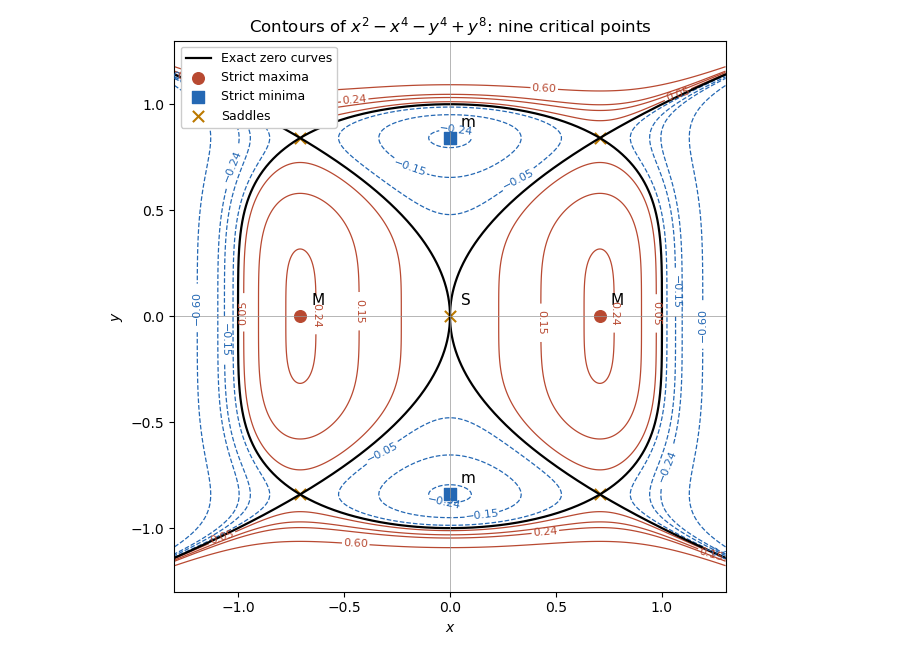
Level curves, exact zero set and all nine classified critical points of the separated quartic-octic function
. Details. 
Past exam of the mathematics course of the University of Cambridge 2013 ia Paper 2 5A Solution Created 2026-09-24 Updated 2026-10-07
For the normalized second-order equation, an ordinary point is one where both coefficient functions are analytic. A singular point of a second-order linear ODE is a point that is not ordinary. It is a regular singular point if and extend analytically to ; a singular point failing that condition is irregular.
Here , . Thus zero is singular but regular, because and are analytic. Write the analytic solution as . Its constant equation gives , and for ,Using givesThe factorial denominators show convergence for every finite .
For the other branch, integrating the first correction equation twice and imposing its two conditions gives andThen , so andEach correction tends to zero at the origin and its derivative vanishes at one. Although the second solution has a finite limiting value one, it has a logarithmically divergent endpoint derivative. Indeed the differential equation gives , and integration givesA finite initial derivative cannot be prescribed for this second branch. The logarithm is consistent with the integer separation of the two exponents in the Frobenius method; this is not the repeated-exponent case.
Past exam of the mathematics course of the University of Cambridge 2013 ia Paper 2 4F ii Created 2026-09-24 Updated 2026-09-24
There are unlisted articles, also show them or only show them.