
Past exam of the mathematics course of the University of Cambridge 2013 ib Paper 2 4G i Created 2026-09-24 Updated 2026-09-24
Past exam of the mathematics course of the University of Cambridge 2013 ib Paper 2 3F Solution Created 2026-09-24 Updated 2026-10-07
Both maxima exist by continuity on the compact set . Their sum is nonnegative and vanishes only for . The identities and the triangle inequality follow by applying the corresponding supremum norm facts to and . This proves that is a norm.
For , . Hence the first unit ball has image contained in : derivative evaluation is a bounded linear functional for this norm.
For the supremum norm alone, take . These smooth functions satisfy , but . Thus the second image is unbounded. The distinction is the unboundedness of derivative evaluation in the supremum norm, not a failure of differentiability of the individual functions.
Past exam of the mathematics course of the University of Cambridge 2013 ib Paper 2 2G Solution Created 2026-09-24 Updated 2026-10-07
Let be a Euclidean domain and a nonzero ideal. Choose minimizing the Euclidean size. For any , Euclidean division gives , where either or has smaller size than . But , so minimality forces . Consequently . The zero ideal is , proving that every Euclidean domain is a principal ideal domain.
A commutative ring is Noetherian if every ideal is finitely generated; equivalently, every ascending chain of ideals stabilizes. To see the equivalence, the union of an ascending chain is an ideal. Finitely many generators for that union already belong to one member of the chain, after which the chain is constant. Conversely, an ideal which is not finitely generated permits successive choices outside the ideals generated by previous choices, producing a strictly ascending chain.
Every principal ideal domain is therefore Noetherian. The given Euclidean domain property of the Gaussian integers yields
Past exam of the mathematics course of the University of Cambridge 2013 ib Paper 2 20H iii Created 2026-09-24 Updated 2026-09-24
Past exam of the mathematics course of the University of Cambridge 2013 ib Paper 2 20H ii Created 2026-09-24 Updated 2026-09-24
Past exam of the mathematics course of the University of Cambridge 2013 ib Paper 2 20H i Created 2026-09-24 Updated 2026-09-24
Past exam of the mathematics course of the University of Cambridge 2013 ib Paper 2 1E Solution Created 2026-09-24 Updated 2026-10-07
Write for the conjugate transpose. Taking determinants in gives . Since the Hermitian matrix is invertible, every such is invertible and . The identity belongs to ; if , then ; and multiplying by and gives . Associativity comes from matrix multiplication, so this is a group.
The Hermitian form obeys precisely when . Thus is the group of linear isometries of this nondegenerate Hermitian form; positivity of is unnecessary.
For , is a unitary matrix. Here is a direct diagonalization of a matrix proof. Over , its characteristic polynomial has a root, giving a unit eigenvector with . Preservation of the inner product gives . If , then , so is invariant. The restriction is again a unitary matrix. Induction on the dimension supplies an orthonormal basis of eigenvectors. In that basis, is diagonal, with diagonal entries on the unit circle.
Past exam of the mathematics course of the University of Cambridge 2013 ib Paper 2 19C Solution Created 2026-09-24 Updated 2026-10-07
Convergence of a numerical method on means that its grid error obeys as , with consistent initial values.
First, the implicit step of Backward Euler method is well-defined for : the map is a contraction mapping on , so the Banach fixed-point theorem gives a unique solution. Let , finite under the stated smoothness. The exact solution's step defect isso . Subtract the exact and numerical step equations. The Lipschitz condition givesWith exact initial data, sum this geometric progression to obtainFor and , , so the bracket is at most . Thus the global error is , uniformly on , and Backward Euler method converges with order one. A vanishing initial error adds only .
Order one is sharp: for , and , .
For the Dahlquist test equation , the stability function is , . Therefore its linear stability domain isThe strict inequality gives decay; equality gives bounded amplification. The whole closed left half-plane lies in this region, so Backward Euler method is A-stable.
Past exam of the mathematics course of the University of Cambridge 2013 ib Paper 2 18D Solution Created 2026-09-24 Updated 2026-10-07
For a thin wire carrying current , the given magnetic vector potential reduces to . Taking its curl and using gives the Biot-Savart lawThis is exactly the sign convention in the printed form using .
Let . Away from the wire, . The supplied divergence and curl of a cross product therefore gives . But , so the integrand is the total differential of along the source loop. Its closed-loop integral is zero. Thus at every point outside , as demanded by the current-free magnetostatic Ampère's law.
Past exam of the mathematics course of the University of Cambridge 2013 ib Paper 2 17B ii Created 2026-09-24 Updated 2026-09-24
Past exam of the mathematics course of the University of Cambridge 2013 ib Paper 2 17B i Created 2026-09-24 Updated 2026-09-24
Past exam of the mathematics course of the University of Cambridge 2013 ib Paper 2 16B Solution Created 2026-09-24 Updated 2026-10-07
For the Dirichlet Green's function, solve with zero endpoint values. Away from , is linear. Continuity at and the derivative jump giveFor nonzero Dirichlet boundary conditions, subtract their linear interpolant. The resulting boundary value problem has solutionIn the final heat equation, a steady state has zero time derivative. Here , , , . Integrating twice and imposing the endpoint values givesIts second derivative and both boundary conditions verify the answer directly.
Past exam of the mathematics course of the University of Cambridge 2013 ib Paper 2 15A Solution Created 2026-09-24 Updated 2026-10-14
The Euler-Lagrange equation is . Since has no explicit dependence,Thus a stationary curve satisfies the Beltrami identity, .
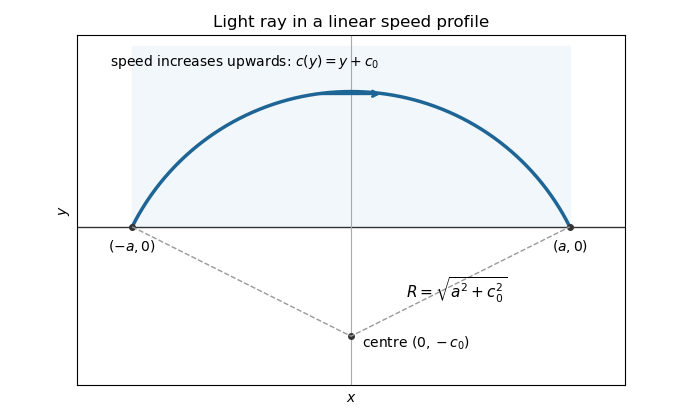
By Fermat principle, the light ray makes the travel time stationary. Its Beltrami identity becomesWriting and integrating the resulting first-order equation gives . Both endpoints have height zero, so subtracting their equations gives , and then . The arc lying in isIts maximum height is . The ray rises into the faster region before returning to the boundary; its circle centre is . The prescribed boundary endpoints are understood by continuity from the open half-plane. This is the circular light ray in a linear speed profile.
Past exam of the mathematics course of the University of Cambridge 2013 ib Paper 2 14F Solution Created 2026-09-24 Updated 2026-10-14
First normalize the two circles by translation and rotation so their centres are and radii . If nothing further is needed. Otherwise choose real satisfyingThe discriminant of this quadratic issince two disjoint circle boundaries are either externally separated or strictly nested. Thus , and is a Möbius transformation. Direct expansion shows that on the first circle , and on the second . Both constants are positive; the pole is on neither circle. Their images are distinct concentric circles. This proves the concentric normalization of disjoint circles.
For a construction with , use inner radius , outer radiusand small circles of radius centred at . Each touches the two boundaries, and adjacent centre distances are . All other distances are at least , so there are no unwanted intersections. These are Steiner chains. For the literal requirement, take , , and two radius-one circles centred at . Their centre distance is , so this gives two distinct mutually tangent circles touching both boundaries. Existence holds for every , but the two-circle case has only one tangency between neighbours, repeated by the cyclic indexing.
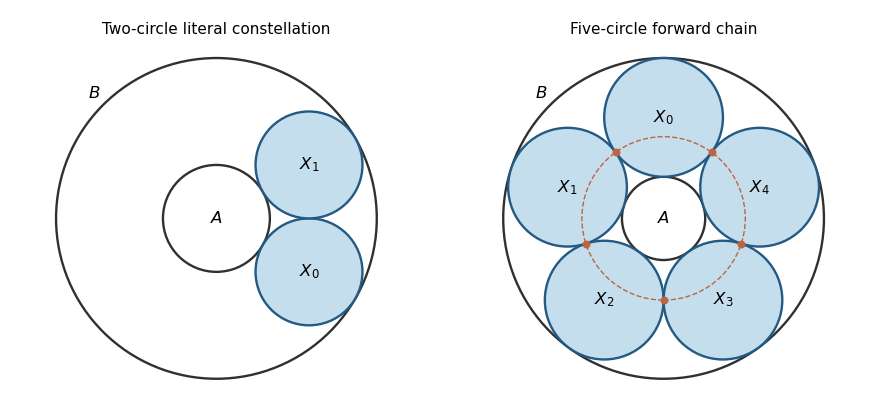


For an annular circle touching radii , its radius and centre distance are and . Two neighbouring such circles have angular separation ; their tangency point is the midpoint of their centres. Its distance from the common centre isThus the tangency locus in concentric coordinates is a circle of radius . For , disjointness forces the constellation to use these annular circles. Indeed, the other family of circles touching both boundaries has radius and centre distance , enclosing the inner boundary. Two members of that larger family intersect. One such circle can be disjoint from an annular circle only at the two opposite centre directions where their boundaries are tangent; those two annular circles cannot be tangent to each other. Hence this family cannot occur in a constellation of three or more circles.
Under the inverse Möbius transformation, the tangency locus is a generalized circle, which can be an ordinary circle or a straight line. The printed claim that it is always an ordinary circle is false without this qualification. For an explicit counterexample, use the above construction, put , and apply . Its pole lies on the tangency locus but on none of the original boundary or chain circles. Consequently all the transformed individual circles remain ordinary circles. The three distinct tangency points transform to three points on the line , so they cannot lie on an ordinary circle.
The usual closure assertion is Steiner's porism, with two essential conventions: stay in the annular family and always choose the next tangent circle in the same angular direction. For a disjoint closed chain with , distinctness prevents reversing direction: a reversed step would return immediately to the preceding circle. Thus every step has the same sign and closure gives for an integer . If , the distinct centres have some angular gap , making two circles intersect. Hence and . Starting at any new angle produces centres , a rotation of the original chain, soMapping back proves the same porism on the corresponding branch of circles for the original pair.
The literal final request, with arbitrary tangent choices and included, is stronger and false. In the two-circle example above, the forward angular step is . Starting at angle , a next circle at and then one at satisfy every inductive tangency requirement, but . Even for , allowing backtracking lets the construction reverse instead of completing the chain. Thus the genuine geometric conclusion is the qualified porism, not unrestricted closure under the printed induction.
Past exam of the mathematics course of the University of Cambridge 2013 ib Paper 2 13D iii Created 2026-09-24 Updated 2026-09-24
Past exam of the mathematics course of the University of Cambridge 2013 ib Paper 2 13D ii Created 2026-09-24 Updated 2026-09-24
Past exam of the mathematics course of the University of Cambridge 2013 ib Paper 2 13D i Created 2026-09-24 Updated 2026-09-24
Past exam of the mathematics course of the University of Cambridge 2013 ib Paper 2 12F Solution Created 2026-09-24 Updated 2026-10-07
Fix and a sufficiently small rectangle inside . Its rectangular incrementcan be evaluated twice using the fundamental theorem of calculus, givingDivide by and let . Continuity of the mixed partial derivatives makes the two limits and . They are equal everywhere on .
Repeated interchange of adjacent partial derivatives reduces every order- derivative of a smooth function to , . Hence there are at most distinct functions. This maximum is attained by , whose listed partial derivatives are the distinct functions . The answer is , rather than the possible written orders.
For the supplied , for , whereas . It is not even continuous at the origin, so is neither differentiable nor infinitely differentiable there.
For , . Thus , proving Fréchet differentiability at the origin with derivative zero. However,including zero at the origin. Therefore and . is differentiable but not infinitely differentiable at the origin: it cannot have continuous second partial derivatives near that point.
Past exam of the mathematics course of the University of Cambridge 2013 ib Paper 2 11G iii Created 2026-09-24 Updated 2026-09-24
Past exam of the mathematics course of the University of Cambridge 2013 ib Paper 2 11G ii Created 2026-09-24 Updated 2026-09-24
There are unlisted articles, also show them or only show them.