
Bifurcations of the 2022 Cambridge quadratic-cubic system Created 2026-09-24 Updated 2026-11-05
Forthe invariant center manifold near is , with reduced equation and hence a transcritical bifurcation. Near , put and . The extended center manifold beginsand substitution into gives , where denotes total degree in . Its leading saddle-node bifurcation balance is ; the mixed and squared-parameter terms must not be hidden in a total-degree-three remainder.
Extended centre manifold of the 2023 Cambridge quadratic-product system Created 2026-09-24 Updated 2026-09-24
Center manifold of the 2024 Cambridge cubic system Created 2026-09-24 Updated 2026-11-05
Consider the cubic feedback systemAt the origin its eigenvalues are . With and , the center subspace is the axis and the two remaining directions are strictly stable. The equations becomeThe symmetry allows a center manifold graph with odd and even. Write and . The invariance equation for a graph requires and , rather than setting the stable-coordinate derivatives to zero.
The quadratic equation gives ; the cubic equation gives . At fourth order the invariance equation is , soSubstitution into the equation yieldsIn particular, the quintic coefficient is , which records both the cubic stable graph and the quartic lag in . For , the leading odd term points toward zero on both sides; for it points outward. At the cubic vanishes but the quintic coefficient is one and still points outward. Since the transverse directions are strictly stable, the centre manifold theorem gives local asymptotic stability exactly when .
Orbital resonance Created 2026-09-24 Updated 2026-09-24
An orbital resonance occurs when orbital frequencies satisfy an approximately integer relation, allowing perturbations to accumulate coherently.
Restricted three-body problem Created 2026-09-24 Updated 2026-09-24
The restricted three-body problem follows a negligibly massive particle in the gravitational field of two massive bodies whose motion is unaffected by the particle.
Kepler orbit Created 2026-09-24 Updated 2026-11-05
A Kepler orbit is a relative trajectory satisfyingFor nonzero specific angular momentum , conservation of angular momentum confines motion to a plane, and the orbit is a conic section:Here is orbital eccentricity and the true anomaly. Negative specific orbital energy gives a bound ellipse; zero or positive energy gives a parabolic orbit or hyperbolic orbit. Other forces make the exact two-body description an approximation.[ref]
Introduction to Celestial Mechanics by Richard Fitzpatrick. Online sections “Elliptic orbits”, equations (4.51)–(4.52), and “Parabolic orbits” and “Hyperbolic orbits”
Randomized controlled trial Created 2026-09-24 Updated 2026-11-05
A randomized controlled trial assigns experimental units to competing treatments by a specified random mechanism and compares their outcomes. Under complete randomization of units, exactly receive assignment one and assignment zero. With fixed potential outcomes, each unit has assignment probability . ThereforeThis proves design-unbiasedness of the mean difference for the finite-population average treatment effect, assuming consistency in causal inference and no interference in causal inference.
Randomization controls the assignment distribution; it does not force every realized baseline covariate difference to be zero. Equal assignment probabilities yield unconditional exchangeability in the design, whereas covariate-dependent randomization can require conditional exchangeability and an analysis respecting that design.[ref]
Estimating causal effects from epidemiological data by Miguel A. Hernán and James M. Robins. Computation of causal effects via (conditional) randomisation: designs 1 and 2
When assigned and received treatments differ, an intention-to-treat analysis estimates an assignment-policy effect. A treatment-receipt effect needs additional assumptions. Allocation concealment, blinded outcome assessment and handling of missing follow-up address other sources of distortion beyond random assignment itself.
Sensitivity analysis for unmeasured confounding Created 2026-09-24 Updated 2026-11-05
Sensitivity analysis for unmeasured confounding asks how an estimated causal effect changes under explicit departures from the assumed conditional exchangeability. It varies parameters describing the omitted variable's assignment imbalance and outcome effect, rather than assuming that measured covariate balance proves the omission harmless.
For a transparent additive linear structural equation model, take a pretreatment variable andAssume intervening on leaves unchanged, so the constant treatment effect in this model is . Subtracting the two conditional outcome means givesThus the adjusted effect for a hypothesized parameter pair is . An observed difference five would fall to three when and ; explaining it entirely would require .
The product is a bias term derived for this particular additive model. Other outcome scales and interactions need different formulas. Plausible ranges can be compared with measured pretreatment predictors or external evidence, but the observed treatment-outcome table alone cannot determine the omitted parameters. A sensitivity result quantifies a model-dependent robustness claim; it does not establish that unmeasured confounding is absent.
Negative control outcome Created 2026-09-24 Updated 2026-11-05
A negative control outcome cannot plausibly be caused by treatment, so an estimated effect can reveal bias.
Unlike treatment comparison alone, this scientific control checks for an association that should vanish under the intended causal model.
Effect modifier Created 2026-09-24 Updated 2026-11-05
Consistency in causal inference Created 2026-09-24 Updated 2026-11-05
Conditional exchangeability Created 2026-09-24 Updated 2026-11-05
In a binary-treatment potential outcomes model, conditional exchangeability given pretreatment covariates is . Within each covariate stratum, treatment assignment then carries no information about the relevant potential outcomes. Together with consistency in causal inference and positivity, it permits outcome standardization to identify average causal contrasts. The assumption concerns unobserved counterfactual outcomes and cannot be established just by checking balance of the measured covariates. Including a large list of predictors is not by itself a guarantee that the assumption holds.
Confounder Created 2026-09-24 Updated 2026-11-05
A confounder is a pretreatment variable relevant to removing confounding for a specified treatment-outcome question. A common cause with arrows is a basic example: it creates a backdoor path between treatment and outcome .
Association with both variables is not a sufficient definition. In an appropriate causal directed acyclic graph, conditioning on a common effect can instead introduce collider bias. A confounder is a causal adjustment role, rather than any predictor with a small p-value.
One precise definition identifies a confounder as a member of some minimal sufficient adjustment set: there is a set containing that makes the relevant potential outcomes independent of treatment, and no proper subset of that set does so. The role can therefore depend on which other covariates are available and on the effect being estimated. A variable that merely reduces residual bias need not satisfy this definition.[ref]
On the definition of a confounder by Tyler J. VanderWeele and Ilya Shpitser. Sections 1–3 and concluding remarks: association-only criteria and the minimally sufficient adjustment-set definition
Potential outcome Created 2026-09-24 Updated 2026-11-05
Cauchy estimate Created 2026-09-24 Updated 2026-10-06
If is holomorphic on a neighbourhood of the closed disc and on its boundary, differentiating the Cauchy integral formula gives
Additive category Created 2026-09-24 Updated 2026-10-05
An additive category is enriched in abelian groups, has a zero object and finite biproducts, and has bilinear composition.
Finitary monad Created 2026-09-24 Updated 2026-10-03
A monad on sets is finitary when its underlying functor preserves filtered colimits. Its operations on finite free algebras form a Lawvere theory.
Lawvere theory Created 2026-09-24 Updated 2026-09-24
A Lawvere theory is a small category with finite products generated by one object: every object is a finite power . A model in a finite-product category is a finite-product-preserving functor from the theory.
Monad Created 2026-09-24 Updated 2026-11-05
A monad on a category consists of an endofunctor and natural transformations , satisfying and . These express associative flattening with a neutral insertion.
For the list monad on sets, is the set of finite lists from , makes a one-element list, and concatenates a list of lists. Both ways of flattening three nested levels agree. An algebra for a monad interprets these formal constructions in an object; list-monad algebras are monoids.
Category Created 2026-09-24 Updated 2026-10-14
A category specifies objects of a category, categorical morphisms between them, and composition in a category. An arrow can be followed by , giving . Every object has an identity morphism , and the rules satisfyAssociativity means that grouping a chain differently does not change its composite. It does not assert commutativity, and the sources and targets must match before a composite is defined.
In the Category of sets, arrows are functions. Take two functions on the real numbers, and . Then , whereas . At , the two orders give 8 and 7, respectively. Both orders are defined here because these maps share their source and target; for arbitrary arrows the reverse composite need not exist.
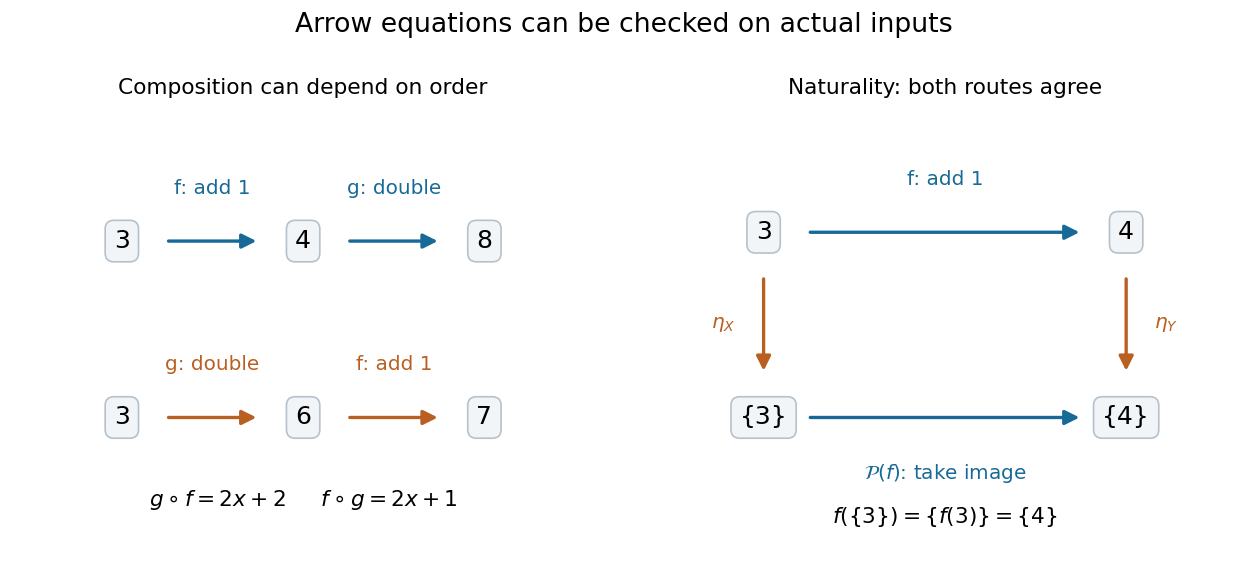
Function composition remembers order, while a naturality square gives equal results along both routes
. Details. 
A partially ordered set supplies a different example: its elements are the objects of a category, with exactly one arrow when , and none otherwise. Transitivity gives composition in a category, and reflexivity gives identity morphisms. For subsets ordered by inclusion, the two chains and have the same composite arrow. Thus arrows need not be maps of elements: they can record a relation.
There are unlisted articles, also show them or only show them.