
Gravitational instability of an astrophysical disk Created 2026-09-24 Updated 2026-11-05
Gravitational instability of an astrophysical disk occurs when a density enhancement attracts enough additional matter for self-gravity to overcome the disk's restoring motions. It can generate spiral density waves or, under suitable thermal conditions, lead to cooling-limited disk fragmentation. Gas pressure and orbital motion oppose collapse on different scales.
For local axisymmetric disturbances of an inviscid razor-thin disk with surface density of a disk , barotropic sound speed and radial epicyclic frequency , the compressive dispersion relation isThe razor-thin disk Poisson kernel supplies the attractive term. Pressure dominates at large wavenumber, while epicyclic motion stabilizes sufficiently small wavenumbers. Minimizing over gives and , where the gas Toomre parameter is . Thus admits exponential local axisymmetric growth; is marginal. Collisionless stellar disks require a different random-motion treatment and numerical normalization.[ref]
On the Gravitational Stability of a Disk of Stars by Alar Toomre. 1964 calculation for stars; fluid versus collisionless stability distinction
Linear growth does not guarantee bound fragments. Compression and shocks heat the gas; continued collapse depends on radiative cooling, transport and the tidal environment. Cooling-limited disk fragmentation therefore asks a further nonlinear question beyond whether an infinitesimal disturbance grows.[ref]
Nonlinear Outcome of Gravitational Instability in Cooling, Gaseous Disks by Charles F. Gammie. Local gas-disk calculations and cooling-dependent nonlinear outcome
Accretion disk Created 2026-09-24 Updated 2026-11-05
An accretion disk is an orbiting flow in which stresses permit matter to move inward by transporting angular momentum to other matter or an outflow. Simply losing heat is insufficient for gas that retains too much angular momentum to reach the center. The stresses also dissipate orbital energy, potentially producing strong radiation. A spreading ring illustrates the exchange: some material can accrete while a smaller fraction moves outward carrying the required angular momentum.[ref]
Thin disk Created 2026-09-24 Updated 2026-11-05
A thin disk has disk aspect ratio , where is its vertical thickness scale and its cylindrical radius. The separation lets radial orbital motion and vertical hydrostatic equilibrium be treated at different orders. In a centrally dominated gas disk, : a low sound speed compared with orbital speed naturally produces a flattened layer. Geometrical thinness alone does not imply large optical depth or efficient radiative cooling.
Black-hole seed Created 2026-09-24 Updated 2026-09-24
A black-hole seed is an early black hole from which a later massive black hole can grow by accretion and mergers.
Tidal disruption event Created 2026-09-24 Updated 2026-09-24
A tidal disruption event occurs when a star passes close enough to a black hole that differential gravity tears it apart outside the capture boundary, producing returning debris and often a luminous flare.
Supermassive black hole Created 2026-09-24 Updated 2026-09-24
Intermediate-mass black hole Created 2026-09-24 Updated 2026-09-24
An intermediate-mass black hole has a mass between stellar remnants and supermassive black holes, approximately --.
Black-hole accretion Created 2026-09-24 Updated 2026-11-05
Black-hole accretion is the inflow of matter onto a black hole, converting some of its gravitational binding energy into heat, electromagnetic radiation and outflows. Matter with substantial angular momentum generally forms an accretion disk; internal stresses transfer angular momentum outward so that matter can move inward. The released energy can be radiated before the material crosses the event horizon. In a thin-disk model the innermost stable circular orbit marks the transition toward rapid plunging motion, although the detailed inner flow depends on the accretion state.[ref]
Dynamics of Astrophysical Discs, Lecture 5: Boundary Conditions and Steady Accretion by Gordon I. Ogilvie. Sections 5.1–5.2: inner black-hole boundary, angular-momentum transport and steady-disk luminosity
The relation defines the radiative efficiency of black-hole accretion, where is emitted luminosity, the mass accretion rate and the speed of light. A radiatively inefficient accretion flow carries much of its available energy inward or into outflows instead of emitting it, so luminosity alone need not measure the mass supply.
Common difference Created 2026-09-24 Updated 2026-10-18
The common difference of an arithmetic progression is the fixed difference between consecutive sequence terms. It gives a finite difference that is independent of position. Checking one adjacent pair finds its value only when the arithmetic progression property is already known; otherwise, other pairs can disagree. For example, the differences in are three and four, so the three entries do not form an arithmetic progression.
Möbius function Created 2026-09-24 Updated 2026-11-05
The Möbius function assigns a cancellation weight to each positive integer:Thus a squarefree integer contributes a sign determined by its number of distinct prime factors; a repeated prime factor makes the weight zero. This packages the alternating signs of inclusion-exclusion into an arithmetic function. [ref]
Floor and arithmetic functions by Darij Grinberg. Darij Grinberg, MIT 18.781 lecture notes, Definition 2.1.2
For example, , , and , since . In contrast, : all three have the square of the prime number as a divisor. On prime powers, and for .
The Möbius function is a multiplicative function: for coprime integers, their prime factors are disjoint, so either a squared prime factor forces both sides of to vanish, or the counts of distinct prime factors add and their signs multiply. It is not a completely multiplicative function, since . Its Möbius divisor-sum identity makes it the inverse of the constant-one arithmetic function under Dirichlet convolution: , the Identity for Dirichlet convolution. This is why the small set of weights can undo an entire divisor sum.
Von Mangoldt function Created 2026-09-24 Updated 2026-11-05
The Von Mangoldt function assigns a natural logarithm weight to each positive power of a prime number. For a positive integer ,Here and throughout the Chebyshev functions, means the natural logarithm. In particular, : the exponent must be positive, even though the convention in prime power allows exponent zero. The support of a function of therefore consists precisely of the prime powers greater than one. [ref]
For example, and , whereas . A composite number can have a nonzero weight: has just one distinct prime factor. But has two distinct prime factors, so its weight is zero. At the weight is , not . This choice lets successive powers record successive copies of the same prime factor in the Von Mangoldt divisor identity.
The Von Mangoldt function is useful because it connects two views of the prime numbers: the prime factorization of an individual integer, through a divisor sum, and the accumulated weights below a cutoff, through the second Chebyshev function. The latter turns questions about the distribution of prime numbers into questions about a partial sum of an arithmetic function.
Divisor function Created 2026-09-24 Updated 2026-11-05
The divisor function counts the positive integer divisors of a positive integer . In particular , because has just one positive integer divisor. More generally the notation gives and the sum-of-divisors function . Thus the divisor function counts the positive integer divisors, while adds their sizes. [ref]
Floor and arithmetic functions by Darij Grinberg. Darij Grinberg, MIT 18.781 lecture notes, Definition 2.1.2 and Theorem 2.1.6
If the prime factorization is with distinct prime numbers and positive exponents , thenThe short proof is a count: each positive integer divisor has a unique form , where . There are choices at each prime number, and choosing them gives every positive integer divisor exactly once. For there are no prime factors and the product is .
For , choose and to obtain . The six values are ; sorted, the positive integer divisors are . Therefore . The diagram makes the independent exponent choices visible.
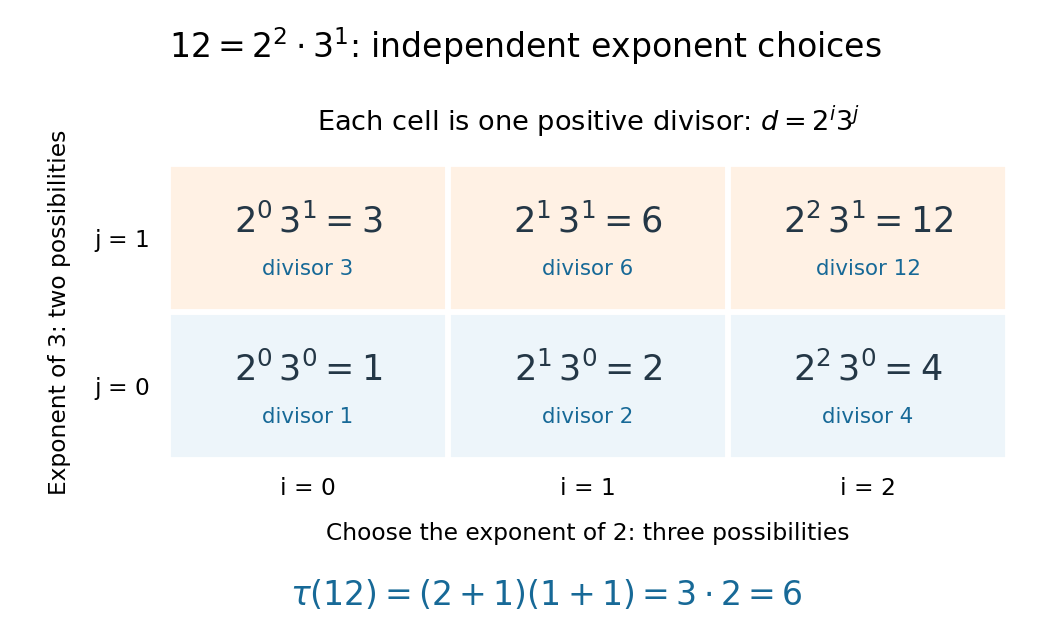
The prime factorization gives a three-by-two array of positive integer divisors , so the divisor function has
. Details. 
This count is useful because a known prime factorization gives without testing every smaller positive integer for divisibility. It also proves the divisor function is a multiplicative function: coprime integers have disjoint prime factors, so their exponent choices combine. For example , but , so it is not a completely multiplicative function. Equivalently, under Dirichlet convolution, counting ordered pairs of positive integers whose product is .
Dirichlet convolution Created 2026-09-24 Updated 2026-11-05
The Dirichlet convolution of arithmetic functions is the arithmetic functionIn the first sum, runs over the positive integer divisors of ; the second uses ordered pairs of positive integers whose product is . Both sums are finite. Each pair contributes one weight from and one from , so Dirichlet convolution combines information attached to complementary factors. It turns a divisor sum into an operation on arithmetic functions. [ref]
Floor and arithmetic functions by Darij Grinberg. Darij Grinberg, MIT 18.781 lecture notes, Sections 2.3 and 2.4: Dirichlet convolution and examples
For the six ordered pairs are . The constant-one arithmetic function gives one per pair, while the identity arithmetic function weights the first factor by its size:Here is the divisor function and is the sum-of-divisors function. By comparison, the pointwise product of arithmetic functions gives and .
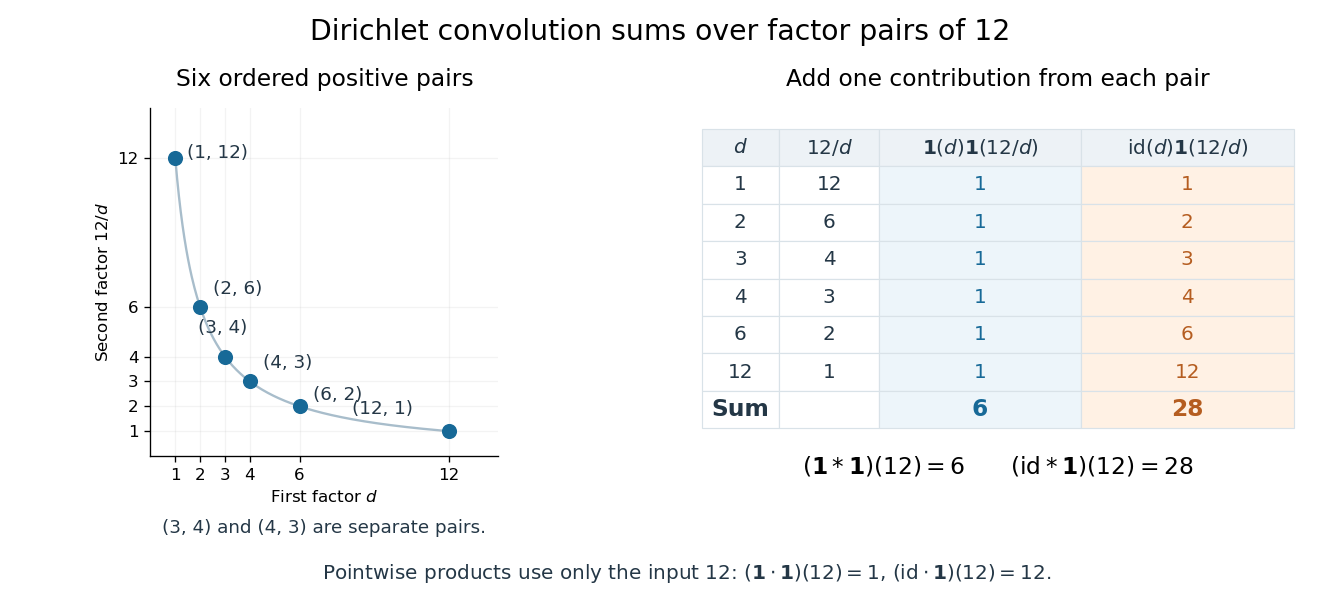
Six ordered pairs of positive integers with product 12 contribute to Dirichlet convolution: one per pair for the divisor function, or the first factor for the sum-of-divisors function
. Details. 
Commutativity follows by swapping the two entries of every ordered pair. Associativity follows by reindexing either grouping over the same ordered tuples of three positive integers:For example, counts ordered tuples of three positive integers with product . Distribute the two occurrences of the prime factor among three entries in ways, and the one occurrence of the prime factor in ways. These binomial coefficients are the stars and bars counts of exponent choices in the nonnegative integers; prime factorization therefore gives such tuples. Directly, the same Dirichlet convolution is .
The Identity for Dirichlet convolution is , and the Möbius function reverses a divisor sum because . This makes Dirichlet convolution useful both for counting factorizations and for recovering an arithmetic function from its divisor sum.
Static coordinates on anti-de Sitter spacetime Created 2026-09-24 Updated 2026-10-13
In four dimensions, global static coordinates have
Addition of angular momentum Created 2026-09-24 Updated 2026-10-03
Riemann zeta function Created 2026-09-24 Updated 2026-11-05
The Riemann zeta function is initially defined by the Dirichlet seriesUnique prime factorization gives its Euler productExpanding each factor as a geometric series chooses an exponent for each prime number, so each positive integer appears exactly once. Absolute convergence justifies this rearrangement. This identity makes the Riemann zeta function a bridge between the distribution of prime numbers and complex analysis.
The function extends meromorphically to the complex plane, with its only pole at , simple with residue . For example, continuation gives even though the defining positive-term series diverges there. The functional equation of the Riemann zeta function relates values at and through the Riemann xi function.[ref]
NIST Digital Library of Mathematical Functions. Sections 25.2(i), 25.4: definition, continuation and reflection formula
For , its negative logarithmic derivative has coefficients given by the Von Mangoldt function. Perron's formula transfers analytic information about its zeros into estimates for prime-counting functions. The Riemann hypothesis specifies the location of its Nontrivial zeros of the Riemann zeta function.
Dirichlet series Created 2026-09-24 Updated 2026-11-05
A Dirichlet series is an infinite serieswith specified coefficients and complex variable . It turns an arithmetic function of positive integers into a complex-analytic object. Examples are the Riemann zeta function, with , and a Dirichlet L-function, with for a Dirichlet character.
Absolute convergence depends on : . In a half-plane of absolute convergence, uniform convergence on compact subsets makes a holomorphic function. The abscissa of absolute convergence of a Dirichlet series records the boundary of that region; continuation can define the same function elsewhere even when its original series diverges.
Multiplying two absolutely convergent Dirichlet series corresponds to Dirichlet convolution of their coefficients, because . In particular, for : each coefficient counts the integer divisors of . Perron's formula reverses this analytic encoding to recover coefficient partial sums.
Sieve theory Created 2026-09-24 Updated 2026-11-05
Sieve theory estimates the number or total weight of integers that avoid specified residue classes modulo prime numbers. The sifting function records what survives. Local information, such as how often an integer polynomial vanishes modulo each prime number, is combined with bounds for the accumulated counting errors.
For example, among the positive integers at most , deleting multiples of , , and leaves . The Chinese remainder theorem predicts a survival density over a full period of length . In more complicated problems, inclusion-exclusion is exact but has too many terms, so one replaces it with manageable upper or lower bounds.
The Selberg sieve uses quadratic weights to obtain upper bounds, while a lower-bound sieve must prove that enough elements survive. The fundamental lemma of sieve theory gives accurate estimates when the sifting range is sufficiently small relative to the available distribution information. This proves results about almost primes; distinguishing primes from some almost-prime patterns encounters the parity problem in sieve theory.[ref]
Harmonic number Created 2026-09-24 Updated 2026-10-13
Invariance principle for a low-degree multilinear polynomial Created 2026-09-24 Updated 2026-10-13
Let and be independent, centered, variance-one random variables with vanishing third moments and fourth moments at most . If is multilinear of degree at most and , then
There are unlisted articles, also show them or only show them.