
Negative binomial deviance 2026-10-14
With known size , the mean-dependent log mass of a negative binomial distribution is . Its derivative is , so the saturated mean is , including its boundary value zero. Subtracting the fitted log mass from that maximum gives the displayed deviance. This formula needs no fitted-intercept cancellation. As , its second term tends to and it becomes the full Poisson deviance.
Curry fixed-point combinator 2026-10-14
With , the combinator satisfies . Every finite reduct of is, up to alpha equivalence, : the remaining copy of is its only beta-redex.
Turing fixed-point combinator 2026-10-14
Put and . Then . Unlike the Curry fixed-point combinator, every finite reduct retains a closed subterm . Contracting this subterm recreates one; every other generated redex substitutes a variable and preserves it. The Church-Rosser theorem therefore proves .
Take the original sphere on the tube axis, with diagonal positive hydrodynamic resistance matrix and axial force . Add a freely moving neutral sphere and extend its rigid velocity through its interior. The resulting field is admissible in the original domain, so its dissipation obeys for any finite nonoverlapping placement of the extra sphere. Since only the first sphere does external work, , giving the displayed bound without assuming zero transverse velocity or rotation. Strictness follows because equality would require the original nontrivial analytic flow to have zero strain throughout the added ball.
For , moving the Mellin contour past the pole at one, the Nontrivial zeros of the Riemann zeta function, and the remaining poles givesZeros are included with multiplicity. The Riemann–von Mangoldt formula makes the zero sum absolutely convergent. If every nontrivial zero has real part below one, division by and dominated convergence give . Monotonicity of then recovers by upper and lower difference quotients.
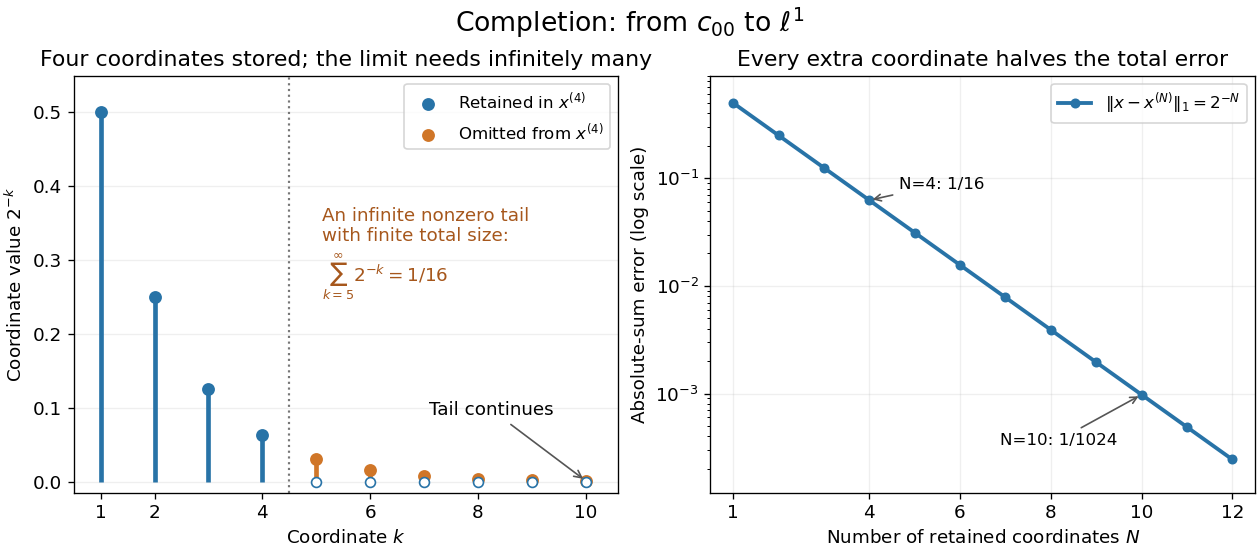
Equip the vector space of finitely supported sequences with the norm inherited from the absolutely summable sequence space. Consider the truncationsFor , the geometric series givesTherefore is a Cauchy sequence. Any possible norm limit must have coordinate equal to , since . That forces infinitely many nonzero coordinates, so no limit lies in . There is nothing wrong with the approximations: the space is missing their limit.
Inside the absolutely summable sequence space, the limit is and its exact truncation error is . Four retained coordinates leave error ; ten leave . More generally, truncating any element of the absolutely summable sequence space leaves a tail whose norm tends to zero. Together with completeness, this identifies that Banach space as the completion of a normed space with this norm. Finite storage and an infinite mathematical object fit together through a controlled error.

Integral fluctuation theorem 2026-10-14
Normalization of the reverse law gives an exact finite identity:The sum notation describes discrete paths; the corresponding path integral has the same change-of-variable argument. Jensen's inequality for the exponential function then gives , hence . Equivalently this mean is the Kullback-Leibler divergence between the forward path law and the reverse path law pulled back by . Equality requires those two laws to agree. [ref]
Entropy production along a stochastic trajectory and an integral fluctuation theorem by Udo Seifert. Seifert, 2005, Eqs. (17)–(18): integral relation and its mean inequality
Rare negative entropy production contributes disproportionately to this expectation through . Missing such events in a finite sample can spoil an estimate of the identity. Matching probability support is also essential: reverse paths absent from the forward law cannot be recovered by cancelling forward weights. This Second law of thermodynamics statement concerns an ensemble average; an individual negative value is compatible with it.
In a Fokas method boundary integral over , where inside, the contribution of replacing by is an integral of times an holomorphic coefficient. For it vanishes by the Cauchy integral theorem and the exponential decay in the upper domain. The transformed amplitude is then independent of the observation time, which simplifies differentiation of the partial differential equation. Temporal inversion at recovers the full boundary value rather than the half-value of a truncated transform at its endpoint.
Spanier-Whitehead dual 2026-10-14
The Spanier-Whitehead dual of a finite spectrum is . It is finite, and evaluation and coevaluation give the natural Spanier-Whitehead duality adjunction.
A product of reflections has , by the rank inequality applied successively to . Conversely an orthogonal transformation fixes the orthogonal complement of its moved space; successive Householder reflections fix one new basis direction at each step in that moved space. At most its dimension are required. Thus central inversion in three dimensions needs exactly three reflections.
Finite-interval Airy spectral determinant 2026-10-14
Here . The missing-trace matrix has determinant . Its nonzero zeros are the eigenvalues in the parametrization of with . Integration by parts gives . No nonzero zero lies in : on its boundary the determinant equation reduces, after rotation, to an equality between a unit-modulus exponential and , whose modulus exceeds one unless . The zero at the origin is removable in the original boundary problem. There are nevertheless infinitely many genuine negative eigenvalues of , obtained from , , with . Absence of contour poles in the Fokas method does not imply absence of discrete spectrum of the operator.
Deligne-Lusztig theory 2026-10-14
Deligne-Lusztig theory constructs virtual characters of finite groups of Lie type from compactly supported étale cohomology of varieties associated with Frobenius and flags. Rational maximal tori and their finite-group characters provide induction data, while the geometry explains character orthogonality and cuspidality.
Harish-Chandra induction 2026-10-14
For a rational parabolic subgroup , use inflation of a group representation for a complex -module across and induce it to . This is Harish-Chandra induction. Its adjoint, Harish-Chandra restriction, takes -invariants. These are ordinary finite-group group representation functors and should not be confused with general Deligne-Lusztig induction from a nonrational Borel.
For ordered states , in the moving frame the first and last exponents in the finite-exponential Cole-Hopf solution have the same leading coefficient. Each interior state's coefficient is smaller by . Thus the large- moving-frame profile is the two-state shock between the extremes. At fixed , the endpoint of largest absolute value dominates; equal opposite extremes leave a stationary shock.
Finite-buffer workload rate truncation 2026-10-14
For the local convex action defining the linear workload rate for a local convex action, continuity and the contraction principle for large deviations give workload rate functions. The pointwise bound makes on nonnegative workloads. Constant-rate burst paths produce the reverse bound for x at most B. Values outside the buffer interval are impossible. This statement concerns the rate at the workload value, rather than equality of exact finite-buffer and infinite-buffer stationary distributions.
Use the clipped Lindley recursion and the weighted cumulative-input topology for a slotted queue. If cumulative past input eventually with , choose a finite so . Starting with a full buffer at time , the queue must hit zero before the present, since otherwise its final workload is at most . Monotonicity couples all initial workloads by that zero, establishing a finite memory horizon. The same horizon works for sufficiently close input . Since and clipping is Lipschitz continuous with constant one, the two finite recursions started empty differ by at most .
Filtered-graded transfer for complete rings 2026-10-14
For a complete separated multiplicatively filtered ring with nonnegative integer valuations, a domain associated graded ring makes the original ring a domain: the leading symbols of two nonzero elements have nonzero product. If the graded ring is left Noetherian, lift finitely many homogeneous generators of the graded ideal of a left ideal. Successively cancelling leading terms leaves remainders of increasing valuation. Completeness makes the coefficient series converge, expressing every ideal element as a finite sum of the chosen generators with completed coefficients. The right-handed argument is identical. Completeness is necessary for this infinite cancellation proof.
For an exhaustive nonnegative increasing multiplicative filtration, each left ideal induces a homogeneous ideal in the associated graded ring. If that graded ring is a left Noetherian ring, lift a finite homogeneous generating set of to elements of . For any element of , subtract a combination of these lifts with the same leading symbol; the remainder has strictly lower degree. Induction on the nonnegative degree proves the lifts generate . There is no completion hypothesis because the cancellation terminates in finitely many steps. The analogous result holds for right ideals.
Filtration of a ring 2026-10-14
A filtration of a ring is an exhaustive increasing family of additive subgroups , with and the displayed multiplicativity condition. Its associated graded ring is . It differs from a probabilistic filtration, which is a nested family of sigma-algebras.
In a filtered colimit in a category of sets, any finite zigzag of generating identifications can be moved to one common stage. The filtered category conditions supply common objects and equalize the finitely many competing arrows. Consequently finitely many representatives and finitely many equalities can be realized simultaneously at one stage. This is the elementwise reason filtered colimits commute with finite limits in sets.
There are unlisted articles, also show them or only show them.