
For real polynomial , , the zero mode of is normalizable on exactly when is odd and . Its squared modulus has leading exponential . Odd gives the same tail sign at both ends; positivity of makes both tails decay. This kernel is one-dimensional because is a first-order differential equation. On the operator domain where integration by parts is valid, the energy form is .
At fixed sphere rotation in an annular Stokes flow, add rigid particles with zero net force and torque. Extend their actual rigid velocities through their interiors. The extension is an admissible incompressible competitor in the particle-free annulus, with zero interior rate-of-strain tensor. The Minimum-dissipation theorem for Stokes flow gives . The boundary-work identity gives , because the stationary outer wall and the freely moving particles contribute no power. Equality would require the extension to equal the unique particle-free flow, whose strain cannot vanish on a finite particle volume when . Thus the resistance component along the imposed rotation strictly increases.
On a compact oriented Riemannian manifold without boundary, the Generalized Stokes theorem applied to gives the displayed identity. The product expansion is . With boundary, the omitted boundary integral is .
The linearization at a travelling wave is . Conjugation by changes this to . The choice removes the first derivative and makes the operator self-adjoint. Its two limiting potentials are and , so essential-spectrum invariance under relatively compact perturbations gives . This lies strictly below zero for but touches zero at the critical speed. Stability of this essential spectrum alone is not a general nonlinear stability theorem.
Exponential of covariant set-valued functors 2026-10-14
For a small category, this formula defines the exponential object in its covariant set-valued functor category. An arrow acts by precomposition with . Evaluation applies a natural transformation to ; currying a map sends to the transformation . The formulas prove the universal property directly, without an adjoint existence theorem.
Gaussian quadratic exponential moment 2026-10-14
For a real standard Gaussian random vector , a real symmetric matrix , and strictly positive,Diagonalize and complete the square in each coordinate. Failure of strict positivity makes the positive exponential integral divergent. The same formula extends to a self-adjoint trace-class quadratic form of an isonormal Gaussian process, with square-summable linear coefficients and a Fredholm determinant. A linear-plus-quadratic Gaussian random field functional is reduced to this form by its covariance square root.
Let have integrable, mean-zero independent and identically distributed random variables as increments, taking integer values at most one, with . For a positive integer , put and , . Then is finite almost surely. Indeed, is a nonnegative martingale; finite convergence on would force its integer increments eventually to vanish, contrary to the Borel-Cantelli lemmas applied to .
The exponential martingale of a random walk stopped at is bounded by because and . The dominated convergence theorem therefore preserves its mean one at the limit and proves the displayed first-passage time transform. This argument accommodates arbitrarily large negative jumps; the restriction concerns upward jumps. For a simple symmetric random walk, , giving .
For a random walk with independent and identically distributed random variables as increments, let define its finite-time exponential tilting. Under the tilted law, is a martingale: the conditional mean of is one. For a stopping time , partition into and apply the tower property of conditional expectation to obtain the displayed identity. Only finite-time absolute continuity of measures is needed; there need not be an infinite-horizon likelihood-ratio density.
The strong law for Brownian motion gives . For every , eventually . Integrating these bounds, taking logarithms and dividing by squeezes the growth rate between and . Let . The corresponding inverse clock grows like .
Geometric-attempt exponential backoff 2026-10-14
A packet with previous collisions attempts independently in each slot with probability . On failure it advances to stage , and on success it leaves. The Markov chain state records the number of packets at every stage, rather than only the total backlog. This memoryless-window model is related to binary exponential backoff, but its geometric waiting times differ from uniform counters in finite retry windows.
// Target: probability-and-statistics.bigb
Zero-start Ornstein-Uhlenbeck covariance 2026-10-14
For with , the explicit stochastic integral is . The Itô isometry on the overlap of the two integration intervals gives the displayed covariance. The second exponential records the zero initial condition; removing it gives the stationary Ornstein-Uhlenbeck process covariance.
Finite-difference option Greeks 2026-10-14
The logarithmic coordinate requires the displayed chain-rule factors for option delta and option gamma. If only a value error bound is known, central differentiation gives and . Thus first and second Greek convergence do not follow with the same order from a value bound alone. With a smooth spatial error expansion and corresponding derivative control, both Greeks can instead retain second-order convergence away from a nonsmooth payoff or boundary. Refinement and Greek-specific regularity are essential to distinguish these situations.
Transit dilution 2026-10-14
Constant extra light makes an exoplanet transit appear shallower. If the host star supplies out-of-transit observed radiative flux and an unresolved source supplies , let . Then . For , a true exoplanet transit depth of appears as ; ignoring transit dilution gives a radius ratio instead of , under the same uniform-disc assumptions.
Cylindrical pump-loss balance 2026-10-14
For a stationary pumped condensate in a closed cross-section, integrate the gain-loss Madelung equations. Vanishing lateral condensate number current and constant integrated axial current imply the displayed balance. It fixes a density-weighted mean, not the pointwise density. If the integrated axial current varies, the exact relation instead is . Thus lateral no-flux conditions alone are insufficient for a slice-by-slice balance in an axially inhomogeneous state.
Two-dimensional viscous shearing wave 2026-10-14
For and , define . Uniform rotation does not enter its evolution: , and . With and , the perturbation energy ratio is . Leading waves can gain energy as shear reduces their wavevector magnitude, before viscosity and subsequent winding damp them.
// Target: hydrodynamic-stability.bigb
Exact magnetic shearing wave 2026-10-14
In an incompressible shearing sheet, a single real-wavevector velocity and magnetic Fourier mode transverse to that wavevector has identically zero quadratic self-advection and cross-advection. Advecting its phase by background shear and stretching its spatially uniform field give the displayed evolution laws. Their opposite contributions keep the Alfvén frequency constant. The resulting viscous and resistive wave-amplitude equations are exact finite-amplitude solutions; physical pressure adjusts to the quadratic magnetic-pressure terms.
E8 lattice 2026-10-14
The positive-definite rank-eight even unimodular lattice can be realized as vectors in or whose coordinate sum is even, with the ordinary Euclidean inner product. Negating this form gives in the K3 intersection lattice.
Degree-two even elliptic function 2026-10-14
An even elliptic function descends through the degree-two quotient map to a rational function on the Riemann sphere. If the original function also has degree two, composition of map degrees gives , so has degree one. Consequently it is a Möbius transformation with . The shift is even and has degree two, providing an example for the common period lattice of the Jacobi elliptic sine and .
Use the cellular chain complex or simplicial chain complex over , rather than the infinite singular chain complex. Put , with . The rank-nullity theorem gives ; quotienting the chain cycles by the chain boundaries then gives . Each boundary operator's rank occurs in adjacent degrees with opposite signs, soFiniteness makes this cancellation an ordinary finite sum. This is the algebra behind the cell-count formula for Euler characteristic.
Continue the initial value problem , , to using the Euler-Heun embedded pair. Choose absolute and relative error tolerances and , so the scalar scale is throughout. This intentionally absolute-only test makes the local and accumulated errors directly comparable. Start with , accept the Heun's method endpoint precisely when , and after every trial use the capped adaptive step-size controllerFor use the growth factor two. Cap every trial at ; on rejection retain the old time and state. These choices specify an original computation, rather than a claim about the defaults of a particular software solver.
The initial trial has and is rejected. Retrying from with gives and is accepted. The run takes 315 accepted steps and one rejected trial. Increasing exponential growth makes the local error estimator grow at a fixed , so subsequent steps shrink roughly like . The final step is additionally shortened to land at .
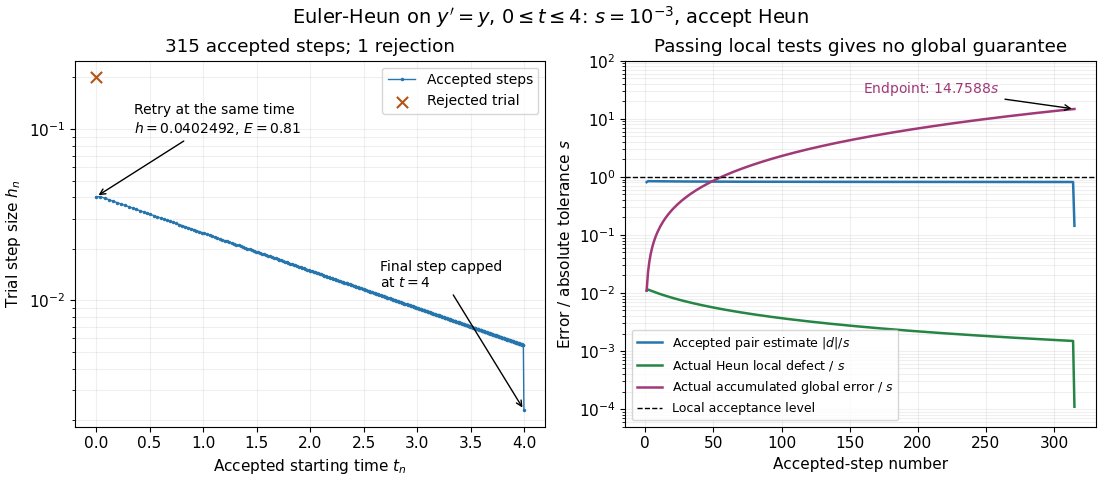
Computed Euler-Heun step sizes and errors: every accepted local estimate passes, but accumulated global error exceeds the absolute tolerance
. Details. 
The right panel plots errors against the accepted-step number, all divided by the same . The actual Heun local defect uses the restarted exact endpoint , while actual global error uses . All accepted are at most one, and the actual Heun local defects here are even smaller, at most about . Nevertheless the endpoint is , versus , with absolute error about . Passing local tests therefore does not certify the original trajectory's global error.
This failure of a global guarantee has an exact explanation for this example. Put and . ThenEach new local defect is added to the previous error amplified by . Iterating this identity, rather than merely inspecting , accounts for accumulation. The variable-step global ODE error bound describes the corresponding mechanism for more general ordinary differential equations.
Repeating with gives 98 accepted steps, one rejection and endpoint absolute error about ; with it gives 1001 accepted steps, two rejections and endpoint absolute error about . Accuracy improves on this smooth problem, but the endpoint error remains about fifteen times the requested local scale. A different initial value problem can amplify or damp defects differently.
There are unlisted articles, also show them or only show them.