
A nilpotent group is finite exactly when its abelianization is finite; finite generation is not a separate hypothesis. Induct on the nilpotency class . The abelian case is immediate. Otherwise has smaller class and the same abelianization, so is finite. Let , . Their commutator subgroup is central. Hence its commutator map is a homomorphism in each variable. Both centralizer quotients are finite because their kernels contain . Finitely many pairs of coset representatives therefore generate the abelian group , and its exponent divides the exponent of . It is finite, completing the induction.
Square-zero element 2026-10-31
An element of an associative algebra is square-zero if its square vanishes. Every such element is a nilpotent element. These elements are preserved by an algebra isomorphism, so their structure distinguishes algebras. Their set need not be a vector space: the matrix units and are square-zero, while their sum has square equal to the identity in . In a square-zero ideal, by contrast, every pairwise product vanishes and all its elements are square-zero. In the square-zero elements are exactly the multiples of , over every field: forces .
Open neighbourhood 2026-10-31
An open neighbourhood of a point in a topological space is an open set containing . A general neighbourhood need only contain an open neighbourhood; it need not itself be open. A finite intersection of open neighbourhoods of the same point is again an open neighbourhood, by the topology axioms.
Double-negation introduction 2026-10-31
From , temporarily assume . Negation elimination rule gives logical falsity; discharge that temporary assumption by negation introduction to obtain . This is valid in Intuitionistic propositional logic, unlike unrestricted double-negation elimination.
Exclusive-or natural deduction rules 2026-10-31
Introduce exclusive or from either or . To eliminate , derive the same conclusion in two subproofs, one under and the other under , then discharge both pairs of case assumptions. These rules express exactly the two disjuncts of the displayed disjunctive normal form. Conjunction introduction and disjunction introduction derive that formula in each elimination branch; conversely disjunction elimination and conjunction elimination supply the two introduction cases. This proves equivalence without adding an unproved truth-table inference to a formal derivation.
Biconditional introduction rule 2026-10-31
Derive each side of a logical biconditional under a temporary assumption of the other, then discharge both assumptions. The surrounding assumptions remain. This is equivalent to deriving the two implications and combining them as the two directions of equivalence.
Equality introduction rule 2026-10-31
The reflexivity rule for first-order equality: any well-formed term satisfies without additional premises. Together with the equality elimination rule, it derives symmetry: from and , substitute in the first designated argument position of to obtain . Transitivity follows from and by substitution in the second designated argument position of .
Weakening 2026-10-31
Adding unused assumptions to the context of a logical derivation. The original derivation still proves the same conclusion because it need not use every available assumption. When eigenvariables are used, rename them first if necessary to preserve the eigenvariable condition for any newly added assumptions. This explains how disjunction elimination with different branch contexts can be written using a common context containing all their assumptions.
Proof goal transformation 2026-10-31
Reading an inference rule backwards to replace a desired conclusion by sufficient subgoals. A conjunction goal can be replaced by its two conjuncts using the conjunction introduction rule; an available disjunction can instead lead to two case subgoals using the disjunction elimination rule. Different choices change the organization and sharing of subproofs. Scope and assumption discharge conditions remain obligations even when a rule is applied backwards during proof search.
Cataplasma Sinapis Created 2026-10-31 Updated 2026-11-05
Cataplasma Sinapis is a mustard poultice. Hydration of crushed seed material changes its chemistry, distinguishing the prepared material from dry intact seeds.[ref]
The Essentials of Materia Medica and Therapeutics by Alfred Baring Garrod (1865). Cataplasma Sinapis, named preparation in the corresponding monograph
For a diffusion-controlled mushy layer of constant solid fraction , a sharp moving edge reduces the thermal heat equation to and the exterior solute diffusion equation to , where is the Lewis number. Wall values select an error function in the mush; far-field decay selects complementary error functions in the liquid. Continuity fixes their amplitudes in terms of the interfacial temperature and . The Stefan condition, solute conservation and marginal equilibrium at a mush-liquid boundary give three algebraic/transcendental equations for these two constants and . Derivation follows by and , followed by one integration . Dividing interface equations can discard degenerate branches, so the undivided equations must be retained when a denominator vanishes. Physical admissibility additionally requires and .
Muscle force 2026-10-31
A force exerted by an active or passively stretched muscle. Its contribution to rotation about an anatomical joint depends on the muscle moment arm, rather than its magnitude alone.
Multiset multiplicity 2026-10-31
Additive multiset union 2026-10-31
The operation adding multiset multiplicities pointwise. Its result retains all occurrences from both operands. Some sources use the name multiset union instead for pointwise maximum, so a contract should state which operation is meant.
Multicast distribution tree 2026-10-31
Reverse path forwarding 2026-10-31
Liquor Morphiae Hydrochloratis Created 2026-10-31 Updated 2026-11-05
Liquor Morphiae Hydrochloratis is a solution of morphine hydrochloride. Its concentration and solvent are necessary to interpret the historical formulation.[ref]
The Essentials of Materia Medica and Therapeutics by Alfred Baring Garrod (1865). Liquor Morphiae Hydrochloratis, named preparation in the corresponding monograph
Prefix-suffix sequence recognizer 2026-10-31
For a fixed word , store the length of the longest suffix of the received stream that is also a prefix of . On a new input symbol, append it to the represented prefix and select the longest resulting suffix that is a prefix of . The complete-word state signals recognition. Its outgoing transitions retain proper suffix matches, allowing overlapping occurrences rather than automatically restarting from the empty prefix. This is the finite-state form of the prefix information used by the Knuth-Morris-Pratt algorithm.
For example, recognizing needs suffix-prefix states of lengths zero through four. After a complete match followed by one, the last two symbols are , so the next state retains length two. This permits the second match in without clearing the useful suffix.
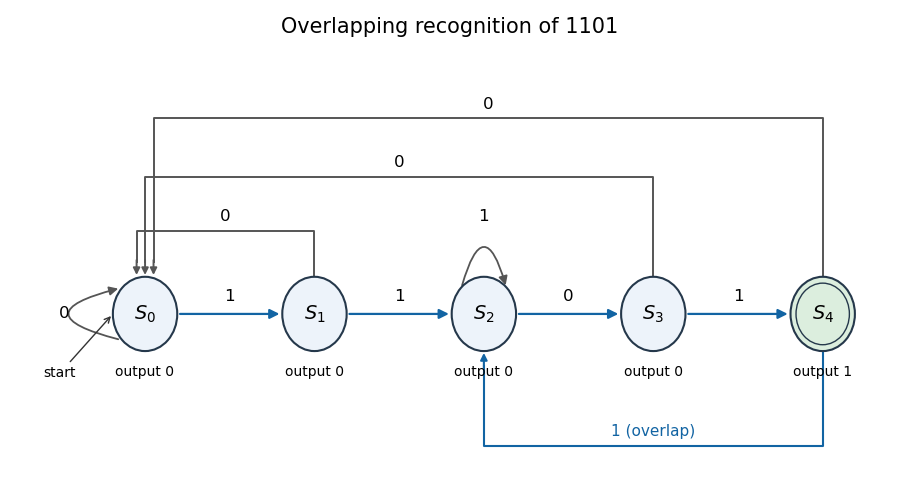
An overlapping prefix-suffix sequence recognizer for
. Details. 
One-clock Moore pulse 2026-10-31
Enter a distinguished Moore machine state whose output is active, and ensure that every outgoing transition leaves that state for an inactive-output state. The output then lasts one clock period. Its outgoing transitions may simultaneously recognize the start of the next event, avoiding an unnecessary idle cycle. The one-period statement refers to the synchronous logical model, with ordinary propagation delay after each clock edge.
Rearmable one-cycle pulse generator 2026-10-31
A synchronous sequential circuit can use three states: armed, pulse, and waiting. Only the pulse state has output one. A reset input rearms the circuit, including when it arrives during the pulse cycle; this permits pulses on alternate clock cycles while each pulse still lasts exactly one cycle.
There are unlisted articles, also show them or only show them.