
Use determinant-one Givens rotations and choose every nonzero eliminated pair to leave a positive pivot. If the input square matrix is orthogonal, its resulting upper triangular factor is orthogonal too, and hence diagonal with entries of absolute value one. Positivity fixes the first entries to one, while determinant preservation fixes the last to . A negative last entry is unavoidable when the input reverses orientation.
Ultrafilter characterization of closure of an image Created 2026-10-31 Updated 2026-11-05
A point lies in exactly when some ultrafilter containing has pushforward converging to . For the forward implication, the sets for neighborhoods of form a filter base; extend to an ultrafilter. For the reverse implication each such intersection belongs to a proper filter and is nonempty.
Pterocarpus santalinus 2026-10-31
The source of the sliced or rasped heartwood called Pterocarpi lignum.
A tree on labels has one root of degree two, other interior vertices of degree three, and leaves precisely when its Prüfer code contains one label once, labels twice, and all other labels zero times. The Prüfer degree formula gives both directions, and identifies the root as the uniquely once-occurring label. Children are unordered unless a plane embedding is additional data.
Gödel-Löb logic 2026-10-31
The Gödel-Löb logic has propositional tautologies, and as axiom schemes. Its rules are modus ponens rule and the necessitation rule; uniform propositional substitution is built into the schemes. Under an arithmetic realization, each axiom and each rule preserves provability in a theory with the Hilbert-Bernays-Löb derivability conditions and diagonalization. This proves arithmetic soundness by induction on derivations; it is distinct from claiming that every true arithmetic sentence is provable.
For a proper matching in a rooted tree, the number of unmatched vertices in a matching does not exceed the number of leaves of a rooted tree. From each unmatched vertex, build a downward path: at an internal current node that is unmatched or matched upward, every child must be matched downward to one of its own children, or properness would fail. Follow a child and its matching partner, then repeat. The path terminates at a leaf and contains no other unmatched vertex. Two such downward paths cannot meet, since then one unmatched starting point would lie on the other's path. Their distinct endpoints give the required injection. No maximum-size assumption is needed.
Countable product metric 2026-10-31
The displayed metric on a countable Cartesian product of metric spaces combines the bounded metric transform with summable positive weights. It is finite even when individual factor metrics are unbounded. The triangle inequality follows from subadditivity of and summation. Zero distance forces equality in each coordinate.
Convergence in this metric is exactly coordinatewise convergence. One term is bounded by the sum, so implies each . Conversely, choose a finite head whose omitted weight sum is small; convergence in those finitely many coordinates controls the head uniformly, while boundedness of the transformed distances controls the entire tail. Thus it induces the countable product topology. Arbitrary positive summable weights work by the same proof.
Nonprincipal ideal generated by a prime and an indeterminate Created 2026-10-31 Updated 2026-11-05
For a prime number , the ideal in the polynomial ring is proper: the constant coefficient of every member is divisible by . If , then divides the nonzero constant , so the additivity of polynomial degree over an integral domain makes constant. Since also divides , it must divide its leading coefficient ; thus . This would make the ideal the whole ring, a contradiction. Therefore is not a principal ideal domain, and hence not a Euclidean domain.
Let be an irreducible element of a principal ideal domain , and suppose . The ideal has generator dividing . Irreducibility makes a unit or an associate of ; the latter would imply . Hence , giving for some . If , multiply this identity by : both and are divisible by , so . This is precisely the prime element property.
Flux average for a translating lubrication gap Created 2026-10-31 Updated 2026-11-05
In dimensionless Couette-Poiseuille flow in a thin gap with lower-wall velocity one and stationary upper wall, the conserved volume flux satisfies . Equal pressures at the two ends imply and give the displayed expression. It is a weighted average of the positive gap height with weight , so . The local pressure gradient has the sign of , making the flux constraint useful for locating pressure extrema without solving for the pressure explicitly.
Reachability preorder 2026-10-31
Reachability in a directed graph, allowing length-zero paths, is a preorder: zero steps give reflexivity and concatenation gives transitivity. Distinct mutually reachable vertices violate antisymmetry. Its equivalence classes under mutual reachability are the strongly connected components; the induced reachability relation on those classes is a partial order. Equivalently, contracting the classes gives the acyclic condensation graph.
For outer tangential speed in steady Prandtl boundary-layer equations, the displayed similarity solution makes the streamwise convection, pressure gradient and transverse viscous diffusion have the same exponential factor. Its profile equation is , with and . Attached far-field matching requires : the outer speed increases along the direction of motion. Linearizing at large gives . For positive there is a Gaussian-decaying mode, while negative leaves only growing nontrivial asymptotic modes. Local thinness additionally requires a large Reynolds number based on the speed and its streamwise variation length.
Power-set product cardinality inequality 2026-10-31
For arbitrary sets each containing at least two elements, the displayed inequality follows by explicitly encoding two subsets in disjoint parts of a Cartesian product. Choose and , put along the row , put along the column , and add the extra point precisely when . These regions are disjoint, so the encoding recovers both and and is an injection from into . This proves the cardinality inequality even for infinite sets. For finite sizes , the same result is , since . Mapping to is insufficient because all pairs with an empty factor collapse.
Surface stagnation points of a circulating cylinder flow Created 2026-10-31 Updated 2026-11-05
For complex potential of a two-dimensional potential flow , zeros of the complex velocity solve a quadratic. If , the displayed two roots are distinct and both have modulus ; positive circulation places them above the centreline. Their polar angles satisfy . At the threshold they merge at the top of the cylinder. This follows also from the surface tangential velocity . The shifted stream function is constant on the cylinder.
Source-driven porous-medium similarity front 2026-10-31
For the nonlinear diffusion equation on , the fixed boundary value and zero slope at admit the displayed compact-support similarity solution, with front . Substitution reduces the equation to . The boundary data make the integration constant zero. While , division gives , hence . At its first zero the diffusive flux vanishes, so extension by zero creates no singular flux term. The solution is smooth inside its positive region and is a weak solution at the moving front.
On a symmetric interval with an even positive weight, the best least-squares polynomial approximation to an odd function is odd, and the approximation to an even function is even. Indeed, the even and odd polynomial subspaces are orthogonal. For odd , write a candidate as . ThenDeleting a nonzero even component strictly reduces the error, so the minimizer has . The same argument exchanges the parities for even . This reduces the normal equations to the matching parity block and avoids computing coefficients known in advance to vanish.
For the weight on , the normal equations for projecting onto have Gram matrix and right side . Its determinant is , and inversion gives the displayed polynomial. orthogonality of the residual to both basis functions proves best approximation in the weighted norm.
Symmetric node pairing bound for interpolation on the unit interval Created 2026-10-31 Updated 2026-11-05
Suppose interpolation nodes in occur in pairs , with the middle node if is odd. For each pair,because both squared quantities lie between zero and one quarter. An unpaired middle factor has magnitude at most one half. Multiplication gives the displayed bound on the nodal polynomial.
The polynomial interpolation remainder therefore satisfies for . For , the derivative bound gives the particularly simple error bound . This proves uniform convergence for these symmetric-node interpolants of that function. It is not a general convergence theorem for arbitrary continuous interpolation data.
Triangulation of a polygon with paired sides 2026-10-31
Triangulate a closed polygon by joining an interior point to every side, using matching parametrizations on paired sides. Orient every radial edge away from the interior point and choose consistent orientations on paired boundary edges. Each triangle then has a local vertex ordering with the centre first and its boundary edge in the chosen direction. These local orderings agree along shared edges. The quotient triangles and their affine face identifications form a finite delta-complex, even if some triangle vertices become identified. The second barycentric subdivision of a delta-complex removes these identifications at the simplicial level without changing the underlying quotient space. Thus every polygonal schema with a complete pairing has a finite triangulation. A single subdivision need not suffice to give an abstract complex.
Standard polygon words for closed surfaces 2026-10-31
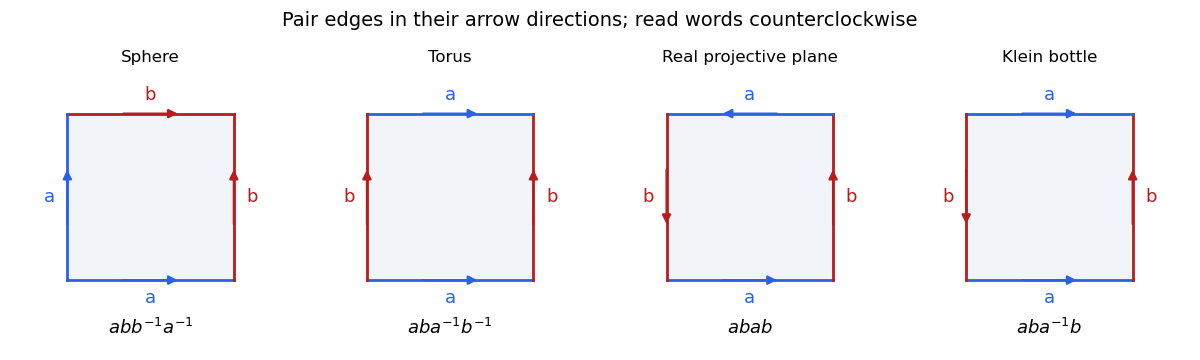
Read a boundary word counterclockwise, giving every paired edge a label. A positive exponent means the edge arrow agrees with the boundary traversal, and an inverse means it disagrees. Identify equally labelled edges in their arrow directions. The sphere has a square word ; the vertex count is three, giving Euler characteristic . A closed orientable surface of genus has wordA nonorientable surface which is the connected sum of surfaces of real projective planes has word . For , this is a digon; the square word , identifying antipodal boundary points, is another model of the real projective plane. The Klein bottle has square word , representing the nonorientable case . The classification theorem for closed combinatorial surfaces says that these orientable and nonorientable families exhaust the connected closed cases.

There are unlisted articles, also show them or only show them.