
Past exam of the quantum condensed matter course of the University of Cambridge 2008 Section B B2 d Solution Created 2026-10-18 Updated 2026-10-20
In a two-dimensional electron system under a perpendicular magnetic field, orbital energies form Landau levels with spacing . Each resolved spin level has states in area . At integer filling, the integer quantum Hall effect has Hall conductance in magnitude and vanishing longitudinal conductance in the ideal plateau regime; inversion of the conductivity tensor gives Hall resistance .
A Hall-bar experiment cools the sample, passes a small current and records longitudinal and transverse voltages while sweeping the field. The Hall resistance develops plateaus while the longitudinal resistance develops minima. Disorder broadens the Landau levels and localizes many bulk states, allowing the chemical potential to move through a range of carrier density without changing the number of conducting edge channels. Extended states near a Landau-level center allow transitions between plateaus. Spin splitting determines which integer sequence is resolved. The robustness comes from the quantum state and its edge transport, rather than the Hall bar having a specially calibrated geometric width.
Past exam of the quantum condensed matter course of the University of Cambridge 2008 Section B B2 c Solution Created 2026-10-18 Updated 2026-10-20
The Hubbard model combines band motion and local repulsion:Hopping favors itinerant states, while positive penalizes simultaneous opposite-spin occupation on one site. In a uniform mean-field treatment, a spin imbalance reduces the interaction cost but raises the band-filling energy. The Stoner criterion for instability of the unpolarized metal is when is the density of states per site, per energy, for one spin. Using a total two-spin density of states changes the displayed numerical convention.
The ordered mean-field state has exchange-split spin bands and a spontaneous magnetization, with the kinetic and interaction costs balancing at equilibrium. This is a model of itinerant ferromagnetism, not a guarantee that every repulsive Hubbard system becomes ferromagnetic. Filling, lattice structure and competing order matter: near half filling on a bipartite lattice, antiferromagnetism and a Mott insulator can be favored instead. The approximation also omits important spin fluctuations and strong-correlation effects.
Past exam of the quantum condensed matter course of the University of Cambridge 2008 Section B B2 b Solution Created 2026-10-18 Updated 2026-10-20
Thomas-Fermi screening treats the carrier density locally as that of a uniform electron gas whose chemical potential is shifted by the slowly varying electrostatic potential. Linearizing gives for electrons. The resulting screened Poisson equation has inverse screening lengthFor a degenerate gas, including both spins, giving Thomas-Fermi screening length . A nondegenerate semiconductor instead has , giving the Debye length . Electrons and holes contribute additively to the charge susceptibility when both are present; the lattice permittivity replaces the vacuum value.
The approximation requires a potential varying slowly compared with microscopic electronic length scales and a small perturbation for the linearized result. It captures smooth electrostatic screening, but not the full nonlocal response or Friedel oscillations. Low carrier density or carrier freeze-out can make a semiconductor's screening much weaker than a metal's.
Past exam of the quantum condensed matter course of the University of Cambridge 2008 Section B B2 a Solution Created 2026-10-18 Updated 2026-10-20
The tight-binding approximation starts with localized atomic orbitals. Their overlap allows hopping, broadening each atomic energy into a band. For example, a single orbital on a simple cubic lattice with nearest-neighbor hopping gives . Small overlap means a narrow band; orbital symmetry and hopping signs determine its extrema and dispersion.
The nearly-free electron model starts instead with free-electron parabolas, folded into the Brillouin zone, and treats the periodic crystal potential as a perturbation. Near a Bragg plane, states differing by a reciprocal vector become degenerate and mix, opening a gap approximately . Away from such degeneracies, the energy remains close to the free-electron dispersion. These are complementary limits of the same Bloch-band framework, not different counts of electronic states. Both can give metals or insulators depending on filling and band overlap, but their natural basis functions and useful expansion parameters differ.
Past exam of the quantum condensed matter course of the University of Cambridge 2008 Section B B1 c Solution Created 2026-10-18 Updated 2026-10-20
A plasmon is a quantum of a collective longitudinal oscillation of electron density against the positive background. A small charge displacement creates an electric restoring field; Newton's law then gives the plasma angular frequency. Assuming approximately one conduction electron per atom and spacing gives . HenceThe ordinary frequency is about , with energy . A different conduction-electron count per atom changes this estimate by its square root; dielectric and band-structure corrections also modify the simplest free-electron result.
Past exam of the quantum condensed matter course of the University of Cambridge 2008 Section B B1 b Solution Created 2026-10-18 Updated 2026-10-20
Put primitive cells in a periodic box. In each reciprocal-space direction, the allowed Bloch wavevectors are spaced by , giving independent values in the first Brillouin zone. There are consequently wavevectors per band and, including two electron spin states at each wavevector,The total and per-atom counts are different; a factor cannot remain in the per-atom count for this monatomic lattice.
In independent-electron band theory, a partially occupied band permits low-energy changes of occupancy and gives a metal. Filled bands separated from empty bands by a finite band gap give a band insulator at zero temperature. An odd number of electrons per primitive cell cannot fill spin-degenerate bands, whereas an even number can; even filling alone does not ensure an insulator if bands overlap. Magnetic symmetry breaking and strong correlations, such as a Mott insulator, go beyond this simple counting criterion.
Past exam of the quantum condensed matter course of the University of Cambridge 2008 Section B B1 a Solution Created 2026-10-18 Updated 2026-10-20
For a single carrier type with unit Hall factor, the magnitude of the Hall voltage is , where is the slab thickness parallel to the magnetic field. ThereforeThe longitudinal electrical resistivity is . Using , the electron mobility magnitude isWithout the Hall polarity these data do not identify the carrier charge sign. The inference assumes one dominant carrier population; electron-hole compensation would require a multicarrier analysis.
Past exam of the quantum condensed matter course of the University of Cambridge 2008 Section A A4 e Solution Created 2026-10-18 Updated 2026-10-20
Here the osmotic pressure is a two-dimensional surface pressure, with units of energy per area. In the dilute regime, independent whole chains provide the translational entropy, soIn the semidilute polymer solution, use a correlation blob containing monomers. Within it the chain still follows the planar good-solvent law . Its area fraction is , so and . There is about one independent thermal contribution per blob area. The semidilute osmotic pressure of a two-dimensional polymer solution is thusIt is independent of total chain length once each chain contains many blobs. The two estimates agree at , where each gives .
Past exam of the quantum condensed matter course of the University of Cambridge 2008 Section A A4 c Solution Created 2026-10-18 Updated 2026-10-20
Write for a segment length and for the excluded-area coefficient, so that the interaction term has the correct dimensions. For a coil of planar size and area of order , the two-dimensional Flory approximation isThe first term is the entropic stretching cost and the second counts repulsive monomer contacts. Minimization gives , henceFor of order this becomes . The parameter multiplying in a two-dimensional interaction energy must have dimensions of area; it cannot simultaneously denote an unsquared bond length.
Past exam of the quantum condensed matter course of the University of Cambridge 2008 Section A A4 b Solution Created 2026-10-18 Updated 2026-10-20
The Kuhn length is the segment length of an equivalent freely jointed chain chosen to match contour length and the unperturbed mean-square end-to-end distance: . Since , its maximum finite-chain value is , attained by a straight rigid rod. Independent steps of length have and , soFor a long freely rotating chain with fixed angle between successive forward bond vectors, orientational correlations decay as with . Summing them gives the Kuhn length of a freely rotating chain:Positive persistence increases the statistical segment length, while negative bond correlations can reduce it. A chemical internal bond angle is supplementary to this forward-vector angle, so the cosine convention matters. Near the perfectly aligned limit the finite-chain bound replaces the long-chain asymptotic formula.
Past exam of the quantum condensed matter course of the University of Cambridge 2008 Section A A4 a i Created 2026-10-18 Updated 2026-10-20
Past exam of the quantum condensed matter course of the University of Cambridge 2008 Section A A3 g Solution Created 2026-10-18 Updated 2026-10-20
An entropic network has approximately one thermal energy of elastic cost per mesh volume, giving . At , the supplied mesh size and viscosity giveThe intermediate-time plateau in the three-dimensional mean squared displacement isAfter the omitted fast initial transient, the log-log sketch is approximately flat for , crosses over near , and grows linearly for . The figure shows the Maxwell compliance prediction over this range.
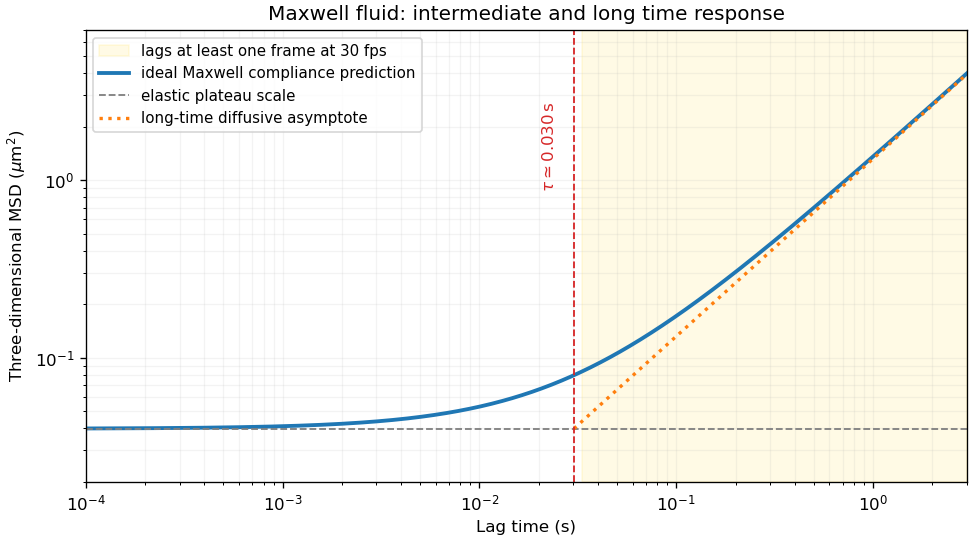
Elastic plateau and diffusive growth in the ideal Maxwell microrheology prediction, with the video time scale marked
. Details. 
An ordinary 25–30 frame-per-second recording samples intervals of about –, comparable to . It therefore has little access to a clear plateau at lags well below the crossover, even if its positional precision resolves a displacement of a few tenths of a micrometre. Higher frame rates and calibrated localization noise would improve the modulus measurement. The bead radius is only twice the mesh size, so treating the network as a homogeneous continuum is also an approximation.
Past exam of the quantum condensed matter course of the University of Cambridge 2008 Section A A3 f Solution Created 2026-10-18 Updated 2026-10-20
Under a step stress, the Maxwell spring extends immediately by , while the dashpot adds . Hence , and the microrheology of a Maxwell fluid relation givesThis idealized overdamped relation describes an elastic plateau followed by long-time diffusion. Its nonzero extrapolated intercept is not the actual displacement variance at exactly zero lag, which is zero. Inertia or fast solvent relaxation must resolve the initial rise; those processes were omitted from the ideal spring-dashpot model.
Past exam of the quantum condensed matter course of the University of Cambridge 2008 Section A A3 e Solution Created 2026-10-18 Updated 2026-10-20
Passive microrheology uses thermal bead motion as a probe of mechanical compliance. The fluctuation-dissipation theorem relates equilibrium displacement fluctuations to the same linear response measured by a small applied force. The stated thermal stress scale has units of energy per bead volume; dividing the mean-square displacement by provides a dimensionless effective strain. With that prescribed analogy,The displacement is relative to the starting position, and the variance here is the sum over three spatial coordinates. For a Newtonian fluid, substitution gives , exactly the Stokes–Einstein relation .
The continuum interpretation assumes a dilute no-slip spherical probe, thermal equilibrium, linear response and a homogeneous incompressible medium on the bead scale. The stated stress estimate is an effective scale for the analogy; a literal instantaneous stress variance would also require a microscopic or temporal averaging prescription.
Past exam of the quantum condensed matter course of the University of Cambridge 2008 Section A A3 d Solution Created 2026-10-18 Updated 2026-10-20
The creep compliance is the strain per unit step stress: if , then for . A Newtonian fluid obeys , so under constant stress its initially zero strain grows as . Therefore
There are unlisted articles, also show them or only show them.