
Let be the indicator random variable of a black ball at draw . The black count after three draws is . By linearity of expectation,Independence is not required for this step. This is also the mean of the corresponding hypergeometric distribution.
Use the inclusion-exclusion principle for two events:As a check, its complement is two white draws, with probability .
Any two distinct draw positions have the same pair law by exchangeability. The marginal and pair probabilities in sampling without replacement therefore giveDivide this joint probability by the relevant marginal probability to get the two conditional probabilities:Conditioning on the third draw can change the probability of the second draw; conditional probability does not require the conditioning event to occur earlier in time.
The first black draw has probability . Given that event, three of the remaining six balls are black. The multiplication rule therefore givesUsing would incorrectly treat the draws as independent.
Uniform sampling without replacement is equivalent to revealing a uniformly random permutation of seven labelled balls. Each draw position is equally likely to contain any label, so its colour has the original proportions. ThusFor example the law of total probability gives . Equal marginal probabilities express exchangeability, rather than independence between successive draws.
Both numerator and denominator vanish quadratically. Factor out before dividing the power series:The reciprocal of the denominator is . HenceThe expansion describes the continuous extension at the removable singularity , where the original quotient is undefined but its limit is one. Odd powers vanish because the quotient is even.
Use the Maclaurin series and . Multiplying through the cubic order givesThese are the first three nonzero terms; the constant term vanishes.
The coefficients follow by differentiating the same monomial:Thus this exact differential form hasExhibiting a global scalar potential proves exactness directly, without needing an additional domain argument.
For a smooth exact differential form , its coefficients must satisfy by Clairaut's theorem. HereThese are not equal as functions on the plane, so the form is not exact. Equality at isolated points or along some lines is insufficient: an exactness test must hold throughout an open domain.
The two coefficients are the corresponding partial derivatives of . Therefore the differential form is exact, withThe arbitrary constant does not change the total differential.
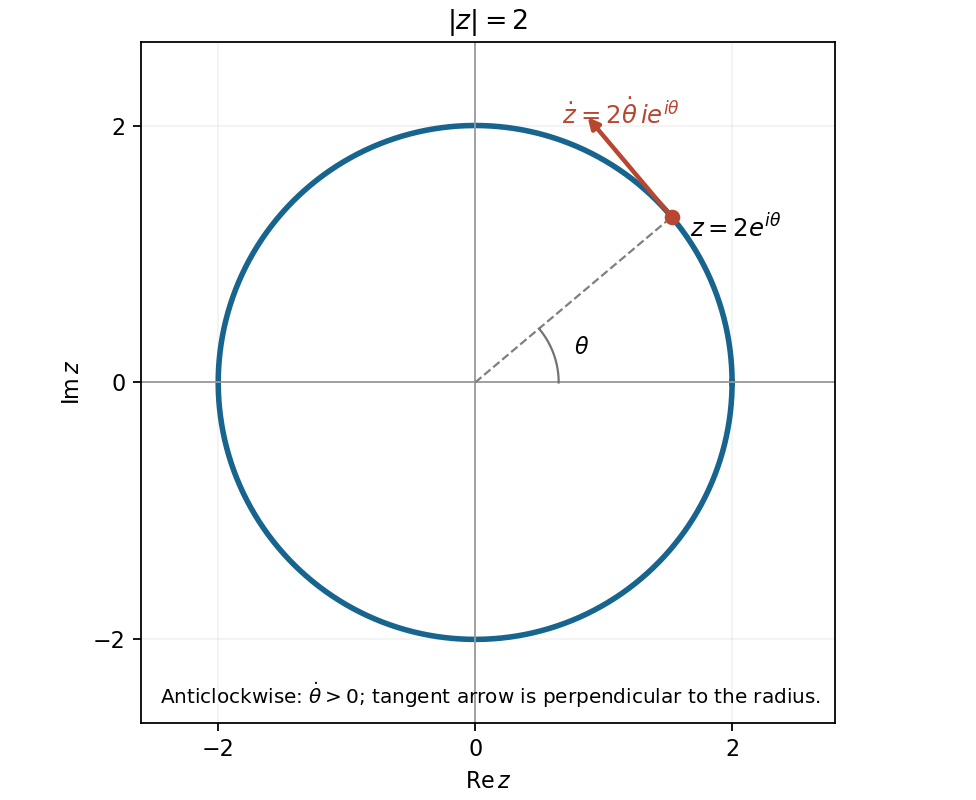
The perpendicular unit vectors represented by and point radially outwards and transversely in the increasing-angle direction. Reading off their real coefficients in part (b) gives the signed componentsThese are velocity in polar coordinates and acceleration in polar coordinates. In particular is a transverse speed component; alone is an angular velocity. The moving basis, rather than any extra force assumption, accounts for the additional acceleration terms. At the origin the polar directions themselves are undefined, although the Cartesian velocity and acceleration can remain well defined.
On this circle the radial coordinate is constant, , so . The velocity is a tangent vector to the circle in the anticlockwise direction, represented by when . Substituting into part (b),The inward component is the centripetal acceleration; the transverse component allows the speed to change. Anticlockwise motion does not imply uniform speed or . The preceding figure includes the required tangent arrow.
Write . Squaring the nonnegative complex modulus on each side givesThe linear terms cancel, leaving . Therefore the locus isIts real and imaginary axis intersections are and .

For real , the numerator and denominator have equal complex modulus:The denominator is always nonzero. HenceThus the real axis maps into the unit circle in the complex plane.
Direct substitution in the Möbius transformation givesNeither substitution meets the excluded denominator point .
For a unit direction , the Cauchy-Schwarz inequality gives , with equality in the gradient direction. Its norm here is , so the direction of fastest increase isThe maximal directional derivative itself is .
The gradient is , so its value at the point is . Since the specified direction is already a unit vector, the directional derivative is its dot product with that gradient:
For , the conservative field is and the tangent is . ThereforeThe two different paths give the same value because their line integrals depend only on the potential difference . There is no scalar potential for to which the conditional request could be applied.
Parametrize the straight path by for . The conservative field along it is and the tangent is . ThusThe associated potential has , in agreement with the fundamental theorem for line integrals.
Integrate the normal component on each face directly, with outward normals. Each unlisted pair of coordinates ranges independently from zero to one:For example, on the integral is . Adding all six contributions givesThis calculation uses the six explicit surface integrals, independently of the divergence theorem.
There are unlisted articles, also show them or only show them.