
Expand the right-hand side in the orthonormal basis from part (b). Its coefficients areThus . If , then matrix multiplication gives . Matching coefficients fixes and , while is arbitrary. Consequently all solutions areGeometrically, the solution set is an affine line in a vector space parallel to the kernel of . The zero eigenvalue makes the component in that direction invisible to ; the other two components are uniquely determined. The displayed particular solution is perpendicular to the kernel, so it is also the point of this line closest to the origin.
The vector is an eigenvector with eigenvalue . The complementary subspace of vectors with first two components equal is preserved by : a vector maps to . There, the eigenvalue equations reduce to the matrix , whose characteristic polynomial is . For , ; for , .
Normalising by the Euclidean norm, a complete orthonormal basis of eigenvectors isSign changes of any of these eigenvectors are equally valid. The eigenvalues also check part (a): their sum is and the sum of their squares is .
Adding the diagonal entries gives . Expansion along the first row gives . For the remaining trace, direct matrix multiplication givesThus . By multiplicativity of the determinant, . Altogether,
Let and . Integrating the trigonometric functions and differentiating in integration by parts gives, modulo constants,Substitution yields and . ThereforeNo division by was used, so this formula also applies at .
Let be the cumulative distribution function of . Normalisation of the proposed probability density function requires . The integrated cumulative distribution function on a bounded interval identity givesFor a direct symmetry proof, the continuous symmetric probability distribution satisfies . HenceIn particular is nonnegative and has total integral one over its stated support.
The expected value is zero, so the variance is . Symmetry givesThe polynomial term contributes . Two applications of integration by parts giveso its definite value on is . Therefore
Since the probability density function is an even function, is an odd function. Its integral over the symmetric support vanishes, so
Put . The function graph is symmetric about the vertical axis, zero outside , and has its unique maximum at with height . On , it decreases as ; the negative side is its reflection. The one-sided interior endpoint values are , so the probability density function jumps to zero at both ends of its support. It also has a corner at its central maximum because of the absolute value in the exponent.
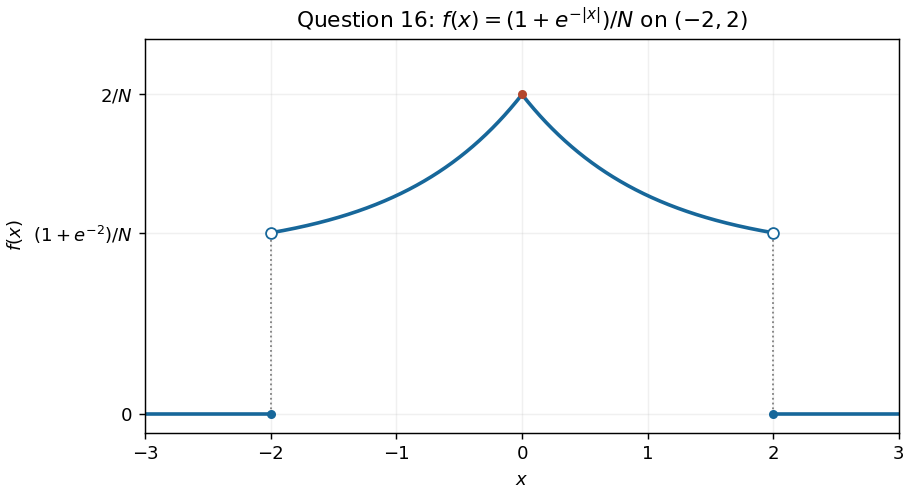

Values assigned exactly at do not affect any probability.
A probability density function must have total integral one. The numerator is an even function, soThis is positive, ensuring nonnegativity of the probability density function.
For , factor out , not , and apply the binomial series with exponent :For each fixed nonzero , these are the first three nonzero terms of the Taylor series about zero; the full binomial series converges when .
For , the function is . Its right derivative at zero is and its left derivative is , so no Taylor series about zero exists when . The one-sided formulas are exactly for and for ; they do not form a single two-sided Taylor expansion, nor can they supply three nonzero terms. The parameter case explicitly included in the question must therefore be treated as this exception.
There are unlisted articles, also show them or only show them.