
Past exam of the advanced quantum physics course of the University of Cambridge 2017 4 Solution 2026-10-18
For elastic scattering by the Yukawa potential, take and use the first Born approximation in the plane-wave normalizationChoose the polar axis along the momentum transfer . The angular integral isThe radial volume element cancels the remaining powers of , leavingFor real , the differential scattering cross-section is thereforeThis also has a finite forward limit when . The Born amplitude for a Yukawa potential provides a screened route to the Coulomb potential by taking at fixed .
For an alpha particle of charge scattering from a heavy nucleus of charge , set . Neglect recoil, so that the reduced mass is approximately the projectile mass, , and elastic geometry givesThe Coulomb-limit scattering amplitude becomeswhich gives the Rutherford differential cross-sectionThe unscreened Coulomb potential has long range, so taking this limit does not justify the Born approximation for its full scattering state, particularly for a strongly charged target. The exact Rutherford scattering amplitude differs by a phase and has the same modulus. Thus the resulting differential scattering cross-section remains applicable to the ideal nonrelativistic Coulomb problem beyond the weak-potential regime.
To relate the detector counts to the atomic number, first compute the number of target atoms per illuminated area. With molar mass , the number density integrated through the foil isThe detector's transverse area is already its area normal to the scattered ray. Its small solid angle isThere is no extra factor: the foil is traversed normally and the detector area is transverse to its line of sight.
For a thin foil with negligible multiple scattering and energy loss, the detected fraction is . Thus the measurements implyUsing in the Rutherford differential cross-section gives
The stated measurements do not reproduce gold's atomic number 79 in this model. The values and units above agree with the original PDF. Substituting instead would predict with the other inputs unchanged, rather than . No stated correction accounts for that discrepancy; forcing the answer to 79 would require changing the data or adding an experimental correction not specified in the problem.
Past exam of the advanced quantum physics course of the University of Cambridge 2017 3 Solution Created 2026-10-18 Updated 2026-10-20
The Zeeman effect comes from . For an electron, the orbital and spin magnetic moments are approximately and , respectively. This explains both the sign and the relative factor two in the term linear in . The second term is the spin-orbit interaction: the electron's motion through the atomic electric field produces a magnetic interaction in its rest frame. The relativistic correction, including Thomas precession, and the radial expectation value are incorporated into . This effective Hamiltonian retains the linear Zeeman splitting and spin-orbit coupling, while omitting diamagnetic and hyperfine structure corrections.
Define the angular momentum ladder operators by and similarly for . Direct expansion givesso adding gives the required scalar product. The off-diagonal terms change and in opposite directions. Consequently commutes with , and remains a good quantum number at every magnetic field.
In the given product eigenbasis, the diagonal matrix elements areFor and , the only off-diagonal couplings are between and , and between and . Each relevant orbital ladder factor is and each spin ladder factor is . Multiplying by gives . ThereforeAll other off-diagonal entries vanish either by the ladder endpoints or by conservation of . This derives every entry of the displayed matrix.
The stretched states have no mixing and yieldThe block is , while the block is . Taking the trace and determinant of each block gives the remaining four energy eigenvalues:The subscripts indicate and the superscripts indicate the upper or lower root. These formulas are the Zeeman spectrum for orbital angular momentum one and remain valid for either sign of .
For the usual ordering , including sodium, the zero-field states follow fromThe quartet lies at and the doublet at , separated by . In a weak magnetic field, the Landé g-factors giveThese label the curves near . In a strong magnetic field, the Paschen-Back effect makes the appropriate approximate labels:for the mixed states, with the stretched-state formulas already exact. The branch connections for areWithin a fixed , the nonzero coupling prevents a crossing; this is an avoided crossing. Curves with different may cross because the Hamiltonian does not couple them.
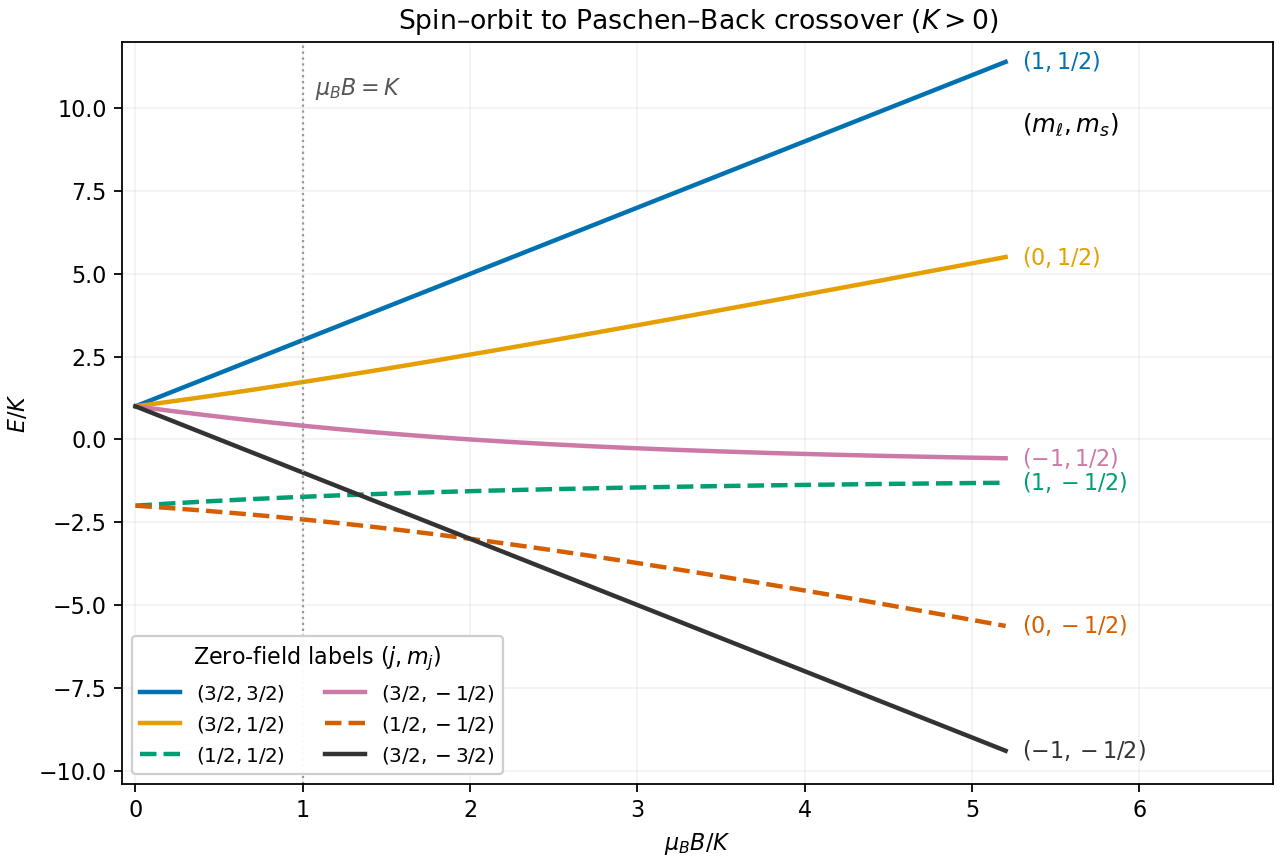
Exact spin-orbit and Zeeman energies for orbital angular momentum one and positive spin-orbit constant
. Details. 
For the sodium estimate, the zero-field frequency separation fixesThe lower doublet has shifts . The Sodium D-line Zeeman pattern gives photon-frequency shifts times for D and for D. Thus the highest-frequency D component and lowest-frequency D component approach each other by . Extrapolating the weak-field Zeeman splitting givesso the crossover occurs at a field of order , where and the weak-field approximation is becoming marginal.
The exact eigenvalues refine the estimate within this Hamiltonian. The relevant photon energies, with a common zero-field reference omitted, are and . The corresponding electric dipole transitions have and , respectively. Equating them givesIts positive solution is , hencein the retained model. The crossing is between optical transition frequencies; the participating upper states themselves need not be degenerate.
Fractionally charged Laughlin quasihole Created 2026-10-18 Updated 2026-10-20
A quasihole adds one zero at per electron; its local deficit carries positive electric charge .[ref]
Anomalous Quantum Hall Effect: An Incompressible Quantum Fluid with Fractionally Charged Excitations by Robert Laughlin. pp. 1396–1397, Eqs. (13), (15) and screening argument
Here is a transport counting outline, conditional on an incompressible quantum Hall fluid. Inserting one magnetic flux quantum slowly compared with , where is the excitation energy gap, produces a circulating electric field by Faraday's law. The transverse sheet conductivity sends a radial electric current whose time integral has magnitudeThe opposite electric charge moves to the boundary, so the total electric charge remains conserved. The counted deficit belongs to a collective quasiparticle; no individual electron has been cut into pieces. The argument assumes the gapped fluid and its Hall response, and is not a consequence of the finite two-electron normalization integral.
There are unlisted articles, also show them or only show them.