
Two-electron Laughlin relative probability Created 2026-10-18 Updated 2026-10-20
Consider the original two-electron example obtained by taking in the Laughlin wavefunction, with no additional polynomial for the centre of mass. Introduce , relative complex coordinate , separation , and dimensionless separation . Since , the probability density factorizes:Integrating out leaves an isotropic relative probability density. Define per unit dimensionless area and per unit dimensionless separation:The physical areal probability density is . The probability of a separation between and is . The extra comes from the Jacobian determinant in polar coordinates: a thin annulus has area . Omitting that factor changes the question being answered.
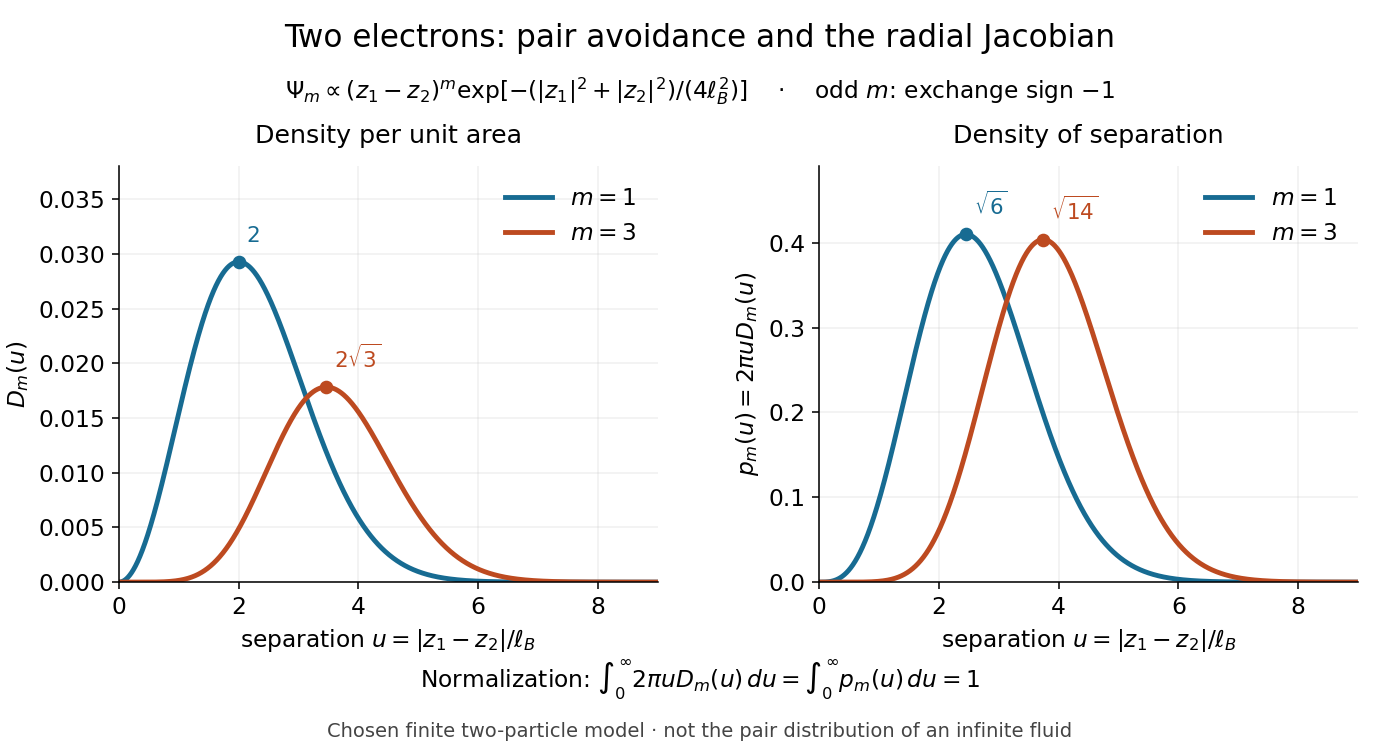

Both wavefunction normalization and the peak shift can be checked exactly. The substitution gives the Gamma function integralFor , logarithmic differentiation givesConsequently the areal maximum lies at , while the most probable separation lies farther out, at . For these are and ; for , and . The same substitution gives , so the root mean square separations are and respectively. The distinction between a probability density maximum and a radial maximum therefore has a directly calculable geometric origin.
This two-electron model explains exchange and pair avoidance. It does not establish a nonzero many-particle spectral gap, an extended quantum Hall plateau, or the topological properties of a fluid in the thermodynamic limit. Those require additional many-electron reasoning and experimental tests.
Evanescent penetration depth 2026-10-18
Define the amplitude evanescent penetration depth as the distance at which the electric field wave amplitude falls to of its surface value:The squared-field envelope decays twice as fast:The same normalized exponential decay describes the tangential average Poynting vector for the TE polarization above. An intensity penetration depth convention often means ; it must not be confused with amplitude depth or interpreted as outgoing normal light intensity.
For the stipulated , , and ,At the normalized wave amplitude is approximately , and its squared envelope is approximately . At , these become and , respectively. The quantity inside the square root is dimensionless, so has inverse-length units and both depths have length units.
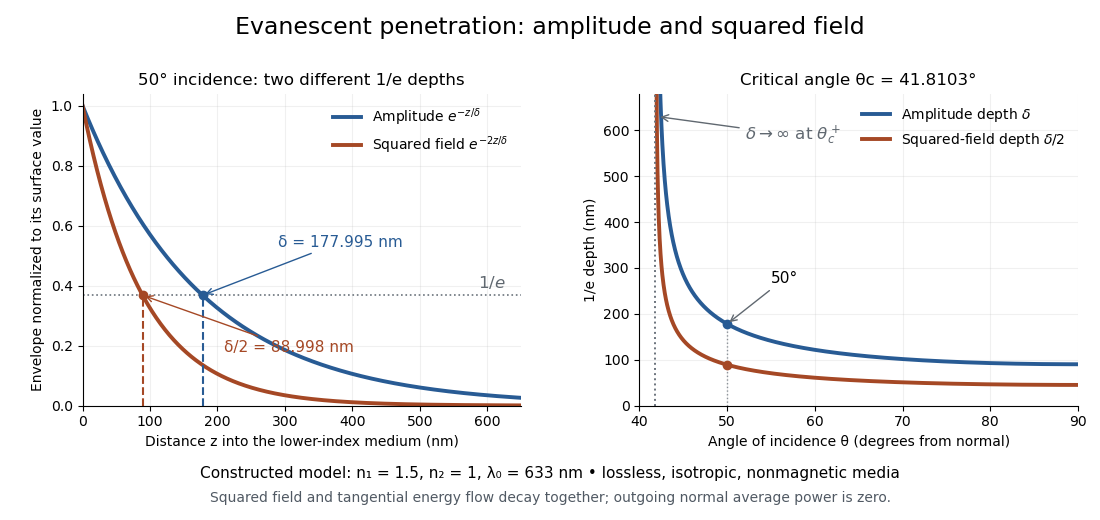
Constructed evanescent-field model at 633 nm: amplitude and squared-field decay at 50 degrees, and their penetration depths as incidence increases above the critical angle
. Details. 
The sharp angular dependence has a simple explanation. For with small and measured in radians, a first-order Taylor expansion givesThus as : exponential confinement disappears continuously. With fixed refractive indices, decreases as the angle of incidence increases and approaches as . This is a limit of the normalized depth; exactly grazing incidence supplies zero incident normal power. Real beam widths, angular spreads and optical dispersion matter when applying these ideal plane electromagnetic wave predictions near the threshold.
Drude-Lorentz reflectivity minimum Created 2026-10-18 Updated 2026-10-25
A doped semiconductor at frequencies far below its bound-electron resonances can haveFor a weakly absorbing nonmagnetic half-space adjacent to vacuum, the normal-incidence optical reflectance is minimized near refractive-index matching, . When and is small this gives . The zero of the real part of , near , is a distinct frequency. Increasing the carrier density shifts the minimum to shorter wavelength if the carrier effective mass and background response remain fixed. With appreciable loss, the minimum must be found from the full complex Fresnel equations.
Fill the lower energy band of the dimerized tight-binding chain with both spin states. Take zero on-site energy and measure ground-state energy per doubled primitive unit cell. State counting in a Bloch band and giveEquivalently, for , , where is the complete elliptic integral of the second kind in the modulus convention.
For fixed and , the change isThe logarithm comes from states near the edge of the Brillouin zone. Put . To leading order the square root there is . For a fixed small cutoff , direct integration givesThe rest of the band, and the higher-order corrections near its edge, contribute only ; multiplying by gives the displayed asymptotic expansion. Here the remainder uses Big O notation. The negative logarithmic term exceeds any fixed quadratic elastic cost , , for sufficiently small nonzero . This explains the zero-temperature instability to a Peierls distortion in the ideal chain model.
Exclusion and the energy of two electrons in three spatial levels Created 2026-10-18 Updated 2026-10-20
Consider an original noninteracting model with three orthonormal spatial orbitals at energies , where . Both spin projections are available at each energy, so there are six spin orbitals. The Quantum Hamiltonian is , with no interaction between particles and no dependence on spin. Comparing its allowed ground states isolates the effect of fermionic exchange symmetry.
For two distinguishable spin-one-half particles, the spatial ground state is and any of four independent two-spin states is possible: and ground-state degeneracy four. For two identical electrons, both can still occupy , using and , but there is just one allowed ground state: the symmetric spatial factor times the spin-one-half singlet state,Exclusion has reduced the ground-state degeneracy without raising the ground state energy.
Now restrict both particles to the same spin projection . Distinguishable particles can still both occupy , so . Identical electrons must occupy different spatial orbitals; the lowest choice is , withThe spin factor is a spin-one-half triplet state, and the spatial factor is antisymmetric. These are ground states within the restricted parallel-spin sector, not the unrestricted two-electron ground state. Both restricted models have ground-state degeneracy one.
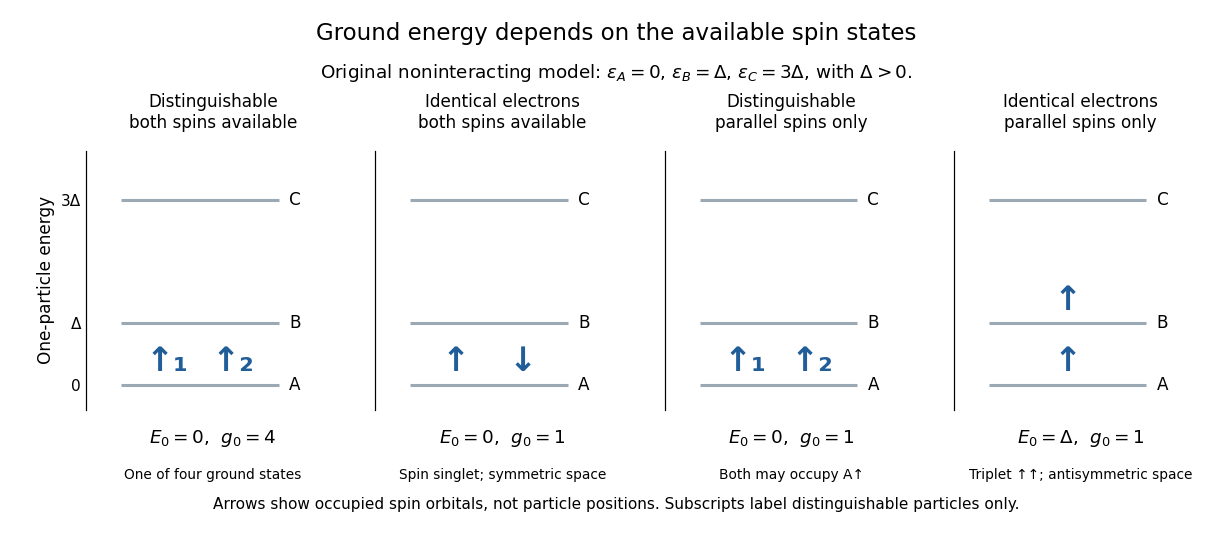

The first excited two-electron energy in the unrestricted model is , with four independent quantum states: one occupant in , one in , and two spin choices for each. A basis adapted to particle exchange operators separates these into one spin-one-half singlet state with symmetric spatial factor and three spin-one-half triplet states with antisymmetric spatial factor. All four have equal energy in this model. Singlet versus triplet does not by itself determine an energy gap; an interaction or a spin-dependent term is needed to split them.
As a further count, the full two-electron space has dimension . Its energies in units of and corresponding multiplicities are and . For distinguishable spin-one-half particles the ordered tensor product instead has dimension , with multiplicities at those same energies. These are exact model counts, not atomic measurements. The higher restricted ground state energy follows from removing forbidden quantum states; the Quantum Hamiltonian contains no additional “exclusion force”.
For the interaction built from the total two-electron spin and orbital angular momentum, set . The spin-dot-product eigenvalue identity then gives the shift in the title. In the first excited two-electron oscillator manifold, the singlet has and zero shift with multiplicity three. The triplet has , with shifts and multiplicities .
The multiplicities sum to twelve, and their weighted shift sums to zero. The specified interaction preserves both and ; it is distinct from summing separate single-electron spin-orbit interactions. Its shifts are exact within this model's invariant oscillator manifold, with weak coupling ensuring the original level ordering remains useful.
Frustrated total internal reflection 2026-10-18
Frustrated total internal reflection occurs when a nearby second high-index dielectric couples to the evanescent field in total internal reflection, allowing power to cross a finite low-index gap. The extra boundary changes the dielectric-interface boundary conditions; the gap field need not be a single decaying evanescent wave. Consequently, the zero normal Poynting vector calculation for two infinite half-spaces does not forbid transmission in this three-medium geometry.
Harvard’s actual demonstration uses two right-angle glass prisms, a helium-neon laser, a small clamp and two perpendicular screens as detectors. The contact faces are cleaned and placed opposite each other, with the clamp protecting the corners. Increasing pressure narrows the intervening air film; the observed beam routing changes gradually from total internal reflection toward onward transmission. The broad-gap reflecting configuration supplies the comparison for the narrow-gap transmitting configuration. This is a qualitative readout: the page explicitly says the gap is not measured.[ref]
Frustrated Total Internal Reflection by Harvard Natural Sciences Lecture Demonstrations. How it works and Setting it up: two prisms, HeNe laser, perpendicular screens, pressure adjustment and unmeasured gap
The inference is that the lower-index region can mediate electromagnetic energy transfer when another boundary is nearby. The demonstration does not determine a numerical evanescent penetration depth, resolve gap uniformity, or establish a three-layer transmission coefficient. For the constructed example, identifies the scale over which the isolated-interface field remains appreciable; substituting for a gap transmission fraction would omit the changed boundary fields and their interference. A quantitative gap calculation must solve the full Maxwell equations with both boundaries.
The evanescent field in total internal reflection oscillates and advances in wave phase along the boundary while its wave amplitude decays away from it. With the coordinates above and time dependence , a TE polarization has complex amplitudeThe physical electric field is . The decaying sign excludes a field that grows without bound at . Dielectric-interface boundary conditions determine ; for nongrazing incidence it is generally nonzero.[ref]
Interactive Optics by Sander Konijnenberg, Aurèle J.L. Adam and H. Paul Urbach. Total Internal Reflection and Evanescent Waves, equations (154)–(158), decaying sign and parallel energy flow
Zero normal energy flux follows directly from Maxwell equations. The wavevector is ; the relation givesConsequently, the cycle-averaged Poynting vector isThe electric field and are a quarter-cycle apart, so their product has zero cycle average. Tangential energy flux survives. This is a local calculation for the single decaying evanescent wave in the infinite second half-space.
To check reflected power independently, put . The existing transverse-electric Fresnel reflection coefficient becomes . Its numerator and denominator are complex conjugates, so , while supplies the surface electric field relative to the incident wave amplitude. Thus a unit optical reflectance does not require a zero transmitted field. The same normal power balance holds for TM polarization; its reflected wave phase generally differs from the TE polarization phase. A mixture can therefore change its polarization of an electromagnetic wave on reflection even though all normal incident power returns.
Tau-pair missing-mass teaching model Created 2026-10-18 Updated 2026-10-20
Choose and purely for illustration. Then each parent has , and . Treat all six daughters as massless, including the charged electron and antimuon, and generate each three-body particle decay with constant squared decay amplitude. Choose the parent direction isotropically and the two decays independently; this omits the physical production angular law and spin correlations.
The Lorentz-invariant phase space factorizes through into a two-body decay to , followed by a two-body decay of :After angular integration the first factor contributes , while the massless second factor is constant. Since , the normalized chosen density is . Drawing with uniform on implements this density. Isotropic directions, followed by a Lorentz boost for the invisible pair and another for the parent, conserve the complete four-momentum of each generated event.
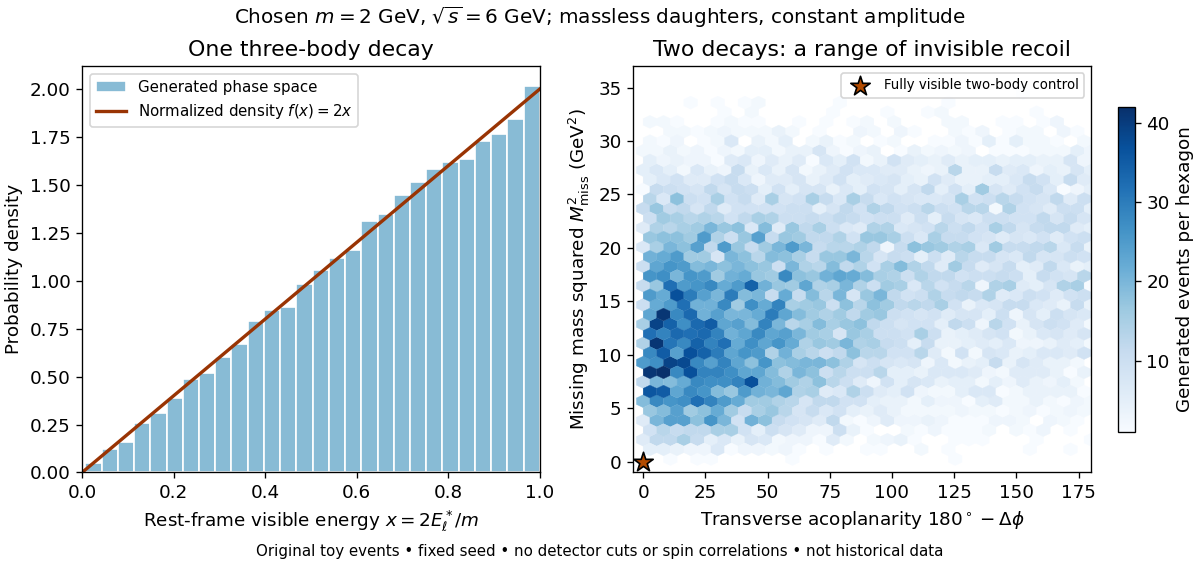

Define transverse acoplanarity by , where is the angle between the two visible momentum projections perpendicular to the beam. A fully visible two-body event with zero initial transverse momentum has and . The toy tau lepton events spread away from that point. These observables are complementary: an angular imbalance asks about directions, while the missing invariant mass also uses the visible energies and longitudinal momenta.
A Lorentz-invariant phase space density supplies allowed configurations and their geometric measure. A physical weak interaction decay amplitude reweights them and correlates spins. Consequently the plotted density is a lesson about conservation and available configurations, not a predicted experimental rate or a fit to the discovery sample. The massless charged-daughter approximation is also unsuitable near the muon rest-energy threshold.
Exponential spherical mass factor 2026-10-18
For radial mass density within radius , integration against the spherical volume element gives . The dimensionless quantity hasThus is positive, strictly decreasing and convex, with and . Its asymptotic forms are near zero and at infinity. The density's central divergence is integrable against the factor .
Polar angle Created 2026-10-18 Updated 2026-10-20
In the usual physics convention for spherical coordinates, the polar angle is the angle between the positive axis and the position vector. For , it satisfies with . The north and south axes have and , respectively; the plane has . The angle is undefined at the origin. In plane polar coordinates, the same phrase usually denotes the oriented in-plane angle instead, so the reference axis and convention should always be stated. The azimuth supplies the other angular coordinate in three dimensions.
Skin depth Created 2026-10-18 Updated 2026-11-05
Surface impedance of a good conductor Created 2026-10-18 Updated 2026-11-05
For a wave penetrating a nonmagnetic good conductor in the direction with time convention , its wavenumber is , with skin depth . If , Faraday's law of induction gives . Thus the field ratio is , equal to the displayed expression. Magnetic and electric fields have equal exponential penetration lengths but a phasor phase difference ; has the positive phase relative to in this convention.
Rabi transit-time and field averaging 2026-10-18
For an ideal single transit, let the oscillatory magnetic field occupy a region of length , take the longitudinal speed constant, and neglect edge fields. Each molecule then experiences one square pulse of duration . This is one contiguous interaction region, distinct from the two separated pulses of Ramsey interferometry. The static magnetic field sets the selected transition gap; the transverse drive sets Rabi angular frequency. A change of RF frequency or static magnetic field changes Rabi detuning.
For an original ideal detector model, suppose every successful transition removes an otherwise accepted molecule and the incident beam occupies the lower state of the selected pair. With accepted no-transition signal , constant background , and effective loss contrast , writeFor identical trajectories , giving an intensity dip where transfer is largest. For real trajectory variation, a normalized joint probability density gives the static-offset modelHere is the trajectory's transition-frequency offset and its drive strength, each in angular-frequency units. The weighting is for molecules accepted by the apparatus, rather than an assumed unfiltered oven distribution. In particular, designing does not produce a Rabi pi pulse for every speed: at and the resonant transfer probabilities are respectively and .
Spread in transit times, static magnetic fields and drive amplitudes can reduce or smear oscillations without quantum decoherence on any individual trajectory. Even the single-transit square pulse has finite spectral width of order in angular frequency. If the magnetic field varies substantially along one path, its Hamiltonian operator changes during the passage and the constant-offset average above must be replaced by a time-ordered exponential. Actual molecules may also have several coupled energy levels; the isolated pair and perfect loss discriminator are explicit idealizations of this model.
Spectral resolution of a quantum propagator Created 2026-10-18 Updated 2026-11-05
Insert a complete resolution of identity in energy eigenstates on either side of the time-evolution operator. Each state evolves by its scalar energy phase, yielding the displayed quantum propagator. Its spectral sum includes an integral over any continuous spectrum, with the measure fixed by the continuum normalization. Omitting the scattering states when bound states are also present destroys completeness and the delta-function short-time limit.
Leading principal minor 2026-10-18
A leading principal minor is a principal minor using the first rows and columns of a square matrix in a specified ordering. Sylvester's criterion uses these minors to characterize positive-definite matrices.
Dimerized tight-binding chain Created 2026-10-18 Updated 2026-10-20
For spin-degenerate electrons at atomic spacing , alternate the hopping amplitudes and , with and . The doubled primitive unit cell gives an off-diagonal Bloch Hamiltonian entry . Its two eigenvalues are the displayed energy bands, for . The band gap at the edge of the Brillouin zone is . At half filling there are two electrons per doubled primitive unit cell, so the lower band is full and the upper empty. This explicit model realizes the period-doubling form of a Peierls distortion.
There are unlisted articles, also show them or only show them.