
Past exam of the mathematics course of the University of Cambridge 2002 iii Paper 4 2 Solution 2026-10-14
The Ohnishi orderability criterion states that, for each finite list , there are signs such that the semigroup of nonempty products of conjugates of does not contain . The conjugates are essential for a two-sided invariant total order. Necessity follows by choosing all signed elements positive: their conjugates and nonempty products are still positive.
For sufficiency, consider the compact product . Impose the closed conditions that an inverse has the opposite sign, that conjugation preserves sign, and that a product of two positive elements is positive whenever it is nonidentity. A positive pair cannot multiply to the identity because of the inverse condition. Each condition uses finitely many coordinates. Given finitely many conditions, collect every nonidentity element appearing in them into a finite list and choose signs using the criterion. These signs satisfy the conditions: an incorrectly negative product would contribute its positive inverse to the generated semigroup, producing identity with the positive factors; an incorrect conjugate or inverse gives the same contradiction. Extend the signs arbitrarily to the remaining coordinates. Thus the finite intersection property and compactness give a global sign assignment. Its positive elements form a conjugation-invariant semigroup with and . Defining by gives the required linearly ordered group.
Restriction shows that every finitely generated subgroup of an orderable group is orderable. Conversely, suppose every such subgroup is orderable. If the criterion failed on , each of the finitely many sign choices would have an identity witness made of finitely many conjugates. Collect all and all conjugating elements in these witnesses into one finitely generated subgroup . An order on supplies one positive sign choice, but its corresponding witness is a nonempty product of positive elements in , a contradiction. Hence the criterion holds in .
Finally, a finitely generated subgroup of a torsion-free abelian group is by the Fundamental theorem of finitely generated abelian groups. Its lexicographic order is two-sided invariant. Applying the local-to-global conclusion proves that every torsion-free abelian group admits the required order.
Past exam of the mathematics course of the University of Cambridge 2002 iii Paper 39 3 Solution 2026-10-14
The response is the species categorical variable, while the four measurements are candidate predictors. The dot in the formula means all other columns of the data frame. The fitted object is a classification tree: it recursively partitions predictor space by binary threshold rules and assigns a species and class-probability vector to each terminal region. Sepal width was available but was not selected in the displayed tree.
At a node , let be the number of observations of class and . The multinomial likelihood is maximized by . The fitted class is one attaining the largest proportion, with a software convention resolving ties. The classification-tree deviance isA pure node has zero deviance. At each nonterminal node, consider candidate split points between distinct observed predictor values, and choose the split with the largest decrease . Repeating this local maximization constructs a binary decision tree; it does not solve a global optimization over all trees. Growth stops when nodes are pure or size/deviance controls prohibit further splitting. Mixed leaves with five or six observations can therefore remain. The node number has children and , and a terminal-node marker means that no further split was retained.
The probability triples are in class order , not . For example, the pure left leaf has probability vector and predicts , while the 54-observation node has counts and predicts . The root counts are , giving and a tied majority class. Its reported choice of does not indicate a more common class.
The complete derived decision rule is shown below. Each leaf includes its fitted class and the observed class counts, so both the branching logic and its remaining errors are visible. For the observed data, the printed strict inequalities leave no equality cases because the thresholds fall between measurement values. A consistent right-branch convention at equality extends the rule to new specimens.
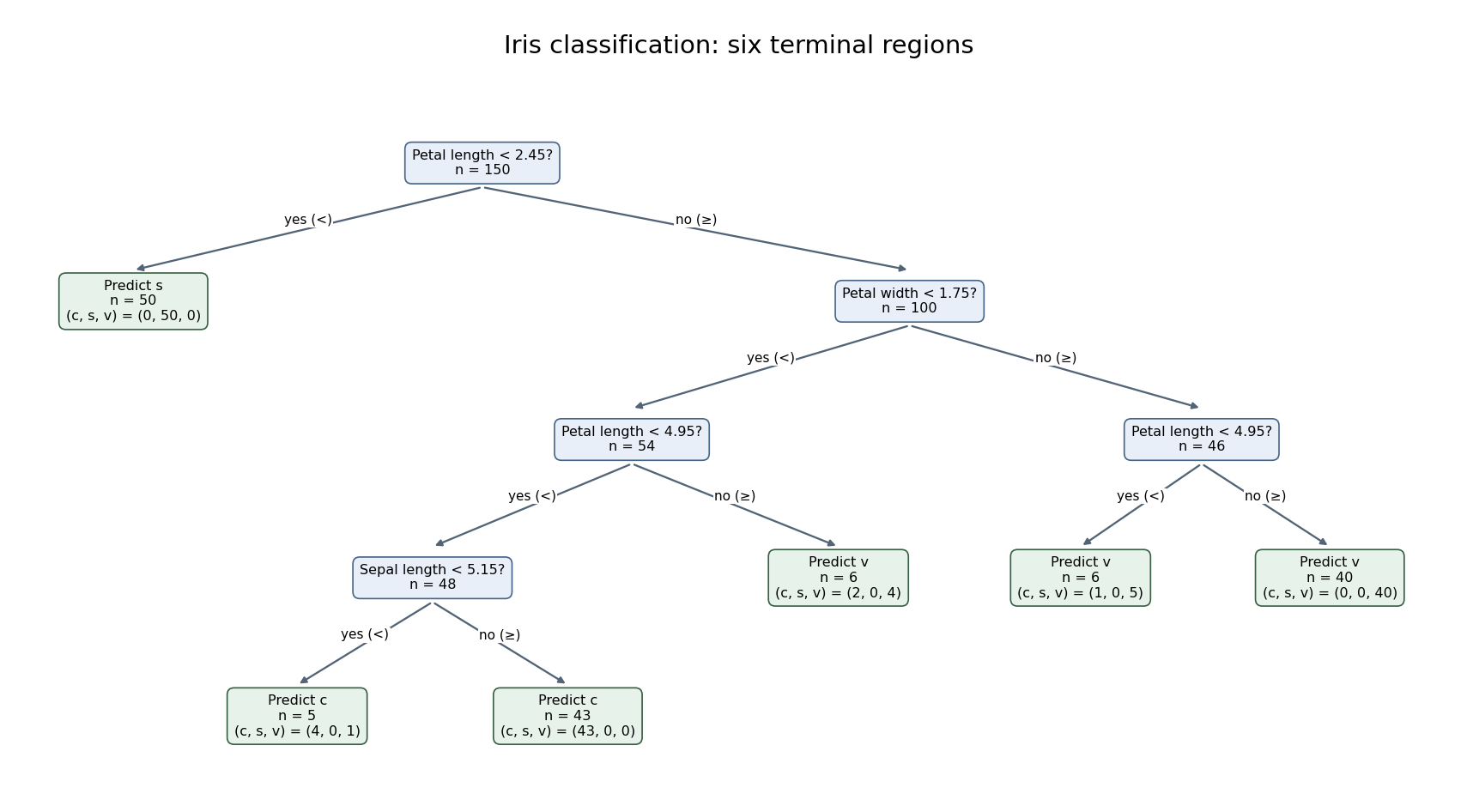
Six-leaf iris classification tree with fitted classes and class counts at every terminal node
. Details. 
The six terminal nodes contain the class countsThus the training misclassification error isThe terminal classification-tree deviance is insteadThe displayed residual mean deviance divides this by , yielding approximately . This is the summary's reporting convention, not a normal-error residual mean square or an automatic chi-squared calibration with 144 statistical degrees of freedom. The two summary measures answer different questions: deviance depends on the fitted probability of each observed class, while misclassification counts only whether the majority-class prediction is correct. Both are training quantities. Cross-validation or independent test data, rather than the displayed training error, are needed to assess prediction on new specimens; cost-complexity tree pruning can select a less elaborate tree if predictive performance warrants it.
Past exam of the mathematics course of the University of Cambridge 2002 iii Paper 37 2 Solution 2026-10-14
For the numerical competing risks update, the estimated probability of remaining event-free just before the tied time isThere were no intervening events, so the cumulative incidence functions did not jump between the two stated times. The Aalen–Johansen estimator uses the risk set immediately before the event time, including the subject censored at that same time under the usual events-before-censoring tie convention. Therefore the cause- increment is , andFor a consistency check, and ; these sum to one. The censoring does not create an incidence jump and leaves subjects for subsequent follow-up. Dividing by would instead assume that the censored subject had already left before the event time, contrary to the stated immediately preceding risk set. This is a cumulative incidence update with tied censoring.
Past exam of the mathematics course of the University of Cambridge 2002 iii Paper 31 6 Solution 2026-10-14
Here is a finite-horizon Girsanov theorem statement with the sign fixed explicitly. Let be a Brownian motion under , and let be predictable with almost surely. Ifis a true martingale with , then the measure defined by makes a Brownian motion up to . The sufficient Novikov condition is . Merely being a local martingale is not a sufficient density condition.
For a deterministic absolutely continuous function with and derivative , take . Novikov's condition holds because its exponential is deterministic and finite. Under , the canonical process has the law of a Brownian motion plus . Thus for every bounded measurable path functional ,This derives the Cameron-Martin theorem density formula from the Girsanov theorem, rather than assuming the two measures have the same drift convention. Replacing by changes the sign of the stochastic integral.
The question's path space is the whole half-line, not just one finite horizon. When , the density martingale satisfiesIt has a uniformly integrable limit of mean one, strictly positive almost surely. Integrals here converge in and almost surely. The finite-time identities then identify as the density on the full path sigma-algebra, since finite-time cylinder events generate it. This is Cameron-Martin shifts on infinite Wiener path space. Finite-horizon absolute continuity of measures alone does not imply infinite-horizon absolute continuity of measures.
Past exam of the mathematics course of the University of Cambridge 2002 iii Paper 29 6 Solution 2026-10-14
Use for the fixed maturity and for the observation time. The original PDF's discounting uses the instantaneous forward rate over and the short rate over . Let be the centered Gaussian forward-rate field, and defineAssume the covariance and mean have the regularity needed for these mean-square integrals and the maturity differentiation below. Splitting at shows that the discounted zero-coupon bond price isThis integrated Gaussian forward-rate process has deterministic varianceIts independent increments hold relative to the entire specified filtration. Indeed, if and , the covariance between and any earlier is the integral ofSince uncorrelated jointly Gaussian variables are independent, the increment is independent of every finite family of earlier observations and hence of their generated sigma-algebra. The increment has normal distribution with mean zero and variance . Also because .
The Gaussian moment-generating function now givesTherefore the Gaussian forward-rate covariance drift restriction is exactly the deterministic conditionIt turns into a Gaussian exponential martingale with deterministic variance. The subparts establish the requested equivalent descriptions from this common calculation.
Past exam of the mathematics course of the University of Cambridge 2002 iii Paper 27 4 Solution 2026-10-14
Standard one-dimensional Brownian motion is a real process with , continuous paths almost surely, and increments independent of the past at time , for . These conditions determine its entire finite-dimensional distribution family.
The Wiener theorem asserts that such a process exists, equivalently that there is a unique Wiener measure on under which the coordinate process has these properties. To construct it, prescribe centered multivariate normal laws with covariance . This covariance is positive semidefinite becauseThe laws are consistent under removing coordinates, so the Kolmogorov extension theorem constructs the process. Normal increments have fourth moment . The Kolmogorov continuity theorem therefore supplies a continuous modification, retaining all the prescribed finite-dimensional laws and hence the independent normal increments. Apply this on every compact time interval, taking consistent versions; continuity and equality at rational times make them agree on overlaps. The resulting law on continuous-path space is unique because evaluations at rational times generate its Borel sigma-algebra. This is a proof sketch of the existence theorem, independent of the random-walk limit in Question 5.
There are unlisted articles, also show them or only show them.