
Past exam of the mathematics course of the University of Cambridge 2003 iii Paper 46 1 Solution 2026-10-14
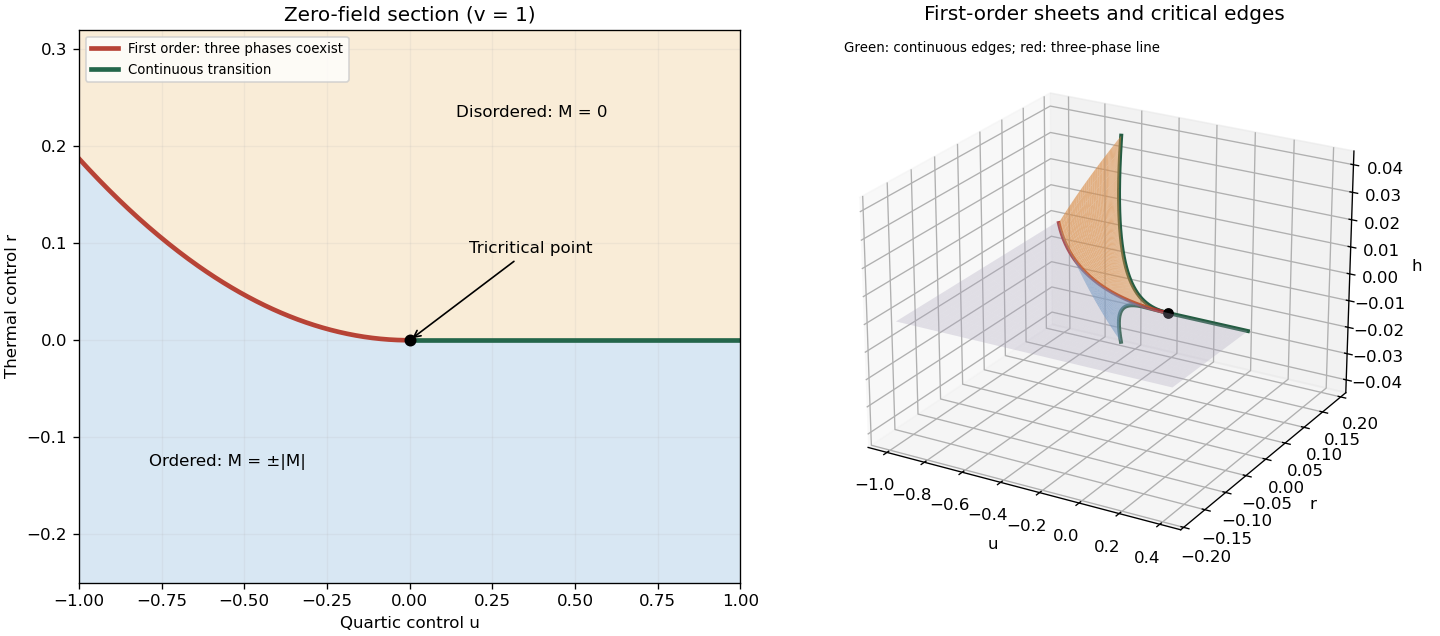
A phase diagram divides a space of control parameters into equilibrium thermodynamic phases, marking phase coexistence boundaries and thermodynamic critical points. Its dimension counts independently variable controls, not spatial dimensions. An explicit three-dimensional example uses the controls of a sextic even Landau potential:Here is a scalar order parameter, its conjugate field, and a thermal control. The equilibrium magnetization minimizes globally. At , , the boundary is a continuous phase transition. At , , the boundary is a first-order phase transition between and . The two boundaries meet at the tricritical point . A fixed strictly positive quartic coupling alone cannot produce this tricritical point; the stabilizing sextic term is essential when the quartic coefficient is tuned through zero.
The full phase diagram also contains the phase coexistence sheet between positive and negative ordered phases. Crossing it changes the sign of discontinuously. For , the three-phase line is the junction of this sheet and two tricritical wings, on which two unequal same-sign equilibrium magnetizations coexist at nonzero . The tricritical wing critical edges are lines of ordinary thermodynamic critical points; they terminate the first-order sheets and meet at the tricritical point. Away from these boundaries, varying produces a smooth crossover.
For an explicit construction of the tricritical wings, write their two coexisting order parameters as and , with and . Equality of their Landau free energies and first derivatives givesIndeed, for these controls the tricritical wing coexistence factorization isThe last factor is , proving that both specified minima are global. The reflected wing has negative and negative . Letting gives the tricritical wing critical edge , , ; there and . Letting recovers the three-phase line. This supplies the first-order sheets and their continuous boundary curves, rather than only a zero-field section.

Past exam of the mathematics course of the University of Cambridge 2003 iii Paper 35 4 Solution 2026-10-14
For a density matrix on a finite-dimensional Hilbert space, its Von Neumann entropy in bits iswhere are its eigenvalues and . It is the Shannon entropy of the spectrum, is zero for a pure state, and is invariant under unitary conjugation.
Past exam of the mathematics course of the University of Cambridge 2003 iii Paper 32 1 Solution 2026-10-14
The positive state-price density alternative characterizes one-period arbitrage. Interpret as the vector of current asset prices and as their terminal payments. A fixed vector of holdings produces initial cost and terminal payment . The first alternative is a nonpositive-cost investment with a nonnegative payment and strict improvement either initially or on an event of positive probability. A strictly positive state-price density prices every such payment and excludes both forms of arbitrage, as proved below.
If there is a traded bank account costing one and paying a deterministic , the density satisfies . Hence defines an equivalent martingale measure andConversely this pricing relation under an equivalent martingale measure gives . Without such an account, is a pricing density, not necessarily a probability density or even an integrable random variable by itself; the stated requirement is integrability of . This distinction keeps the abstract alternative valid without an unstated asset paying one.
Past exam of the mathematics course of the University of Cambridge 2003 iii Paper 20 4 Solution 2026-10-14
For a Boolean algebra , write for its principal lattice ideal. The ideal frame of a Boolean algebra has intersections as meets and ideals generated by unions as joins. The pseudocomplement of an ideal isIn particular , so every principal ideal is complemented and regular.
If is complete, put . Then and . Thus all regular ideals are principal and complemented, so the corresponding locale is extremally disconnected.
Conversely, if the ideal frame of a Boolean algebra is extremally disconnected, each is complemented. Any complemented ideal is principal: if and , the fact that their generated join contains supplies with . Then , so ; every is disjoint from and therefore . Thus . Write . Since , bounds . If is another upper bound, implies , so . An arbitrary subset has the same upper bounds as the lattice ideal it generates, so every subset of has a supremum. Hence
Now put and . This is a complete Boolean algebra, with arbitrary Boolean joins , so the preceding result makes extremally disconnected. We construct its map to using the permitted Joyal extension lemma.
The map , , is a frame homomorphism, with right adjoint . Thus is a nucleus on a frame whose fixed frame is . It preserves finite joins: both and equal , and . Consequently the locale with frame is a flat sublocale of . It is also the Booleanization of a locale , so it has its inclusion map to .
The Joyal extension lemma says that a map from a flat sublocale to a compact locale that is a regular locale extends uniquely to the ambient locale. Apply it to this inclusion. Its frame formula giveswhere is the well-inside relation . This also proves directly that the map is surjective. Indeed implies : meet with . Every member of the ideal is therefore at most in , since a finite Boolean join of its generators is below ; the last inequality follows because . Regularity givesThus can be recovered from , so is injective. A locale map with injective inverse-image frame homomorphism is a surjection. We have obtained an extremally disconnected and a surjection .
Past exam of the mathematics course of the University of Cambridge 2003 iii Paper 19 1 Solution 2026-10-14
A well-quasi-ordering is a preorder such that every infinite sequence has indices with . Reflexivity and transitivity are part of the definition; antisymmetry is unnecessary. An infinite sequence without such a pair is a bad sequence.
The perfect subsequence lemma strengthens this definition: every infinite sequence in a well-quasi-order has an infinite nondecreasing subsequence, meaningHere is a proof that does not assume the lemma implicitly. There must be an index with infinitely many later indices satisfying . Otherwise each index would have only finitely many such successors. Starting with any index, choose the next one beyond the union of those finite successor sets for the previously chosen indices. This constructs a bad sequence, contradicting the well-quasi-ordering property.
Choose with infinitely many successors above it, and restrict to those successors. Apply the same argument to that infinite subsequence, obtaining with infinitely many later successors above it within the restricted sequence. Continue. Every subsequent restriction lies inside all previous upper cones, so for every . This proves the lemma, including for a genuine quasi-order with distinct equivalent elements. Both alternatives below use it.
Past exam of the mathematics course of the University of Cambridge 2003 iii Paper 17 5 Solution 2026-10-14
A compatible almost complex structure is a smooth endomorphism satisfying , preserving , and making a positive-definite inner product. Preservation and make this bilinear form symmetric.
To construct one, choose any Riemannian metric and define by . The endomorphism is skew-adjoint and invertible. Consequently is positive definite and self-adjoint. Let be its positive square root and setThe spectral theorem gives fibrewise, and the positive-square-root operation is smooth on positive-definite matrices, so this defines a smooth endomorphism. Since commutes with , . Also , so . Commutation then givesThis is the metric construction of a compatible almost complex structure, proving nonemptiness.
If we start with for an already compatible , then , so , , and the construction recovers . For two compatible structures, linearly interpolate their metrics,and apply the construction to . This is a continuous smooth-in- path with endpoints . Thus the space is nonempty and path connected. Interpolating instead to a single fixed auxiliary metric actually gives the contractibility of compatible almost complex structures.
Past exam of the mathematics course of the University of Cambridge 2003 ib Paper 2 4E Solution 2026-10-14
For the cofinite topology , the empty set and are included. A nonempty union of cofinite sets is cofinite because its complement is contained in the finite complement of any one member. A finite intersection is cofinite because its complement is a finite union of finite sets; intersections involving the empty set are empty. This proves all topology axioms.
For the tail topology on the natural numbers , . Any nonempty collection of tails has a smallest starting index, so its union is that tail; a finite intersection of tails is the tail with largest starting index. Empty sets and empty-family conventions supply the remaining cases. Thus is also a topology.
We classify continuous maps between cofinite and tail topologies. Continuity is equivalent toIf has unbounded image, each is nonempty, hence cofinite. For every threshold , eventually , which is exactly . If the image is bounded, it is a nonempty finite subset of and has a maximum . Then is nonempty and cofinite, but always, so except at finitely many indices. These exhaust the two possibilities and prove necessity. Their sufficiency is checked separately below.
Past exam of the mathematics course of the University of Cambridge 2003 ia Paper 4 7C Solution 2026-10-14
For integers not both zero, their greatest common divisor is the greatest positive integer dividing both. For the degenerate pair use the conventional value zero. A number divides both exactly when it divides both : one direction uses closure of divisibility under sums; the reverse subtracts . The positive common-divisor sets are therefore identical, provingThis also holds for under the stated convention and does not depend on the signs of the integers.
Bezout identity states that there exist integers such that . If a prime divides but does not divide , then , so choose with . Multiplying by gives . Both terms on the left are divisible by , so . Thuswhich proves the Euclid lemma from the requested identity. The separately numbered entries use these arithmetic facts for the Fibonacci numbers.
Past exam of the mathematics course of the University of Cambridge 2003 ia Paper 4 2C Solution 2026-10-14
An equivalence relation on a set is a binary relation that is reflexive, symmetric and transitive: every satisfies ; implies ; and , imply . Each of these quantifiers ranges over the entire specified set. The separate entries below test these three properties.
Past exam of the mathematics course of the University of Cambridge 2003 ia Paper 2 7D Solution 2026-10-14
For the homogeneous solution, expand in the independent eigenvectors of . Each coefficient obeys , so the complementary function isIf is any particular integral, subtracting it from any other solution gives a homogeneous solution. Hence is the general solution. Complex-conjugate modes can be combined to produce real solutions when the forcing is real.
For a real two-by-two matrix, the characteristic polynomial is . Under the stated distinct-eigenvalue assumption, all nonzero homogeneous modes are purely oscillatory exactly when the eigenvalues are with . Their sum and product imply , . Conversely these trace and determinant conditions force those eigenvalues, so there is no exponential growth, decay or Jordan-block secular growth.
For the final specified initial-value problem, direct multiplication gives . The forcing vector satisfies , so the forcing is resonant and is a particular integral. The matrix exponential isSince the resonant particular integral vanishes initially, the initial-value solution isThis complex solution is appropriate to the complex forcing as written. Taking real parts gives the corresponding solution for the real part of that forcing.
Past exam of the mathematics course of the University of Cambridge 2003 ia Paper 2 1D Solution 2026-10-14
The direction field has slope , independent of . Its line segments slope upward for , are horizontal at , and slope downward for . Thus is an attracting equilibrium in forward , while is repelling. The two constant solutions must be included separately when separating variables.
The following original sketch shows the slope field and one solution in each requested region. The lower exterior solution ends at a finite pole; it cannot be continued across that pole as a real finite-valued solution.
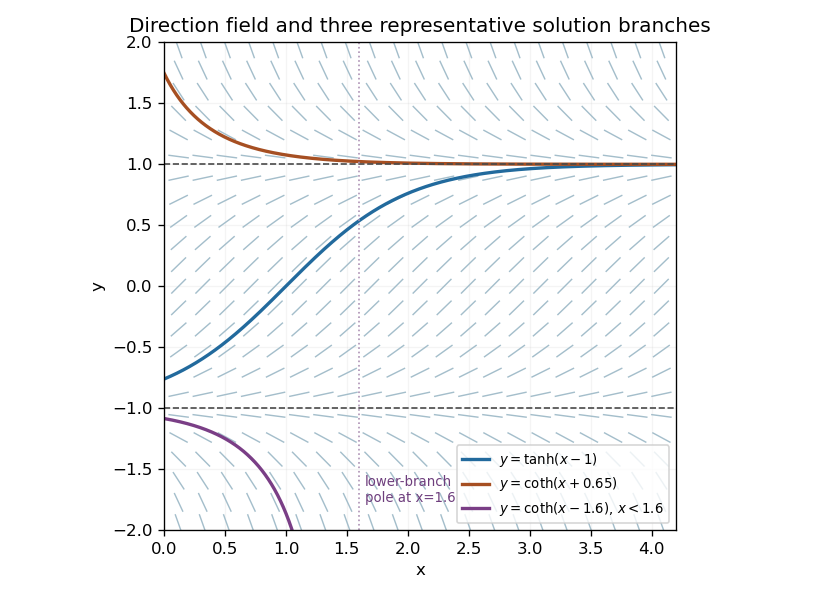
Direction field, equilibrium lines and representative solutions in the three regions of the autonomous scalar equation
. Details. 
There are unlisted articles, also show them or only show them.