
Past exam of the mathematics course of the University of Cambridge 2003 ia Paper 1 8D Solution 2026-10-14
Two nonzero vectors are linearly independent when implies . Their span then has dimension two. If they are linearly dependent, one is a scalar multiple of the other, so their span is a nonzero line and has dimension one. Thus the requested dimensions are two and one, respectively.
The dot product and corresponding Euclidean norm areThe Cauchy-Schwarz inequality states . If this is immediate. Otherwise the nonnegativity of a squared norm, with , givesMultiplying by and taking square roots proves the inequality. Equality holds precisely when the vectors are linearly dependent. Expanding another squared norm and using the inequality givesand hence the triangle inequality .
In , the two vectors lie in a common plane. If their directions make angle , the law of cosines gives . Comparing with the dot-product expansion yieldsThe sketch shows the same relation as a projection: multiply the length of by the signed component of in its direction. That component is negative for obtuse .
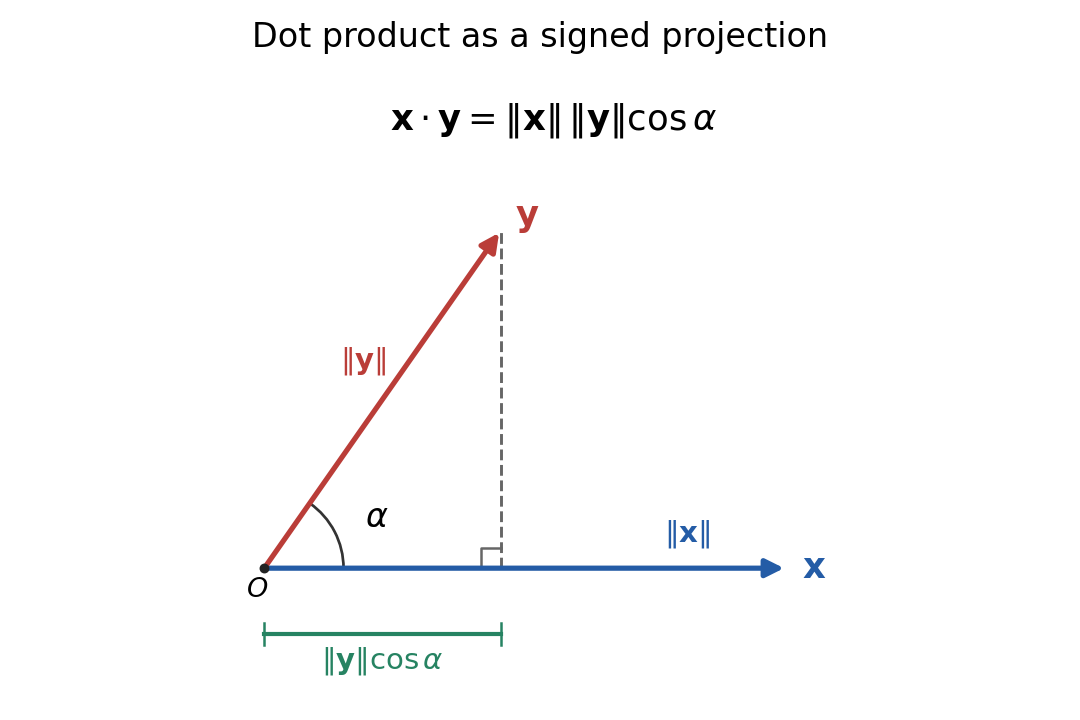

A unit vector is a vector of Euclidean norm one, equivalently . In particular the dot product of two unit vectors is the cosine of their mutual angle.
Past exam of the mathematics course of the University of Cambridge 2003 ia Paper 1 7B Solution 2026-10-14
There are nontrivial proper normal subgroups. The determinant defines a surjective group homomorphism . Its kernel is the rotational symmetry group of a cube, a normal subgroup of order twenty-four. Also is a central subgroup of order two: central inversion preserves the cube and commutes with every matrix. Both provide affirmative examples.
For the body diagonal through , write a general cube symmetry as , with a permutation matrix and , each . Since , preserving the unoriented diagonal requires to be either or . ThusThe map from to is a group homomorphism, because central inversion commutes with every coordinate permutation. It is surjective by the displayed description and injective because a permutation matrix cannot equal the negative of another permutation matrix. Consequently the body-diagonal stabilizer in the cube symmetry group isThis also agrees with the orbit-stabilizer theorem for the transitive action on the four body diagonals. The line is preserved as a set, so exchanging its opposite endpoints is allowed.
Past exam of the mathematics course of the University of Cambridge 2003 ia Paper 1 4C Solution 2026-10-14
The radius of convergence of a power series is the unique for which the series converges absolutely when and diverges when . When it converges for every complex ; when it converges only at the centre. The definition makes no assertion about convergence on , so boundary points must be checked separately.
Past exam of the mathematics course of the University of Cambridge 2003 ia Paper 1 10F Solution 2026-10-14
The integral test for convergence applies when for all sufficiently large , where is nonnegative, continuous and nonincreasing on . It states that converges if and only if the improper integral is finite. Its comparison bounds areNo conclusion about an arbitrary nonnegative sequence follows without such a monotone comparison function; finite initial terms do not affect convergence.
For with , all the hypotheses hold. If ,whereas for the integral is . The first expression has a finite limit exactly when . Thus the p-series satisfies
Past exam of the mathematics course of the University of Cambridge 2002 iii Paper 8 5 Solution 2026-10-14
For , write for the coordinates other than , and setBy Tonelli theorem, . The key estimate is the functional Loomis-Whitney inequality:Here is a proof in every dimension. In dimension two, the left-hand side separates into a product of two one-dimensional integrals, so Tonelli theorem gives equality. For , first integrate . Apply Hölder's inequality with factors to , which may depend on , and leave the factor outside that integral. WriteEach depends on the coordinates other than . With , the full integral is at mostPut . A second application of Hölder's inequality, with exponents and , bounds this expression byBy induction in dimension , . Since , substitution proves the claimed functional inequality. Nonnegative integrands justify all integrations; truncation gives the extended-valued version if necessary.
The pointwise hypotheses imply , soApply the proved functional inequality and take the power to obtainFor the useful case all the right-hand norms are finite. If one of them is zero, its line integral vanishes for almost every transverse coordinate and forces almost everywhere; there is no division by that factor. In dimension one the corresponding direct assertion is .
Past exam of the mathematics course of the University of Cambridge 2002 iii Paper 76 3 Solution 2026-10-14
Let contain all free variables of . The lambda term is a solvable lambda term if there are closed lambda terms such thatAdditional arguments beyond the first are allowed. A head normal form is a term with a variable at the head; its arguments need not be beta-normal.
If reduces to this head normal form, close its free variables and supply every resulting initial binder with the same closed projection(take when ). The head variable becomes and discards all argument terms, even divergent ones, leaving . Thus a head normal form implies solvability.
Conversely suppose a closure and applications of yield . The standardization theorem for beta reduction supplies a finite successful head-reduction sequence. Until exposes a head variable, its head contractions lie within : a closing substitution cannot create a new head redex there, and supplied arguments cannot be used until an initial abstraction is exposed. Each such contraction commutes with the closing capture-avoiding substitution. Project the successful head computation back onto , ignoring contractions in supplied arguments and the consumption of its initial binders. If this projected head computation did not reach a variable-headed spine, the full computation could not reach either. It therefore gives a finite head reduction of to a head normal form. ConsequentlyThe same head-trace argument shows that an unsolvable lambda term stays unsolvable under substitution and application. This also justifies the unsolvability conclusion in the preceding solution.
Past exam of the mathematics course of the University of Cambridge 2002 iii Paper 72 1 Solution 2026-10-14
Use sequential semicolon indices: , where the second covariant derivative also differentiates the lower index of . For a torsion-free connection, direct expansion givesSubtract the expression with exchanged. Commuting partial derivatives cancel the first term; the first-derivative terms cancel in pairs; symmetry of the lower Christoffel symbol indices cancels both terms containing . What remains isThis is the Ricci identity with the curvature convention printed on the PDF's first page. In terms of derivative operators it is ; writing the operator order explicitly avoids reversing the sign.
The lower-index rule follows by applying the commutator to the scalar contraction . Its second derivatives commute, so the product rule implies . The derivative commutator is a derivation on tensor products, since the cross terms cancel. It therefore acts once on every index, with a positive sign on each upper index and a negative sign on each lower index. For an arbitrary tensor of valence ,Local sums of decomposable tensors establish the formula for every tensor field, rather than only for a single tensor product.
Past exam of the mathematics course of the University of Cambridge 2002 iii Paper 69 2 Solution 2026-10-14
The renormalization group compares descriptions at successively longer length scales. First eliminate short-wavelength degrees of freedom, then rescale coordinates and fields to restore the reference cutoff. This changes the couplings, including interactions and additive free-energy terms generated during elimination. A renormalization-group fixed point is a scale-invariant description. Linearized directions growing under coarse graining are relevant, shrinking directions are irrelevant, and zero-eigenvalue directions are marginal and require higher-order analysis.
A diverging correlation length means that many coarse-graining steps can approach a renormalization-group fixed point before a relevant perturbation becomes large. Systems with different microscopic details but the same renormalization-group fixed point and relevant directions share universal critical behavior. For the quadratic model below, Fourier modes decouple, so eliminating a high-momentum shell produces a Gaussian determinant but does not couple the remaining modes. The anisotropic gradient kernel requires different length rescalings in the parallel and transverse directions. This is an anisotropic renormalization group, not an isotropic rescaling of all coordinates.
Past exam of the mathematics course of the University of Cambridge 2002 iii Paper 69 1 Solution 2026-10-14
Spontaneous symmetry breaking occurs when the statistical Hamiltonian is invariant under a symmetry but a chosen equilibrium pure state is not. A small selecting field or a boundary condition chooses one of several states related by the symmetry. For a finite unconstrained system the symmetric ensemble generally has zero order parameter; spontaneous order is defined by taking the thermodynamic limit before removing the selecting field. A ferromagnet with a selected magnetization direction is the standard example.
If the broken symmetry is continuous, nearby symmetry-related states cost no energy for a uniform displacement along the manifold of states. Locality and a nonzero stiffness then make a slowly varying displacement cost gradient energy rather than a mass term. These gapless long-wavelength fluctuations are Goldstone modes. In the conventional relativistic internal-symmetry setting their count is the number of broken generators. Nonrelativistic dynamics can pair broken generators, as in a ferromagnet; gauge symmetries and broken space-time symmetries require additional qualifications. A discrete broken symmetry alone does not produce a Goldstone mode.
For an interface with a selected mean height, the continuous displacement is a rigid translation normal to the mean plane. The tension gives a stiffness for spatially varying translations. The following calculation concerns this static Goldstone sector. It determines the excitation energy and equilibrium fluctuations, but a frequency dispersion requires a separate inertial or dissipative dynamics. In low dimensions thermal roughness also limits the existence of a strictly localized flat interface in an infinite system.
Past exam of the mathematics course of the University of Cambridge 2002 iii Paper 68 2 Solution 2026-10-14
Choose the extended supersymmetry normalizationThe central charge in supersymmetry is antisymmetric in , because the full anticommutator is symmetric and is antisymmetric. In a massive one-particle state rest frame, , and the first anticommutator becomes .
A unitary skew-diagonalization of an antisymmetric matrix puts into blocks , with a remaining zero direction if is odd. For one block write , and label its two supersymmetries . The combinationshaveFor example the mixed contribution to the first expression is . This is the phase-aligned version of taking a supercharge minus a unitary combination of its adjoints, as suggested by the hint.
For every operator and normalized state ,Applying this to in every block proves the BPS boundIf the algebra is instead written with on its right side, the same result is ; the factor is purely a central-charge convention.
A BPS state saturates at least one of these inequalities. The corresponding zero-norm combinations of supercharges and their adjoints annihilate the representation, so part of supersymmetry is preserved. Its massive supermultiplet is shortened: each saturated block removes two complex fermionic oscillators, giving states from a spin- Clifford vacuum when blocks saturate, before any necessary CPT completion of a supermultiplet. It preserves of the real supercharges. Its mass is tied to the central charges in supersymmetry and remains protected while it stays on the same short branch. Stability is not unconditional: a wall of marginal stability can permit a charged BPS state to decay into other BPS states with the same total charge.
Past exam of the mathematics course of the University of Cambridge 2002 iii Paper 64 1 Solution 2026-10-14
Take the symmetric scalar Landau free energy with , for a positive constant , and leading equation of stateAt zero conjugate field, minimization gives for and for . Selecting the positive pure thermodynamic phase,Consequently the order-parameter critical exponent is .
Differentiate the equation of state at fixed temperature, within the selected phase:Both sides diverge as , so the magnetic-susceptibility critical exponent is . The leading above-to-below magnetic susceptibility amplitude ratio is two. These are the ordinary mean-field critical exponents, valid under the fluctuation qualification explained above.
Past exam of the mathematics course of the University of Cambridge 2002 iii Paper 61 6 Solution 2026-10-14
The ordinary interpolation formulation is unambiguous for strictly increasing knots; repeated knots require specified confluent interpolation or a limiting convention. First take distinct knots and , and for fixed write . The two degree-at-most- Lagrange interpolation polynomials and agree at the shared knots . Their difference is thereforeThis remains valid if their difference has lower degree: the coefficient is then zero. The leading coefficient of a degree-at-most- interpolant is its order- divided difference. Comparing leading coefficients and using the divided-difference recursion givesConsequently the Lee interpolation identity holds for every real :No differentiability of the truncated power in its argument was needed for this distinct-node proof.
Sum the identity over . The right side telescopes, giving . When , all the nodes for lie below , so its interpolation data are zero and . All the nodes for lie above , where is already a polynomial of the admissible degree. Uniqueness of polynomial interpolation gives . Therefore the Marsden identity isFor order one the empty product is one, the interpolants are constants and a consistent half-open interval convention for gives the same telescoping proof. Nondecreasing repeated-knot sequences can be treated by the appropriate confluent or limiting convention wherever that definition is valid; merely specifying repeated data values does not uniquely determine the interpolation polynomials. The basic open knot interval in the Marsden identity avoids endpoint convention ambiguity.
Past exam of the mathematics course of the University of Cambridge 2002 iii Paper 61 5 Solution 2026-10-14
For real continuous , the Chebyshev alternation theorem says that is the unique best uniform approximation to precisely when there are ordered points and a sign such thatHere means degree at most . Best approximants exist: a minimizing sequence is bounded in the finite-dimensional polynomial space, and finite-dimensional equivalence of norms gives a convergent coefficient subsequence. When , the zero error is treated separately; the derivative-sign hypothesis below excludes that case.
Let be a best degree-at-most- approximant and suppose for contradiction that . Since , is not a degree-at-most- polynomial and its error is nonzero. The same would be best in , so the Chebyshev alternation theorem at that degree supplies alternating error extrema. The intermediate value theorem gives at least distinct zeros of , one between each consecutive pair of extrema.
Repeated Rolle's theorem then forces a zero of . But , whereas everywhere. This contradiction provesThe argument proves strict decrease of best polynomial approximation under a derivative sign; an everywhere negative st derivative gives the same strict conclusion after replacing by .
There are unlisted articles, also show them or only show them.