
A minimal normal subgroup of a finite faithful two-transitive group action is either regular elementary abelian or primitive nonabelian simple. The imprimitive case reduces to two-point stabilizers being trivial, then counting derangements gives a characteristic regular Sylow subgroup. In the primitive nonregular case, each simple direct factor is transitive. Two commuting transitive factors are regular and are mutual full centralizers. Thus at most two factors occur and . But the common subdegree of then divides both and , forcing , a contradiction. Only one factor remains.
Degree-ten partition action of S6 2026-10-14
There are partitions of six letters into two unordered triples. A stabilizer is , also the normalizer of the Sylow subgroup generated by one 3-cycle in each triple. Relative to one partition, all other partitions have intersection pattern up to interchange, giving one orbit of the stabilizer and hence a two-transitive action. A natural fixing one letter is transitive on these partitions, giving .
Elementary abelian regular kernels in doubly transitive groups Created 2026-10-14 Updated 2026-11-05
A point stabilizer in a finite two-transitive group action acts transitively by conjugation on the nonidentity elements of a regular normal subgroup . All those elements have the same order; Cauchy's theorem makes this a prime p and excludes other primes from . A finite p-group has a nontrivial characteristic center. Transitivity then forces all of into its center, so is elementary abelian. Choosing a vector-space basis identifies the original permutation group with a subgroup of the corresponding general affine group.
Cartan decomposition of a two-qubit gate Created 2026-10-14 Updated 2026-11-05
Every two-qubit gate has the displayed form with local elements of the special unitary group and real interaction parameters. The three Pauli-product generators commute, so the central exponential is the product of three interactions. Local basis changes turn an Ising coupling into either of the other Pauli-product couplings. A fixed entangling controlled phase together with arbitrary local rotations can also synthesize each variable interaction, for example through two CNOT gates enclosing a variable rotation.
Diagonal two-qubit phase entanglement criterion Created 2026-10-14 Updated 2026-10-25
A diagonal two-qubit gate with entries is a product of local diagonal gates, up to global phase, exactly when modulo . This follows by factoring the two-by-two array of phases; its determinant vanishes precisely in that case. If the determinant is nonzero, applying the gate to produces an entangled state by the two-qubit product-state determinant criterion. In particular is local, whereas is the entangling Controlled-Z gate.
After the quantum quench, hold fixed and evolve without an intervening energy measurement. The unitary time evolution isProjection onto the original gives probability amplitude . Squaring its modulus yields the two-level quantum return probabilityTheir sum is one. For , the first minimum of is at , and the return is complete at . At or there is no oscillation, because the initial quantum state is already a final energy eigenstate.
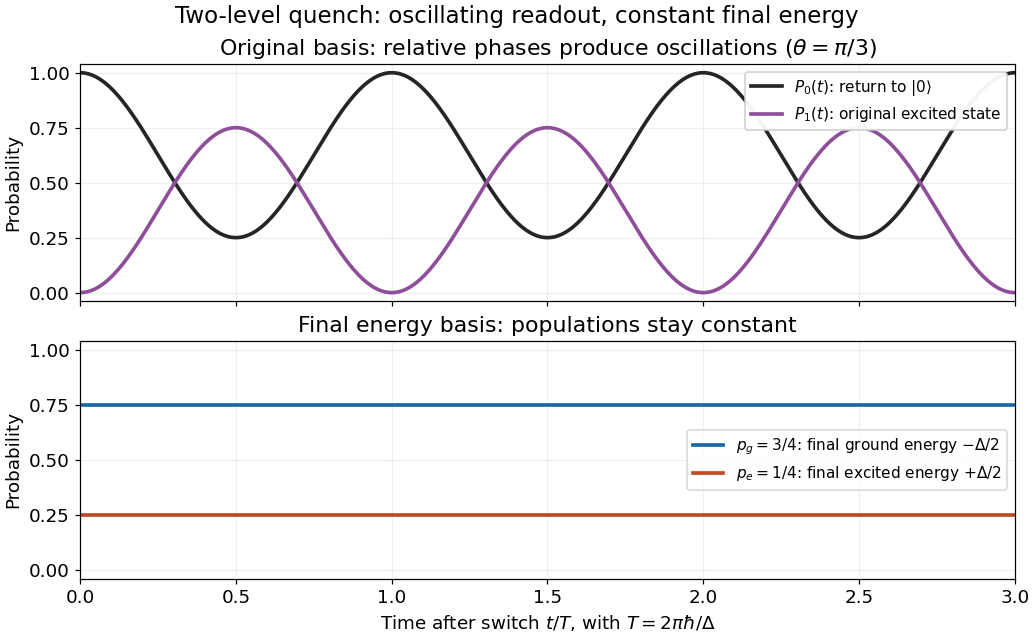

Changing measurement basis reveals the evolving relative quantum phase. Measuring the final energy first instead destroys this quantum coherence between final energy eigenstates in the unconditioned ensemble: its later original-basis return probability is , equal to for this example. That constant differs from the oscillation of the unmeasured pure state. The work protocol and the oscillation protocol therefore use separate preparations.
Work in a two-level sudden quench 2026-10-14
The drive can supply or extract work while the quantum state stays approximately fixed. For a differentiable bounded Hamiltonian operator, the Schrödinger equation givesThe state-evolution terms cancel, leaving the external drive's power. For a finite ideal step the change in mean energy is . Thus conservation of energy for a closed system with a time-independent Hamiltonian operator does not assert conservation of the driven subsystem's energy during switching.
Specify work operationally by two energy measurements: one before the switch and one after. For the prepared initial ground state, the first outcome is definite; the second samples the new Born rule probabilities. This protocol gives a distribution of measured energy differences, rather than generally the measurement distribution of the single operator .[ref]
Fluctuation theorems: Work is not an observable by Peter Talkner and others. Talkner, Lutz and Hänggi, p. 2, equations (8)–(10): initial energy outcome, conditional transition probability and two-measurement work distribution
and henceFor and , the work is or , with probabilities and ; its expectation is and its variance is . The initial mean energy becomes . Using different initial and final scalar offsets would also shift the measured work; the displayed Hamiltonian operators fix that convention explicitly. Supersymmetric Liouville equation Created 2026-10-14 Updated 2026-11-05
In two-dimensional N=(1,1) superspace, one convention for the supersymmetric Liouville equation is . With the ordered expansion and left Grassmann derivatives, its left side isWriting , Grassmann parity gives and . HenceComparing coefficients eliminates the auxiliary field as and gives , , . The fermion bilinear sign depends on the stated ordering and derivative convention.
For a wide range and separation well below its outer scale, the second-order longitudinal structure function is controlled by . The low-wavenumber filter term gives , larger than the order- energy above the cutoff. This is a marginal dependence on larger-scale enstrophy.
Primary field Created 2026-10-14 Updated 2026-11-05
A primary field in a two-dimensional conformal field theory transforms homogeneously under local conformal coordinate changes, with conformal weights . Its scaling dimension is and its two-dimensional spin is .
In the holomorphic sector, its defining operator product expansion with the stress-energy tensor is . The double pole encodes rescaling and the simple pole translation. Acting with negative Virasoro algebra modes generates Virasoro descendants. This separates each family into a primary starting point and symmetry-generated operators, greatly reducing the independent information needed to specify correlation functions.
Free chiral Majorana fermion conformal field theory Created 2026-10-14 Updated 2026-11-05
A real chiral Majorana fermion with contraction has stress tensor . Fermionic Wick contractions give . Double contractions in give , so the central charge is . Fermion bilinears of different species are weight-one currents; equal-species undifferentiated bilinears vanish by antisymmetry.
Quasi-primary operator Created 2026-10-14 Updated 2026-11-05
A quasi-primary operator transforms with weights under global conformal, or Möbius, transformations. A primary operator has this covariance under every locally invertible holomorphic and antiholomorphic coordinate change. In radial quantization, quasi-primary states are annihilated by , whereas primary states are annihilated by every positive Virasoro mode. The stress tensor at nonzero central charge is quasi-primary but not primary because its transformation under a general coordinate change includes a Schwarzian term.
Radial quantization Created 2026-10-14 Updated 2026-11-05
Radial quantization treats circles around the origin as equal-time slices and logarithmic radius as Euclidean time. A local insertion at the origin prepares a state on a surrounding circle. Contours of the stress tensor act on that insertion, turning its singular operator product expansion into the Virasoro algebra action on the corresponding state.
Liouville field theory Created 2026-10-14 Updated 2026-11-05
Liouville field theory is a two-dimensional scalar theory with a curvature background charge and an exponential interaction. In the usual spacelike normalization, quantum conformal invariance gives and central charge . When a noncritical string worldsheet conformal factor is retained as a dynamical field, its effective action has this form and its central charge combines with the matter and worldsheet ghost field charges. It is closely related to a background-charge scalar field, but its exponential potential supplies an additional interaction.
Global conformal Ward identities for chiral correlators Created 2026-10-14 Updated 2026-11-05
For primary operators of holomorphic weights and a Möbius transformation invariant vacuum, infinitesimal translations, dilations and special conformal transformations give , , and . Solving gives a constant one-point function only at , a two-point function only for equal weights, and a three-point function . Three-point covariance imposes no further equality of weights; dynamical selection rules may still force . For more points, arbitrary functions of conformal cross-ratios remain.
Null twistor 2026-10-14
A nonzero twistor null for the twistor Hermitian form. Its projective class determines a real null geodesic in compactified Minkowski space. For nonzero , its affine real solutions of the twistor incidence relation have the form , . Twistors with encode generators at infinity rather than finite affine solutions.
Real compactified Minkowski points are the two-dimensional totally isotropic subspaces for the signature- twistor Hermitian form. In a graph chart this is the usual Hermitian reality condition on . Their twistor lines lie in projective null twistor space. On the Klein quadric the same real form is the projectivized null cone of a real quadratic form of signature .
Neo-Hookean tube pressure under twist and inflation Created 2026-10-14 Updated 2026-11-05
Twin-prime constant Created 2026-10-14 Updated 2026-11-05
This positive convergent product corrects for the dependence of primality of and at each odd prime. The associated singular series is : the factor at two is two, and at an odd prime the local correction is . It appears in the Hardy–Littlewood twin-prime asymptotic conjecture and in upper bounds from the Selberg sieve.
// Target: analytic-number-theory.bigb
Hardy–Littlewood twin-prime asymptotic conjecture Created 2026-10-14 Updated 2026-11-05
The local-density prediction for twin primes is the displayed asymptotic, with the twin-prime constant . It is stronger than infinitude alone. The Selberg sieve proves the correct order of magnitude as an upper bound, but the parity problem in sieve theory prevents its elementary majorant from proving this conjectured asymptotic.
// Target: analytic-number-theory.bigb
There are unlisted articles, also show them or only show them.