
Twin paradox clock experiments 2026-10-14
The 1972 paper Around-the-World Atomic Clocks: Observed Relativistic Time Gains by J. C. Hafele and others reports four cesium-beam atomic clocks flown around the world in October 1971, eastward and westward. Their readings were compared with the U.S. Naval Observatory reference time scale before and after travel. An electronic time-interval counter resolved differences to the nearest nanosecond; intercomparisons among the flying clocks continued during travel. The final ensemble results were eastward and westward; the quoted spreads are standard deviations. These are corrected clock offsets, not raw readings or aircraft travel times. Four clocks allowed identification of individual rate changes through patterns in their mutual differences. The authors also report magnetic shielding and laboratory orientation checks. Their analysis could not detect a disturbance common to every flying clock, and the small ensemble limits statistical conclusions. This is a concrete reunited-clock experiment with apparatus, readout and drift controls.[ref]
Around-the-World Atomic Clocks: Observed Relativistic Time Gains by J. C. Hafele and others. pp. 168–170: Table 1, electronic counter, correlated rate-change analysis, magnetic shielding and common environmental effects
The companion paper Around-the-World Atomic Clocks: Predicted Relativistic Time Gains by J. C. Hafele and others computes eastward and westward from the recorded flight paths. These are predictions, with flight-data uncertainty estimates. Both time dilation from motion and gravitational time dilation matter: aircraft clocks at altitude experience a different gravitational potential, while the rotating Earth means a ground clock is not the inertial home clock of our simple model. Eastward and westward motion change the aircraft's velocity relative to an approximately nonrotating inertial frame, not merely its speed relative to the ground. The measured agreement therefore tests combined special relativity and general relativity; the westward gain does not contradict the maximum-proper time result for fixed endpoints in Minkowski spacetime.[ref]
A complementary microscopic test is Measurements of relativistic time dilatation for positive and negative muons in a circular orbit by J. Bailey and others. The authors measured muon decay lifetimes in a storage ring at Lorentz factor : for positive muons and for negative muons. The reported positive-muon lifetime agrees with the independently measured lifetime at rest and special relativity to a fractional error of at 95% confidence. This is a decay-lifetime readout under continuous centripetal acceleration, rather than a reunion of portable clocks. It supports the clock hypothesis for this physical process and regime; the inspected abstract does not establish universal immunity of every clock mechanism to acceleration. [ref]
Twin paradox with finite acceleration 2026-10-14
An instantaneous reversal is an idealization. A real traveller changes velocity over a finite time, follows a smooth world line, and has finite proper acceleration. Special relativity still calculates the elapsed proper time using the home inertial frame and the same integral; general relativity is not needed merely because the traveller accelerates in otherwise flat spacetime. The clock hypothesis identifies an ideal clock's reading with this geometric proper time.
One explicit smooth trip between the same and starts and ends at rest in the home inertial frame. ChooseIts velocity reverses continuously at , and its proper acceleration is bounded because and is finite. With and , numerical integration givesThis comparison fixes the reunion spacetime events and maximum speed, not the turnaround distance: the smooth trip reaches light-years, whereas the ideal trip reaches light-years. The smooth traveller spends less time at high speed and therefore accumulates more proper time than the ideal traveller, while still accumulating less than the home clock.
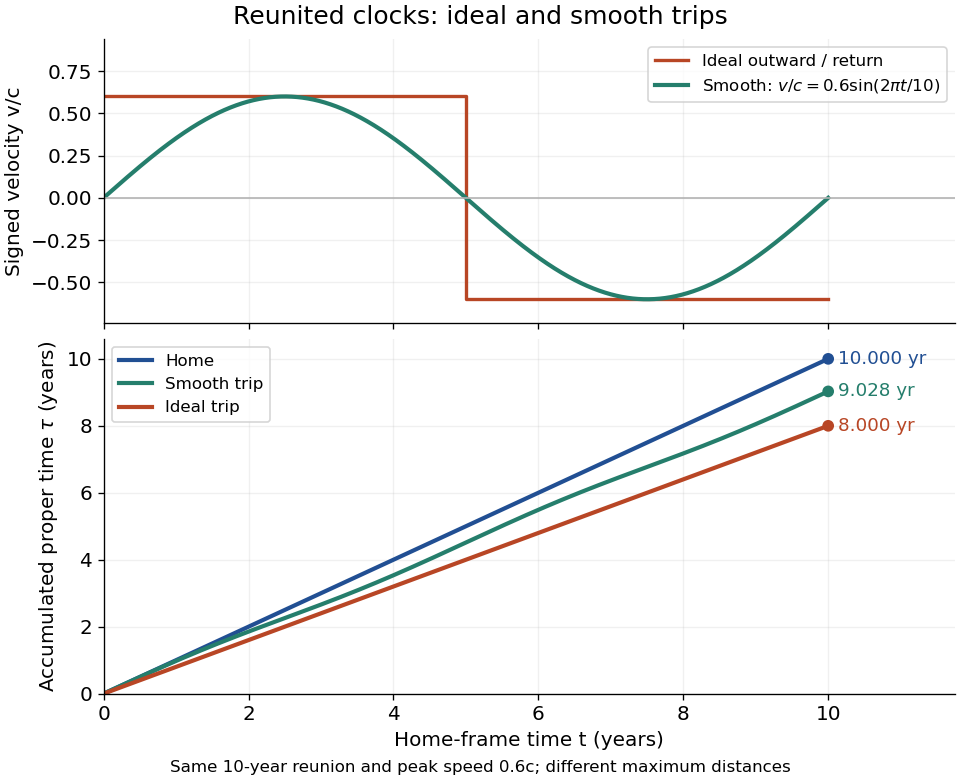
Signed velocity and accumulated proper time for ideal and smooth trips with the same ten-year reunion and maximum speed 0.6c; their turnaround distances differ
. Details. 
For a sufficiently short smooth reversal replacing the corner, the proper time approaches the piecewise inertial result. A reversal interval of home duration contributes between zero and to the clock reading; shrinking that interval cannot create a finite extra loss concentrated at the corner. The finite difference survives in the long coasting legs. Keeping the same reversal manoeuvre while lengthening those legs changes the age difference. Conversely, two travellers following mirrored paths with the same speed history accumulate equal proper times, even though both accelerate. Thus acceleration distinguishes paths and enables reunion here, but an amount of acceleration alone does not determine the age difference.
The changing simultaneity assignment also becomes continuous. At a traveller spacetime event with instantaneous velocity , the momentarily comoving inertial frame assigns home time . Differentiating givesDuring the reversal at positive , the last term advances the assigned home time rapidly. It describes the traveller's changing relativity of simultaneity, not a locally measured alteration of the home clock's ticking.
Twin paradox simultaneity change 2026-10-14
During either inertial leg, the traveller can correctly say that the moving home clock runs slowly. The missing step is deciding which distant home-clock reading is simultaneous with turnaround. By the Lorentz transformation, the outward inertial frame's constant-time line through obeys . At it meets the home world line atFor the return inertial frame, use through the same spacetime event ; its home-clock assignment isThe dashed lines in the spacetime diagram illustrate this relativity of simultaneity. For and , they assign and to the home clock. The difference of is a change in the traveller's distant-time assignment, not a sudden physical advance of the home clock.
On each leg, the traveller's of proper time corresponds to of home-clock advance according to that leg's inertial frame. Including the twin paradox simultaneity change gives , exactly the reading at reunion. Actual received light signals remain continuous across a physical turnaround; their arrival times are distinct from the distant spacetime events assigned as simultaneous by Einstein synchronisation.
Twin paradox with fixed reunion events Created 2026-10-14 Updated 2026-10-25
Work in Minkowski spacetime, neglect gravity, and choose the stay-at-home clock's inertial frame. Let departure be and reunion be . The home clock follows . A traveller moves outward with velocity and returns with velocity , where and is the speed of light. The ideal world line has a sharp turnaround at :Each straight leg lies in an inertial frame, but no single traveller inertial frame covers both legs.
For any differentiable timelike curve in this home inertial frame, its clock accumulates proper time through the integralApply it separately to the traveller's two legs. With the Lorentz factor ,For and , the Lorentz factor is . The turnaround is light-years away at home time . The traveller records outward and returning: the reunited clocks read and . These are illustrative model values, not experimental measurements.
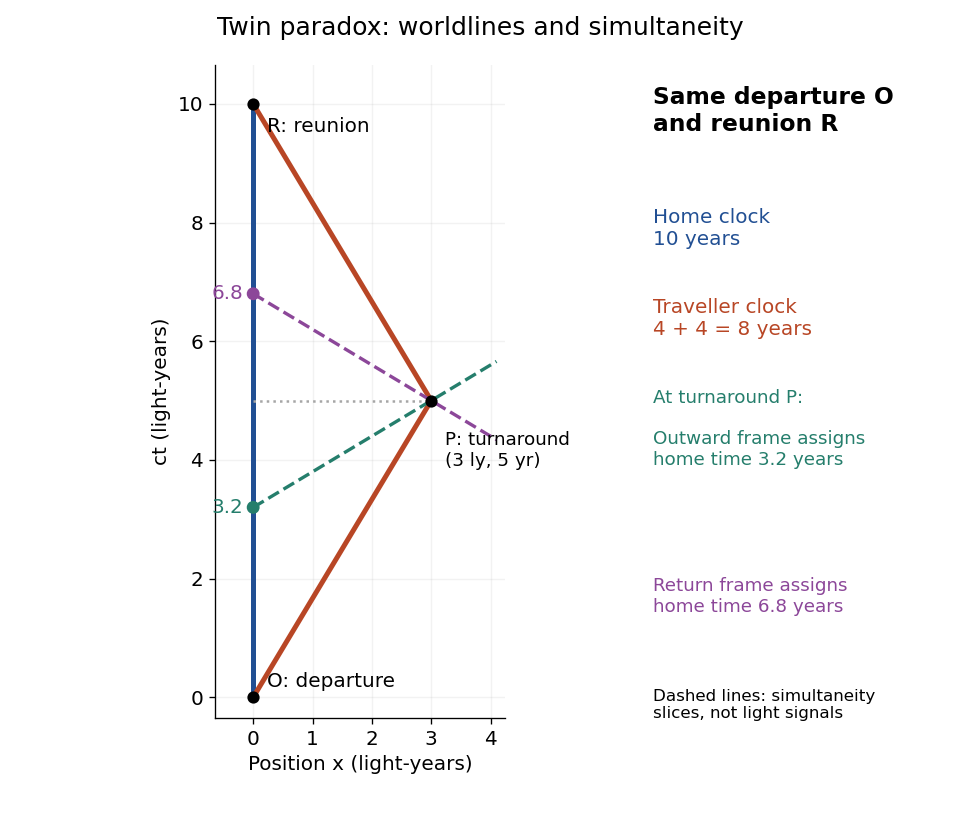
Fixed departure and reunion events: a 0.6c traveller records eight years while the inertial home clock records ten; turnaround simultaneity slices meet the home world line at 3.2 and 6.8 years
. Details. 
The same integral gives a short geometric explanation: , so every such competing timelike curve between these fixed spacetime events has . Equality requires zero velocity throughout, apart from sets of zero duration. Thus the straight home world line maximizes proper time in this Minkowski spacetime problem. This statement concerns fixed endpoints and an inertial home clock; in a gravitational field, compare paths using the appropriate metric tensor.
Reynolds analogy 2026-10-14
Scanning tunneling microscopy Created 2026-10-14 Updated 2026-10-18
Scanning tunneling microscopy uses a scanning tunneling microscope to map a surface from the electric current across a tunnel junction. In constant-current operation, feedback control adjusts the tip height to maintain a chosen electric current. The current-distance test of vacuum tunnelling explains the underlying distance sensitivity and its measurement limits.
The image records the response of a tunnel junction, rather than photographing chemical atoms. Its apparent height can reveal both surface structure and the local density of states; distinguishing them is part of interpreting the measurement.[ref]
Scanning Tunneling Microscopy: From Birth to Adolescence by Gerd Binnig and others. p. 391, Fig. 2; p. 396, Fig. 5
Work function Created 2026-10-14 Updated 2026-10-20
Upper-endpoint estimation in a truncated distribution Created 2026-10-14 Updated 2026-11-05
For a positive continuous density with strictly increasing cumulative distribution function , observations from its upper-truncated law have likelihood on . Holding fixed, decreasing toward increases the likelihood; taking a supremum over preserves nonincreasing dependence on . Provided the nuisance fit is finite, the usual closed-support endpoint estimate is . With the literal open support , only a limiting supremum need exist. A sample maximum is not a validated bound for future observations, and support depending on a parameter prevents automatic application of Wilks theorem.
Truncated exponential distribution Created 2026-10-14 Updated 2026-11-05
Condition an exponential distribution of rate on falling below . Normalizing its probability density function gives the displayed density. Integration gives expectation . As , the density tends to the uniform distribution on and the expectation tends to .
// Target: probability-and-statistics.bigb
Gauge singlet Created 2026-10-14 Updated 2026-10-20
A field is a gauge singlet if it transforms in the trivial representation of the entire gauge group: every gauge transformation leaves it unchanged. A singlet of only one factor need not be a gauge singlet of the product group. For example a right-handed neutrino with representation is a Standard Model gauge singlet, whereas a color-singlet charged lepton is still acted on by the electroweak group. A singlet can have ordinary derivatives in its kinetic term and gauge-invariant masses, subject to Lorentz invariance and any additional global symmetries.
Positive lacunary trigonometric series 2026-10-14
For an odd integer and positive summable coefficients , the Weierstrass M-test makes continuous. Its partial sum over is the unique best uniform approximation by degree-at-most- trigonometric polynomials, for . If is the first omitted frequency, at every omitted cosine equals because all frequency ratios are odd. Thus the tail attains alternating extrema equal to its coefficient sum at points. The trigonometric Chebyshev alternation theorem proves the formula. For , , the largest decay exponent is .
Canonical scroll of a trigonal curve 2026-10-14
The rank-two bundle of fibre spans is globally generated and splits as with . On its rational normal scroll, is the degree-three pencil and . The adjunction formula then forces the displayed divisor class. Writing and on the Hirzebruch surface gives .
Scalar triangle Feynman integral Created 2026-10-14 Updated 2026-11-05
In mostly-minus signature, take . Feynman parameters and a momentum shift giveFor massive internal lines this is ultraviolet finite in four dimensions. Physical external kinematics can still create threshold cuts, encoded by the Feynman i-epsilon prescription.
Convergence holds in total variation distance. A triangle indicator depends only on its three edges, so its dependency neighborhood consists of itself and the triangles sharing an edge. The Poisson approximation with dependency neighborhoods gives errors and . Under the displayed scaling is of order , so both vanish. The probability of at least one triangle therefore tends to .
Triangle variance in a binomial random graph 2026-10-14
For the triangle count in a binomial random graph, distinct triangle indicators are independent unless they share an edge. A shared-edge pair has covariance , and there are ordered pairs of that type. The individual indicator variances give the first term. Equivalently,by counting ordered pairs according to the number of shared vertices.
Distinguishable scalar scattering by a shared mediator Created 2026-10-14 Updated 2026-11-05
At regular transverse intersections, the displayed map has a rank-three Jacobian matrix. Its one-dimensional kernel is the parameter tangent, while the physical tangent is parallel to the cross product of the surface normals. A continuation method predicts along that tangent and corrects together with a transverse section equation using Newton method. Patch bounds and component isolation supply seeds; one seed alone cannot discover every disconnected curve or closed loop. Tangency or coincident surfaces violate the regular-curve assumptions and require separate analysis.
Transportation dual potentials 2026-10-14
Row and column potentials satisfying the displayed inequalities give a lower bound on the cost of every feasible shipment matrix: , since row sums are supplies and column sums are demands . The reduced costs are . A feasible matrix using only zero-reduced-cost cells attains the lower bound, proving optimality by weak duality. The transportation simplex algorithm sets these potentials by equality on a transportation spanning tree, and enters a negative-reduced-cost cell if one exists.
Production costs in a transportation problem 2026-10-14
When factory incurs unit production cost only on goods actually shipped, add that cost to every real shipping destination in its row. Unused capacity incurs no production cost; a dummy unused-capacity column therefore keeps zero cost rather than receiving . This changes the optimal factory utilization when capacity exceeds total demand. Transportation dual certificate with capacity inequalities proves optimality without assuming every factory must produce at full capacity.
For fixed positive density , every sufficiently large of size at least has a long arithmetic progression in its triple sumset. Embed it in , where its density is at least . A translated Bohr neighborhood in a triple sumset has bounded rank and fixed positive radius depending only on . A torus pigeonhole principle argument supplies a nonzero step whose small multiples stay in the Bohr set, with polynomially many multiples. All resulting residues have representatives in , an interval shorter than half the modulus, so their successive ordinary integer differences agree and give an actual integer arithmetic progression. The positive constant prefactor is absorbed by reducing the exponent for sufficiently large .
There are unlisted articles, also show them or only show them.