
If a strongly additive arithmetic function is supported on primes up to , its th uniform central moment differs from the independent Bernoulli random variables model with probabilities by . Expansion of divisibility indicator functions reduces the comparison to .
Borel construction 2026-10-06
For a group action on and a contractible free -space , the diagonal orbit space maps to the classifying space with fibre . It defines equivariant cohomology. When is a principal -bundle, the map has contractible fibre and gives a homotopy equivalence for spaces of CW type. Freeness without the bundle hypotheses should not be substituted for this assertion for arbitrary topological groups.
Barotropic stellar equation of state Created 2026-10-06 Updated 2026-10-18
A perfect fluid in general relativity stellar model in which pressure depends only on energy density, . A positive derivative makes this relation locally invertible and turns outward-decreasing pressure into outward-decreasing density. This general relation need not have the constant ratio used for a constant cosmological fluid parameter.
Completed Epstein zeta function 2026-10-06
The completion satisfies . Its simple poles at zero and have residues and . The pole-subtracted theta integral for an Epstein zeta function gives both the continuation and this dual lattice symmetry.
For finite-alphabet independent and identically distributed random variables, fixed and , every epsilon-sufficient set of length- words satisfies for sufficiently large . Intersect with a typical set whose excluded mass is at most . The intersection retains that much probability and each word has probability at most .
Epicyclic ellipse 2026-10-06
In a Cartesian frame rotating with an epicyclic guiding center, a small planar oscillation obeys and . The ellipse is elongated azimuthally when the radial epicyclic frequency satisfies . Conservation of angular momentum makes the motion around the guiding centre retrograde.
Epicyclic azimuthal advance 2026-10-06
The azimuthal advance over one complete small radial oscillation is . The oscillatory azimuthal correction averages to zero at first order. This angle compares successive radial turning points of the same type and describes apsidal precession when it differs from a full revolution.
Velocity-kick epicycle Created 2026-10-06 Updated 2026-10-14
A small planar velocity kick on a stellar circular orbit produces a local epicyclic motion in the source's rotating reference frame. With outward , forward , and initial displacements zero, Hill equations give and . Tangential kicks combine an epicycle with Keplerian shear; a radial kick gives a closed leading-order epicyclic ellipse.
Reduced forms of discriminant minus forty-four Created 2026-10-06 Updated 2026-10-14
The reduced positive definite triples are , and . The imprimitive middle form represents only even numbers; the two last forms have identical value sets after reversing one variable.
Compression of an entropy sum 2026-10-06
A union-intersection compression can only decrease the sum of information entropies for a finite-valued random vector . Each elementary step follows from entropy submodularity; iteration proves the assertion with multiset multiplicities. Uniform coordinate multiplicity gives Shearer inequality by compressing to repeated full sets and empty sets.
Entropy density at zero chemical potential Created 2026-10-06 Updated 2026-10-14
For an extensive equilibrium system, the thermodynamic Euler relation gives . At zero chemical potential, divide by to obtain . Equivalently, makesThe first law of thermodynamics identifies this as ; the thermodynamic Euler relation fixes the entropy normalization. For adiabatic expansion satisfying the cosmological perfect-fluid continuity equation, the numerator on the right vanishes, proving cosmological entropy conservation.
First variation of geodesic energy Created 2026-10-06 Updated 2026-10-14
For and variation vector field , the first variation is . For fixed endpoints the boundary term vanishes, so the critical points of the energy are exactly affinely parametrized geodesics.
Empirical characteristic process 2026-10-06
The centered process describes fluctuations of the empirical characteristic function. At a fixed frequency, its real and imaginary parts satisfy a multivariate central limit theorem. A process-level limit requires further control over the frequency index.
For a classical solution of on a half-ball with zero data on its flat face, a tangential Caccioppoli inequality controls every second partial derivative having at least one tangential index. The equation recovers the remaining second normal derivative. The resulting Sobolev norm estimate has a dimension-only constant for the fixed radii one and two. Nonzero data are handled by homogenization of Dirichlet boundary data, adding the norm of the supplied boundary extension. No condition is imposed on the curved face because the smooth cutoff function vanishes there.
For a smooth uniformly elliptic homogeneous equation away from other boundaries, an interior gradient estimate on a ball of radius comparable to the distance from a flat side gives . If extends continuously with value zero on that side, locally along it. This justifies vanishing boundary terms such as in a distributional Fourier sine projection.
Divergence-forcing interior H1 estimate 2026-10-06
For and , a cutoff function energy estimate gives . One derivative of forcing is permitted because integration by parts places it on the test function. This estimate allows a mollified distributional solution initially in to gain its first weak derivative.
Elliptic regularity bootstrap with smooth lower-order coefficients Created 2026-10-06 Updated 2026-10-14
Once an distributional solution of gains regularity, expand the divergence term. Smooth multiplication makes the right side belong to whenever . Interior Poisson regularity gives . Iteration and the Sobolev embedding theorem produce a smooth representative.
Motional electromotive force Created 2026-10-06 Updated 2026-10-14
Motional electromotive force is the contribution from an electrical conductor moving with local velocity through a magnetic field. The cross product comes from the magnetic part of the Lorentz force. For a straight rod of length , perpendicular to both its velocity and a uniform magnetic field, its magnitude is . The sign depends on the direction of integration along the rod. [ref].
For a computed example, take , velocity to the right, and magnetic field out of the page. The rod lies along . ThenPositive electric charge is driven downward. For an isolated rod after charge separation has equilibrated, inside it, and the electric potential difference is ; the bottom is positive. This open-circuit statement does not imply a sustained electric current.
Close the rod's path with stationary U-shaped rails and an electrical resistance at the left. With out-of-page unit normal, the positive loop direction is counterclockwise, hence upward along the rod. If the rod's horizontal position is , the enclosed area is and the external magnetic flux is . ThusHere the resistive approximation neglects self-inductance. The negative electric current is clockwise, downward along the rod, consistent with the charge-separation calculation and Lenz's law.
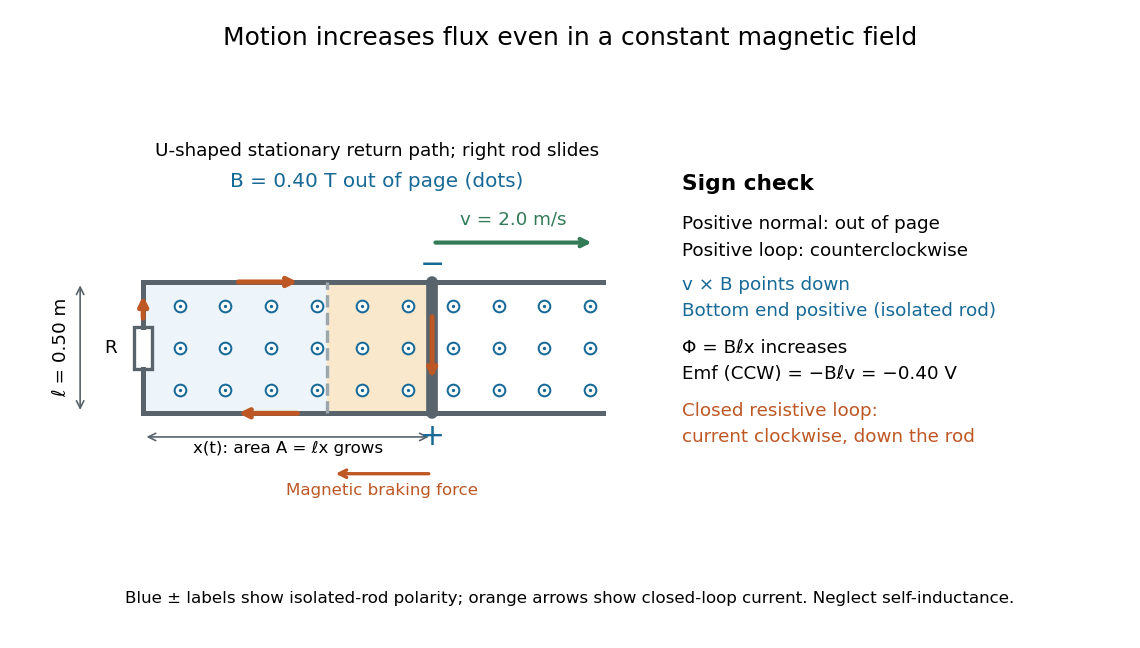

The closed-loop result illustrates why the moving-circuit form of Faraday's law of induction includes motional electromotive force: the magnetic field is constant in time, so the electric field circulation alone would miss this drive. Its mechanical consequence is electromagnetic braking of a sliding rod.
Dual electromagnetic field tensor Created 2026-10-06 Updated 2026-10-18
The dual electromagnetic field tensor is obtained by applying the Hodge star operator to the electromagnetic field tensor. For metric signature and , define . With and , it has components and . The homogeneous Maxwell equations become .
Assume an exact solution of finite penalty exists and select the unique -minimizing exact solution . Minimality gives . If and , boundedness, weak sequential compactness of bounded sequences in a reflexive Banach space and lower semicontinuity identify every weak limit with . The separate lower semicontinuity of and , together with the upper bound on , forces the Hilbert norms to converge. The Radon-Riesz theorem then gives norm convergence.
There are unlisted articles, also show them or only show them.