
Identify the nonrelativistic mass with the rest mass, . Expanding the relativistic kinetic energy in givesFirst-order perturbation theory requires . Put , so . The annihilation relations are and . In particular, does not vanish. A short calculation retaining the operator ordering givesEquivalently, of the ordered words in , only and have nonzero ground-state expectation values, respectively and . Words with a creation operator on the far left or an annihilation operator on the far right vanish; the remaining unbalanced words also vanish. ThusThe correction is negative because the relativistic kinetic energy is smaller than at fixed nonzero momentum. This relativistic oscillator ground-state kinetic correction requires .
Use the orthonormal energy eigenstates of the infinite square well,The identity resolves the initial wavefunction into . Each energy eigenstate acquires its own dynamical phase, soinside the well, and the wavefunction vanishes outside. The energy probabilities are and at every time. ConsequentlyFor the left half, each diagonal integral is , whileThe interference term therefore yieldsThis probability lies between approximately and , with period . A conserved energy distribution is compatible with time-dependent position probabilities because the relative quantum phase keeps evolving.
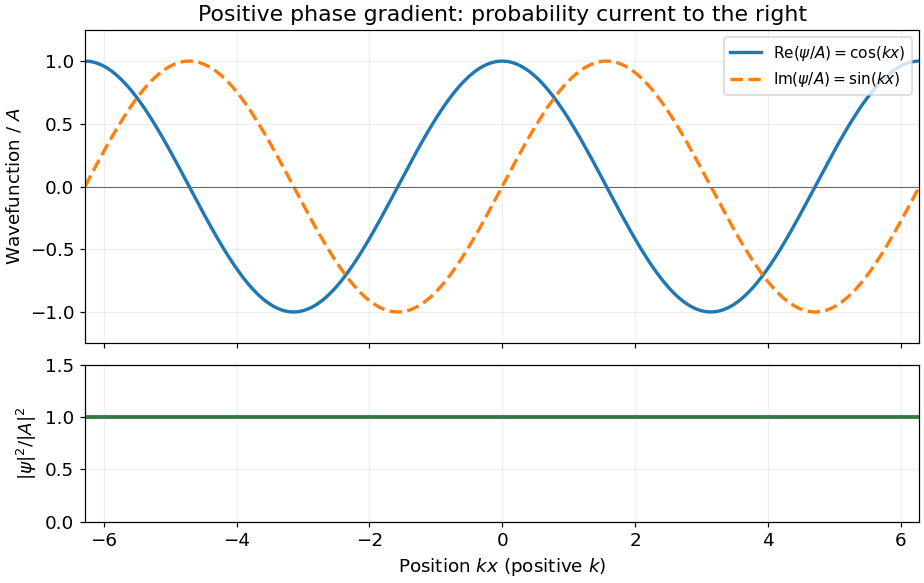
For the Schrödinger equation with a real scalar potential and no vector potential, the probability current isTogether with the probability density , it satisfies the continuity equation . Substituting givesA complex wavefunction requires both its real and imaginary parts in the sketch. Choosing the irrelevant constant phase so that is real, they are and , while the probability density is horizontal. It is the spatial phase gradient of a Schrodinger wavefunction that determines the sign of the probability current. In particular, and have the same real part but opposite probability currents, so the slope of the real part cannot determine the direction.
A nonzero plane wave on the whole real line is not square integrable. The displayed density is understood with box normalization, generalized normalization, or as a local description of a broad wave packet; it does not define a normalized probability distribution on the whole line.

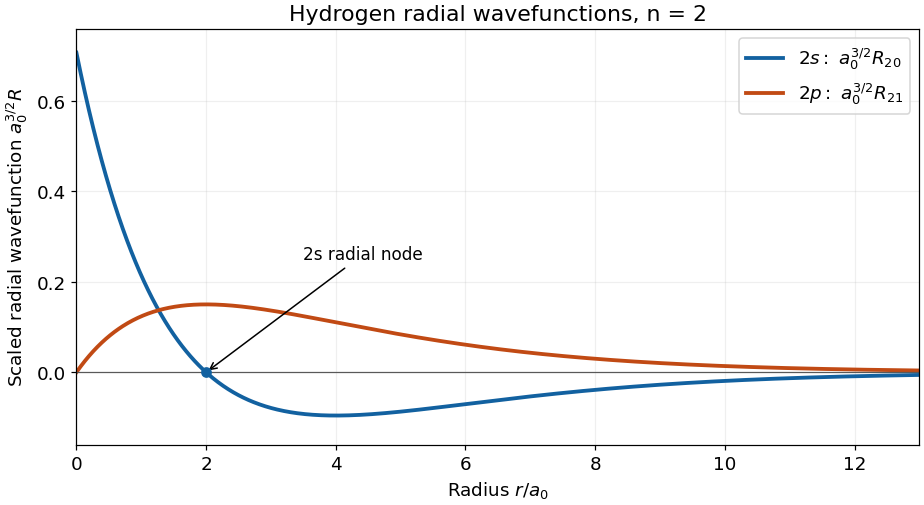
Separation of variables in the central Coulomb potential gives . The radial wavefunction depends on and , independently of . For the hydrogen radial wavefunction in the first excited shell, put . The Bohr radius is , where is the electron–proton reduced mass. Choose the real phasesNear the origin, , whereas . More generally, regular hydrogen radial wavefunctions behave as . At large , both displayed functions have a polynomial factor proportional to multiplying ; approaches zero from below and from above with these phase choices.
The radial wavefunction crosses zero once, at , and has its negative minimum at . The radial wavefunction has no radial node at positive , and reaches its maximum at . The count is ; neither the origin nor the limit at infinity is counted as a radial node. These are sketches of , rather than of or the radial probability density .

Insert hydrogen energy eigenstates on either side of the commutator. Because is Hermitian and has eigenvalue ,ThusThis is a necessary electric-dipole selection rule, not a sufficient condition for a nonzero matrix element. For example, by parity even though . The angular factor additionally requires : multiplication of a spherical harmonic by gives only harmonics with the same and adjacent . The commutator alone establishes only the magnetic quantum number restriction; radial integrals and the remaining electric-dipole selection rules for hydrogen must still be considered.
There are unlisted articles, also show them or only show them.