
Divergence theorem Created 2026-09-24 Updated 2026-10-14
Let be a bounded region in Euclidean space with piecewise smooth boundary and outward unit normal vector . For a continuously differentiable vector field on a neighborhood of its closure,The total outward flux equals the accumulated divergence inside. Contributions across shared internal faces cancel when a region is divided into small pieces.
For on a ball of radius , the divergence is , giving . On the boundary, , so the surface integral is also . This agreement turns the derivative into a geometric flux measurement. The required regularity matters: a singular field at the center cannot be included without checking its contribution separately.
Conservative vector field Created 2026-09-24 Updated 2026-10-14
A vector field is conservative when for a potential of a conservative vector field . On a simply connected open subset of , every continuously differentiable curl-free vector field is conservative. Locally this follows from the Poincaré lemma applied to the differential one-form ; globally, simple connectivity makes its line integral independent of the path. The fundamental theorem for line integrals expresses that path independence as the difference of the potential at the endpoints.
Feasible inner products with two unit vectors Created 2026-09-24 Updated 2026-09-24
For linearly independent unit vectors with , a pairis attained by some unit vector exactly whenThe left-hand side is the squared norm of the least-norm vector having those two inner products.
Levi-Civita symbol Created 2026-09-24 Updated 2026-09-24
Divergence and curl of a cross product Created 2026-09-24 Updated 2026-09-24
For smooth vector fields ,andBoth follow by contracting two Levi-Civita symbols and applying the product rule.
Laplacian Created 2026-09-24 Updated 2026-10-18
The Laplacian takes the divergence of a scalar field's gradient. For a real-valued function on an open region of Euclidean space, with continuous partial derivatives through order two, its expression in a Cartesian coordinate system isThus the Laplacian, also called the Laplace operator, adds the coordinate second derivatives; equivalently it is the matrix trace of the Hessian matrix. Its output is another scalar field.[ref]
The Feynman Lectures on Physics, Volume II by Richard Feynman and others. Volume II, §2–7, equations 2.52–2.54: divergence of a gradient and the Cartesian Laplacian
Three original examples distinguish shape from this sum. The bowl has . The saddle instead has : opposite second derivatives cancel. It is a harmonic function, although its graph of a function is not a plane. For the Gaussian function , with , differentiation givesIts Laplacian is negative inside the circle of radius one, zero on that circle, and positive outside it. The Gaussian function itself is positive throughout: its value and its Laplacian describe different properties.
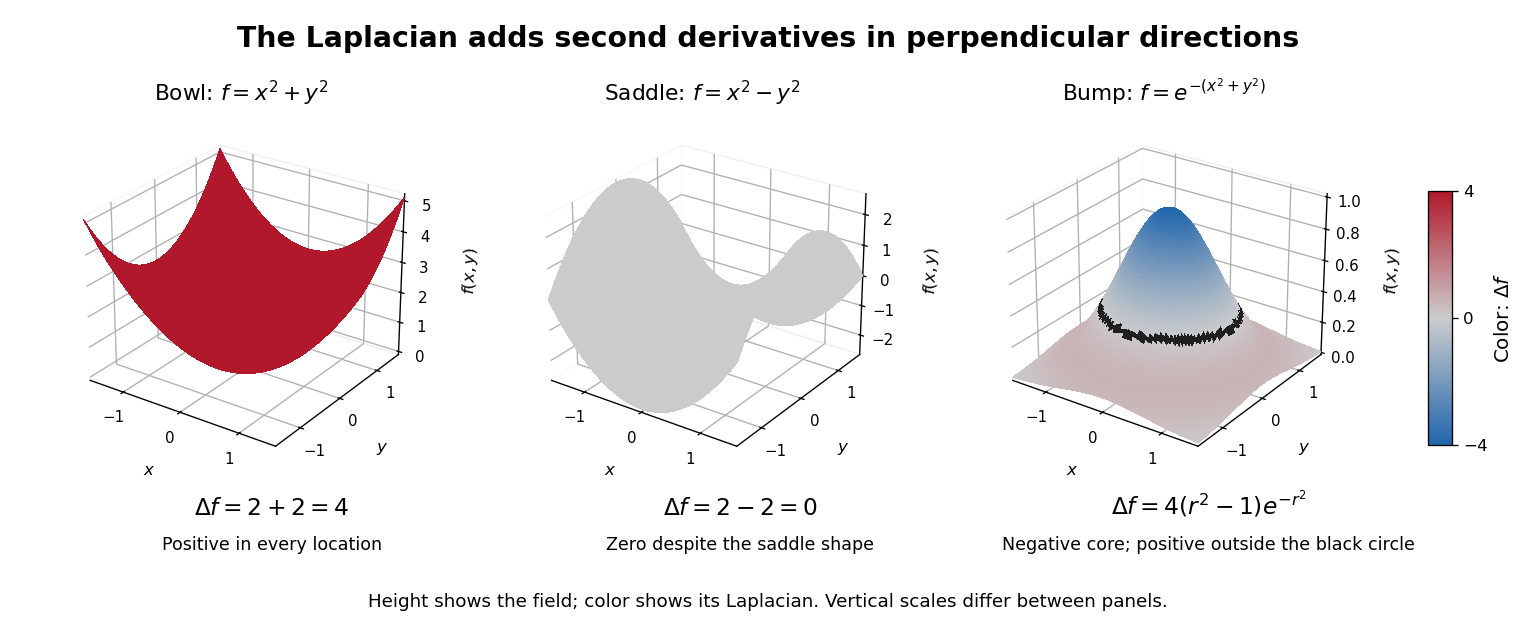

The sum does not favor a particular orientation. Under a change of Cartesian coordinate system represented by an orthogonal matrix , the Hessian matrix becomes . The cyclic property of the trace and preserve its matrix trace. This makes the Laplacian useful when the behavior depends on spatial differences equally in every direction, rather than on the arbitrary choice of axes.
For a vector field, the Euclidean Laplacian acts separately on components expressed in a fixed Cartesian coordinate system. Components in a position-dependent basis require differentiating that basis too; applying a scalar formula separately to polar components omits those terms.[ref]
The Feynman Lectures on Physics, Volume II by Richard Feynman and others. Volume II, component formula following equation 2.54 and final paragraph of §2–8: fixed rectangular components
The scalar formula in Laplacian in polar coordinates is valid away from ; smoothness at the origin must be handled in coordinates that remain regular there. Curl Created 2026-09-24 Updated 2026-10-14
For a continuously differentiable vector field in three-dimensional Euclidean space, the component of its curl along a unit normal vector is the limiting circulation per unit area around a small loop in the perpendicular plane. The loop direction and the normal obey the right-hand rule. Stokes theorem gives the corresponding relation for a finite surface.
For the rigidly rotating velocity field , direct differentiation gives . A circle of radius has tangential speed and circumference , so its circulation is , twice the angular velocity times the enclosed area. The factor of two distinguishes vorticity from rigid-body angular velocity.
Curved integral curves alone do not demonstrate nonzero curl. The field has zero curl, yet its trajectories satisfy , and hence : away from the axes they are hyperbolas. The curl measures local circulation of the field, not the curvature of an individual trajectory.
Divergence Created 2026-09-24 Updated 2026-10-14
For in Cartesian coordinates,
For a continuously differentiable vector field, the divergence is the limiting outward flux per unit volume through a small closed surface. Opposite faces of a small rectangular box almost cancel; the remaining differences in the three components give the sum of partial derivatives above. The divergence theorem extends this local balance to a whole region.
For , the divergence is . In a planar unit square, the right edge contributes outward flux and the top contributes , while the left and bottom contribute zero. The total equals the integral of the planar divergence over area .
If is a velocity field, positive divergence means local volume expansion, not automatically creation of mass. The continuity equation gives , where is the material derivative. For this field, a uniform initial density evolves as while material volumes grow as . Their product stays constant.
Helicity conservation by tangent boundary conditions Created 2026-09-24 Updated 2026-09-29
If a helicity density evolves as a sum of directional derivatives along divergence-free fields tangent to the boundary, its volume integral is conserved because both terms become vanishing boundary fluxes.
Vector field Created 2026-09-24 Updated 2026-10-03
Riemannian index form Created 2026-09-24 Updated 2026-10-14
Finite forbidden-pattern axiomatization Created 2026-09-24 Updated 2026-10-05
If failure of a property has a finite witness, one can often axiomatize the property by a universal sentence forbidding each possible finite witness. Compactness supplies finite witnesses when failure is expressed by inconsistency of an associated theory.
Poincaré-Birkhoff-Witt theorem Created 2026-09-24 Updated 2026-10-14
For an ordered basis of a Lie algebra , the ordered monomials form a basis of . In particular, a triangular decomposition gives as vector spaces.
Time-reversal symmetry in quantum mechanics Created 2026-09-24 Updated 2026-10-03
Heisenberg picture Created 2026-09-24 Updated 2026-09-28
In the Heisenberg picture, states are fixed and an observable evolves asFor a time-independent Schrödinger-picture observable,
Fully faithful adjoint criterion Created 2026-09-24 Updated 2026-10-06
For , the right adjoint is full and faithful exactly when the counit is an isomorphism. Dually, is full and faithful exactly when the unit is an isomorphism.
Kolchin theorem Created 2026-09-24 Updated 2026-10-06
Every unipotent algebraic subgroup of is conjugate to a subgroup of the upper unitriangular group. The filtration by vanishing initial superdiagonals then proves that every unipotent algebraic group is a nilpotent group.
Entropy bound for a union-closed family Created 2026-09-24 Updated 2026-09-24
Every finite union-closed family other than has an element belonging to at leastof its members. The proof applies the binary entropy product inequality coordinate by coordinate to the union of two independent uniform members of the family.
Binary entropy product inequality Created 2026-09-24 Updated 2026-09-24
Uniform split of a random total Created 2026-09-24 Updated 2026-10-14
There are unlisted articles, also show them or only show them.