
A matrix with entries in is a totally unimodular matrix if every column has at most two nonzero entries, with opposite signs when both occur. To prove this, induct on the size of a square submatrix. A zero column gives determinant zero, a one-entry column reduces by cofactor expansion, and if every column has two entries then all column sums vanish, giving dependent rows. The total unimodularity of directed incidence matrices is a central instance.
Fourth derivative 2026-10-31
The fourth derivative is the derivative of the third derivative. It vanishes for a polynomial of polynomial degree at most three. For a cubic spline, this statement applies inside each knot interval; a jump of the third derivative can prevent a classical fourth derivative from existing at a spline knot.
Suppose . By summable L1 norms imply almost-everywhere absolute convergence, let where the series converges absolutely, and choose zero on the exceptional null set. Then is a Lebesgue measurable function and almost everywhere. Since is Lebesgue integrable, so is . The signed partial sums are bounded in absolute value by , so the dominated convergence theorem proves termwise integration. It also gives the quantitative L1 norm estimateThe numerical series of integrals is absolutely convergent because .
For example, on take . Its L1 norm is , and these norms sum to two. Every positive lies in only finitely many supports, so the series is pointwise finite, although its terms are not uniformly small. Termwise integration gives , by differentiating the geometric series. This illustrates why a small L1 norm can permit tall terms on short intervals.
Replacement theorem for logical equivalence 2026-10-31
Replacing a designated subformula by a logically equivalent formula preserves logical equivalence of the surrounding propositional formulas. For any Boolean valuation the two expressions at the replaced node have the same truth value. Each logical connective preserves this agreement when its other inputs are unchanged. Induction from that node to the root proves agreement of the whole formulas under every valuation.
Subformula replacement 2026-10-31
Subformula replacement is the operation of replacing one specified subformula occurrence by another logical formula. Its preservation of well-formedness is the subformula replacement theorem.
For with deterministic coefficients, , where . The random part does not depend on the initial value. For , the mean value theorem bounds the initial-value difference quotient by , and dominated convergence theorem gives the displayed derivative. The transition law is normal with mean and variance .
Gelfand–Naimark–Segal construction 2026-10-31
For a state on a C-star algebra on a unital algebra , put on , with the inner product linear in its first argument. The Cauchy–Schwarz inequality for positive C-star functionals makes the null vectors pair to zero with every vector. Moreover gives , so is a left ideal and is well-defined and bounded by . Completion gives a Hilbert space and a star-representation . The adjoint identity follows from . The unit vector is cyclic and recovers the state as .
Vector state on a C-star algebra 2026-10-31
For a unital represented C-star algebra , the displayed functional is a state. It is linear under the first-argument-linear inner-product convention, has , and is positive because . The Cauchy-Schwarz inequality gives , while evaluation at the unit gives equality of its norm with one. Its GNS null left ideal consists exactly of the operators annihilating .
For a nonzero unital C-star algebra, a positive functional on a C-star algebra obeys , and conversely this equality for a bounded functional implies positivity. Therefore its state on a C-star algebra functionals are exactly the maximizers of the real linear evaluation on the closed dual unit ball. If a convex combination reaches that maximum, each constituent must reach it: each real part is at most one, and their weighted mean is one. The modulus bound then forces evaluation to equal one, so each constituent is again a state. Hence the state space is an exposed face and a face of a convex set.
Band matrix 2026-10-31
A band matrix has nonzero entries confined to a band around its main diagonal. The nonnegative integers in the displayed condition are its lower and upper bandwidths. A tridiagonal matrix has . Storing only the band reduces memory use; banded Gaussian elimination can exploit the same structure when the pivoting assumptions permit it.
Sorted sparse dot product 2026-10-31
For two sparse vectors with the same dimension and sorted nonzero entries, merge their coordinate lists. Equal indices contribute their product and advance both cursors. If one index is smaller, advance only that cursor: the other vector has zero at that coordinate, because all its smaller indices have already been processed and all remaining indices are larger. This proves a loop invariant consisting of the accumulated inner product over settled indices. Every iteration consumes at least one stored entry, giving time complexity and constant auxiliary space for nonzero entries. The method avoids work proportional to the ambient dimension. Its floating-point arithmetic error remains distinct from its exact algorithm correctness.
Supersolvable Lie algebra 2026-10-31
A finite-dimensional Lie algebra is supersolvable if it has a full flag of ideals of a Lie algebra, increasing by one dimension at each step. It is solvable over every field: induct on dimension using the first one-dimensional ideal, which is abelian, and the quotient flag. Conversely over an algebraically closed field of characteristic zero, Lie's theorem applied to the adjoint representation supplies a one-dimensional ideal in every nonzero solvable Lie algebra. Induct on the quotient and lift its flag. A full ideal flag in lifts across a one-dimensional ideal simply by taking inverse images and prepending zero. Thus solvability and supersolvability agree over the complex numbers, although they need not over an arbitrary field.
GL fixed point by truth substitution 2026-10-31
Let and . Boxed replacement gives , and positive introspection gives . For the reverse implication rewrite it as , necessitate, use , and apply the Löb axiom to obtain . This explicit one-variable construction needs no reflection axiom.
Fano slice code redundancy bound 2026-10-31
Recursively split an ordered list of positive source probabilities into contiguous blocks, choosing each cut to minimize the difference between the total masses of the two children. The resulting binary prefix code has expected codeword length less than , where is its source Shannon entropy. If the probabilities were in nonincreasing order, its expected length is less than .
To prove this, an interior node of mass with child masses contributes to the expected path length and to the Shannon entropy, by the chain rule for information entropy. The inequality bounds that node's redundancy by . If the cut is between probabilities , shifting the cut by one position cannot improve the imbalance. On the heavier side this gives or , respectively; a singleton heavier side gives the same inequality directly. Thus .
For , a leading oscillation has slow time . The first-order forcing contains only zero and double frequencies. At second order the fundamental forcing is ; eliminating resonance gives the displayed equation. Its modulus is constant and its phase drifts. A leading real amplitude therefore has frequency . This replaces a secular phase term by a uniformly modulated oscillation.
Growth rate of two-column sticky deposition 2026-10-31
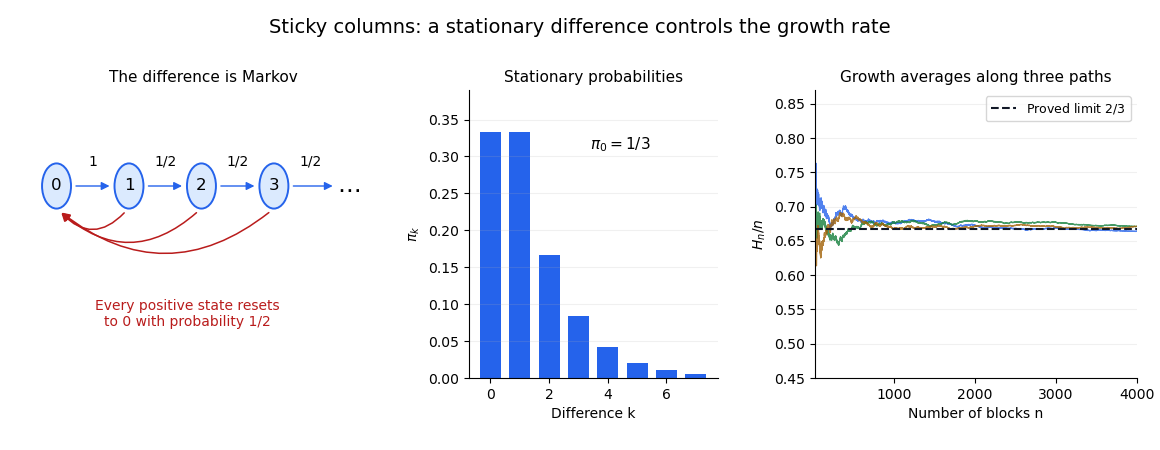
Suppose each new unit block independently selects one of two columns with equal probability. On the taller column it increases the maximum height; on the shorter column it sticks level with the other column, leaving the maximum unchanged. If the columns have equal height, the next block increases the maximum. Their absolute height difference is the reset-or-increment Markov chain with .
For the maximum height , each increment obeys . The stationary distribution has . Applying the countable-state Markov chain ergodic theorem to the bounded indicator function of the positive states givesalmost surely, from any fixed finite starting configuration. The reward average depends only on whether a reset occurred, even though the difference chain has infinitely many states.

Free surface of a Rankine vortex 2026-10-31
For a steady Rankine vortex in a fluid of constant density with gravity , the Euler equations give and . Integrating on the two sides and matching pressure at givesSetting a constant surface pressure yieldsThus the free surface and its radial slope match at the core edge. The central depression is , twice the depression at . Bernoulli's theorem applies throughout the exterior; the rotational core instead uses the radial momentum balance above.
In the constant-free language with multiplication as its sole nonlogical symbol, every term in one free variable is for some . Every atomic formula holds at both zero and one. Hence every quantifier-free formula, being a finite Boolean combination of those atoms, has the same truth value at both points. They have the same quantifier-free type, and neither singleton is quantifier-free definable. Quantifiers distinguish them: defines zero, while defines one. These formulas do not rely on named zero or one constants.
Pascal's theorem 2026-10-31
For six distinct points on an irreducible conic in the complex projective plane, the three intersections of opposite sides of the resulting hexagon are collinear. Form the two cubics given by the products of alternate side equations. They meet at the six conic points and the three opposite-side intersections. Applying residual intersection through a curve pencil with degrees three and two places the last three points on a line. This is the conic counterpart of Pappus's hexagon theorem for two lines.
Hesse pencil 2026-10-31
This pencil consists of projective cubic curves generated by and . The displayed finite parameter gives a nonsingular cubic exactly when ; the parameter at infinity gives the triangle . Multiplying the three gradient equations proves the finite singularity criterion. The Hessian curve of a member has equation , so the Hessian stays in the same pencil.
There are unlisted articles, also show them or only show them.