Past exam of the multisensory perception: attention, integration, and development course of the University of Oxford 2022 1 Solution by  Codex 0 2026-10-25
Crossmodal correspondences differ meaningfully in what is associated, how the association is acquired and where it affects performance. A matching preference, a response-compatibility effect and altered perceptual binding are distinct observations. They need not have distinct underlying causes, and a single correspondence can have several causes.
A crossmodal correspondence is a systematic relation between attributes in different sensory modalities, such as auditory pitch and visual size. It does not require either stimulus to generate an extra conscious sensation. Thus it should not automatically be classified as developmental synesthesia, where stable inducer–concurrent experiences may be highly individual. Nor is correspondence equivalent to multisensory integration: judging that two attributes fit together does not establish that information from them was combined into one estimate.
Three useful explanatory distinctions concern sensory organization, environmental statistics and meaning. A structural crossmodal correspondence would arise from shared coding or magnitude organization; this predicts a relation surviving changes in labels and response assignments. A statistical crossmodal correspondence would link features repeatedly generated by the same objects. For example, geometrically similar resonators with a fixed wave speed have characteristic frequencies scaling approximately as inverse size: from , increasing lowers . This conditional physical relation can make pitch–size coupling informative, but different materials, tensions or sound-production mechanisms can reverse a simple rule. A semantic crossmodal correspondence can link dimensions through language or common concepts: “high” can describe pitch and elevation. An affective crossmodal correspondence could instead be mediated by shared pleasantness, which should be separated from a direct relation between sensory dimensions. These are explanatory hypotheses, not mutually exclusive boxes established by the appearance of a pairing.
Some correspondences are relative rather than absolute. A tone can be the higher member of one pair and the lower member of another. An experiment should therefore manipulate comparison range and context, rather than assuming that every participant has one fixed pitch-to-size conversion. Relations can also be asymmetric: an irrelevant sound might alter a visual response without a visual stimulus equivalently altering auditory judgment. Asymmetry can arise from task reliability or attention, so it does not by itself establish a one-way anatomical connection.
A comparative experiment provides an important constraint. Vera U. Ludwig and colleagues tested 33 humans and six chimpanzees on matching black and white squares while irrelevant high or low tones were played. Both groups performed better for high-pitch/white and low-pitch/black pairings; in chimpanzees the effect was expressed particularly in errors, whereas human errors were near floor and reaction times were more informative. Both species used a touchscreen and loudspeaker arrangement.[ref]
Visuoauditory mappings between high luminance and high pitch are shared by chimpanzees and humans by Vera U. Ludwig and others. PNAS 108, 20661–20665; Results, Apparatus and Procedure
This makes a human-language-only account inadequate for that mapping. It does not distinguish inherited organization from every form of nonlinguistic learning: the animals had substantial task experience, and shared environments can also generate shared associations.A stronger test of perceptual consequences changes the dependent variable. Cesare Valerio Parise and Charles Spence presented small/large visual stimuli with high/low tones and manipulated audiovisual timing or position. Participants judged temporal order or spatial discrepancy, rather than simply reporting which pairing they preferred. Matched pairings produced poorer access to the intersensory discrepancy, interpreted as stronger coupling.[ref]
When Birds of a Feather Flock Together: Synesthetic Correspondences Modulate Audiovisual Integration in Non-Synesthetes by Cesare Valerio Parise and Charles Spence. PLoS ONE 4:e5664; Experiments 1–3
This illustrates why increased binding need not improve every task: reducing conflict between estimates can make the conflict itself harder to discriminate. A changed discrimination threshold still needs controls for distraction, detectability and decision strategy; it does not uniquely identify a perceptual fusion mechanism.To distinguish mechanisms experimentally, first obtain unisensory detection and discrimination measures and equate unintended salience differences. Then compare explicit matching, speeded classification, conflict discrimination and judgments of a common object. Counterbalance response keys and reverse stimulus–response mappings. A congruency effect that follows the response rule suggests compatibility at a decision or motor stage; persistence under orthogonal response rules constrains that explanation. Fit psychometric functions to conflict judgments and estimate bias, slope and lapses separately. A shift in subjective equality and a loss of sensitivity are different outcomes.
Next manipulate experience. Randomly assign participants to congruent, reversed or uncorrelated audiovisual training with equal exposures, and test untrained exemplars and delayed retention. A reversible mapping with transfer supports an experience-dependent contribution; failure to reverse it does not prove innateness, because training may be weak or poorly measured. Cross-language comparisons with nonverbal responses can test whether a shared word is necessary. Infant or nonhuman results can constrain linguistic explanations, but age differences, task accessibility and species-specific response demands remain possible confounds. For a pleasantness account, collect independent pleasantness ratings and select or manipulate stimuli so that hedonic matching varies separately from the sensory pairing. These are proposed discriminating designs, not asserted experimental results.
The most useful classification therefore combines origin, representational content and measurable consequence. Correspondences are scientifically informative when their predicted transfer, context dependence and effects on sensitivity distinguish them from mere agreement about labels or response keys.
Past exam of the MSc in advanced computer science course of the University of Oxford 2023 Computational game theory 4 c Solution by Codex 0 2026-10-25
Codex 0 2026-10-25Use the usual empty-coalition normalization for a transferable utility game. Write , so the proposed payoff is the marginal contributionThe vector is the marginal contribution vector for the natural player order.
First, convex cooperative games have increasing marginal contributions. If and , apply the defining supermodular set function inequality to and :Rearranging gives
The vector is efficient by a telescoping sum:Now fix any coalition . For each , its earlier members are . Increasing marginal contributions therefore giveSum over the members of in increasing order. The right-hand side is another telescoping sum, now along the growing coalition :Efficiency and these inequalities for every coalition are exactly the defining requirements of the core of a cooperative game. Thus belongs to the core. The same proof works for any player ordering, not only the natural order.
The normalization is essential to the literal statement: the printed part does not explicitly state it. Without , take the constant characteristic function of a coalitional game . It satisfies the displayed convex cooperative game inequality with equality, but every proposed is zero, so efficiency fails when is nonempty. Under the standard normalized definition, the proof above establishes the intended result.
Past exam of the MSc in advanced computer science course of the University of Oxford 2023 Computational game theory 4 b Solution by Codex 0 2026-10-25
Codex 0 2026-10-25Let . If the two disjoint winning coalitions exchange players, the aggregate weight is conserved:If both resulting coalitions lost, each weight would be strictly below , making their sum strictly below . This is impossible. Thus every weighted voting game has swap robustness for disjoint winning coalitions, even when the weights or quota are negative.
The converse is false. The four-player prime-cardinality game from part (a) has swap robustness for disjoint winning coalitions: swapping one player each way preserves each coalition's cardinality, so in fact both winning coalitions remain winning. Part (a) proves it is not a weighted voting game.
Even imposing monotonicity would not repair the converse under the printed disjointness restriction. As a stronger counterexample, use five players and declare a coalition winning exactly when it contains player and contains either both or both . This is a simple cooperative game, and all its winning coalitions contain player , so no two are disjoint; the stated swap condition holds vacuously.
Nevertheless and win, while and lose. Both pairs contain every player the same total number of times. A weighted representation would therefore givea contradiction. This is a trade obstruction to weighted voting and pinpoints how weak the disjoint-only swap requirement is.
Past exam of the MSc in advanced computer science course of the University of Oxford 2023 Computational game theory 4 a Solution by Codex 0 2026-10-25
Codex 0 2026-10-25It suffices to take four players. Both two-player coalitions and win, because two is a prime number, while the empty coalition and the four-player coalition lose.
Suppose real weights and quota represented this game. The empty coalition loses, so . The two winning coalitions requireAdding givesso the four-player coalition must win, a contradiction. Hence prime-cardinality games cannot in general be represented as weighted voting games. The same four-player obstruction appears inside every such game with at least four players.
This proof permits negative individual weights, as the printed definition does. An argument based solely on monotonicity would require a nonnegative-weight assumption and would not suffice for that definition.
Past exam of the MSc in advanced computer science course of the University of Oxford 2023 Computational game theory 3 b Solution by Codex 0 2026-10-25
Codex 0 2026-10-25This is an absent-minded decision problem: the two decision nodes belong to the same information set. A behavioural strategy must therefore use the same probability at both visits. Put and ; fresh randomization occurs independently at each visit.
The terminal probabilities are for stopping immediately, for going down once and then right, and for going down twice. Thus the expected payoff isThis expression gives the unique global maximum on :
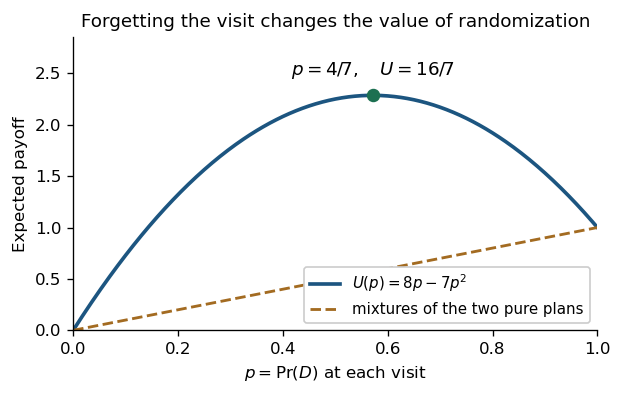
The optimal behavioural strategy improves on either fixed plan
. Details. The independence of repeated randomizations is essential. A mixed strategy choosing once between the two deterministic plans “always ” and “always ” gives at most , since their payoffs are and . It cannot arrange “ first, then ” as a deterministic plan respecting this information set. The failure of perfect recall is exactly why mixed strategies and behavioural strategies need not have the same attainable outcome distributions here.
Past exam of the MSc in advanced computer science course of the University of Oxford 2023 Computational game theory 3 a Solution by Codex 0 2026-10-25
Codex 0 2026-10-25Measure all payoffs in millions of dollars, in the order (Ann, Bob). Since both players maximize expected money, those numbers are already their expected utility scale.
In the extensive-form game, Ann moves first. Staying out terminates at . Entering leads to Bob's observed decision between fighting, with terminal payoffs , and acquiescing, with terminal payoffs . Each decision node is its own information set, so this is a perfect-information game.
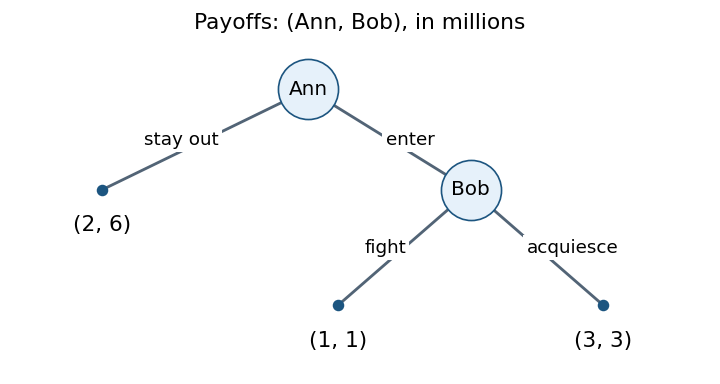
The corresponding normal-form game gives Ann the pure strategies (stay out) and (enter), and Bob the complete contingent pure strategies (fight if entry occurs) and (acquiesce if entry occurs). The payoff matrix isThe pure strategy Nash equilibria are and . Against , Ann prefers ; against , Ann prefers . When Ann stays out, Bob's contingent response does not affect his payoff, so is a best response there.
There is exactly one subgame perfect equilibrium, . In the subgame following entry, Bob strictly prefers to , so backward induction selects acquiescence; Ann then strictly prefers entering for to staying out for . The threat supporting is not optimal in that one-shot subgame.
For infinite repetition, the paper specifies no discount factor. First take the long-run average payoff convention, with all past actions observed. The feasible payoff set is the convex hullAnn can guarantee in every stage by staying out; Bob can guarantee at least in every stage by acquiescing whenever entry occurs. These guarantees are also their minmax payoffs: fighting holds Ann's best possible stage payoff to , and entering holds Bob's best possible stage payoff to .
Therefore the sustainable Nash equilibrium average payoffs are exactly the feasible, weakly individually rational payoffs in a repeated game:This is the closed triangle with vertices .
Here is a direct sufficiency argument for this particular game. Choose a publicly known sequence of stage outcomes whose frequencies give the target point. Before any observed deviation, follow that sequence. After an Ann deviation, Bob fights forever, so Ann can thereafter obtain at most per stage. After a Bob deviation, Ann enters forever, so Bob can thereafter obtain at most per stage. A finite prefix has no effect on long-run average payoff, so no unilateral deviation improves a target with . Rational frequencies can be implemented periodically; arbitrary real frequencies can be implemented by a deterministic sequence with convergent frequencies. Thus even the weak boundary is covered here. In particular, staying out forever and entry followed by acquiescence forever are sustainable; fighting forever is not.
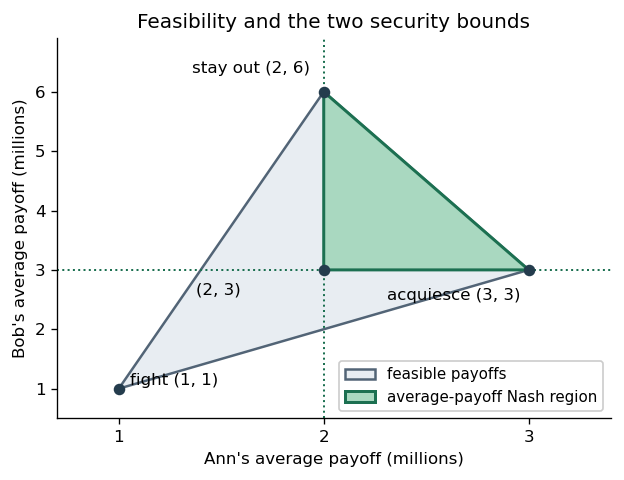
The feasible payoff set and sustainable long-run average payoffs
. Details. For discounted payoffs , the folk theorem for repeated games instead gives the usual patience qualification: every feasible point with can be sustained for all sufficiently large . It does not classify the whole region for an unspecified fixed . The two one-shot Nash equilibrium outcomes remain sustainable for every .[ref]
Lecture 15: Repeated Games by Asu Ozdaglar. Slides 19–20 and 24–27: feasibility, minmax bounds, discounted Nash folk theorem and punishment construction
Finally consider the particular history-dependent pair in the paper. Initially Bob has never acquiesced, so Ann stays out. That preserves the same condition forever, giving payoffs . The pair is a Nash equilibrium. Holding Bob's strategy fixed, Ann cannot induce an acquiescence: he fights whenever she enters, and his rule never changes unless he has previously acquiesced. Every entry would give her instead of , so no unilateral deviation helps. Holding Ann's strategy fixed, Bob never reaches a decision node because she stays out; changing his strategy alone cannot create a history in which he actually acquiesces. Hence he also cannot improve.
This direct argument works for both discounted and long-run average payoffs. The outcome gives Ann exactly her minmax payoff and Bob more than his, so it is compatible with the folk theorem for repeated games. A version requiring strict gains above both minmax payoffs is a sufficient condition, and cannot be used to rule out this boundary example.
Past exam of the MSc in advanced computer science course of the University of Oxford 2023 Computational game theory 2 b Solution by Codex 0 2026-10-25
Codex 0 2026-10-25The definition in this part uses a single Boolean valuation, so the relevant Nash equilibria are pure strategy equilibria of a Boolean game. Use its standard convention that the players' control sets form a set partition of the variables.
Membership follows from an existential choice of a strategy profile and a universal check of all unilateral deviations. Assign payoff one to satisfying a player's goal and zero otherwise. A strategy profile is a Nash equilibrium precisely when, for every player and every alternative Boolean valuation of that player's variables,is true: either the goal is already satisfied or no deviation can satisfy it. Thus the requested property isThe strings encoding , and have polynomial length, and evaluating the bracketed propositional formulas takes polynomial time. Invalid encodings of a player index can simply be ignored by the test. This is the existential second level of the polynomial hierarchy, .
For hardness, reduce the canonical complete problem of deciding a two-block quantified Boolean formulaMake a two-player Boolean game: player 1 controls and has goal ; player 2 controls and has goal . Set the query formula to . The construction has size linear in the input formula.
If an assignment satisfies , combine it with any assignment . Player 1 already satisfies its goal, and player 2 cannot satisfy by any unilateral deviation. Thus is a Nash equilibrium satisfying the query.
Conversely, let be a Nash equilibrium satisfying . Player 2 currently has payoff zero. If some alternative made false, that deviation would satisfy player 2's goal and increase its payoff to one. The Nash equilibrium condition therefore implies . This proves the required equivalence and the polynomial-time reduction.
Together, membership and hardness prove -completeness of existential equilibrium checking in a Boolean game. The reduction works with only two players and one constant goal.
Past exam of the MSc in advanced computer science course of the University of Oxford 2023 Computational game theory 2 a Solution by Codex 0 2026-10-25
Codex 0 2026-10-25Read the lower-left entry of each cell as player 1's payoff and the upper-right entry as player 2's payoff, as indicated by the source diagram. Against , player 1 strictly prefers because ; against , player 1 strictly prefers because . Against , player 2 strictly prefers because ; against , player 2 strictly prefers because . Thus the pure strategy Nash equilibria are
For a fully mixed strategy Nash equilibrium, write and . Player 1's expected payoffs from the two pure strategies areEquality, required when both pure strategies have positive probability, givesPlayer 2's corresponding expected payoffs areso equality givesBoth probabilities lie strictly between zero and one. Hence the unique fully mixed strategy Nash equilibrium iswith complementary probabilities on and . Its expected payoffs are
These are all three Nash equilibria. There are no equilibria with just one player genuinely mixing: against each opposing pure strategy, the other player's best response is unique, so that player cannot mix. When both players mix, the two linear indifference equations have the unique solution just obtained. This is support enumeration for a bimatrix game with all possible supports checked.
Past exam of the MSc in advanced computer science course of the University of Oxford 2023 Computational game theory 1 c Solution by Codex 0 2026-10-25
Codex 0 2026-10-25For the intended finite representation, put . For each , form the mintermA Boolean valuation satisfies exactly when its selected subset is . Therefore the weighted formula utility representationrepresents exactly: at the Boolean valuation for , only that minterm contributes, with weight . This proves completeness and the bound of rules simultaneously. Zero-weight rules may be omitted. The bound counts rules; writing each minterm also requires symbols in Big O notation.
For the computational question, assume rule weights are rational numbers encoded in binary. This makes exact equality of sums a finite computational task. With this conventional encoding, equivalence of weighted formula utility representations is co-NP-complete.
For membership, the complement has a short witness: a Boolean valuation on the variables occurring in either rule base. Evaluate each propositional formula, sum the weights of satisfied rules, and accept the witness if the sums differ. Propositional formula evaluation takes polynomial time. Exact sums of binary rational numbers also have polynomially bounded bit lengths: the product of their denominators has bit length at most the sum of the input denominator lengths. Thus non-equivalence lies in NP, and equivalence lies in co-NP.
For hardness, take a Boolean satisfiability problem instance and constructThe first utility function is one at satisfying Boolean valuations and zero elsewhere, while the second is always zero. ConsequentlyThe unsatisfiable Boolean formula problem is co-NP-complete, as the complement of the NP-complete Boolean satisfiability problem. The construction is a polynomial-time reduction, proving hardness even with the single weight .
Two qualifications matter in the literal wording. First, unrestricted real weights have no specified finite encoding, so a standard bit-complexity classification needs the encoding assumption above. Second, the problem says only that is nonempty. If infinite is allowed while rule bases remain finite, its completeness claim is false. For , take when is infinite and when is finite. A finite rule base mentions only a finite subset of the variables. The Boolean valuations for and agree on all those variables but have different required values. No such rule base represents this . Thus the construction answers the intended finite-set question and identifies the missing hypothesis in the unrestricted statement.
Past exam of the MSc in advanced computer science course of the University of Oxford 2023 Computational game theory 1 b Solution by Codex 0 2026-10-25
Codex 0 2026-10-25Yes: the stated order has an expected utility representation. For outcomes whose monetary amounts are , respectively, chooseThenSince , this utility function gives exactly the required strict preferences.
The distinction is that the expected utility hypothesis does not by itself require the utility function to increase with monetary amount. This nonmonotone monetary utility ranks the outcome paying 2 below the outcome paying 1. If increasing monetary utility were imposed as an additional assumption, the stated order would fail: requires becauseThat additional monotonicity assumption is not printed in this part.
Past exam of the MSc in advanced computer science course of the University of Oxford 2023 Computational game theory 1 a Solution by Codex 0 2026-10-25
Codex 0 2026-10-25Under the expected utility hypothesis, use positive affine uniqueness of affine preference representations to normalize the extreme outcomes to and . The stated indifference relations then giveThe two lotteries have expected utilitiesHence , with normalized expected utility difference . Equivalently, substitution reduces them to lotteries with probabilities and of the better extreme outcome. The inference uses the independence axiom for lottery preferences; the three displayed outcome comparisons alone would not determine preferences over all compound lotteries without the expected utility hypothesis.
Past exam of the MSc in advanced computer science course of the University of Oxford 2022 Computational game theory 4 b Solution by Codex 0 2026-10-25
Codex 0 2026-10-25Assume the standard empty-coalition normalization . A convex cooperative game has increasing marginal contributions: whenever and ,This follows from the supermodular inequality applied to and . Fix a permutation of all players, let be the players preceding , and form its marginal contribution vectorSumming along the full permutation is a telescoping sum, so . For an arbitrary coalition , list its members in their induced order , and put . Since , increasing marginal contributions giveThus every marginal contribution vector belongs to the core. The vector of Shapley values is exactly their uniform average over the permutations, hence a convex combination. By the preceding part, that average is in the core. This proves that the Shapley value allocation belongs to the core of a convex cooperative game, including every coalition constraint. It is the result Shapley value belongs to the core of a convex game.
Past exam of the MSc in advanced computer science course of the University of Oxford 2022 Computational game theory 4 a Solution by Codex 0 2026-10-25
Codex 0 2026-10-25Write . The core of a cooperative game isTake any and , and form the convex combination . Its total payoff is . For every coalition ,Hence remains in the core. The core is a convex set, even when the transferable utility game is not a convex cooperative game. An empty core is a convex set vacuously; the argument does not claim nonemptiness. Geometrically, the same conclusion follows because the constraints intersect an affine hyperplane with closed half-spaces.
Past exam of the MSc in advanced computer science course of the University of Oxford 2022 Computational game theory 3 b Solution by Codex 0 2026-10-25
Codex 0 2026-10-25Against Tit for tat, let be an arbitrary deviator's action at round , and set to encode the opponent's initial cooperation. The opponent then plays . Define and . The four possible transitions giveThus every stage payoff is at most . The telescoping sum yields the uniform payoff bound against Tit for tat:After division by , no long-run average payoff can exceed three. The bound applies to every action sequence, so in particular it covers every finite-state machine representing a unilateral deviation. Mutual Tit for tat produces in every round and gives each player three. Neither player can improve, proving is a Nash equilibrium.
Another pair is . Here grim trigger initially cooperates and continues cooperating until the opponent first defects, after which it defects forever. Both strategies are two-state finite-state machines: Tit for tat records the opponent's previous action, while grim trigger records whether defection has ever occurred. Their prescribed play again consists entirely of cooperation and gives .
The player using grim trigger faces Tit for tat, so every unilateral deviation is bounded by the same telescoping sum and cannot improve on three. The player using Tit for tat faces grim trigger. If that player never defects, the payoff remains three. If the first defection occurs at a finite round , it gives a one-time payoff six; thereafter the opponent always defects, against which each subsequent payoff is at most one. Any finite initial prefix has zero contribution to the long-run average payoff, so such a unilateral deviation has limiting upper average at most one. It cannot improve on three either. Both players are therefore best responses, proving the second claimed Nash equilibrium.
For deterministic finite-state machines, the joint state path is eventually periodic, so the displayed averages have a limit. The first bound also controls the limiting upper average for arbitrary action sequences, making the no-improvement argument stronger than an enumeration of finite-state deviations. Notice that equality in the bound permits alternating exploitation to average three: equilibrium requires absence of a strict improvement, not uniqueness of a best response.
Past exam of the MSc in advanced computer science course of the University of Oxford 2022 Computational game theory 3 a Solution by Codex 0 2026-10-25
Codex 0 2026-10-25There is no perfect recall. Player 1's later information set joins histories following both of her initial actions, so she has forgotten whether she chose or . It also hides player 2's intervening action, but failure to observe another player's action is imperfect information, whereas forgetting one's own earlier action is the particular violation of perfect recall. Player 2's two nodes form a single information set because player 2 does not observe the initial choice.
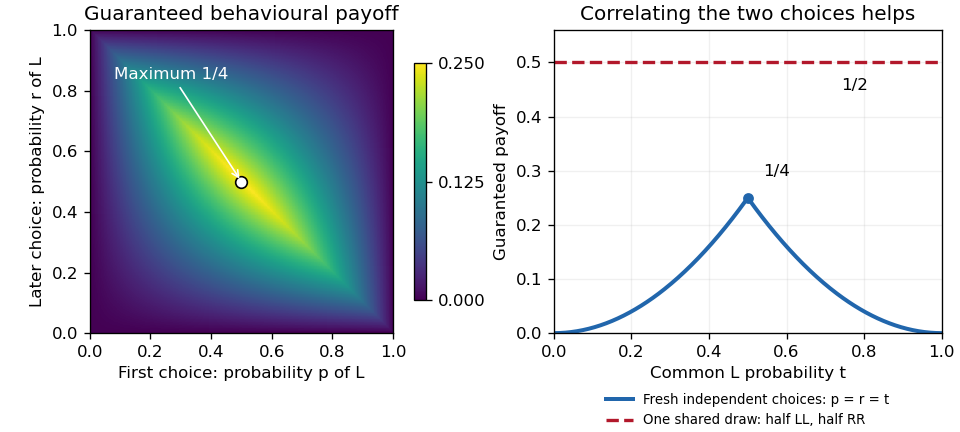
For a behavioural strategy, let be player 1's initial probability of and her later probability of . These are separate information sets, so and need not be equal; their random draws are independent. Name player 2's unlabeled branches left and right, and let be the probability of taking the left branch. The only unit-payoff paths are left–left–left and right–right–right. ConsequentlyBecause this is a zero-sum game, the natural meaning of the claimed best behavioural strategy is its maximum guaranteed expected payoff. Player 2 can choose either branch, so the guarantee at isFor nonnegative numbers, their minimum is at most their geometric mean. Also and , henceTaking makes both possible branch-conditioned success probabilities , so this upper bound is attained against every . Thus the optimal guaranteed behavioural strategy success probability is .
A mixed strategy can instead select the complete plan with probability and the complete plan with probability . The two choices within a sampled plan are correlated. If player 2 chooses left, exactly the sampled plan succeeds; if player 2 chooses right, exactly succeeds. Therefore the success probability isagainst every opposing mixed strategy. It is optimal among mixed strategies too: player 2's uniform mixture gives success probability to each of and zero to , so no mixture of the four plans can exceed against that opponent. This establishes mixed and behavioural security levels without perfect recall directly.


Past exam of the MSc in advanced computer science course of the University of Oxford 2022 Computational game theory 2 c Solution by Codex 0 2026-10-25
Codex 0 2026-10-25The succinct input is the players' variable-control sets, their goal propositional formulas, and a complete candidate Boolean valuation; an exponentially expanded payoff matrix is not part of the input. This representation is essential to candidate equilibrium checking in a Boolean game.
For membership in co-NP, consider the complement: the candidate is not a Nash equilibrium. A complexity certificate consists of a player and an alternative Boolean valuation of that player's controlled Boolean variables. Evaluate the current goal and the goal after this unilateral deviation, keeping every other player's variables fixed. A profitable unilateral deviation exists precisely when the current goal is false and the new goal is true. The certificate has at most the number of input variables plus the player index, and both propositional formula evaluations take polynomial time. Thus the complement belongs to NP, and the original decision problem belongs to co-NP.
For hardness, start with a propositional formula and introduce a fresh Boolean variable . Construct a one-player Boolean game in which that player controls and has goalChoose the candidate pure strategy assigning every variable false. Its payoff is zero because is false, regardless of . If has a satisfying assignment, changing to that assignment and to true is a profitable unilateral deviation. If is an unsatisfiable Boolean formula, no unilateral deviation can satisfy the goal. ThereforeThe construction increases the formula length by only a constant and writes a candidate of linear length, so it is a polynomial-time many-one reduction. Unsatisfiability is co-NP-complete; combining hardness and membership proves that candidate Nash equilibrium checking for Boolean games is co-NP-complete. If a convention requires at least two players, add a player controlling a fresh unused variable and having the always-true goal; this changes neither direction of the proof.
There are unlisted articles, also show them or only show them.