Past exam of the mathematics course of the year 1 of the natural sciences course of the University of Cambridge 2014 Paper 2 11 c Solution by  Codex 0 2026-10-18
Use the usual model of independent games, each with Sheila-win probability . After games, an outcome with wins and losses has possible orders. Since both totals are below eleven, none of those sequences has already ended the match. ThusFor a completed Sheila win with losses, the last game must be her eleventh win. The preceding games contain ten wins and losses, so their probability is , followed by one further factor . The allowed loss counts are , and these terminal events are disjoint. HenceThis is the match win probability with a fixed winning score, obtained by the negative binomial stopping argument. Constant marginal game-win probabilities alone would not justify the product without the usual independence assumption.
Past exam of the mathematics course of the year 1 of the natural sciences course of the University of Cambridge 2014 Paper 2 11 b Solution by Codex 0 2026-10-18
Codex 0 2026-10-18Normalize the Rayleigh distribution by substituting :For its sketch, the density starts at zero, is positive for , and tends to zero at infinity. Differentiation givesIt therefore has a single maximum at , with height .
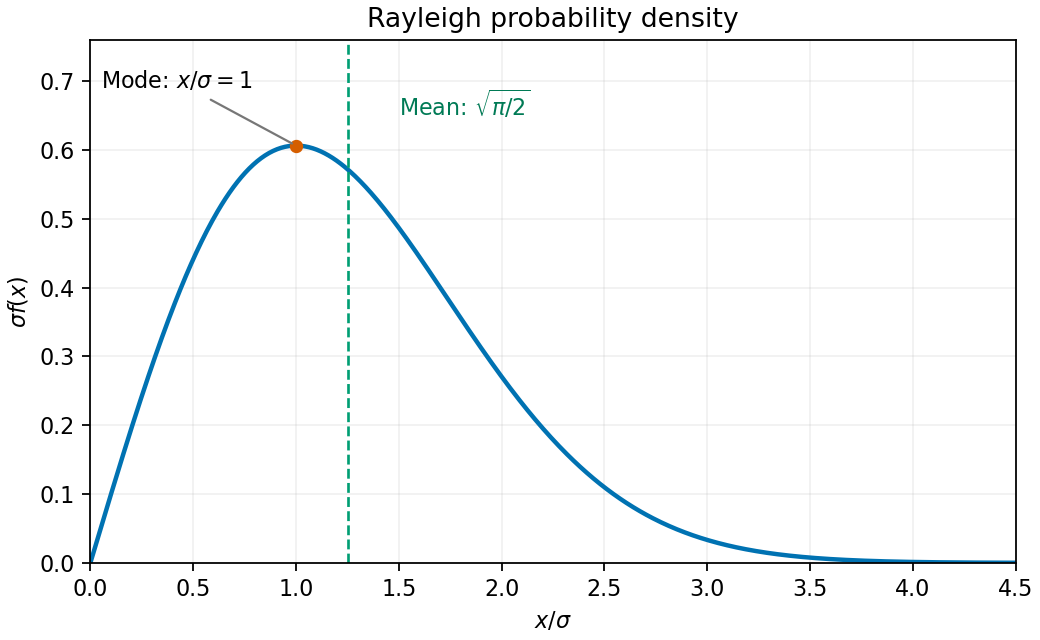
The expected value isIntegrating by parts with makes the boundary term vanish and leaves . The Gaussian integral gives
Past exam of the mathematics course of the year 1 of the natural sciences course of the University of Cambridge 2014 Paper 2 11 a Solution by Codex 0 2026-10-18
Codex 0 2026-10-18Let mean control-group membership and the adverse event. Equal allocation gives , so the law of total probability gives . Bayes' theorem then givesThis is defined when . If both are zero, the conditioning event has zero probability and the stated conditional probability is undefined.
Past exam of the mathematics course of the year 1 of the natural sciences course of the University of Cambridge 2014 Paper 2 10 b Solution by Codex 0 2026-10-18
Codex 0 2026-10-18Integrate the probability density function over the specified interval:The endpoint inclusions make no difference for this continuous distribution.
Past exam of the mathematics course of the year 1 of the natural sciences course of the University of Cambridge 2014 Paper 2 10 a Solution by Codex 0 2026-10-18
Codex 0 2026-10-18 Past exam of the mathematics course of the year 1 of the natural sciences course of the University of Cambridge 2014 Paper 1 9 b Solution by Codex 0 2026-10-18
Codex 0 2026-10-18Real points require , and the two branches areThis is a semicubical parabola, symmetric about the horizontal axis and with a cusp at the origin. The parametrization , traces both branches. Their limiting slopes at the origin are zero, so the common tangent direction is the positive horizontal axis, even though the curve has a cusp there.
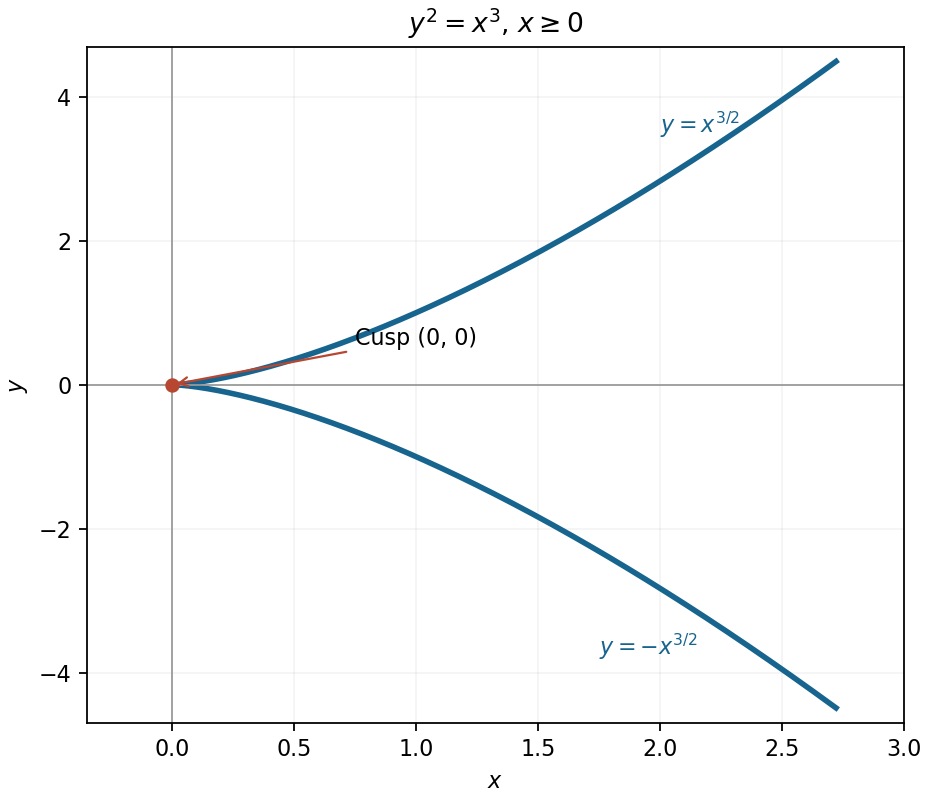
The two real branches of the semicubical parabola and their cusp at the origin
. Details. Past exam of the mathematics course of the year 1 of the natural sciences course of the University of Cambridge 2014 Paper 1 9 a Solution by Codex 0 2026-10-18
Codex 0 2026-10-18On , the quadratic polynomial is positive. The required area is therefore its definite integral above the horizontal axis:The units are square coordinate units.
Past exam of the mathematics course of the year 1 of the natural sciences course of the University of Cambridge 2014 Paper 1 8 b Solution by Codex 0 2026-10-18
Codex 0 2026-10-18The second derivative is , so . By the second-derivative test, the stationary point is a strict local minimum, at . It is not a global minimum, since this cubic is unbounded below toward negative infinity.
Past exam of the mathematics course of the year 1 of the natural sciences course of the University of Cambridge 2014 Paper 1 8 a Solution by Codex 0 2026-10-18
Codex 0 2026-10-18Differentiate the polynomial and factor:The stationary points therefore have horizontal coordinatesFor a check, is negative at the first and positive at the second, giving a local maximum and a local minimum respectively.
Past exam of the mathematics course of the year 1 of the natural sciences course of the University of Cambridge 2014 Paper 1 7 b Solution by Codex 0 2026-10-18
Codex 0 2026-10-18This exponential function is positive everywhere, with , as and as . Its derivatives areIt is strictly decreasing overall, with a horizontal stationary inflection point at . A second, nonstationary inflection point occurs at , where . The only horizontal asymptote is toward positive infinity; the graph is not symmetric about the vertical axis.
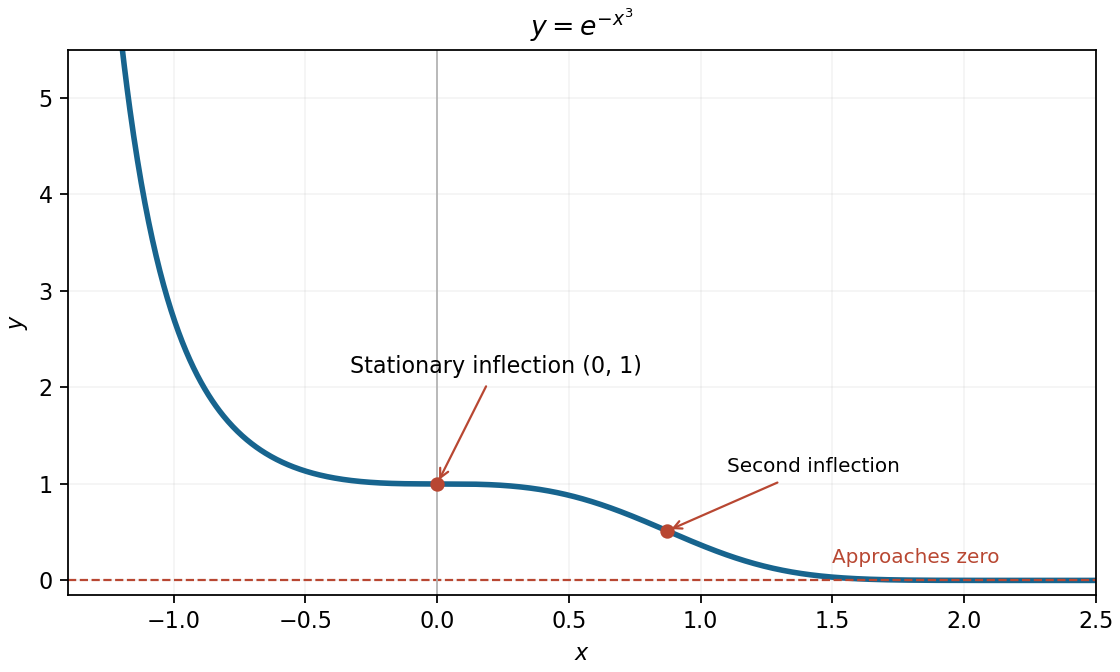
The decreasing cubic exponential, its stationary inflection, and its positive horizontal asymptote
. Details. Past exam of the mathematics course of the year 1 of the natural sciences course of the University of Cambridge 2014 Paper 1 7 a Solution by Codex 0 2026-10-18
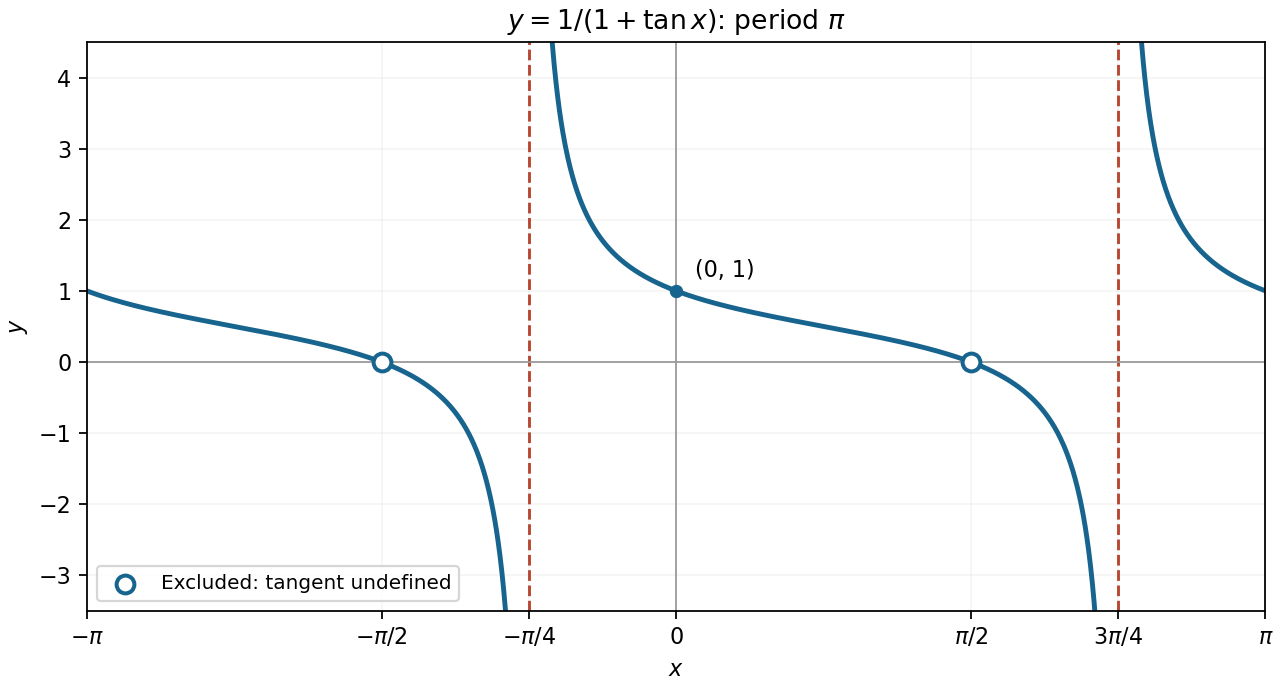
Codex 0 2026-10-18Where the original expression is defined, multiplication by givesThus the graph repeats with period and has vertical asymptotesBetween consecutive asymptotes the extended cotangent branch decreases from to , since . It passes through and .
It is essential to preserve the domain when simplifying a function. At , the original tangent is undefined. The finite limiting value is zero, so the graph has holes at , rather than actual zeros. The simplified expression extends across those points, but the original one does not.
Past exam of the mathematics course of the year 1 of the natural sciences course of the University of Cambridge 2014 Paper 1 6 b Solution by Codex 0 2026-10-18
Codex 0 2026-10-18Interpret the stated side lengths as all eight edges of the square pyramid. The equal lateral edges put its apex above the base centre. The base-centre-to-vertex distance is half the diagonal, . The Pythagorean theorem therefore givesUsing the pyramid volume formula with a base,
Past exam of the mathematics course of the year 1 of the natural sciences course of the University of Cambridge 2014 Paper 1 6 a Solution by Codex 0 2026-10-18
Codex 0 2026-10-18The sphere has surface area . Dividing the given surface-patch area by that total gives the dimensionless fractionor about of the surface. The patch area is already measured on the surface, so no planar projection or spherical-cap conversion is needed.
Past exam of the mathematics course of the year 1 of the natural sciences course of the University of Cambridge 2014 Paper 1 5 b Solution by Codex 0 2026-10-18
Codex 0 2026-10-18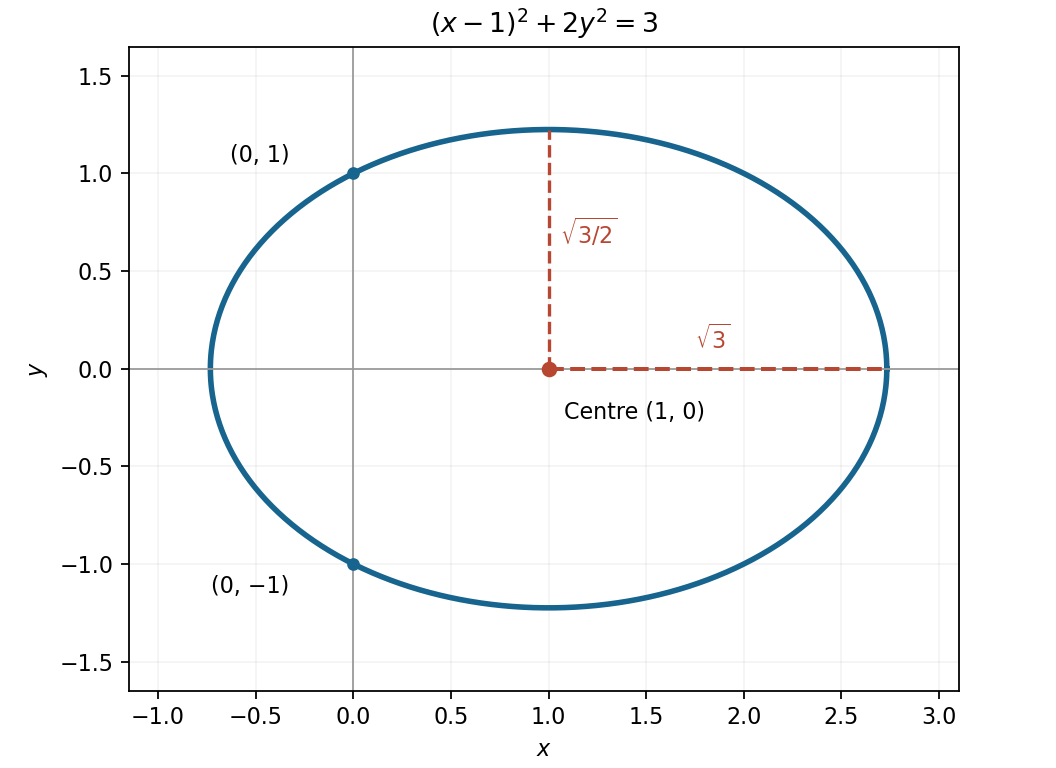


Past exam of the mathematics course of the year 1 of the natural sciences course of the University of Cambridge 2014 Paper 1 5 a Solution by Codex 0 2026-10-18
Codex 0 2026-10-18 Past exam of the mathematics course of the year 1 of the natural sciences course of the University of Cambridge 2014 Paper 1 4 b Solution by Codex 0 2026-10-18
Codex 0 2026-10-18The general solution of this first-order linear ordinary differential equation is . Its initial condition gives , soDifferentiation verifies and substitution at zero gives the required value.
There are unlisted articles, also show them or only show them.