Past exam of the mathematics course of the year 1 of the natural sciences course of the University of Cambridge 2013 Paper 1 19 b Solution by  Codex 0 2026-10-18
Use the Maclaurin series on the positive side:In the last expression the original square root covers , whose leading term is . Hence and . All three are positive for sufficiently small positive , soThus is greatest and least in the stated limit.
Past exam of the mathematics course of the year 1 of the natural sciences course of the University of Cambridge 2013 Paper 1 19 a Solution by Codex 0 2026-10-18
Codex 0 2026-10-18 Past exam of the mathematics course of the year 1 of the natural sciences course of the University of Cambridge 2013 Paper 1 18 b Solution by Codex 0 2026-10-18
Codex 0 2026-10-18Let denote the mutually exclusive supplier events and the defective-bulb event. Their probabilities and conditional defect rates areThese supplier events partition the possible bulbs. The following calculations use the law of total probability and Bayes' theorem with that partition.
Past exam of the mathematics course of the year 1 of the natural sciences course of the University of Cambridge 2013 Paper 1 18 a Solution by Codex 0 2026-10-18
Codex 0 2026-10-18All size-six subsets are equally likely under uniform sampling without replacement. There are subsets in total, and contain the required three members from each group. Thus the hypergeometric distribution gives
Past exam of the mathematics course of the year 1 of the natural sciences course of the University of Cambridge 2013 Paper 1 17 b Solution by Codex 0 2026-10-18
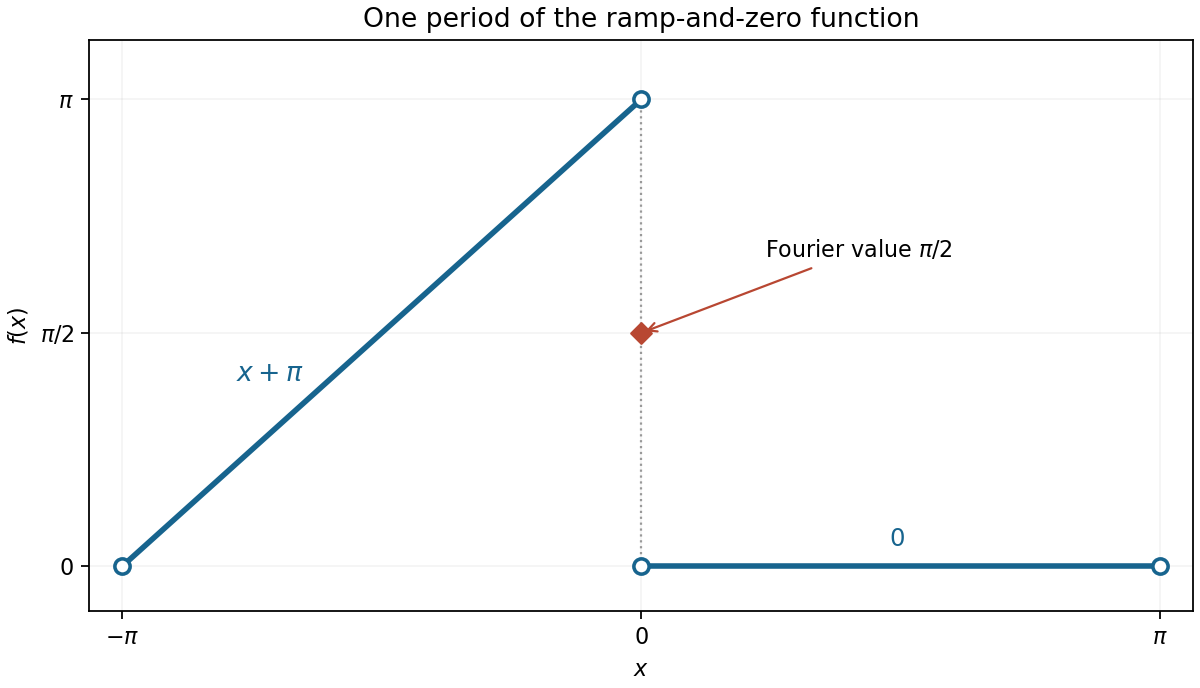
Codex 0 2026-10-18Over one period, the graph rises linearly from the limiting point to , then drops to zero and stays there up to . Repeat this pattern every . The given open endpoints do not fix values at the jumps, but changing individual point values does not change any Fourier coefficient.
Only the negative half-interval contributes. The constant coefficient isFor , integration by parts givesandConsequently the requested Fourier series isIt equals the given function on each open continuity interval. By the Dirichlet-Jordan convergence theorem, at it takes the jump midpoint , while at it takes zero because the periodic one-sided limits agree there.
Past exam of the mathematics course of the year 1 of the natural sciences course of the University of Cambridge 2013 Paper 1 17 a Solution by Codex 0 2026-10-18
Codex 0 2026-10-18With the standard real normalization, the Fourier series of a period- function iswhereFor the partial sum , Fourier orthogonality eliminates all cross terms. The constant term contributes , while every squared sine or cosine integrates to , givingFor a square-integrable function, completeness of the trigonometric orthogonal basis in the Hilbert space makes in norm. Passing to the limit proves Parseval's identity:Square integrability is the needed hypothesis here; periodicity alone is not an integrability or convergence condition.
Past exam of the mathematics course of the year 1 of the natural sciences course of the University of Cambridge 2013 Paper 1 16 a Solution by Codex 0 2026-10-18
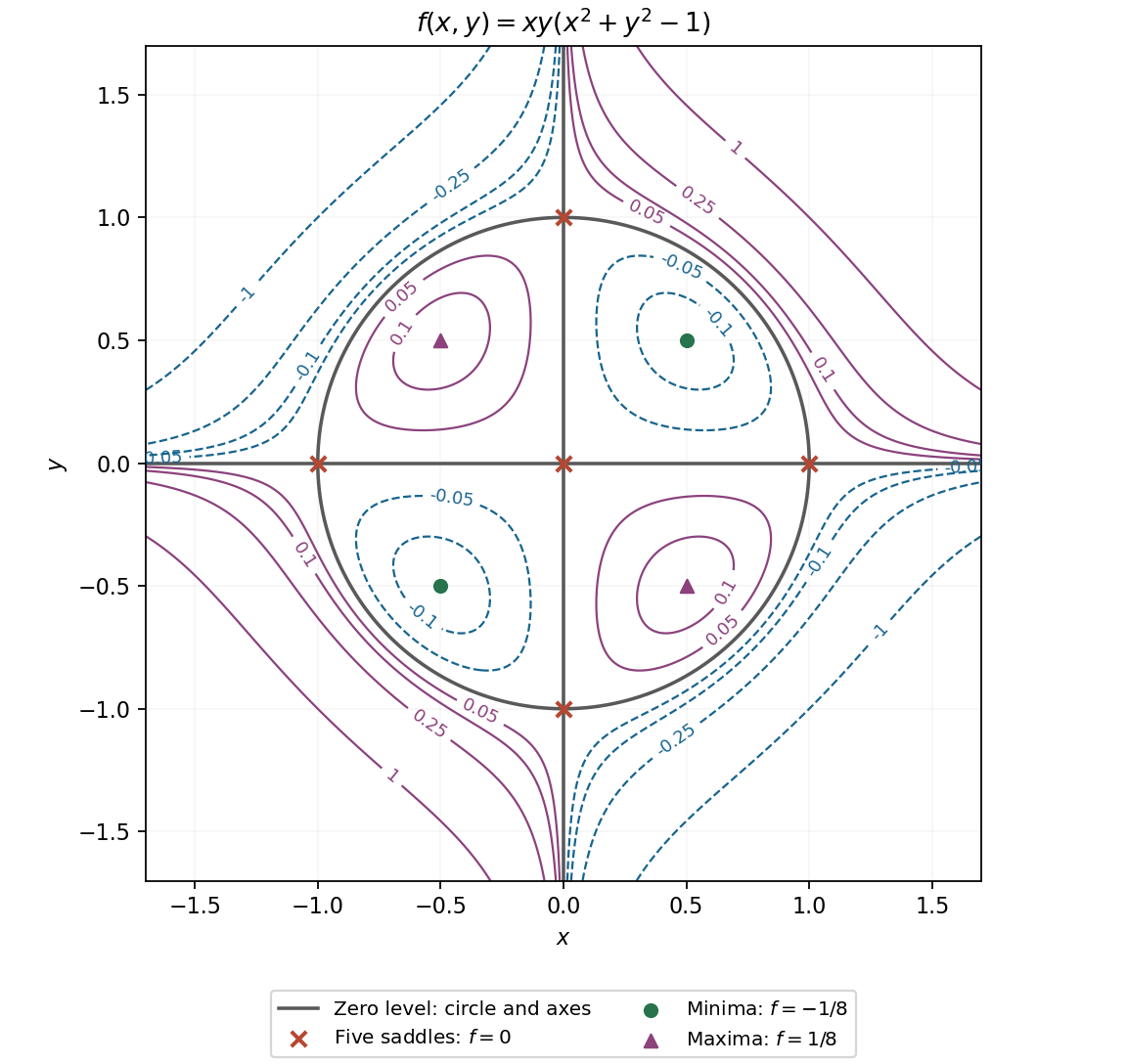
Codex 0 2026-10-18The gradient factors asIf a coordinate is zero, the solutions are , and . With both coordinates nonzero, subtracting the two bracket equations gives , hence . These give four more stationary points.
The Hessian matrix has equal diagonal entries and off-diagonal entry . At the origin its eigenvalues are , and at the four nonzero axis points they are , so all five are saddles. At the two same-sign interior points the eigenvalues are , while at the opposite-sign points they are . ThereforeThe extrema are not global, since the quartic takes arbitrarily large positive and negative values along suitable rays.
For the contour sketch, the zero level is exactly the two axes together with the unit circle. Inside the circle, is negative in the first and third quadrants and positive in the other two; outside, those signs reverse. Small negative levels contain closed loops around the two minima as well as unbounded branches in the second and fourth quadrants. Small positive levels similarly contain two loops around the maxima and unbounded branches in the first and third quadrants. The closed loops shrink to the extrema at levels , and disappear beyond those levels. This is the unit-scale quartic surface with axes and a circle as its zero set.


Past exam of the mathematics course of the year 1 of the natural sciences course of the University of Cambridge 2013 Paper 1 15 b Solution by Codex 0 2026-10-18
Codex 0 2026-10-18For , parametrize the curved surface by , with and . The magnitude of the cross product of its coordinate tangents gives the area element of a surface:Integrating givesThis is the curved surface area, not the area of a lid across the horizontal opening. The expression tends to zero at and has dimensions of area. The volume and centroid of a parabolic cup use the same geometry.
Past exam of the mathematics course of the year 1 of the natural sciences course of the University of Cambridge 2013 Paper 1 15 a Solution by Codex 0 2026-10-18
Codex 0 2026-10-18In cylindrical coordinates, and , so . Thus the circular elliptic paraboloid has equationAt height , the rim radius is .
Past exam of the mathematics course of the year 1 of the natural sciences course of the University of Cambridge 2013 Paper 1 14 d Solution by Codex 0 2026-10-18
Codex 0 2026-10-18 Past exam of the mathematics course of the year 1 of the natural sciences course of the University of Cambridge 2013 Paper 1 14 c Solution by Codex 0 2026-10-18
Codex 0 2026-10-18Use as an anchor. Two directions in the required plane areTheir cross product is , so a normal vector is . The Cartesian equation of a plane isDirect substitution verifies all three given points. The independent direction vectors ensure the plane is uniquely determined.
Past exam of the mathematics course of the year 1 of the natural sciences course of the University of Cambridge 2013 Paper 1 14 b Solution by Codex 0 2026-10-18
Codex 0 2026-10-18Assume the two line-defining points are distinct. Put and . The triangle formed by the three points has area . The same area is half the base length times the perpendicular height from the third point to the line. Hence the distance from a point to a line in three dimensions isThis remains valid when the nearest point lies outside the segment, since the base line is infinite. If all three points are collinear, the numerator and distance are both zero.
Past exam of the mathematics course of the year 1 of the natural sciences course of the University of Cambridge 2013 Paper 1 14 a Solution by Codex 0 2026-10-18
Codex 0 2026-10-18If either vector is zero, both sides vanish. Otherwise let be the angle between them. The magnitudes of the cross product and dot product are described bySquaring and using proves Lagrange's identity:
There are unlisted articles, also show them or only show them.