Past exam of the mathematics course of the year 1 of the natural sciences course of the University of Cambridge 2012 Paper 2 12 d Solution by  Codex 0 2026-10-18
Subtract the integrands first, using . Then set :The further integration by substitution makes , soThis also holds at .
Past exam of the mathematics course of the year 1 of the natural sciences course of the University of Cambridge 2012 Paper 2 12 c Solution by Codex 0 2026-10-18
Codex 0 2026-10-18Apply the power-complement integral recurrence three times, starting from :Each factor corresponds to reducing by one; the final unreduced integral is just .
Past exam of the mathematics course of the year 1 of the natural sciences course of the University of Cambridge 2012 Paper 2 12 b Solution by Codex 0 2026-10-18
Codex 0 2026-10-18Set , so , and write . The integration by substitution gives . For , integration by parts yieldsBoth endpoint terms vanish. Use inside the remaining integral:ConsequentlyThis is the instance of the power-complement integral recurrence, with initial value .
Past exam of the mathematics course of the year 1 of the natural sciences course of the University of Cambridge 2012 Paper 2 12 a Solution by Codex 0 2026-10-18
Codex 0 2026-10-18Apply the fundamental theorem of calculus separately to the upper and lower limits. No evaluation of the integral is needed:The first result has no dependence and the second no dependence, so the mixed partial derivative is
Past exam of the mathematics course of the year 1 of the natural sciences course of the University of Cambridge 2012 Paper 2 11 g Solution by Codex 0 2026-10-18
Codex 0 2026-10-18The eigenvector equations give . Multiplying on the left by therefore givesThis is an orthogonal diagonalization: the linear map acts independently by multiplication by its eigenvalues in the new orthonormal basis. The repeated eigenvalue explains the freedom to rotate the last two basis directions.
Past exam of the mathematics course of the year 1 of the natural sciences course of the University of Cambridge 2012 Paper 2 11 f Solution by Codex 0 2026-10-18
Codex 0 2026-10-18The entry of is . Hence is an orthogonal matrix, whose matrix inverse equals its transpose:This obtains the inverse without unnecessary cofactor calculations.
Past exam of the mathematics course of the year 1 of the natural sciences course of the University of Cambridge 2012 Paper 2 11 e Solution by Codex 0 2026-10-18
Codex 0 2026-10-18Using the ordered orthonormal basis chosen in (c), the column matrix isOther signs or another orthonormal choice within the repeated eigenspace are equally valid, provided the same choice is retained in the remaining parts.
Past exam of the mathematics course of the year 1 of the natural sciences course of the University of Cambridge 2012 Paper 2 11 d Solution by Codex 0 2026-10-18
Codex 0 2026-10-18The trace is the sum of the eigenvalues, counting multiplicity, while the determinant is their product:A direct expansion along the middle row checks the latter: .
Past exam of the mathematics course of the year 1 of the natural sciences course of the University of Cambridge 2012 Paper 2 11 c Solution by Codex 0 2026-10-18
Codex 0 2026-10-18Choose two perpendicular unit directions in the eigenspace:Their pairwise dot products vanish and their Euclidean norms are one. They form an orthonormal basis of eigenvectors, with eigenvalues , as guaranteed for a real symmetric matrix by the spectral theorem for real symmetric matrices.
Past exam of the mathematics course of the year 1 of the natural sciences course of the University of Cambridge 2012 Paper 2 11 b Solution by Codex 0 2026-10-18
Codex 0 2026-10-18A vector perpendicular to has the form . Direct matrix multiplication givesThus every nonzero such vector is an eigenvector with . The zero vector must be excluded from the literal claim about “any” perpendicular vector, since an eigenvector is nonzero. The eigenspace is two-dimensional. Equivalently, exhibits the spectrum of a scalar matrix plus a rank-one projector.
Past exam of the mathematics course of the year 1 of the natural sciences course of the University of Cambridge 2012 Paper 2 11 a Solution by Codex 0 2026-10-18
Codex 0 2026-10-18Solving gives and . A convenient normalized eigenvector isThe displayed nonzero vector proves that four is an eigenvalue. Every nonzero multiple represents the same eigendirection.
Past exam of the mathematics course of the year 1 of the natural sciences course of the University of Cambridge 2012 Paper 1 9 b Solution by Codex 0 2026-10-18
Codex 0 2026-10-18The absolute value in the original PDF reflects every negative sine arch upward. The graph is nonnegative, with zeros at for , and it lies below the decaying envelope . On the th arch, differentiation gives a factor proportional to . Thus its unique local maximum isSuccessive maximum heights have ratio . At each interior zero the one-sided slopes have opposite signs, producing a corner. The smaller panels below magnify the later arches so that all four remain visible.
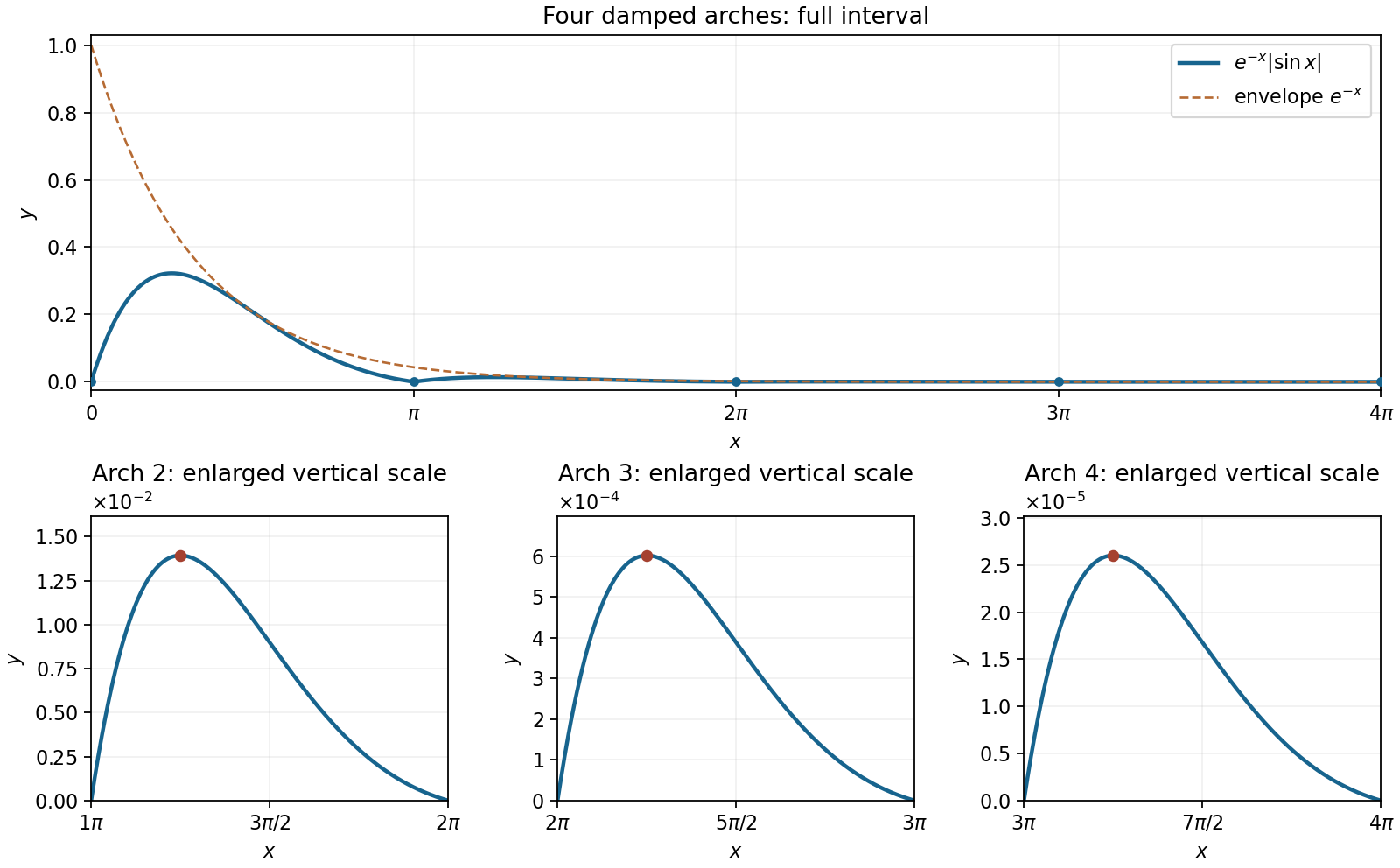
Four positive exponentially damped sine arches, with separate linear-scale enlargements of the later arches
. Details. 
Past exam of the mathematics course of the year 1 of the natural sciences course of the University of Cambridge 2012 Paper 1 9 a Solution by Codex 0 2026-10-18
Codex 0 2026-10-18The domain of a function is , because the denominator vanishes at zero. Near zero, , so is a vertical asymptote, approached with value from the left and from the right. The horizontal asymptotes are as and as .
Moreover,Both branches define a strictly decreasing monotone function: the left branch lies below , and the right branch is positive. There are no zeros or vertical-axis intercept.
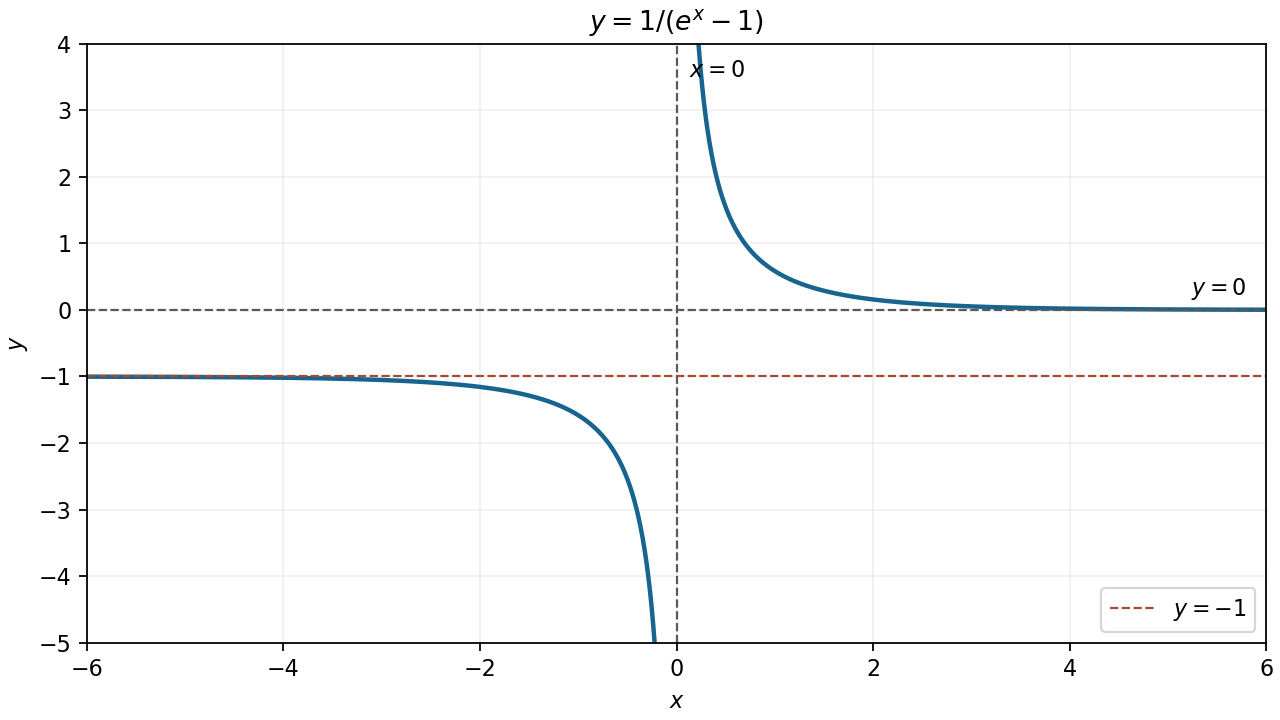
The decreasing reciprocal-exponential branches with their three asymptotes
. Details. 
Past exam of the mathematics course of the year 1 of the natural sciences course of the University of Cambridge 2012 Paper 1 8 b Solution by Codex 0 2026-10-18
Codex 0 2026-10-18 Past exam of the mathematics course of the year 1 of the natural sciences course of the University of Cambridge 2012 Paper 1 8 a Solution by Codex 0 2026-10-18
Codex 0 2026-10-18This geometric series has first term and common ratio , whose absolute value is less than one. Consequently
Past exam of the mathematics course of the year 1 of the natural sciences course of the University of Cambridge 2012 Paper 1 4 b Solution by Codex 0 2026-10-18
Codex 0 2026-10-18 Past exam of the mathematics course of the year 1 of the natural sciences course of the University of Cambridge 2012 Paper 1 4 a Solution by Codex 0 2026-10-18
Codex 0 2026-10-18 Past exam of the mathematics course of the year 1 of the natural sciences course of the University of Cambridge 2012 Paper 1 20 a Solution by Codex 0 2026-10-18
Codex 0 2026-10-18Take positive dimensions measured in metres. The volume is and the external surface area constraint is . There is one base and four walls, with no lid. The Lagrange multiplier equations for areThe first equation implies . Multiply the first by and the second by and subtract; this gives , hence . The last equation gives . Substituting into the first yields and therefore .
The constraint now reads . ThusFor a global check, apply the arithmetic-geometric mean inequality to , and , whose sum is . Their product is , so no feasible box has . Equality holds exactly at the dimensions found above. This is the maximum-volume open rectangular box at fixed surface area.
There are unlisted articles, also show them or only show them.