Past exam of the mathematics course of the year 1 of the natural sciences course of the University of Cambridge 2011 Paper 2 13 c Solution by  Codex 0 2026-10-18
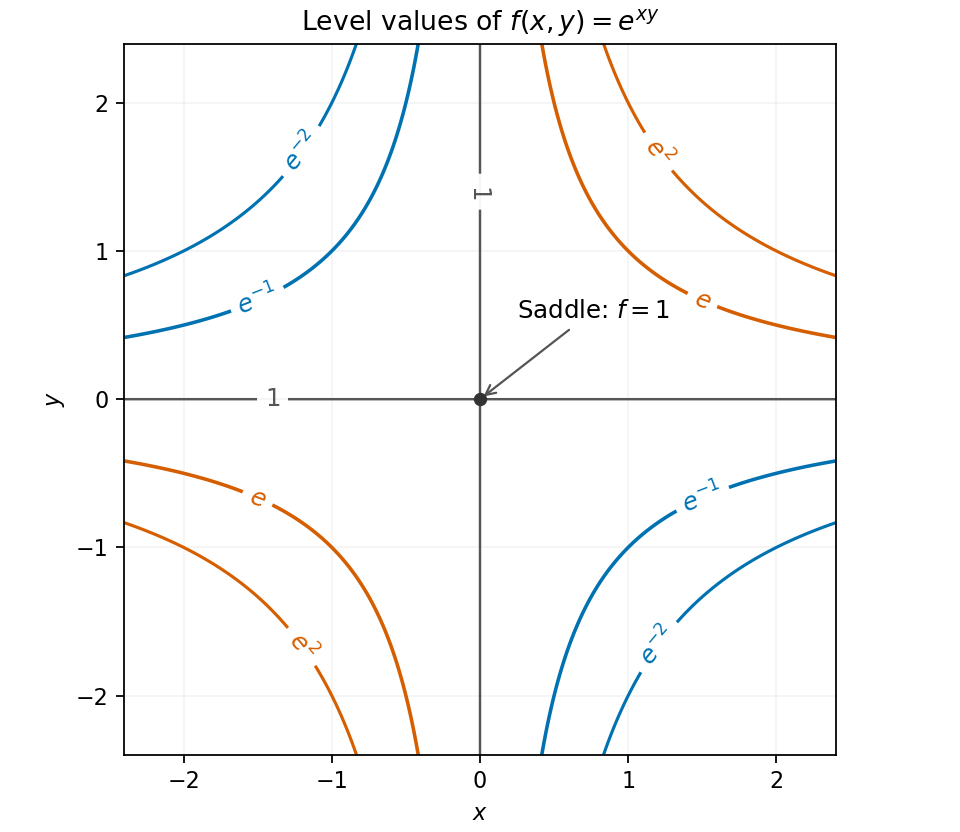
Since , a level can occur only for . Taking its natural logarithm gives . Thus produces rectangular hyperbolas in the first and third quadrants, produces them in the second and fourth quadrants, and consists of both coordinate axes.
The gradient vanishes only at , where . The Hessian matrix there is , with negative determinant. Equivalently, while for nonzero small . Hence the only stationary point is a saddle point at on the graph; its location in the contour plane is the origin.
Past exam of the mathematics course of the year 1 of the natural sciences course of the University of Cambridge 2011 Paper 2 13 b Solution by Codex 0 2026-10-18
Codex 0 2026-10-18The specified unit vector is ; the positive component selects that direction. The gradient is , giving at the point. The directional derivative is therefore
Past exam of the mathematics course of the year 1 of the natural sciences course of the University of Cambridge 2011 Paper 2 13 a Solution by Codex 0 2026-10-18
Codex 0 2026-10-18For , the exponential definitions of the hyperbolic functions give and . Taking reciprocals of these positive quantities proves . Also for , so division by the positive gives . Combining,
Past exam of the mathematics course of the year 1 of the natural sciences course of the University of Cambridge 2011 Paper 2 12 d Solution by Codex 0 2026-10-18
Codex 0 2026-10-18At the first endpoint, the Cartesian coordinates are , so its great circle must have . At the second endpoint, the plane condition gives . Since , an equivalent regular plane equation isWhere , divide by to obtainThe regular implicit equation includes the equatorial first endpoint; the tangent form is undefined there and must be read by a limit. The shorter connecting arc of this great circle is the shortest path. The endpoints are not antipodal, so this shorter arc is unique. For example, the central angle is , giving spherical distance .
Past exam of the mathematics course of the year 1 of the natural sciences course of the University of Cambridge 2011 Paper 2 12 c Solution by Codex 0 2026-10-18
Codex 0 2026-10-18A plane through the origin has equation for some nonzero normal . Dividing that normal by its Euclidean norm makes without changing the plane. Substitute the spherical coordinates from (a) and cancel the nonzero radius:Its intersection with the sphere is the desired great circle; changing the sign of all three coefficients describes the same circle.
Past exam of the mathematics course of the year 1 of the natural sciences course of the University of Cambridge 2011 Paper 2 12 b Solution by Codex 0 2026-10-18
Codex 0 2026-10-18Hold fixed and differentiate the position vector . Its coordinate tangent vectors areTheir dot product is zero, and their squared Euclidean norms are and . To first order, the displacement is . Squaring givesThis is the line element on a sphere. The chord distance and the short surface arc length agree to the order retained here.
Past exam of the mathematics course of the year 1 of the natural sciences course of the University of Cambridge 2011 Paper 2 12 a Solution by Codex 0 2026-10-18
Codex 0 2026-10-18Using the physics convention for spherical coordinates, the polar angle is measured from positive and the azimuth from positive toward positive . The Cartesian coordinates are
Past exam of the mathematics course of the year 1 of the natural sciences course of the University of Cambridge 2011 Paper 1 4 b Solution by Codex 0 2026-10-18
Codex 0 2026-10-18At the stated point, the radial distance is , so and . Differentiate the parametric curve:At , these are and . Since , the tangent line has finite slope
Past exam of the mathematics course of the year 1 of the natural sciences course of the University of Cambridge 2011 Paper 1 4 a Solution by Codex 0 2026-10-18
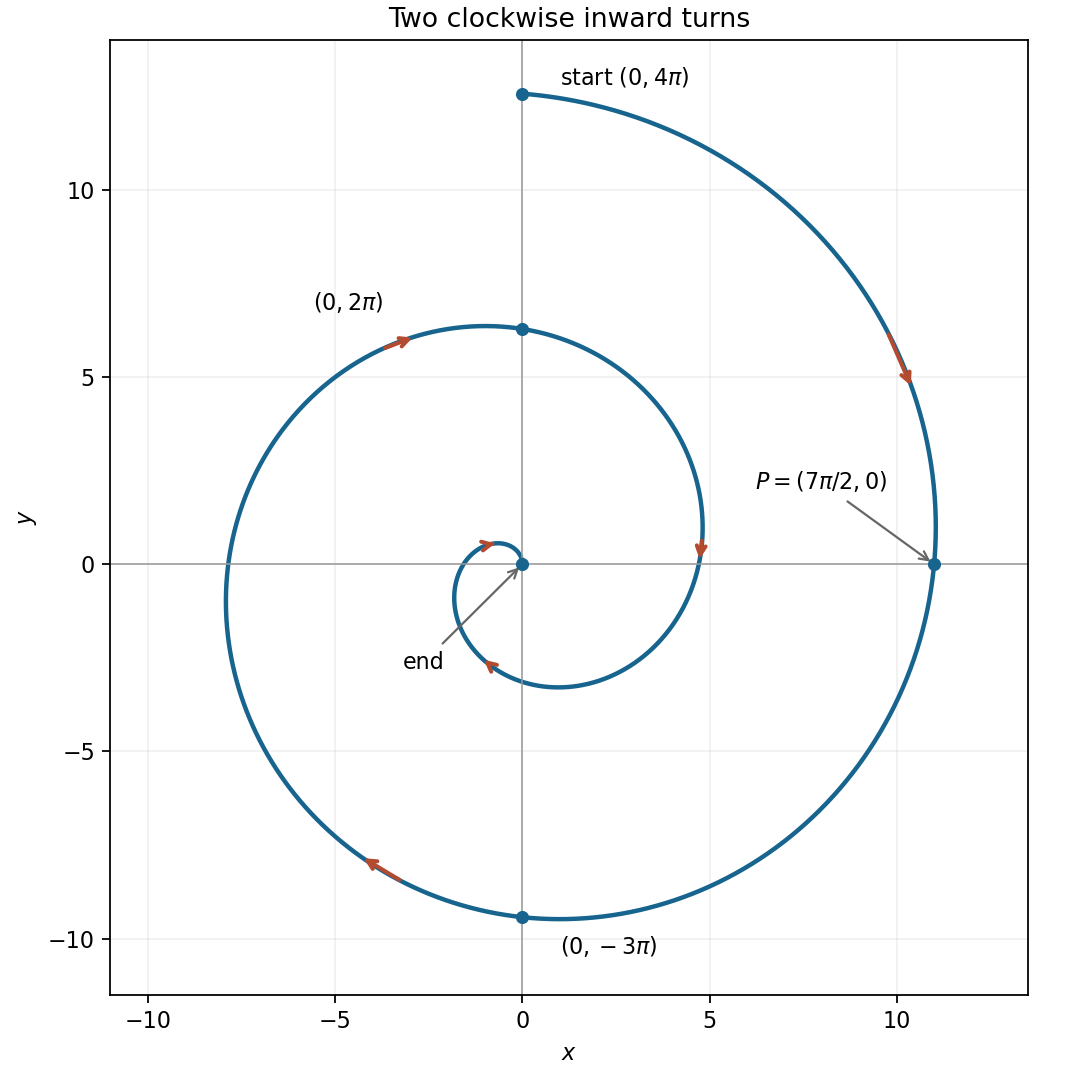
Codex 0 2026-10-18The distance from the origin is . The direction angle, measured counterclockwise from the positive horizontal axis, is modulo . Thus the path is an Archimedean spiral, turning clockwise through two complete revolutions as its radius decreases linearly from to zero.
It starts at , reaches at , crosses at , returns to the positive vertical axis at when , and ends at the origin when . These crossings fix both the scale and direction of the sketch.


Past exam of the mathematics course of the year 1 of the natural sciences course of the University of Cambridge 2011 Paper 1 3 b Solution by Codex 0 2026-10-18
Codex 0 2026-10-18For , logarithmic differentiation givesSince , the derivative vanishes precisely when . HenceThe derivative is positive before and negative after , so this is a global maximum on the given positive domain.
Past exam of the mathematics course of the year 1 of the natural sciences course of the University of Cambridge 2011 Paper 1 3 a Solution by Codex 0 2026-10-18
Codex 0 2026-10-18Differentiating the hyperbolic cosine with the chain rule gives . For real , , so the only zero of the derivative is , namely . ThusSince , this stationary point is the global minimum.
There are unlisted articles, also show them or only show them.