Past exam of the mathematics course of the year 1 of the natural sciences course of the University of Cambridge 2012 Paper 1 16 a Solution by  Codex 0 2026-10-18
A directional derivative measures change per unit distance, so first normalize the direction: . The gradient isTaking the dot product with the unit vector,Using the unnormalized vector would instead give , the change per unit parameter along ; it is not the rate per unit distance requested here.
Past exam of the mathematics course of the year 1 of the natural sciences course of the University of Cambridge 2012 Paper 1 15 c Solution by Codex 0 2026-10-18
Codex 0 2026-10-18Differentiate , :Squaring and adding cancels the mixed terms and uses , givingFor this cardioid, the polar arc length integrand isThe cosine inside the absolute value changes sign at . Therefore the perimeter isin coordinate length units. The isolated cusp does not obstruct this piecewise smooth arc length integral.
Past exam of the mathematics course of the year 1 of the natural sciences course of the University of Cambridge 2012 Paper 1 15 b Solution by Codex 0 2026-10-18
Codex 0 2026-10-18Each radial segment from to lies inside the cardioid. Integrating the polar area element givesThe three integrals are respectively , and . Thusin square coordinate units, agreeing with the scale-one case of the area and perimeter of a cardioid.
Past exam of the mathematics course of the year 1 of the natural sciences course of the University of Cambridge 2012 Paper 1 15 a Solution by Codex 0 2026-10-18
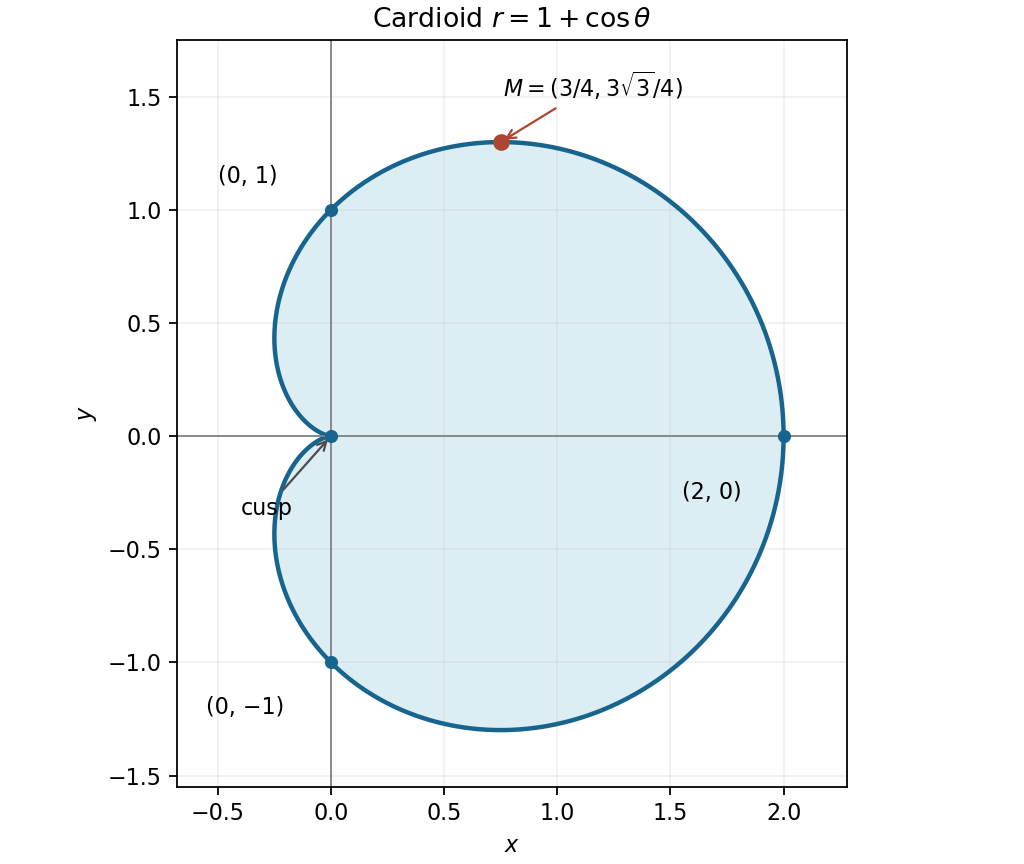
Codex 0 2026-10-18Convert the cardioid from polar coordinates to Cartesian coordinates:The curve is symmetric about the horizontal axis. It has a cusp at the origin at , passes through , and reaches on the right. Its leftmost horizontal coordinate is , since .

Past exam of the mathematics course of the year 1 of the natural sciences course of the University of Cambridge 2012 Paper 1 14 e Solution by Codex 0 2026-10-18
Codex 0 2026-10-18With , substitute into the plane constraints. They become and , givingThe Pythagorean theorem for the two orthogonal terms in then gives the closest distanceZero values of either scalar are allowed, including zero distance if both planes contain the origin.
Past exam of the mathematics course of the year 1 of the natural sciences course of the University of Cambridge 2012 Paper 1 14 d Solution by Codex 0 2026-10-18
Codex 0 2026-10-18The squared Euclidean distance along the line isIts minimum occurs at exactly when its derivative there vanishes, so . Since are independent, their linear span is the two-dimensional orthogonal complement of . Consequentlyfor unique real . This is the closest point on the intersection of two planes; the positive quadratic coefficient proves that the stationary distance is a strict global minimum.
Past exam of the mathematics course of the year 1 of the natural sciences course of the University of Cambridge 2012 Paper 1 14 c Solution by Codex 0 2026-10-18
Codex 0 2026-10-18Apply the vector triple product identity and the two plane constraints:Put . If is one intersection point, subtraction gives , so is parallel to . Conversely, adding any multiple of preserves both plane constraints because is orthogonal to both normal vectors. The whole intersection is thereforeSuch an exists: choose and solve the two-by-two linear system with determinant . This also proves sufficiency rather than assuming a nonempty intersection.
Past exam of the mathematics course of the year 1 of the natural sciences course of the University of Cambridge 2012 Paper 1 14 b Solution by Codex 0 2026-10-18
Codex 0 2026-10-18The nonzero vectors are normal vectors to the two planes. If , then for some nonzero real . Their equations are therefore and .
When , the planes coincide and their intersection is an entire plane. Otherwise they are distinct parallel planes and have no intersection. Neither case has exactly a line as its intersection. Hence is necessary for intersection in a line. It means that the two normal vectors are not parallel; in that case it is also sufficient.
Past exam of the mathematics course of the year 1 of the natural sciences course of the University of Cambridge 2012 Paper 1 14 a Solution by Codex 0 2026-10-18
Codex 0 2026-10-18The vector triple product identity isThus the expression lies in the linear span of and , with respective scalar coefficients and . The order and the minus sign matter because the cross product is not an associative operation.
Past exam of the mathematics course of the year 1 of the natural sciences course of the University of Cambridge 2012 Paper 1 13 c Solution by Codex 0 2026-10-18
Codex 0 2026-10-18The integrating factor is , giving . The required antiderivative isAfter dividing by , the general solution is the oscillatory term plus . The initial condition fixes , soThe real, nonzero parameters ensure ; direct substitution verifies both the equation and .
Past exam of the mathematics course of the year 1 of the natural sciences course of the University of Cambridge 2012 Paper 1 13 b Solution by Codex 0 2026-10-18
Codex 0 2026-10-18Let and . Their cross partial derivatives agree: . More directly, construct the scalar functionThis exhibits the expression as an exact differential. Along a solution of the differential equation,Thus the general solution isFor , the graph also extends smoothly through and satisfies the original, undivided equation there. Nonzero cannot extend through zero as a finite-valued differentiable solution. The extra vertical component of the implicit zero-level equation is not a graph on an interval and is not an additional solution of this ordinary differential equation.
Past exam of the mathematics course of the year 1 of the natural sciences course of the University of Cambridge 2012 Paper 1 13 a Solution by Codex 0 2026-10-18
Codex 0 2026-10-18Work on an interval with . The homogeneous first-order differential equation becomes a separable differential equation under : substituting gives , hence .
For , integration gives . Renaming the arbitrary constant producesFor the nonzero family the denominator must remain nonzero, so take any connected interval avoiding both and . The zero solution must be restored after division by ; by the Picard-Lindelöf theorem away from , a solution cannot switch between zero and a nonzero branch there.
Past exam of the mathematics course of the year 1 of the natural sciences course of the University of Cambridge 2012 Paper 1 12 d Solution by Codex 0 2026-10-18
Codex 0 2026-10-18Using the exponential definition of hyperbolic cosine, multiply by the nonzero quantity . This yields , hence .
If , its complex modulus requires , so ; its phase then requires . Thus all complex solutions areThere are no real solutions, since real .
Past exam of the mathematics course of the year 1 of the natural sciences course of the University of Cambridge 2012 Paper 1 12 c Solution by Codex 0 2026-10-18
Codex 0 2026-10-18Set , so . The binomial theorem givesUse and to obtainThis is a finite Fourier sine series, with only odd harmonics.
Past exam of the mathematics course of the year 1 of the natural sciences course of the University of Cambridge 2012 Paper 1 12 b Solution by Codex 0 2026-10-18
Codex 0 2026-10-18Write a square root as , with real. Equating the real part and imaginary part of its square gives and . Taking complex modulus also gives . ThereforeSince , the signs agree. The two roots areThe changes both signs together, rather than independently.
Past exam of the mathematics course of the year 1 of the natural sciences course of the University of Cambridge 2012 Paper 1 11 d Solution by Codex 0 2026-10-18
Codex 0 2026-10-18For , orthogonality to the image of a matrix would requireThe second component forces , but then the third component is . Equivalently, the last two required zero components always sum to . Therefore there are no such values of .
Past exam of the mathematics course of the year 1 of the natural sciences course of the University of Cambridge 2012 Paper 1 11 c Solution by Codex 0 2026-10-18
Codex 0 2026-10-18Use orthogonality to the image of a matrix. For , the condition is , since must vanish for every nonzero input. Direct multiplication givesEach coefficient must vanish; choosing the three coordinate basis vectors as inputs already proves necessity. Solve , to obtainThese values make every output have zero dot product with , including any zero output. Here orthogonality is understood in this algebraic sense; no direction is assigned to the zero vector.
There are unlisted articles, also show them or only show them.