Past exam of the phase transitions and collective phenomena course of the University of Cambridge 2012 Paper 1 2 Solution by  Codex 0 2026-10-20
Spontaneous symmetry breaking means that a pure thermodynamic phase is less symmetric than the Hamiltonian even when the selecting external field is removed. For example,The direction of the infinitesimal field is held fixed in this limit. Reversing the limits in a finite symmetric sample normally gives zero. For the XY model, an ordered state chooses one direction from a circle of energetically equivalent directions.
A Goldstone mode is a long-wavelength fluctuation along this continuously degenerate family. A uniform angle rotation costs no energy; a slowly varying one costs only gradient energy. In the stated static phase-only model the quadratic kernel is , tending to zero as . There is one independent soft order-parameter phase coordinate for broken rotation. The static Hamiltonian does not specify a dynamical dispersion ; that requires a dynamical law. Magnitude fluctuations instead have a restoring local curvature and have been excluded from this low-energy model.
Past exam of the particle Astrophysics course of the University of Cambridge 2012 Paper 1 2 Solution by Codex 0 2026-10-20
Codex 0 2026-10-20Gravitational evidence requires much more nonbaryonic matter than can be supplied by ordinary luminous material or by the baryon abundance permitted by nucleosynthesis. A stable, electrically neutral massive particle is a plausible cold component. Thermal production followed by cosmological particle freeze-out gives an additional motivation: an annihilation rate near a weak-interaction scale can leave an appreciable relic abundance. This is a mechanism and search hypothesis, not proof that the dark matter must be a WIMP or have any particular elastic-scattering cross section.
The plotted regions are conditional WIMP interpretations of different measurements. The experiments use different targets and distinguish signal from background differently:
- DAMA experiment uses NaI(Tl) particle scintillation and seeks an annual variation of low-energy single-hit counts as the Earth's velocity through the halo changes. Multiple-hit events and other energy ranges provide controls, but particle scintillation alone does not identify every event as an electron or nuclear recoil. Converting the modulation into mass and cross section requires a halo model and nuclear-recoil quenching factor assumptions.[ref]New results from DAMA/LIBRA by R. Bernabei and others. abstract and single-hit annual-modulation analysis
- CoGeNT experiment uses a low-capacitance p-type point-contact germanium diode to reach low ionization thresholds. Low-energy event radiation spectrum and a possible annual modulation can suggest light dark matter, but surface charge collection, internal x-ray lines and threshold efficiency must be distinguished from bulk recoil events. Its 2011 modulation paper described a modulated component of unknown origin rather than an unambiguous particle identification.[ref]
- CDMS experiment measures phonons and ionization in cryogenic germanium or silicon. The smaller ionization yield of nuclear recoils and phonon timing help reject electron and surface events. The lowered-threshold germanium analysis improves low-mass sensitivity, at the cost of more difficult background discrimination near threshold; this explains why distinct 2010 and 2011 curves appear.[ref]Results from a Low-Energy Analysis of the CDMS II Germanium Data by CDMS Collaboration. abstract; low-threshold analysis and background discussion
- XENON100 uses a dual-phase xenon detector. A recoil produces prompt liquid particle scintillation, S1, and ionization electrons. A drift field transports the charge to the surface; extracted electrons produce gas electroluminescence, S2. Drift delay and the S2 light pattern reconstruct position, while S2/S1 statistically separates electron and nuclear recoils. An inner fiducial volume suppresses external radiation. Neutron and gamma calibrations establish recoil response and leakage, and low-light-yield calibration is particularly important for light WIMPS. Neutrons can themselves mimic nuclear recoils.[ref]The XENON100 Dark Matter Experiment by the XENON100 Collaboration. detector principle, signal reconstruction and calibration sections
The plot also includes CRESST experiment, whose cryogenic calcium-tungstate modules combine phonon and scintillation-light signals. Different nuclei contribute to its recoil interpretation. Its excess region is another conditional candidate region, not an extra confirmed detection.[ref]
Around ten GeV, the shaded regions favour cross sections roughly –, while the XENON100 solid curve and the improved low-mass CDMS curve cut into or exclude much of those regions under the common elastic, spin-independent WIMP-nucleus scattering interpretation expressed per nucleon. There is tension within that shared model; the plot does not show mutually confirmed discoveries. electron backgrounds, threshold response, nuclear-recoil quenching factors, channeling assumptions and the halo velocity distribution can shift interpretations. Changing the interaction model can also alter target comparisons, but cannot establish a WIMP by assertion. The 100-live-day XENON100 result itself reported candidates compatible with estimated background.[ref]
Dark Matter Results from 100 Live Days of XENON100 Data by XENON100 Collaboration. abstract; background-compatible candidates and elastic spin-independent limit
For a rough dimensional event estimate, givesIf a collider production cross section had this value, that small yield, before acceptance and backgrounds, would not support a likely discovery. The plotted nuclear-scattering cross section is not the LHC production cross section, however. Converting between them needs a mediator, couplings, parton distributions and production kinematics; a light stable WIMP would normally be inferred from missing transverse momentum with a visible recoil object, not a visible WIMP track. The mass makes pair production kinematically accessible, but the plot and integrated collider luminosity alone do not decide discovery probability.
For the relic estimate, define and . The sharp-freeze-out relic dilution model givesAssume stable particles, no subsequent annihilation, and . Conserved comoving particle number then givesThe present rest-energy density and its critical fraction areThus the supplied toy model yields a cosmologically substantial density, of the right broad scale to motivate a dark-matter candidate. It is not an independent precision prediction: is imposed and the abundance depends exponentially on it. If entropy degrees of freedom change, entropy conservation instead gives an extra factor in when using the photon temperature. The species content needed to evaluate that correction is not supplied. A realistic calculation also follows residual annihilations with the abundance Boltzmann equation rather than stopping exactly at equilibrium freeze-out.
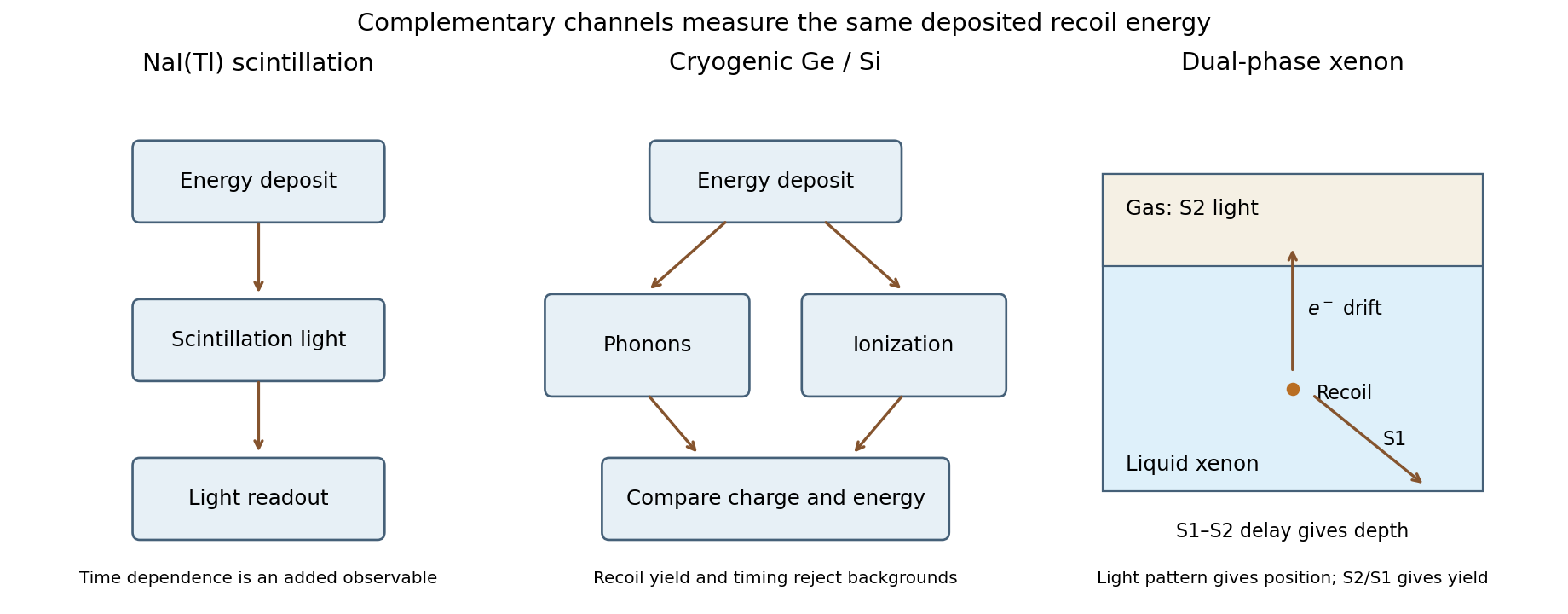
Complementary nuclear-recoil signals
. Details. 
Past exam of the particle Astrophysics course of the University of Cambridge 2012 Paper 1 1 Solution by Codex 0 2026-10-20
Codex 0 2026-10-20The metric source is a gravitational frequency shift. photons following null geodesics through a time-dependent spatial metric change momentum relative to the background comoving frame. The directional projection of that metric change gives the factor. It is not a collision term or continuing photon scattering after recombination. The normalization and sign belong to the specified definition of and ; a distribution perturbation should not silently be identified with temperature without fixing that normalization.
Define , where dots here mean conformal-time derivatives. In an Einstein-de Sitter background,A power law therefore satisfies , or . Thuswith the required growing mode . This is a solution in the perturbation convention used in the question, rather than a statement that every gauge-invariant gravitational potential grows as .
Use an integrating factor for the photon equation:For the growing mode . For the polynomial-source photon transport solution, a particular solution is : direct substitution gives . The initial-value solution is consequentlyThis also follows by integrating the source twice by parts. The apparent inverse powers of cancel in the complete long-wavelength limit; the integral form remains regular. At , the source vanishes and the complete expression reduces to .
Physically, the exponential transports the recombination pattern along photon trajectories; its direction-dependent phase projects a Fourier perturbation onto different angular multipoles. The extra terms are the accumulated gravitational contribution, here expressible as endpoint terms because the source has this special time dependence. For endpoint monopole and dipole in photon transport, at the observer the last two terms are respectively a directional dipole and an angular monopole for each mode; they do not supply a new sky pattern at multipoles . The propagating recombination combination contains the intrinsic perturbation and gravitational/velocity endpoint contributions. Individual terms depend on the perturbation gauge; observable temperature anisotropy requires the consistent emitter and observer contributions.
In pure matter domination the gauge-invariant scalar potentials are constant for a growing linear mode: the matter contrast grows as while the potential scales as its contrast divided by . Thus growth of this is compatible with no late Integrated Sachs-Wolfe effect in Einstein-de Sitter. When dark energy suppresses matter growth, the potentials generally evolve; photons gain and lose unequal energies entering and leaving a potential well. In a convention where are the dimensionless Newtonian-gauge potentials, the integrated temperature source is along the light path.
Large-angle cosmic microwave background data can constrain that late contribution, but low-multipole power alone has large cosmic variance and depends on the primordial radiation spectrum, geometry and foreground treatment. Cross-correlating the temperature map with low-redshift galaxies or other matter tracers isolates a late-time connection; decaying wells typically correlate overdensities with hotter cosmic microwave background directions. Boughn and Crittenden compared WMAP temperature data with the HEAO1 hard X-ray background and examined possible foreground origins of the correlation. This tests potential evolution under a cosmological model, not dark energy independently of all gravity and curvature assumptions.[ref]
There are unlisted articles, also show them or only show them.