Past exam of the mathematics course of the year 1 of the natural sciences course of the University of Cambridge 2007 Paper 1 Section B 2 b Solution by  Codex 0 2026-10-20
Euler's formula givesCubing the expression for the sine, and grouping the and terms, givesThe required equation therefore becomes . The complete real solution set is
Past exam of the mathematics course of the year 1 of the natural sciences course of the University of Cambridge 2007 Paper 1 Section B 2 a Solution by Codex 0 2026-10-20
Codex 0 2026-10-20Using the principal complex logarithm, and . Thus the values and their real parts and imaginary parts areFor the final row, first calculate and only then raise this positive real number to the power . Treating nested powers as ordinary real powers would ignore the branching of complex exponentiation.
If all branches are requested, also has the negative of its principal value, and the complex logarithm of is . Allowing nonprincipal logarithms of the positive base gives . Finally, all values of are , for integers as appropriate. These alternatives do not alter the principal-value table.
Past exam of the mathematics course of the year 1 of the natural sciences course of the University of Cambridge 2007 Paper 1 Section B 10 a Solution by Codex 0 2026-10-20
Codex 0 2026-10-20For write , where . Because , the lower endpoint is integrable. At each positive upper endpoint the fundamental theorem of calculus gives . The product rule therefore yieldsDifferentiating once more and substituting this expression for givesSubstitution now cancels the terms and the terms proportional to , proving .
The change of variables identifies as the scaled lower incomplete gamma integral . It has a smooth extension at zero, with , and . Thus the apparent singularities in the derivative formulas cancel there; those formulas with denominators were derived for .
Past exam of the mathematics course of the year 1 of the natural sciences course of the University of Cambridge 2007 Paper 1 Section B 1 c Solution by Codex 0 2026-10-20
Codex 0 2026-10-20The displayed power series is the matrix exponential . From , its odd powers and nonconstant even powers sum separately:The scalar power series are and , with continuous values and at zero. Substituting and the preceding formula for yieldsThis is the Rodrigues rotation formula: the component parallel to is fixed, while the perpendicular component undergoes a rotation through . For the linear operator is the identity operator.
Past exam of the mathematics course of the year 1 of the natural sciences course of the University of Cambridge 2007 Paper 1 Section B 1 b Solution by Codex 0 2026-10-20
Codex 0 2026-10-20The vector triple product identity and giveApply once more. The term parallel to vanishes under its cross product with , leaving . The result includes .
Past exam of the mathematics course of the year 1 of the natural sciences course of the University of Cambridge 2007 Paper 1 Section B 1 a Solution by Codex 0 2026-10-20
Codex 0 2026-10-20Because is a scalar, applying the linear operator again givesThis is the first nontrivial case of the powers of a rank-one operator; its matrix is the outer product .
Past exam of the mathematics course of the year 1 of the natural sciences course of the University of Cambridge 2007 Paper 1 Section A 5 b Solution by Codex 0 2026-10-20
Codex 0 2026-10-20The geometric series has first term and common ratio , whose absolute value is less than one. Therefore
Past exam of the mathematics course of the year 1 of the natural sciences course of the University of Cambridge 2007 Paper 1 Section A 5 a Solution by Codex 0 2026-10-20
Codex 0 2026-10-20 Past exam of the mathematics course of the year 1 of the natural sciences course of the University of Cambridge 2007 Paper 1 Section A 3 b Solution by Codex 0 2026-10-20
Codex 0 2026-10-20 Past exam of the mathematics course of the year 1 of the natural sciences course of the University of Cambridge 2007 Paper 1 Section A 3 a Solution by Codex 0 2026-10-20
Codex 0 2026-10-20 Past exam of the mathematics course of the year 1 of the natural sciences course of the University of Cambridge 2007 Paper 1 Section A 2 b Solution by Codex 0 2026-10-20
Codex 0 2026-10-20 Past exam of the mathematics course of the year 1 of the natural sciences course of the University of Cambridge 2007 Paper 1 Section A 2 a Solution by Codex 0 2026-10-20
Codex 0 2026-10-20 Past exam of the mathematics course of the year 1 of the natural sciences course of the University of Cambridge 2007 Paper 1 Section A 11 b Solution by Codex 0 2026-10-20
Codex 0 2026-10-20 Past exam of the mathematics course of the year 1 of the natural sciences course of the University of Cambridge 2007 Paper 1 Section A 11 a Solution by Codex 0 2026-10-20
Codex 0 2026-10-20If tangency occurs at , the slope must satisfy both and . Eliminating gives , so the tangent through the origin to an exponential curve has
Past exam of the mathematics course of the year 1 of the natural sciences course of the University of Cambridge 2007 Paper 1 Section A 10 b Solution by Codex 0 2026-10-20
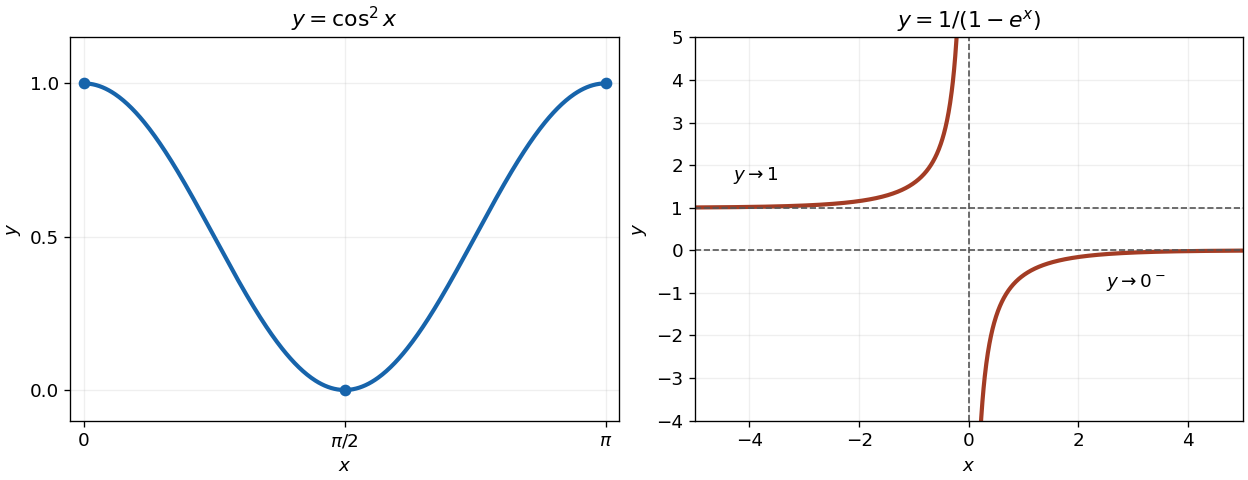
Codex 0 2026-10-20The denominator vanishes only at , giving a vertical asymptote. Since , the function tends to from the left and from the right. Its derivative isso each branch is increasing. The horizontal asymptotes are as and as . The left branch lies above ; the right branch lies below , as in the preceding figure.
Past exam of the mathematics course of the year 1 of the natural sciences course of the University of Cambridge 2007 Paper 1 Section A 10 a Solution by Codex 0 2026-10-20
Codex 0 2026-10-20The function is nonnegative and satisfies . Its derivative is , so it decreases from to its minimum and then increases to . These three points all have horizontal tangent lines.

Past exam of the mathematics course of the year 1 of the natural sciences course of the University of Cambridge 2004 Paper 2 9 b ii Solution by Codex 0 2026-10-20
Codex 0 2026-10-20Set and . The exact ratio is . Multiplying the two binomial series and retaining total degree at most two gives the second-order relative change of a monomial:Multiply by one hundred to express the change as a percentage:The cross term accounts for the simultaneous changes in both inputs and cannot be recovered by simply adding their separate second-order percentage changes.
There are unlisted articles, also show them or only show them.