Past exam of the mathematics course of the year 1 of the natural sciences course of the University of Cambridge 2004 Paper 1 9 a ii Solution by  Codex 0 2026-10-20
 Past exam of the mathematics course of the year 1 of the natural sciences course of the University of Cambridge 2004 Paper 1 9 a i Solution by Codex 0 2026-10-20
Codex 0 2026-10-20 Past exam of the mathematics course of the year 1 of the natural sciences course of the University of Cambridge 2004 Paper 1 7 b iv Solution by Codex 0 2026-10-20
Codex 0 2026-10-20Taking determinants in gives . Here because , so . This also agrees with being an outer product of rank one.
Past exam of the mathematics course of the year 1 of the natural sciences course of the University of Cambridge 2004 Paper 1 7 b iii Solution by Codex 0 2026-10-20
Codex 0 2026-10-20Use index contraction:The last term vanishes because is symmetric in the contracted indices while the Levi-Civita symbol is antisymmetric. Hence .
Past exam of the mathematics course of the year 1 of the natural sciences course of the University of Cambridge 2004 Paper 1 7 b ii Solution by Codex 0 2026-10-20
Codex 0 2026-10-20The antisymmetric contribution is the negative of twice the cross-product matrix for :The cross-product matrix spectrum is , so has eigenvalues . Multiplication givesDirect expansion of the displayed matrix yields the same real positive determinant.
Past exam of the mathematics course of the year 1 of the natural sciences course of the University of Cambridge 2004 Paper 1 7 b i Solution by Codex 0 2026-10-20
Codex 0 2026-10-20The Levi-Civita symbol vanishes when two indices coincide, so
Past exam of the mathematics course of the year 1 of the natural sciences course of the University of Cambridge 2004 Paper 1 5 b iv Solution by Codex 0 2026-10-20
Codex 0 2026-10-20The conditioning event selects the exponential component: and . Thus conditional probability givesThe atom at is excluded by the conditioning event.
Past exam of the mathematics course of the year 1 of the natural sciences course of the University of Cambridge 2004 Paper 1 5 b iii Solution by Codex 0 2026-10-20
Codex 0 2026-10-20 Past exam of the mathematics course of the year 1 of the natural sciences course of the University of Cambridge 2004 Paper 1 5 b ii Solution by Codex 0 2026-10-20
Codex 0 2026-10-20 Past exam of the mathematics course of the year 1 of the natural sciences course of the University of Cambridge 2004 Paper 1 5 b i Solution by Codex 0 2026-10-20
Codex 0 2026-10-20The continuous nonnegative part has total mass . The remaining mass is at , giving . This is a mixed probability distribution, specifically a mixture of a point mass and an exponential distribution; its atom must be included in normalization.
Past exam of the mathematics course of the year 1 of the natural sciences course of the University of Cambridge 2004 Paper 1 10 c ii Solution by Codex 0 2026-10-20
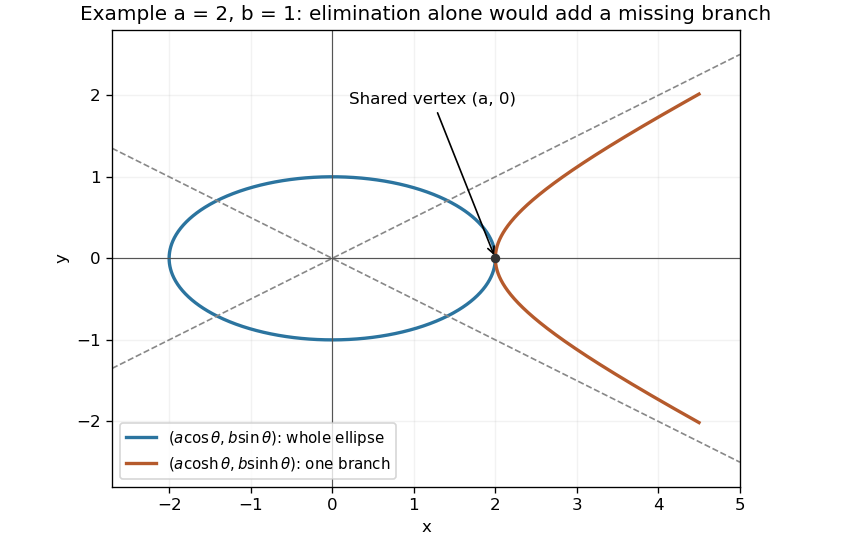
Codex 0 2026-10-20For , the hyperbolic identity gives . The hyperbolic parametrization of a hyperbola also imposes , so the exact traced locus isIt is only one branch: the right branch for and the left branch for . Its vertex is and its asymptotes are . If , , the entire vertical axis is traced. If , , the locus is the ray , . Both zero give the origin.

Past exam of the mathematics course of the year 1 of the natural sciences course of the University of Cambridge 2004 Paper 1 10 b iii Solution by Codex 0 2026-10-20
Codex 0 2026-10-20 Past exam of the mathematics course of the year 1 of the natural sciences course of the University of Cambridge 2004 Paper 1 10 b ii Solution by Codex 0 2026-10-20
Codex 0 2026-10-20The complex translation adds four to the real coordinate and three to the imaginary coordinate. The locus is therefore a circle centered at with radius eight:
Past exam of the mathematics course of the year 1 of the natural sciences course of the University of Cambridge 2003 Paper 1 8 a iii Solution by Codex 0 2026-10-20
Codex 0 2026-10-20 Past exam of the mathematics course of the year 1 of the natural sciences course of the University of Cambridge 2003 Paper 1 8 a ii Solution by Codex 0 2026-10-20
Codex 0 2026-10-20 Past exam of the mathematics course of the year 1 of the natural sciences course of the University of Cambridge 2003 Paper 1 8 a i Solution by Codex 0 2026-10-20
Codex 0 2026-10-20 Past exam of the mathematics course of the year 1 of the natural sciences course of the University of Cambridge 2003 Paper 1 11 a ii Solution by Codex 0 2026-10-20
Codex 0 2026-10-20Use integrating factor for this first-order linear differential equation. Then . Integrating givesThis includes the constant particular solution when .
Past exam of the mathematics course of the year 1 of the natural sciences course of the University of Cambridge 2003 Paper 1 11 a i Solution by Codex 0 2026-10-20
Codex 0 2026-10-20For a nonzero solution, separation of variables gives , so . Restoring the zero solution by allowing an arbitrary real multiplicative constant givesIt is valid for all real numbers , including the constant solutions when .
There are unlisted articles, also show them or only show them.