Past exam of the mathematics course of the year 1 of the natural sciences course of the University of Cambridge 2003 Paper 1 10 a ii Solution by  Codex 0 2026-10-20
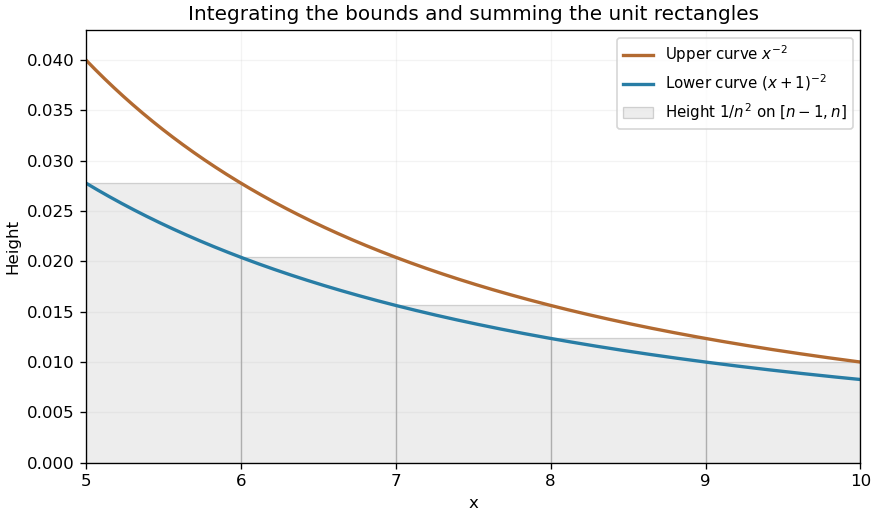
Add the supplied five-term partial sum to each side of the tail inequality. Since and ,Numerically this is approximately .
Past exam of the mathematics course of the year 1 of the natural sciences course of the University of Cambridge 2003 Paper 1 10 a i Solution by Codex 0 2026-10-20
Codex 0 2026-10-20For and , monotonicity gives . Integrating over each unit interval and summing proves the integral test tail boundsThe inequalities remain strict because the very first rectangle already has a strictly positive difference from either bounding integral.

Past exam of the mathematics course of the year 1 of the natural sciences course of the University of Cambridge 2002 Paper 1 7 a ii Solution by Codex 0 2026-10-20
Codex 0 2026-10-20Divide by on an interval where it is nonzero. For the resulting first-order linear differential equation, use the integrating factor , since . The right-hand side after division is also , soThe identity shows never vanishes on the interval, givingAn integrating factor may have either fixed sign; if obtained by integrating , the real logarithm is .
Past exam of the mathematics course of the year 1 of the natural sciences course of the University of Cambridge 2002 Paper 1 7 a i Solution by Codex 0 2026-10-20
Codex 0 2026-10-20On an interval avoiding , separation of variables gives, for ,Absorb the sign into the integration constant and include the equilibrium solution by allowing . The complete real family isEach solution is considered on a connected interval in , where the original equation is defined.
Past exam of the mathematics course of the year 1 of the natural sciences course of the University of Cambridge 2001 Paper 2 9 a ii Solution by Codex 0 2026-10-20
Codex 0 2026-10-20At fixed , differentiating gives . Also, gives . At fixed , eliminate to write , giving . Finally, the previous part gave . ThusThe held-fixed subscripts matter: substituting a reciprocal partial derivative while silently changing what is held fixed would not preserve these cancellations.
Past exam of the mathematics course of the year 1 of the natural sciences course of the University of Cambridge 2001 Paper 2 9 a i Solution by Codex 0 2026-10-20
Codex 0 2026-10-20Solve the two algebraic constraints for the squared coordinates:On any nonsingular real branch, implicit differentiation at fixed gives and . Differentiating with the other original coordinate fixed gives and . ThereforeThis is the multivariable chain rule applied to . These formulas assume the relevant denominators are nonzero and the chosen variables are valid local coordinates.
Past exam of the mathematics course of the year 1 of the natural sciences course of the University of Cambridge 2001 Paper 2 7 a iii Solution by Codex 0 2026-10-20
Codex 0 2026-10-20 Past exam of the mathematics course of the year 1 of the natural sciences course of the University of Cambridge 2001 Paper 2 7 a ii Solution by Codex 0 2026-10-20
Codex 0 2026-10-20 Past exam of the mathematics course of the year 1 of the natural sciences course of the University of Cambridge 2001 Paper 2 7 a i Solution by Codex 0 2026-10-20
Codex 0 2026-10-20 Past exam of the mathematics course of the year 1 of the natural sciences course of the University of Cambridge 2001 Paper 2 12 b ii Solution by Codex 0 2026-10-20
Codex 0 2026-10-20The series has absolute convergence if is a convergent series, meaning its nonnegative partial sums have a finite limit. Absolute convergence implies convergence of the original real or complex series. The converse fails: the alternating harmonic series converges, while its absolute-value series is the divergent harmonic series.
Past exam of the mathematics course of the year 1 of the natural sciences course of the University of Cambridge 2001 Paper 2 12 b i Solution by Codex 0 2026-10-20
Codex 0 2026-10-20A series is a convergent series if its partial sums have a finite limit as . The number is the sum of the series. Explicitly, for every there is an integer such that whenever . The condition alone is insufficient: the harmonic series has terms tending to zero but diverges.
Past exam of the mathematics course of the year 1 of the natural sciences course of the University of Cambridge 2001 Paper 2 12 a iii Solution by Codex 0 2026-10-20
Codex 0 2026-10-20The derivative of the exponential function at zero gives . Hence , andThe denominator is nonzero for every real , so this is a two-sided finite limit.
Past exam of the mathematics course of the year 1 of the natural sciences course of the University of Cambridge 2001 Paper 2 12 a ii Solution by Codex 0 2026-10-20
Codex 0 2026-10-20Although oscillates without a limit, its magnitude is at most one. Therefore . The squeeze theorem givesThe shrinking factor suppresses the oscillation from either side of zero.
Past exam of the mathematics course of the year 1 of the natural sciences course of the University of Cambridge 2001 Paper 2 11 b v Solution by Codex 0 2026-10-20
Codex 0 2026-10-20The definition of conditional probability givesConditioning on a red in the second position leaves one red among the six counters that could occupy the first position, giving the same result directly.
Past exam of the mathematics course of the year 1 of the natural sciences course of the University of Cambridge 2001 Paper 2 11 b iv Solution by Codex 0 2026-10-20
Codex 0 2026-10-20By inclusion-exclusion, subtract the intersection once to correct the double counting:As a check, the complementary event is two greens, of probability .
Past exam of the mathematics course of the year 1 of the natural sciences course of the University of Cambridge 2001 Paper 2 11 b iii Solution by Codex 0 2026-10-20
Codex 0 2026-10-20After a red first draw, one red remains among six counters. The multiplication rule for conditional probability gives
Past exam of the mathematics course of the year 1 of the natural sciences course of the University of Cambridge 2001 Paper 2 11 b ii Solution by Codex 0 2026-10-20
Codex 0 2026-10-20Use the law of total probability according to the first draw. Without replacement, the second-draw red probability is after a red and after a green. ThusEquivalently, each counter has the same probability of occupying the second position as the first. Equal marginal probabilities do not make the two draw events independent.
Past exam of the mathematics course of the year 1 of the natural sciences course of the University of Cambridge 2001 Paper 2 11 b i Solution by Codex 0 2026-10-20
Codex 0 2026-10-20 Past exam of the mathematics course of the year 1 of the natural sciences course of the University of Cambridge 2001 Paper 1 12 c ii Solution by Codex 0 2026-10-20
Codex 0 2026-10-20For the standard normal density, . Using integration by parts,The boundary term vanishes because Gaussian decay dominates every power. Since the given mean is zero and variance is one, , yielding the Gaussian fourth moment
There are unlisted articles, also show them or only show them.