Past exam of the mathematics course of the year 1 of the natural sciences course of the University of Cambridge 2007 Paper 1 Section B 9 a Solution by  Codex 0 2026-10-20
For , strict decrease gives , while for it gives . Integrating over these unit intervals provesSumming the rectangle bounds givesThe partial sums and the improper integral are nondecreasing. These bounds show that one is bounded exactly when the other is bounded, proving the integral test for convergence. In the convergent case, sum the same interval inequalities for to obtainFor , the antiderivative is , which grows without bound, so the first series diverges. For , the antiderivative is , whose tail integral is finite, so the second series converges, withBoth functions are positive and strictly decreasing on , as required.
Past exam of the mathematics course of the year 1 of the natural sciences course of the University of Cambridge 2007 Paper 1 Section B 7 ii Solution by Codex 0 2026-10-20
Codex 0 2026-10-20In cylindrical coordinates the spherical cap has , and . Its mass density is and the volume element is . ThereforeThis is the mass of a spherical cap with height-proportional density with and .
For its curved surface area, write with . The surface integral of one becomesIt agrees with the curved area of a spherical cap, , for . The planar closing disk is not part of the requested curved surface.
Past exam of the mathematics course of the year 1 of the natural sciences course of the University of Cambridge 2007 Paper 1 Section B 7 i Solution by Codex 0 2026-10-20
Codex 0 2026-10-20The region is , . Reversing the order describes the same triangle as , . Since the integrand is continuous on this compact region, Fubini's theorem permitsThe new inner integral introduces the factor needed for the change of variables .
Past exam of the mathematics course of the year 1 of the natural sciences course of the University of Cambridge 2007 Paper 1 Section B 5 b Solution by Codex 0 2026-10-20
Codex 0 2026-10-20On the interval containing the initial condition, division by gives a linear ordinary differential equation with integrating factor . ConsequentlyThe initial value gives . ThusThis polynomial also satisfies the original equation at and gives an extension to all real . The initial value problem is uniquely determined on ; the vanishing leading coefficient at does not ensure unique continuation to its left.
Past exam of the mathematics course of the year 1 of the natural sciences course of the University of Cambridge 2007 Paper 1 Section B 4 b Solution by Codex 0 2026-10-20
Codex 0 2026-10-20Let , , and denote the three disjoint categories, and or the test result. The law of total probability givesTo calculate the requested conditional probability, first combine the two categories with the virus. Their joint negative-test probability is , whereas . Bayes' theorem therefore givesThese numbers use the specified population proportions and test probabilities; the negative result reduces the initial combined proportion to about within this model.
Past exam of the mathematics course of the year 1 of the natural sciences course of the University of Cambridge 2007 Paper 1 Section B 4 a Solution by Codex 0 2026-10-20
Codex 0 2026-10-20The exponential series proves normalization of a probability distribution:Let and count the two labels. Conditional on , independent labeling gives a binomial distribution, so the joint probability mass function isEach bracket is a normalized Poisson distribution. Summing over therefore givesThe factorization also proves that and are independent random variables. This is Poisson thinning; the phrase about ignoring the other count refers to taking a marginal distribution, rather than fixing that count.
Past exam of the mathematics course of the year 1 of the natural sciences course of the University of Cambridge 2007 Paper 1 Section B 3 b Solution by Codex 0 2026-10-20
Codex 0 2026-10-20Since , only the first three positive powers of contribute through degree three. The composition coefficients of power series follow by using and in . HenceHere and are coefficients of the power series, rather than raw derivatives; their definitions already contain any factorial factors.
Past exam of the mathematics course of the year 1 of the natural sciences course of the University of Cambridge 2007 Paper 1 Section B 2 c Solution by Codex 0 2026-10-20
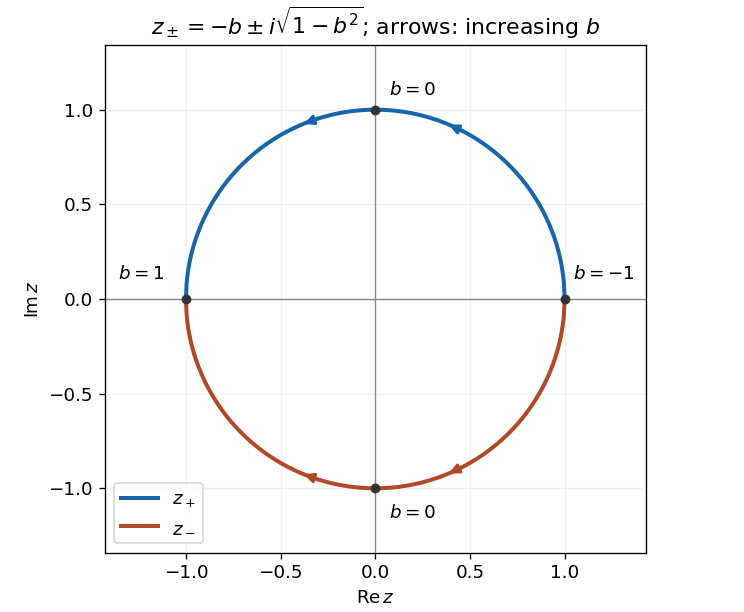
Codex 0 2026-10-20The quadratic formula gives . For , write this asEach root of a polynomial has modulus , since . As increases from to , the upper root traverses the upper unit semicircle from to , and the lower root traverses the lower semicircle in the opposite angular direction. At the roots coincide at ; at they coincide at . For intermediate they are complex conjugates.

There are unlisted articles, also show them or only show them.