Past exam of the mathematics course of the year 1 of the natural sciences course of the University of Cambridge 2007 Paper 2 Section B 6 b Solution by  Codex 0 2026-10-20
Integrating with respect to gives . Matching requires , and matching requires constant. A scalar potential with the requested sign isThus the force field is a conservative vector field on all of .
Past exam of the mathematics course of the year 1 of the natural sciences course of the University of Cambridge 2007 Paper 2 Section B 6 a Solution by Codex 0 2026-10-20
Codex 0 2026-10-20 Past exam of the mathematics course of the year 1 of the natural sciences course of the University of Cambridge 2007 Paper 2 Section B 5 b Solution by Codex 0 2026-10-20
Codex 0 2026-10-20For the internal energy , its exact differential identifies and . The Maxwell relation from equality of mixed partial derivatives is . At fixed volume, the constant-volume heat capacity satisfiesso , assuming nonzero and a locally invertible relation. Applying the chain rule to gives the isentropic temperature-volume derivativeFor the stated one-mole ideal gas, the equation of state gives and , so the right side is . Along an isentropic process, and , giving the same left side:
Past exam of the mathematics course of the year 1 of the natural sciences course of the University of Cambridge 2007 Paper 2 Section B 5 a Solution by Codex 0 2026-10-20
Codex 0 2026-10-20If with continuous second partial derivatives of , then and . The symmetry of second derivatives gives the necessary condition for an exact differential form:This condition is also locally sufficient on a small rectangle for continuously differentiable coefficients; global sufficiency additionally needs suitable topology of the domain.
Past exam of the mathematics course of the year 1 of the natural sciences course of the University of Cambridge 2007 Paper 2 Section B 4 b Solution by Codex 0 2026-10-20
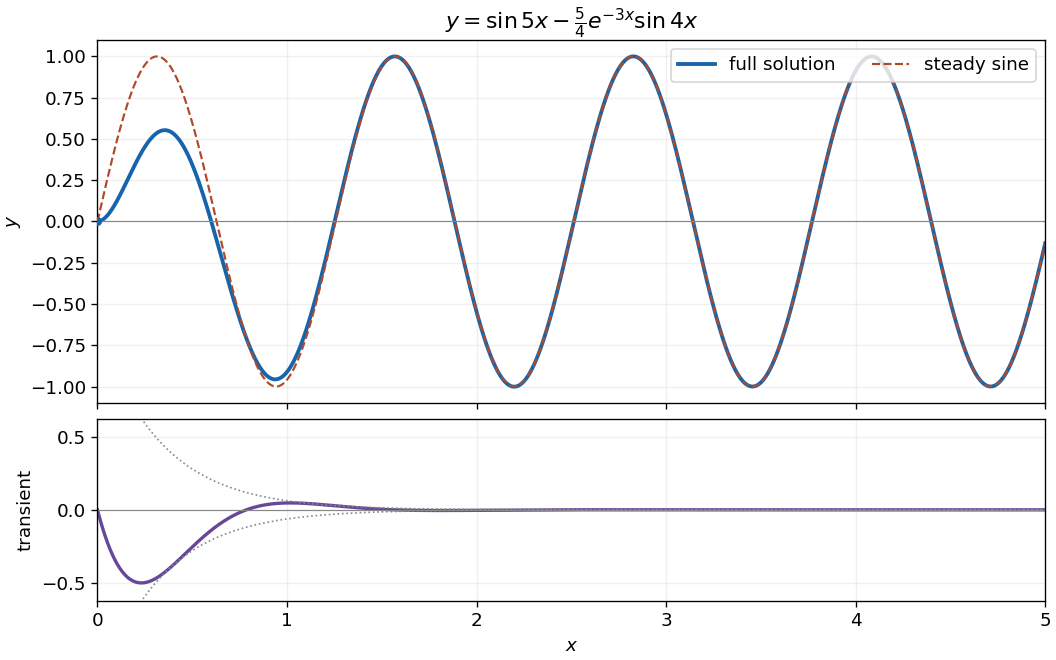
Codex 0 2026-10-20The characteristic equation has roots , giving the homogeneous solution . For the sinusoidal forcing term, is a particular solution, since its second derivative cancels and . The zero initial displacement gives ; zero initial derivative gives . ThusThe transient response decays as , leaving the steady-state response . Near zero, and , so the sketch starts with and a horizontal tangent line.

Past exam of the mathematics course of the year 1 of the natural sciences course of the University of Cambridge 2007 Paper 2 Section B 4 a Solution by Codex 0 2026-10-20
Codex 0 2026-10-20The characteristic equation for the homogeneous solution is , giving . For a particular solution, substitute : the left side becomes , so . The general solution is
Past exam of the mathematics course of the year 1 of the natural sciences course of the University of Cambridge 2007 Paper 2 Section B 3 b Solution by Codex 0 2026-10-20
Codex 0 2026-10-20Write . The probability density function normalizes when , so . Its survival function is for ; hence, for ,Differentiating this conditional tail givesThe value assigned at the single endpoint does not affect any probability. The memorylessness of the exponential distribution says that , conditional on , is again an exponential distribution of rate . Its first two moments are and , found by integration by parts, so translation leaves the variance unchanged:
Past exam of the mathematics course of the year 1 of the natural sciences course of the University of Cambridge 2007 Paper 2 Section B 3 a Solution by Codex 0 2026-10-20
Codex 0 2026-10-20Normalization of a probability distribution and the geometric series give , so . For a nonnegative integer , the strict tail starts at :For nonnegative integers , the event is contained in . ThereforeThis is the memorylessness of the geometric distribution with the zero-based counting convention. Keeping strict versus non-strict inequalities explicit is essential: , conditional on , has the original distribution of .
Past exam of the mathematics course of the year 1 of the natural sciences course of the University of Cambridge 2007 Paper 2 Section A 9 b Solution by Codex 0 2026-10-20
Codex 0 2026-10-20Let be indicator random variables for the two draws being red. Each draw has red probability , even though the draws are dependent. By linearity of expectation, the number satisfies
Past exam of the mathematics course of the year 1 of the natural sciences course of the University of Cambridge 2007 Paper 2 Section A 9 a Solution by Codex 0 2026-10-20
Codex 0 2026-10-20There are equally likely unordered pairs, and contain one ball of each colour. Thus the hypergeometric distribution gives
Past exam of the mathematics course of the year 1 of the natural sciences course of the University of Cambridge 2007 Paper 2 Section A 5 b Solution by Codex 0 2026-10-20
Codex 0 2026-10-20 Past exam of the mathematics course of the year 1 of the natural sciences course of the University of Cambridge 2007 Paper 2 Section A 5 a Solution by Codex 0 2026-10-20
Codex 0 2026-10-20 Past exam of the mathematics course of the year 1 of the natural sciences course of the University of Cambridge 2007 Paper 2 Section A 4 c Solution by Codex 0 2026-10-20
Codex 0 2026-10-20Each component depends only on its own coordinate, so all cross partial derivatives vanish. Therefore the curl isThis also follows from the identity that the curl of a gradient vanishes for a twice continuously differentiable potential energy.
Past exam of the mathematics course of the year 1 of the natural sciences course of the University of Cambridge 2007 Paper 2 Section A 4 b Solution by Codex 0 2026-10-20
Codex 0 2026-10-20 Past exam of the mathematics course of the year 1 of the natural sciences course of the University of Cambridge 2007 Paper 2 Section A 4 a Solution by Codex 0 2026-10-20
Codex 0 2026-10-20 Past exam of the mathematics course of the year 1 of the natural sciences course of the University of Cambridge 2007 Paper 2 Section A 3 b Solution by Codex 0 2026-10-20
Codex 0 2026-10-20 Past exam of the mathematics course of the year 1 of the natural sciences course of the University of Cambridge 2007 Paper 2 Section A 3 a Solution by Codex 0 2026-10-20
Codex 0 2026-10-20 Past exam of the mathematics course of the year 1 of the natural sciences course of the University of Cambridge 2007 Paper 2 Section A 2 b Solution by Codex 0 2026-10-20
Codex 0 2026-10-20 Past exam of the mathematics course of the year 1 of the natural sciences course of the University of Cambridge 2007 Paper 2 Section A 2 a Solution by Codex 0 2026-10-20
Codex 0 2026-10-20 Past exam of the mathematics course of the year 1 of the natural sciences course of the University of Cambridge 2007 Paper 1 Section B 9 b Solution by Codex 0 2026-10-20
Codex 0 2026-10-20The ratio test uses , when it exists for eventually nonzero terms: gives absolute convergence, gives divergence, and is inconclusive.
There are unlisted articles, also show them or only show them.