Past exam of the mathematics course of the year 2 of the natural sciences course of the University of Cambridge 2006 Paper 1 10 Solution by  Codex 0 2026-10-20
For fixed endpoint values, stationarity requires the Euler-Lagrange equation . Differentiate along an extremal: its derivative is . Thus when the Beltrami identity makes that quantity constant.
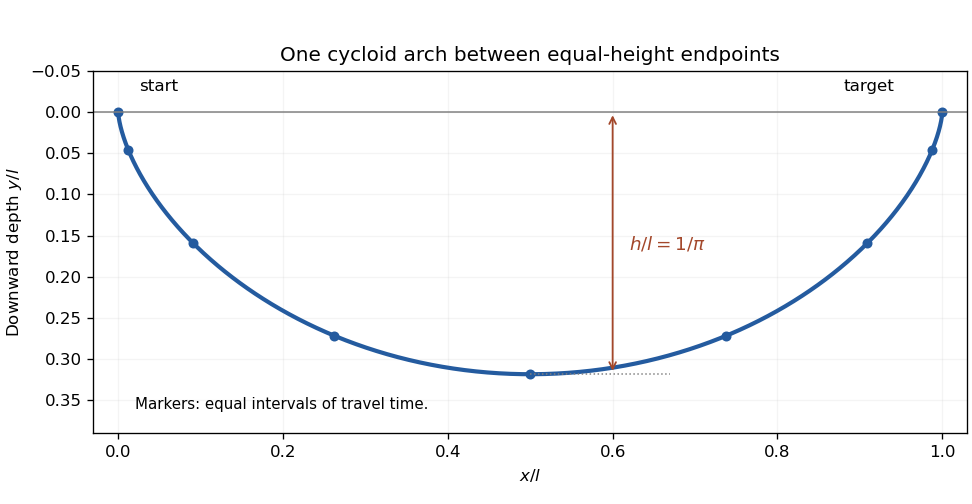
Take as depth measured downward. Conservation of energy from rest gives , hence speed . With arc length , the travel time is . For , the Beltrami quantity is . Thus .
Put and take along the first arch. Since , one obtains . Integrating from the initial cusp gives the cycloid solving the brachistochrone problem:For the equal-height target, the first complete arch has , so . Also and for . ThereforeThe endpoint zeros of speed cancel the zeros of , leaving finite travel time. Global minimality follows from the maximum-depth bound for a brachistochrone: any competing track with maximum depth satisfies . The displayed cycloid attains both inequalities with .

Past exam of the mathematics course of the year 2 of the natural sciences course of the University of Cambridge 2005 Paper 2 6 Solution by Codex 0 2026-10-20
Codex 0 2026-10-20Under an orthogonal Cartesian change , the chain rule gives . Thus the derivative operator transforms as a rank-one Cartesian tensor. Under a general coordinate change it has the covector transformation law when applied to a scalar; derivatives of vector components then need the usual connection terms. The calculations below use Cartesian coordinates.
Past exam of the mathematics course of the year 2 of the natural sciences course of the University of Cambridge 2004 Paper 2 9 Solution by Codex 0 2026-10-20
Codex 0 2026-10-20Let be a quarter-turn and a reflection of the square. The dihedral group is generated by with and , and its elements are . Two generators are minimal because this group is not cyclic. Its subgroups of order two are and for . Its subgroups of order four are , and .
A group homomorphism obeys for all elements; a group isomorphism is a bijective group homomorphism. Take the rotation subgroup and defineThe quaternion element has order four, so the map is well defined modulo four, preserves products and is injective onto . Surjectivity onto all eight quaternion elements is not required of a homomorphism.
A cyclic group is generated by the powers of one element. The final claim needs the usual qualification no nontrivial proper subgroup, and : the trivial subgroup is proper in every nontrivial group, even one of prime order. With that interpretation, if has prime order , Lagrange's theorem permits only subgroup orders one and . Conversely, if its order is composite, choose a divisor with . The subgroup has order , strictly between one and . This proves the assertion described by groups with no proper nontrivial subgroups.
Past exam of the mathematics course of the year 2 of the natural sciences course of the University of Cambridge 2004 Paper 2 10 Solution by Codex 0 2026-10-20
Codex 0 2026-10-20A group representation is a homomorphism into invertible linear maps. It is a faithful representation when it is injective, equivalently when its kernel contains only the identity. A faithful real two-dimensional representation of the cyclic group of order four isThese are rotations of the plane through . Since and , their multiplication agrees with the group, and all four matrices are distinct.
For any invertible , set . Thenso this also is a group representation. The character of a representation is . For the displayed quarter-turn representation, its values on are .
Past exam of the mathematics course of the year 2 of the natural sciences course of the University of Cambridge 2004 Paper 1 8 Solution by Codex 0 2026-10-20
Codex 0 2026-10-20The homogeneous Cauchy-Euler equation has powers with . Boundedness at zero selects , and boundedness at infinity selects . Put for and for . Continuity gives . Since the operator is , the required delta-function normalization is . Thus , giving the bounded Green kernel for a radial Euler operator:In the requested notation, . The two expressions agree at .
Past exam of the mathematics course of the year 2 of the natural sciences course of the University of Cambridge 2004 Paper 1 6 Solution by Codex 0 2026-10-20
Codex 0 2026-10-20The Wronskian is . If constants obey , differentiating gives . At any point where , these form an invertible two-by-two system, forcing . Thus the two solutions are linearly independent.
For the given equation, the normalized coefficients are and , so zero is a regular singular point. Substitute a Frobenius series , . The lowest power gives the indicial equationThe coefficient of givesFor either root the common factor is nonzero for , soWith leading coefficient one, the two independent solutions areTheir analytic series factors both have infinite radius of convergence, because the ratio of consecutive terms tends to zero for every fixed . The factor still gives the second solution a branch point at zero; it is not an entire function or an ordinary Taylor series there. On , the general real solution is . This is the , case of the exponential reduction of a confluent hypergeometric equation with equal parameters.
Past exam of the mathematics course of the year 2 of the natural sciences course of the University of Cambridge 2003 Paper 2 7 Solution by Codex 0 2026-10-20
Codex 0 2026-10-20Use the ordered displacement vector , and define by . For an unstretched spring, the extension to first order is the dot product of the relative displacement with its equilibrium unit vector. Summing its squared extensions gives the central spring stiffness matrix. The four side springs and two diagonal springs giveThereforeThe kinetic energy is , so a normal mode satisfies . Keeping the factor in the definition of fixes the normalization of and the resulting frequencies.
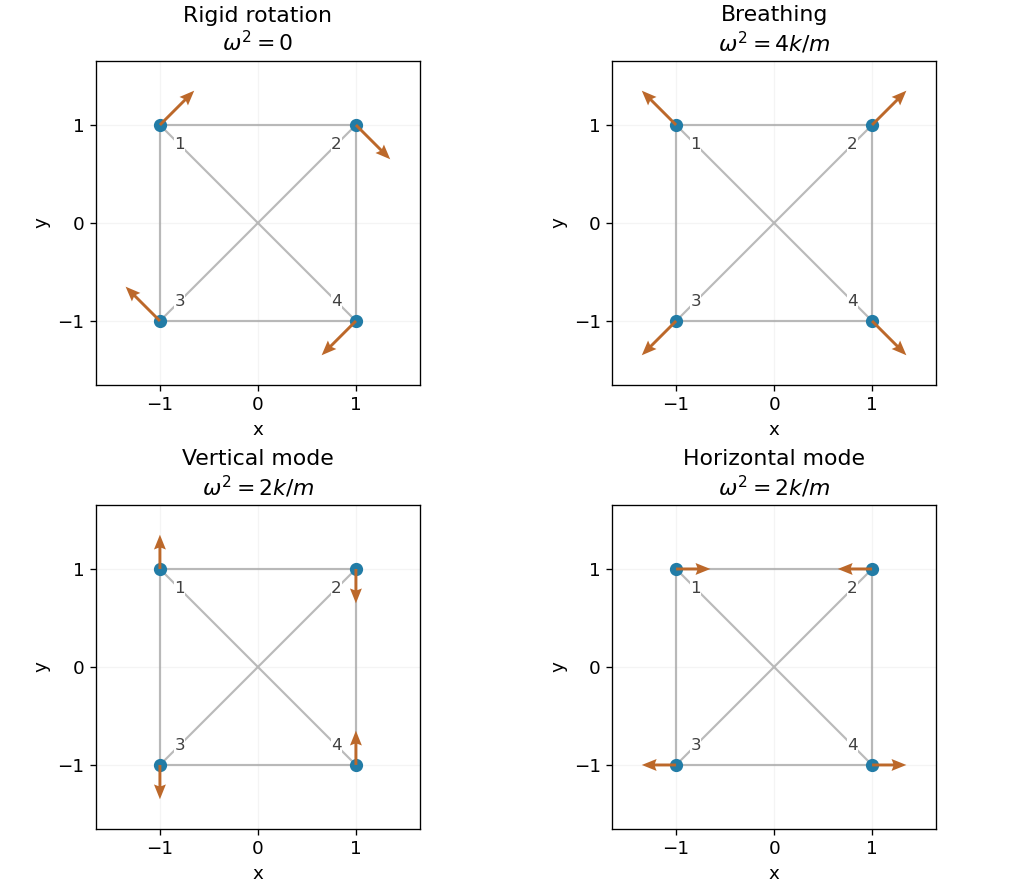
Rigid rotation, breathing and modes with reflection symmetry
. Original displacement diagrams. Grey lines show all six equilibrium springs; arrows show representative mode vectors. The rotation has zero frequency, the breathing mode has squared frequency 4k/m, and the two other modes have squared frequency 2k/m. Details.
There are unlisted articles, also show them or only show them.