Past exam of the MPhil in micro- and nanotechnology enterprise course of the University of Cambridge 2020 Paper 1 Section B 10 iii a Solution by  Codex 0 2026-10-20
Under uniform geometric scaling, write . Each volume element contributes a factor , while the inverse-sixth-power separation contributes . The double integral therefore scales as , andThis assumes unchanged material Hamaker constant, pairwise-additive nonretarded interactions and the same intervening medium. It is a simultaneous scaling of both body sizes and their separation, not merely moving fixed bodies apart.
Past exam of the MPhil in micro- and nanotechnology enterprise course of the University of Cambridge 2020 Paper 1 Section B 10 i d Solution by Codex 0 2026-10-20
Codex 0 2026-10-20Approximating the skin as a uniform thin water shell with density ,This is about 2500 times the buoyant mass of the enclosed gas. The film weight therefore dominates the bubble's downward gravitational force under the stated assumptions. Equal-temperature air inside does not provide a net lift to balance it: an apparently floating bubble can be transiently supported by air currents or have different internal temperature/composition. Film thickness is generally nonuniform and changes with drainage and evaporation; the uniform thickness is an estimate, not a stable equilibrium condition.
Past exam of the MPhil in micro- and nanotechnology enterprise course of the University of Cambridge 2020 Paper 1 Section B 10 i c Solution by Codex 0 2026-10-20
Codex 0 2026-10-20Treat the two film surfaces as an effective interfacial tension . The relevant Bond number for the gas-density difference is . Substituting the Young–Laplace equation and the preceding density relation givesThus the formal crossover gives . This compares gravity on the excess gas with capillary restoration and neglects film weight. It does not say gravity-driven drainage of a real water film is negligible below kilometre scales. At this enormous radius, treating ambient pressure and density as uniform is itself no longer quantitatively reliable.
Past exam of the MPhil in micro- and nanotechnology enterprise course of the University of Cambridge 2020 Paper 1 Section B 10 i b Solution by Codex 0 2026-10-20
Codex 0 2026-10-20For the same ideal gas composition and temperature, , hence . The bubble volume is . The gas's mass in excess of displaced ambient air isThis is a positive buoyant mass, meaning a net downward weight after subtracting ordinary air buoyancy. It is not an upward lifting capacity. Temperature, humidity and gas-composition differences have been excluded.
Past exam of the MPhil in micro- and nanotechnology enterprise course of the University of Cambridge 2020 Paper 1 Section B 10 i a Solution by Codex 0 2026-10-20
Codex 0 2026-10-20 Past exam of the MPhil in micro- and nanotechnology enterprise course of the University of Cambridge 2020 Paper 1 Section A(i) 1 ii b Solution by Codex 0 2026-10-20
Codex 0 2026-10-20Two useful properties are adhesion and contact elastic modulus. The pull-off force, the most negative force on retraction relative to the noncontact baseline, maps adhesion. Fit the contact part of the force-indentation relation using a suitable contact mechanics model to obtain a reduced elastic modulus; for example, the DMT contact model useswhere , is the calibrated tip radius and is indentation. Converting to a sample Young's modulus also requires the tip modulus and the two Poisson's ratios. The approach curve alone does not supply a retraction pull-off measurement. The loop area can additionally map dissipated energy; it is not automatically a purely viscous loss.[ref]
Past exam of the MPhil in micro- and nanotechnology enterprise course of the University of Cambridge 2020 Paper 1 Section A(i) 1 ii a Solution by Codex 0 2026-10-20
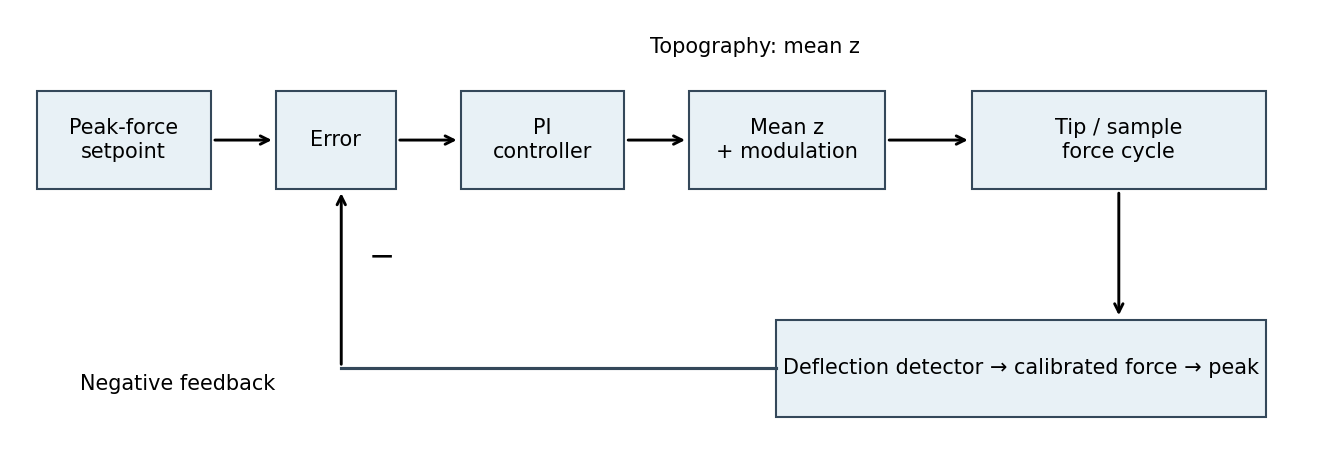
Codex 0 2026-10-20The controlled quantity is the maximum repulsive force in each tapping cycle. In PeakForce quantitative nanomechanical mapping, a vertical modulation below the cantilever resonance produces a force-distance cycle at each pixel. The optical lever measures deflection; the calibrated cantilever stiffness converts this to force. Subtract the measured peak force from the setpoint and use proportional-integral control to adjust the mean vertical scanner position. Excessive peak force makes the controller withdraw the sample or tip; insufficient force makes it approach. The scanner position required to maintain the setpoint supplies the topography signal. This controls the top of the repulsive branch in the preceding curve, rather than the oscillation amplitude used in conventional tapping mode.[ref]

Past exam of the MPhil in micro- and nanotechnology enterprise course of the University of Cambridge 2019 Paper 2 Section B 21 iv c Solution by Codex 0 2026-10-20
Codex 0 2026-10-20Use the one-way density per unit length . The electron-flux magnitude in an interval is charge times velocity times line density:If is instead defined for a finite length , the traversal frequency is ; the same cancellation follows. The printed therefore requires to be a line density, not an unscaled total particle number.
Subtract the opposite reservoir's incoming flux. With the stated electron electrochemical potentials, conventional positive current is opposite to electron-number flux, soAt low temperature and small bias, each fully transmitted occupied spin-degenerate subband contributes . Hence . More generally, the Landauer formula weights each mode by its transmission probability; imperfect transmission removes exact integer plateaux.
Past exam of the MPhil in micro- and nanotechnology enterprise course of the University of Cambridge 2019 Paper 2 Section B 21 iv b Solution by Codex 0 2026-10-20
Codex 0 2026-10-20For a wire of length , one spin state has states in one propagation direction. Including two degenerate spin states and using givesDivide by for density per unit length. The factor-of-two distinction is essential: the current from one reservoir uses only its incoming propagation branch. If spin degeneracy is lifted, count each resolved spin channel separately.
Past exam of the MPhil in micro- and nanotechnology enterprise course of the University of Cambridge 2019 Paper 2 Section B 21 iv a Solution by Codex 0 2026-10-20
Codex 0 2026-10-20For longitudinal motion in transverse subband ,For a completely free particle take and use the full wave vector. In a semiconductor the parabolic-band mass is the appropriate effective mass rather than necessarily the bare electron mass.
Past exam of the MPhil in micro- and nanotechnology enterprise course of the University of Cambridge 2019 Paper 2 Section A(iii) 18 ii c Solution by Codex 0 2026-10-20
Codex 0 2026-10-20 Past exam of the MPhil in micro- and nanotechnology enterprise course of the University of Cambridge 2019 Paper 2 Section A(iii) 18 ii b Solution by Codex 0 2026-10-20
Codex 0 2026-10-20 Past exam of the MPhil in micro- and nanotechnology enterprise course of the University of Cambridge 2019 Paper 2 Section A(iii) 18 ii a Solution by Codex 0 2026-10-20
Codex 0 2026-10-20 Past exam of the MPhil in micro- and nanotechnology enterprise course of the University of Cambridge 2019 Paper 2 Section A(ii) 15 iv c Solution by Codex 0 2026-10-20
Codex 0 2026-10-20The measured energy selects . Immediately after an ideal projective measurement, the normalized state is up to an overall phase, with no surviving components. At later times before any further disturbance it is , where is the measurement time. A repeated energy measurement returns with probability one.
Past exam of the MPhil in micro- and nanotechnology enterprise course of the University of Cambridge 2019 Paper 2 Section A(ii) 15 iv b Solution by Codex 0 2026-10-20
Codex 0 2026-10-20Let and . For the time-independent well,It remains zero outside the well. Each expansion coefficient acquires a phase of unit magnitude, so every energy probability, including the preceding , is time-independent. The position probability density generally changes because cross terms between different energies oscillate.
Past exam of the MPhil in micro- and nanotechnology enterprise course of the University of Cambridge 2019 Paper 2 Section A(ii) 15 iv a Solution by Codex 0 2026-10-20
Codex 0 2026-10-20Only have . The printed squared coefficients sum to , rather than exactly one. Normalizing those numbers givesTreating the coefficients as rounded values of an already normalized state gives the intended approximately answer. Probabilities are sums of squared amplitudes because the energy eigenstates are orthonormal.
Past exam of the MPhil in micro- and nanotechnology enterprise course of the University of Cambridge 2019 Paper 1 Section B 9 ii c Solution by Codex 0 2026-10-20
Codex 0 2026-10-20Mesa definition comes first so that the two front contacts can be aligned to an already isolated active area and can avoid damaged mesa edges. Keeping the cap until after metallization provides the intended contact surface and protects the window during the contact process. lift-off process must precede selective cap removal if the retained metal is to act as that etch mask. The cap etch must stop above the emitter rather than destroy the junction.
Rear metallization after the wet-processing stages avoids unnecessarily exposing the rear contact to their etchants. Contact activation precedes the optical coating where possible, because the anneal can alter dielectric properties and optical thickness. The antireflection coating goes last and leaves the pads uncoated for electrical access. The key ordering constraints are clean semiconductor before contacts, electrical isolation without severing the intended current path, selective aperture opening, and a thermal budget compatible with every retained layer. If a different metal or etchant requires a changed order, it must preserve these same functions.
Past exam of the MPhil in micro- and nanotechnology enterprise course of the University of Cambridge 2019 Paper 1 Section B 9 ii b Solution by Codex 0 2026-10-20
Codex 0 2026-10-20Use optical photolithography for the two masks and a resist profile compatible with the selected process. A controlled wet mesa etch or a calibrated reactive-ion etching process must pass completely through the p–n interface, with limited sidewall damage. Use profilometry or cross-section controls to verify depth and a test device to check leakage. For the front lift-off process, directional evaporation and an undercut resist profile discourage a continuous metal fence bridging the mask sidewall.
The cap-removal step requires a separately qualified selective etchant: its selectivity between gallium arsenide and the particular aluminium gallium arsenide alloy depends on alloy composition, chemistry and processing conditions. Establish etch rate and endpoint on a witness stack; a universal etch time cannot be inferred from a diagram without thicknesses. The front metal must resist that etchant. Back metallization and activation must establish an ohmic contact rather than an unintended rectifying junction. Verify specific contact resistance on test structures and avoid an anneal that degrades the p–n profile. The final dielectric can be deposited by a low-damage evaporation or other compatible thin-film method.
Past exam of the MPhil in micro- and nanotechnology enterprise course of the University of Cambridge 2019 Paper 1 Section B 9 ii a Solution by Codex 0 2026-10-20
Codex 0 2026-10-20One workable route uses two resist coatings and a metal-defined optical aperture. The following are eleven fabrication operations; exposure/development is grouped as one lithographic operation, and rear metallization includes its contact activation if required. Detailed cleaning, rinsing and inspection occur between compatible operations.
1. Spin-coat a first photoresist on the front surface to define a mesa mask.
2. Expose and develop that mask, retaining resist over the complete active-cell mesa, including its future front contacts.
3. Etch the exposed semiconductor through the p-type layers and slightly into the n-type base. This removes the unwanted junction around the cell and produces the lateral mesa step.
4. Strip the first photoresist, leaving a clean mesa with its cap intact.
5. Spin-coat a second photoresist suitable for the lift-off process.
6. Expose and develop openings at the intended front grid or contact pads, positioned safely inside the mesa edge.
7. Evaporate a p-contact metal stack onto the exposed gallium arsenide and resist. Au/Zn-based contact metallization is a conventional candidate, subject to doping and contact-resistance qualification.
8. Dissolve the second photoresist to lift off unwanted metal, leaving the front contacts on the cap.
9. Selectively remove the cap from the light-receiving aperture, using the front metal as a hard mask and the aluminium gallium arsenide window as the etch stop.
10. Deposit the rear n-contact metallization, for example a qualified AuGe/Ni/Au system, with an appropriate contact-activation anneal if required and compatible with the front contact.
11. Deposit an antireflection dielectric over the optical aperture through a mechanical shadow mask that keeps the contact pads accessible. Its refractive index and thickness are chosen for the target optical band.
The essential material changes are junction isolation at the mesa edge, metal retained on the front cap, cap removed only from the optical aperture, and a conducting rear contact. The metal systems and anneal are a process design, not compositions specified by the drawing. A workable design must also qualify the passivation of etched sidewalls and the front-contact surface preparation.
Past exam of the MPhil in micro- and nanotechnology enterprise course of the University of Cambridge 2019 Paper 1 Section B 12 v b Solution by Codex 0 2026-10-20
Codex 0 2026-10-20For , the same duty cycle model gives . Thus . The tenfold reduction in active fraction reduces average power by only about because the sleep current remains. The ideal limit as is , before leakage elsewhere or wake-up energy. Active and sleep contributions become comparable at a duty cycle of roughly ; below that scale lowering sleep current is particularly valuable.
There are unlisted articles, also show them or only show them.